Lisa Reviews An Oscar Nominee: Three Coins In The Fountain (dir by Jean Negulesco)


The 1954 Best Picture nominee, Three Coins In The Fountain, tells the story of three American women living in Rome. They’re all employed by the same secretarial agency. Maria Williams (Maggie McNamara) is young and hoping that she’ll stay in Rome for at least a year and that she’ll meet her future husband. Anita Hutchins (Jean Peters) is not-so-young and is planning on returning to America so that she can meet her own future husband. Miss Frances (Dorothy McGuire) is middle-aged and has spent the last 15 years working for the man that she wishes could be her future husband.

If you’re getting the feeling that there’s not much to our leads beyond a desire to get married, you’re not wrong. However, Anita swears that it’s impossible to find a husband in Rome because the only Italians who are interested in “secretaries” are too poor to be good husbands which …. well, like I mentioned before, this film is from 1954. Just the fact that the film featured three single women living together in a foreign country was probably considered to be daring back in 1954.

The three women eventually end up at the Trevi Fountain, where Maria and Frances throw in their coins and make their wishes. Anita, however, does not toss in a coin because apparently, she’s not scared of offending God. No sooner have the three women visited the fountain than things begin to happen. Soon, all three of them are in love but each has to deal with a compliction.

Miss Frances may have finally convinced her employer, writer John Frederick Shadwell (Clifton Webb), to marry her but when he discovers that he’s terminally ill, he tries to call off the engagment.

Maria meets Prince Dino di Cessi (Louis Jourdan) but will the Prince still want to be with her after he discovers that she’s been lying about being interested in the same things that he’s interested in?

Anita falls for Giorgio (Rossano Brazzi) but he’s poor! Plus, he also works for the agency and apparently, there’s some sort of weird 1954 rule that forbids the American employees from fraternizing with the Italian employees. Is Anita willing to lose her job just so she can marry someone who doesn’t have any money?

That’s pretty much it. Other than John Shadwell wrestling with his own mortality, there’s really not a whole lot of drama to be found in Three Coins In The Fountain. This is a film about pleasant people doing pleasant things and having pleasant conversations. It’s a rather chaste romance, one of those films where you have no doubt that everyone involved will wait until marriage and that all of the women will quit their jobs and settle down as soon as the right ring gets put on their finger. In other words, this is very much a film of its time and watching it today can be bit of an odd experience. This is ultimately the type of film that works best as a travelogue. Rome looks beautiful. There’s a striking shot of the sunset reflected in the canals of Venice. The Trevi Fountain truly does look like it can grant wishes. (It’s amusing to compare the reverence that the American-made Three Coins In The Fountain shows towards The Trevi Fountain to the way that Rome-native Federico Fellini used the fountain in La Dolce Vita.) One gets the feeling that, even in 1954, people flocked to this film more to see Rome than to really worry about whether or not the Prince would eventually propose.

In fact, one of the main reasons why I watched this film tonight is because I spent one of the greatest summers of my life in Italy. I’ve been to Rome. I’ve thrown coins into the Trevi Fountain and I’ve made wishes. I loved Rome. I loved the people. I loved the culture. I loved the buildings. I loved the feeling of walking through history. I loved looking out at the horizon and feeling as if I was somehow in a living painting. (I actually went into a bit of daze when I was in Florence. Stendhal Syndrome is for real.) If you can’t find romance in Rome then you’re obviously not looking. For me, the main appeal of Three Coins In The Fountain was being able to watch it and say, “I’ve been there!” I imagine for audiences in 1954, the appeal was probably to be able to watch it and say, “I’m going to go there!”

How did this perfectly pleasant but otherwise unmemorable film end up as a best picture nominee? I imagine a lot of it had to do with the fact that the film was a box office success. It’s certainly not because it was a better film than either Rear Window or Sabrina, both of which were not nominated for Best Picture despite being nominated for Best Director. In the end, the 1954 Best Picture Oscar was won by On The Waterfront, a film that appears to be taking place in an entirely different universe than Three Coins In A Fountain.

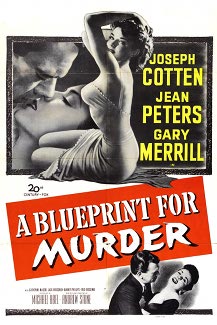
Lisa Cleans Out Her DVR: A Blueprint for Murder (dir by Andrew L. Stone)


(I am currently in the process of cleaning out my DVR!  I recorded the 1953 film noir, A Blueprint for Murder, off of FXM on February 21st.)

Much like Alfred Hitchcock’s Shadow of a Doubt, A Blueprint for Murder stars Joseph Cotten in a story about a seemingly wonderful person who might actually be a murderer.  Actually, now that I think about it, it seems like Joseph Cotten appeared in quite a few films that centered around that idea.  What distinguished A Blueprint For Murder is that, for once, Joseph Cotten is not the murderer.  Instead, he’s the one who is forced to deal with the overwhelming evidence that someone in his life might be a sociopath.

Cotten plays Cam Cameron, who is shocked when his niece, Polly, suddenly takes ill and dies.  Cam’s immediate response is to comfort his sister-in-law, Lynne (Jean Peters).  And yet, Lynne doesn’t seem to be too upset over Polly’s death.  Could it be because Polly was only her stepdaughter? Or maybe Lynne is no longer surprised by sudden death, seeing as how her husband also died after a sudden and mysterious illness.

Or could it be that Lynne murdered both Polly and her husband?  That’s the theory put forward by Maggie (Catherine McLeod), the wife of Cam’s friend, Fred (Gary Merrill).  Maggie thinks that it sounds like both Polly and her father were poisoned with strychnine!  As the initially skeptical Fred points out, when Lynne’s husband died, he put all of his money in a trust for his children.  If his children die, Lynne stands to inherit the fortune.  Polly’s already dead.  The only remaining obstacle would be Cam’s nephew, Doug.

Much like Don’t Bother To Knock, A Blueprint for Murder barely clocks in at a little over 70 minutes.  It’s a briskly told melodrama and, seen today, it’s easier to imagine it as an episode of a television series than as an actual movie.  As I watched it, I kept thinking that it felt like an old episode of CSI Miami, with Joseph Cotten in the role that would have been played by David Caruso.  (“Two deaths in one family?  It sounds like something’s in the water and it’s not fluoride.”  YEEEEEEEEEEAHHHHHH!  DON’T GET FOOLED AGAIN!!  NO NO!)  For that matter, it was also easy for me to imagine A Blueprint For Murder being remade for Lifetime, with Josie Davis in the Joseph Cotten role and maybe AnnaLynne McCord replacing Jean Peters.

A Blueprint For Murder is actually pretty predictable up until the final 15 minutes.  It’s during the final 15 minutes that Cam, Lynne, and Doug all end up on a cruise ship together and, in an effort to prove his suspicions, Cam does something that has so much potential for backfiring that it kind of makes you reconsider everything that you previously assumed about him.  To be honest, it doesn’t make much sense.  It’s hard to believe, despite what Cam insists, that what he did was his only possible option.  Then again, it is the 1950s.  In an era before DNA testing, maybe the only way to solve a crime was by doing something crazy.

That said, I enjoyed A Blueprint for Murder.  It’s a real time capsule film and you know how much I love those.  I may never be able to find a time machine but I can always experience the past by watching something like A Blueprint for Murder.  Joseph Cotten is, as always, a sturdy lead.  In real life, Jean Peters’s acting career was somewhat derailed when she married legendary weird guy Howard Hughes.  In this film, she gives a great performance as the potentially murderous sister-in-law.

If you’re a fan of 50s noir or either of the two leads, keep an eye out for A Blueprint For Murder.

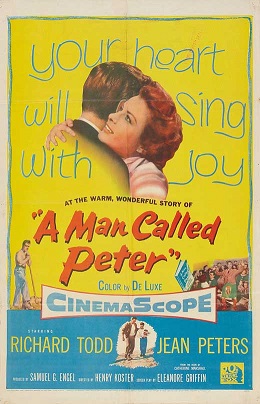
Shattered Politics #10: A Man Called Peter (dir by Henry Koster)


A_Man_Called_Peter

Occasionally, I’ll see a film like Crime of Passion or Bigger Than Life and I’ll say, “Wow, that’s really subversive for a movie that came out in the 1950s!”

And it’s true.  We tend to think of the 1950s as being a time when conformity ruled all.  It was a time of innocence and chastity, when cinema heroes all wanted to have a house in the suburbs and loving couples slept in separate beds and nobody ever questioned anything.  Of course, the truth of the matter is that there were a lot of films released in the 50s that challenge that perception.

And then again, there were also films like 1955’s A Man Called Peter.

A Man Called Peter is a biopic about Peter Marshall (played by Richard Todd), a Scottish immigrant who came to the United States, became a Presbyterian minister, and then eventually became the Chaplain of the United States Senate.  (That means that he would open each session of the Senate with a prayer and occasionally provide spiritual counsel to the senators.)  I recently watched it on Netflix, specifically because I thought it might be appropriate for this series of political reviews.

And it is, but just barely.

It actually takes the film a while to get to the part where Peter Marshall becomes the Senate Chaplain.  First, we watch him as a boy in Scotland, trying to stow away on a boat heading for America.  Then, several years later, he’s out walking on a foggy night.  He trips over a tree root and, as he lies on the ground, he announces that God has told him to 1) pursue a career as a minister and 2) to do so in America.  (I have to admit that I was raised Catholic so I have no idea whether he was having a typical Presbyterian spiritual experience or not.  But the film certainly takes it seriously.)

Peter ends up in America where he ministers to a church in Atlanta, marries Catherine (Jean Peters), and then eventually ends up at a church in Washington, D.C.  When he eventually is asked to serve as Chaplain of the Senate, both he and the film go out of their way to avoid taking any definite position on any issue.  Instead, Peter gives prayers that encourage the senators to put partisan bickering aside and work together to make the United States the best country in the world.

Having now watched all 120 minutes of A Man Called Peter, I can safely that this is a film that epitomizes everything that we always assume to be true about the 1950s.  From the film’s view of marriage to religion to politics, A Man Called Peter is perhaps one of the most stereotypically 1950s  movies ever made.  This is such a 1950s movie that it’s even filmed in CinemaScope!

(And speaking of CinemaScope, A Man Called Peter looks great but it’s perhaps one of the least intimate biopics that I’ve ever seen.  You can see every inch of the surrounding landscape but the human beings get lost.)

For me, the film’s most 1955 moment comes when Catherine first discovers that her husband has been reassigned to Washington, D.C.  She and Peter are on their honeymoon when they get a telegram telling them that their new home in Washington is ready.  Catherine is shocked.  Peter says that he didn’t want to interrupt their honeymoon by telling her that they’re not going home to Atlanta.  Instead, they’re going to an entirely new city and an entirely new life.  (In other words, Peter has decided to say goodbye to Catherine’s family and friends.)

“Aren’t you pleased?” Peter asks her.

Cheerfully, Catherine replies, “Well, who wouldn’t be?”

Ah, the 50s.

44 Days of Paranoia #23: Pickup On South Street (dir by Samuel Fuller)


For today’s entry in the 44 Days of Paranoia, let’s take a look at Sam Fuller’s 1953 film noir, Pickup on South Street.

Pickup On South Street opens with Candy (Jean Peters) on a subway.  In her purse, she’s carrying an envelope that’s been given to her by her boyfriend, the rather shady Joey (Richard Kiley).  Candy is delivering the envelope to friends of Joey.  What Candy doesn’t know is that Joey and his friends are communists and that the envelope contains top secret micro-film.  She also doesn’t know that she’s being followed by both the FBI and Skip Martin (Richard Widmark), a professional pickpocket.

Skip picks Candy’s purse and, without realizing it, steals the microfilm that everyone wants.  With the help of professional informant Moe (Thelma Ritter, a great character actress who gives a great performance here), both Candy and the police track down Skip and try to get him to return the microfilm.  Skip, however, has figured out what he’s stolen and announces that he’ll give the microfilm to whichever group is the first to pay him $25,000.  When the FBI make the mistake of trying to appeal to his patriotism, Skip merely smirks and asks, “Are you waving the flag at me?”

In his introduction to Sam Fuller’s autobiography A Third Face: My Tale of Writing, Fighting, and Filmmaking, Martin Scorsese writes, “(I)f you don’t like the films of Sam Fuller, then you just don’t like cinema.”  Now, I really can’t say whether that’s true or not because, while I love cinema, I’ve only seen three of the films that Sam Fuller directed over the course of his long career: The Naked Kiss, Shock Corridor, and now Pickup On South Street.  However, I can say that I loved all three of those films.  The Naked Kiss I loved because I happen to love old films that expose the secrets of small town America.  As Arleigh can tell you, I fell in love with Shock Corridor the minute that the film’s hero said, “NYMPHOS!”  As for Pickup On South Street, I love it because it’s truly a great film and one of the best B-movie ever made.

And make no mistake about it — Pickup On South Street is a B-movie, a melodramatic, wonderfully sordid, and terrifically entertaining B-movie.  It’s a thriller that both embraces and subverts the conventions of the genre and, as a result, it tells a story that manages to be both over-the-top and subtle at the same time.  By focusing on those on the margins of society, the Skips and the Moes of the world, Fuller also forces us to confront just how little the ideology of a government means to those of us who live on the margins of society.

This is certainly made clear by Thelma Ritter’s poignant performance as Moe, one of the weary inhabitants of the margins who has been reduced to just hoping that she’ll have enough money when she dies to be buried in a decent plot.  One watches Pickup on South Street and realizes that, regardless of which side ultimately end up with the microfilm, people like Moe are still most likely going to end up getting buried in an pauper’s grave.

Watching Pickup On South Street, it’s easy to see why Martin Scorsese had such high praise for Fuller.  Fuller’s camera literally never stops moving, nervously darting through the urban landscape and occasionally zooming in for a close-up of either a desperate face or Richard Widmark’s smirk.  And make no doubt about it — Richard Widmark’s charming but infuriating smirk tells you everything that you need to know about both the character Skip McCoy and Pickup On South Street as a film.  It’s a smirk that lets us know that both the character and the film are a lot more intelligent than they initially let on.

Pickup on South Street is a film that every lover of cinema must see.  And, after you’ve seen it, why not get a copy of Fuller’s autobiography?  It’s an interesting read.

Other Entries In The 44 Days of Paranoia 

  1. Clonus
  2. Executive Action
  3. Winter Kills
  4. Interview With The Assassin
  5. The Trial of Lee Harvey Oswald
  6. JFK
  7. Beyond The Doors
  8. Three Days of the Condor
  9. They Saved Hitler’s Brain
  10. The Intruder
  11. Police, Adjective
  12. Burn After Reading
  13. Quiz Show
  14. Flying Blind
  15. God Told Me To
  16. Wag the Dog
  17. Cheaters
  18. Scream and Scream Again
  19. Capricorn One
  20. Seven Days In May
  21. Broken City
  22. Suddenly