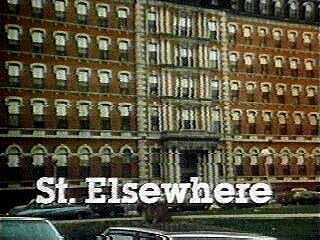
Retro Television Review: St. Elsewhere 1.22 “Addiction”


Welcome to Retro Television Reviews, a feature where we review some of our favorite and least favorite shows of the past! On Fridays, I will be reviewing St. Elsewhere, a medical show which ran on NBC from 1982 to 1988.  The show can be found on Hulu and, for purchase, on Prime!
This week, the first season comes to a close.

Episode 1.22 “Addiction”

(Dir by Mark Tinker, originally aired on May 3rd, 1983)

“To life,” Dr. Auschlander toasts towards the end of the finale of St. Elsewhere’s first season and the sentiment could not be more called for.

While Auschlander has spent the episode hanging out with a friend of his and getting into fights with disrespectful street punks, Dr. Morrison’s wife has been giving birth to their son.  While someone breaks into the supply room and takes off with a huge supply of drugs, Dr. White is sobbing and telling his estranged wife that he knows he has to get help for his addictions.  While one drug addict (Ralph Seymour) commits suicide by injecting an air bubble into his veins, Dr. Craig’s cocky son, Stephen (Scott Paulin), visits from medical school and turns out to be quite a weed-smoking, pill-popping drug user himself.  Ehrlich, assigned to show Stephen around the hospital and teach him what it’s like being a resident, considers telling Dr. Craig that his son has a drug problem but apparently decides not to.  Dr. Craig is very proud that his son is going to follow the family tradition of becoming a surgeon.  Meanwhile, Dr. Fiscus cheats on Shirley Daniels with Kathy Martin.  Fiscus, you idiot.

Life goes on at St. Eligius.  That’s was the theme of the finale and it’s also been the theme of the first season.  For all the bad things that happen, there are also good things.  Some patients die.  Some doctors are incompetent.  But babies are born and doctors like Morrison and Ehrlich and Chandler haven’t given up and are still trying to make the world a better place.  Dr. Auschlander may be terminally ill with cancer but he embraces life and we should all do the same.

It’s a good ending for an overall good first season.  There were a few weak episodes.  Dr. Samuels was a pretty annoying character and I’m a bit relieved to see that David Birney left the show after this season.  Ed Flanders can be a bit overly somber as Dr. Westphall and Howie Mandel is still one of the least convincing doctors that I’ve ever seen.  That said, Morrison, Ehrlich, Chandler, Nurse Daniels, and even Dr. White are interesting characters and I look forward to seeing what happens with them during season 2.  The season’s stand-out was definitely William Daniels as the pompous yet still likable Dr. Craig.  Other than the terrible storyline where he cheated on his wife (and I still claim that was a dream episode, like almost all of the stuff with Dr. Samuels), Dr. Craig was this season’s standout character.

Next week, we start season 2!
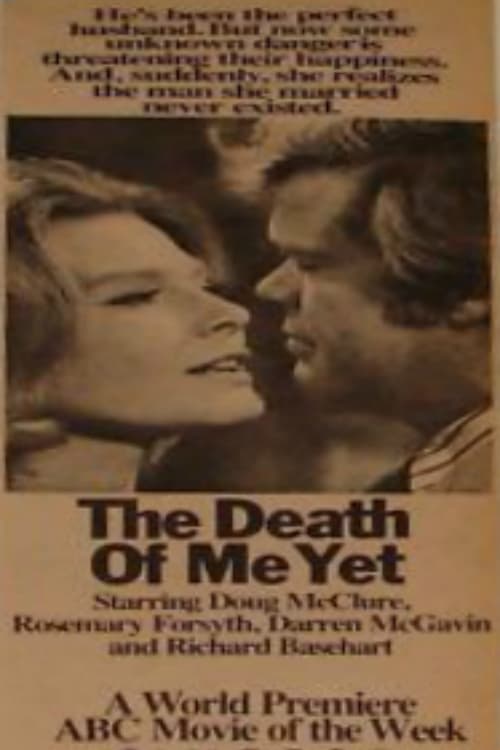
Retro Television Review: The Death Of Me Yet (dir by John Llewellyn Moxey)


Welcome to Retro Television Reviews, a feature where we review some of our favorite and least favorite shows of the past!  On Sundays, I will be reviewing the made-for-television movies that used to be a primetime mainstay.  Today’s film is 1971’s The Death Of Me Yet!  It  can be viewed on YouTube.

Welcome to Middletown!

Middletown is a nice, comfy, and friendly little town.  As you might guess from the name, it seems just like the type of town that you would expect to find in the middle of the country.  Edward Young (Doug McClure) is a friendly and popular citizen of the town.  Everyone loves to see Edward walking around Middletown with his girlfriend, Alice (Meg Foster, of the otherworldly eyes).  But one day, Edward comes home to find a message waiting for him.  He has been “activated” and it’s time for him to leave Middletown and head to …. THE UNITED STATES!

You see, Middletown is in the middle of a country.  It’s in the middle of Russia, to be exact.  It’s a KGB training center, where sleeper agents learn how to pass for Americans.

Edward heads to America, where he takes on the name of Paul Towers.  Over the years, Paul settles in a town that looks a lot like Middletown.  Paul becomes a newspaper publisher and he comes to love America.  He also marries Sibby (Rosemary Forsyth), the sister of defense contract Hank Keller (Dana Elcar).  When one of Hank’s executives dies under mysterious circumstances, Hank offers to bring Paul into the business.

Paul is reluctant, both because he doesn’t know if he could pass the background check that the FBI is going to run on him and also because he suspects that someone is trying to kill him!  When he sees Alice and his former KGB handler (Richard Basehart) in town, Paul realizes that he’s going to have to pick a side and face the consequences of all of his actions.

The Death of Me Yet is an enjoyably twisty thriller, one that embraces the melodrama while having some fun with the idea of a bunch of sleeper agents doing business in a generic American town.  Doug McClure’s natural earnestness makes him an odd choice for the role of a lifelong spy but the casting works in that it explains why no one has ever suspected Paul in the past.  As always, Darren McGavin is a welcome presence as the FBI agent who assures Paul that he will be doing a thorough background check.  Richard Basehart makes for a good villain and Meg Foster’s enigmatic screen presence keeps the viewer guessing as to what her ultimate goal may be.

The film ends with the hint of continued adventures for Paul.  It wouldn’t surprise me if this movie was made with an eye on turning it into a weekly series.  As far as I know, that series never happened, though The Americans would later feature many of the same themes and ideas found in The Death of Me YetThe Death of Me Yet holds up as an entertaining espionage thriller.

Late Night Retro Television Reviews: Highway to Heaven 1.8 “A Divine Madness”


Welcome to Late Night Retro Television Reviews, a feature where we review some of our favorite and least favorite shows of the past!  On Thursdays, I will be reviewing Highway to Heaven, which aired on NBC from 1984 to 1989.  The entire show is currently streaming on Tubi and several other services!

This week, things get a bit silly on the highway.

Episode 1.8 “A Divine Madness”

(Dir by Michael Landon, originally aired on November 7th, 1984)

Oh, this episode.

Years ago, a ruthless land developer named Arthur Krock (Ron Moody) built a castle for his beloved wife.  Tragically, his wife passed away and Arthur had a nervous breakdown.  Now, he spends all of his time in his castle and he believes that he actually is King Arthur.  He says that he’s waiting for the return of his Guinevere.  Only Marian (Helen Kleeb), his loyal maid, has remained with him over the years.  He, of course, calls her Maid Marian even though that’s a Robin Hood reference and not anything from the Arthurian legends.

Though the elder Arthur Krock is still the head of his company, the day-to-day business is handled by his son, Arthur Krock, Jr. (played by a young and beardless Jonathan Frakes).  Bitter over his unhappy childhood, Arthur, Jr. is just as ruthless as his father once was.  Arthur, Jr. has a 12 million dollar deal to force a woman named Gwen (Jean Allison) off of her land and he’s determined to get it done, even if it means displacing all of the dogs that she and her veterinarian son (Scott Stevenson) look after.

Arthur, Sr.’s daughter, Linda (Ellen Maxted), hires two new handyman and you can probably already guess that they’re going to be Jonathan and Mark.  Working around the castle, Jonathan arranges for Arthur, Sr. to meet Gwen.  When Arthur, Sr. discovers that Gwen is short for Gweneviere, he announces that she can stay on her land.  Arthur, Jr. goes to court to get his father declared incompetent.

Can you guess what happens?  Well, if you think that Arthur, Sr. hires Jonathan to be his lawyer and then announces in court that he has not been the father that he should have been …. you’re absolutely correct!

When people talk about Highway to Heaven being a campy or cheesy show, it’s usually episodes like this that they’re talking about.  Unabashedly sentimental in its approach, this episode suffers from the fact that Arthur, Jr. has a point.  Arthur, Sr. is clearly mentally ill and allowing him to run the company is totally unfair to his employees and the people who have invested in his business.  Just because Arthur, Jr. isn’t particularly likable, that doesn’t make him incorrect.  If the episode had merely portrayed Arthur, Sr. as an eccentric who didn’t want to have to deal with the pain of the real world, that would be one thing.  But this episode has Arthur, Sr. living in a literal castle, sitting on an actual throne, and referring to his son as being Lancelot.  It’s all just a bit too much and Ron Moody’s over-the-top performance doesn’t particularly help.  To the show’s credit, it does eventually acknowledge that Arthur, Sr. needs some help but still, the whole thing just feels a bit …. well, silly.

Next week, Jonathan and Mark help a movie star become a better father!  Hopefully, he doesn’t think that he’s Prester John or Robin Hood or anyone like that.

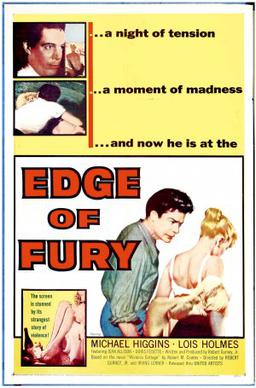
The TSL’s Horror Grindhouse: Edge of Fury (dir by Robert J. Gurney Jr. and Irving Lerner)


Damn, this is a dark movie.

The 1958 film, Edge of Fury, opens with a man standing on the beach.  It seems like it should be a pleasant opening but instead, the entire scene feels threatening.  The man, Richard Barrie (Michael Higgins), is a veteran of the Korean War and he’s working on a painting with what appears to be an almost possessed intensity.  Thanks to the film’s black-and-white, noir-like cinematography, the beach does not look inviting.  Instead, it looks dark and cold.  A voice over informs us that Richard once asked to be confined for not only his own good but also the good of society.  However, the authorities could not intervene because Richard had yet to commit a crime.

Suddenly, the police arrive.  They arrest Richard and take him away, suggesting that Richard has finally proven just how much of a threat he actually is.

The rest of the film is told in flashback.  We watch as Richard, who works in a bookstore, comes across a beach house that he quickly rents.  It turns out that he wants to stay there with the Hacketts, Florence (Lois Holmes) and her daughters, Eleanor (Jean Allison) and Louisa (Doris Fesette).  Somewhat improbably, Richard and Florence are friends, having met in a grocery store.  Florence trusts Richard because he’s so polite and nice.  Eleanor has a crush on Richard because he’s handsome and brooding.  And Louisa just thinks that Richard is kind of a loser.

The Hacketts move into the beach house and Richard sets up an artist’s studio in the shed.  He paints a lot of pictures of Louisa, despite the fact that Louisa has a boyfriend and wants nothing to do with him.  Though the three women don’t realize it, Richard is growing increasingly unstable and obsessed.  He wants the three women to be his new family and when he realizes that he’s not going to get his way, he turns violent….

And certainly, this is not the only film to be made about a mentally disturbed man who becomes obsessed with what he considers to be the perfect family.  It’s also not the only film to end with an act of shocking violence and to leave the audience feeling as if they’ve just taken a journey into a waking nightmare.  What does set Edge of Fury apart from some other films is that it was made in 1958 and, in many ways, it’s the exact opposite of what we expect a 1958 film to be.  This is a dark, dark movie that suggests that the universe is ruled by chaos and that kindness will be rewarded with pain.

Seriously, it’s dark.

That said, it’s definitely a flawed film.  You never buy that Florence would trust Richard as much as she does.  Michael Higgins is frighteningly intense as Richard but the rest of the cast often seems to simply be going through the motions.  That said, it’s definitely a film that sticks with you.  This isn’t a story that you just shrug off and forget.

Probably the best thing about the film is the cinematography.  This film was an early credit for Conrad L. Hall, who later went on to become one of the great cinematographers.  He fills the film with ominous shadows and hints of the madness to come.  As filmed by Hall. the beach looks like some alien landscape, as twisted as the inside of Richard’s mind.

Edge of Fury took me by surprise.  It’s nowhere close to being perfect but it’s worth tracking down on YouTube.

A Movie A Day #152: Bad Company (1972, directed by Robert Benton)


Missouri during the Civil War.  All young men are being forcibly constricted into the Union army, leaving those who want to avoid service with only two options: they can either disguise themselves as a woman and hope that the soldiers are fooled or they can head out west.  Drew Dixon (Barry Brown) opts for the latter solution but his plans hit a snag when he’s robbed and pistol-whipped by Jake Rumsey (Jeff Bridges).  When Drew coincidentally meets Jake for a second time, he immediately attacks him.  Jake is so impressed that he insists that Drew join his gang of thieves.

Jake’s gang, which include two brothers (one of whom is played by John Savage) and a ten year-old boy, is hardly the wild bunch.  They spend most of their time robbing children and are, themselves, regularly robbed by other gangs, including the one run by Big Joe (David Huddleston).  Their attempt to rob a stagecoach goes hilariously wrong.  Less hilarious is what happens when they try to steal a pie from a window sill.

Bad Company was the directorial debut of Robert Benton and it has the same combination of comedy and fatalism that distinguished both his script for Bonnie and Clyde and several of the other revisionist westerns of the 1970s.  While the interplay between Drew and Jake may remind some of Butch Cassidy and the Sundance Kid, the film’s sudden bursts of violence feel like pure Peckinpah.  Fortunately, the combination of Robert Benton’s low-key direction and the excellent performances of Jeff Bridges and Barry Brown allows Bad Company to stand on its own.  Brown and Bridges make for an excellent team, with Bridges giving a charismatic, devil-may-care performance and the late Barry Brown holding his own as the more grounded Drew.  (Sadly, Brown, who appears to have had the talent to be a huge star, committed suicide six years after the release of Bad Company.)  This unjustly forgotten western is one of the best films of the 1970s.