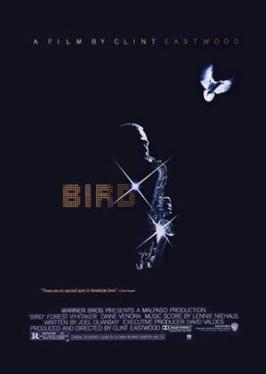
Bird (1988, directed by Clint Eastwood)


Forest Whitaker stars as the legendary saxophonist Charlie “Bird” Parker.  The film, which is structured around flashbacks and time jumps and features some of the most beautifully-done transitions that I’ve ever seen, follows Parker as he plays his saxophone, challenges the jazz purists who his own individual style, and looks for work in both America and France.  Along the way, we watch as he befriends and learns from Dizzy Gillespie (Samuel Wright), mentors a young trumpet player named Red Rodney (Michael Zelniker), and has a complex relationship with a white jazz lover named Chan Parker (Diane Venora).  Throughout his life, Charlie Parker struggles with his addiction to heroin and alcohol, occasionally getting clean to just then fall back into his habit.  To its credit, the film avoids most of the biopic cliches when it comes to portraying Parker’s addiction.  Parker accepts that he’s an addict, just as he accepts that he has a talent that is destined to revolutionize American music.

Director Clint Eastwood has always been a fan of jazz and he actually saw Charlie Parker perform when he was a young man.  His love of jazz had been present in almost every modern-era film that he has directed, staring with Play Misty For Me’s lengthy trip to the Monterey Jazz Festival.  Bird was a passion project for Eastwood, the first film that Eastwood directed without also appearing in.  (Eastwood doesn’t star in his second directorial effort, Breezy, but he does have a brief and silent cameo as a man standing on pier.)  Eastwood takes a nonlinear approach to telling the story, eschewing the traditional bopic format and instead putting the focus on Parker’s music.  Eastwood was able to get several never bef0re-released recordings of Parker performing and, when Whitaker is blowing into his saxophone in the film, we’re actually hearing Parker.  Eastwood’s direction captures the smoky atmosphere of the jazz clubs where Parker and Gillespie made their name while the nonlinear style reflects the feeling of just letting a song take you to wherever it’s going.  This is a movie about jazz that plays out like a jazz improvisation.

Forest Whitaker gives an amiable and charismatic performance as Charlie Parker, playing him as someone who has found both an escape and peace in his music, even as he physically struggles with the ravages of his drug addiction.  Whitaker won the Best Actor at Cannes for his performance in Bird.  Eastwood received the Golden Globe for Best Director.  Bird feels like it was labor of love for both of them.  Bird may not have set the box office on fire when it was originally released but it remains one of the best jazz films.

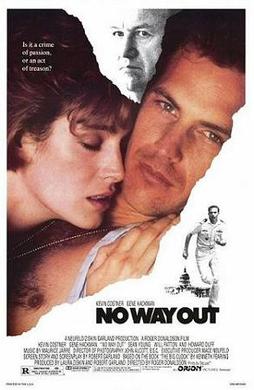
14 Days of Paranoia #7: No Way Out (dir by Roger Donaldson)


Trust no one in Washington would seem to be the message of this 1987 thriller.

Kevin Costner plays Lt. Commander Tom Farrell, a Naval Intelligence officer who is hailed as a hero after saving a shipmate who falls overboard.  In Washington, Tom is recruited by a friend from college, Scott Pritchard (Will Patton), to work for Secretary of Defense Brice (Gene Hackman).  Brice doesn’t trust the head of the CIA (played by future senator, Fred Dalton Thompson) and he wants Tom to serve as his mole within the service.  What Brice doesn’t know is that Tom is sleeping with Brice’s mistress, Susan Atwell (Sean Young).

Still, Brice does suspect that the woman with whom he is cheating is also cheating on him.  When he confronts her about it, their argument leads to him accidentally pushing Susan over an upstairs railing.  Pritchard, who is implied to be in love with Brice, takes charge of the cover-up and decides to push the story that Susan was killed by a possibly mythical Russian agent who is known only by the name “Yuri.”

Tom assists with the investigation of her death, both because he wants to know who killed Susan and also because he knows that there’s evidence in Susan’s apartment that could be manipulated to make him look guilty of the crime.  For instance, Susan took a picture of Tom shortly before her death.  The picture failed to develop but, through the use of what was undoubtedly cutting edge technology in 1987, Naval Intelligence is slowly unscrambling the picture.  For Tom, it’s a race against time to find the actual killer before the picture develops and he’s accused of both killing Susan and being Yuri.

Everyone has an agenda in No Way Out, from the ambitious Brice to the fanatical Scott Pritchard to the head of the CIA, who wants Brice to approve funding for a costly submarine.  Even the film’s nominal hero has an agenda, which has less to do with finding justice for Susan and everything to do with protecting himself and his future.  In fact, as is revealed in the film’s enjoyable if slightly implausible twist ending, some people in Washington have multiple agendas.  The film portrays Washington as being a place where, behind the stately facade, everyone is a liar and everyone is ultimately a pawn in someone else’s game.  If you have the right connections, you can even get away with murder.  Loyalty is rewarded until you’re no longer needed.

It’s an enjoyably twisty thriller, one that makes good use of the contrast between Kevin Costner’s All-American good looks and his somewhat shady screen presence.  The film introduces Costner as being a character who, at first glance, seems almost too good to be true and then spend the majority of its running time suggesting that is indeed the case.  Gene Hackman is well-cast as the weaselly cabinet secretary, as is Sean Young as the woman who links them all together.  In the end, though, the film is stolen by Will Patton, who plays Scott Pritchard as being someone who has unknowingly given his loyalty to a man who is incapable of returning it.  As played by Patton, Scott is an outsider who desperately wants to be an insider and who is willing to do just about anything to accomplish that goal.  He’s a version of Iago who never turned against Othello but instead devoted all of his devious tricks to trying to cover up the murder of Desdemona.

Even with an over-the-top final twist, No Way Out holds up well as a portrait of how the lust for power both drives and corrupts our political system.

14 Days of Paranoia:

  1. Fast Money (1996)
  2. Deep Throat II (1974)
  3. The Passover Plot (1976)
  4. The Believers (1987)
  5. Payback (1999)
  6. Lockdown 2025 (2021)

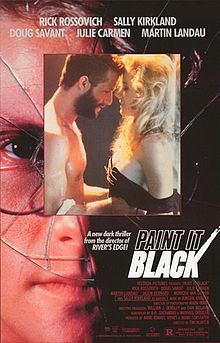
A Movie A Day #89: Paint It Black (1989, directed by Tim Hunter)


This month, since the site is currently reviewing every episode of Twin Peaks, each entry in Move A Day is going to have a Twin Peaks connection.  Paint In Black was directed by Tim Hunter, who directed three episodes of Twin Peaks, including the one that I reviewed earlier today.

Jonathan Dunbar (Rick Rossovich) should have it all.  He is an acclaimed sculptor but he’s being cheated financially by his dealer and sometimes girlfriend, Marion Easton (Sally Kirkland).  Things start to look up for Jonathan after he has a minor traffic accident with Gina (Julie Carmen).  Not only are he and Gina immediately attracted to each other but it turns out that Gina is the daughter of Daniel Lambert (Martin Landau), who owns the most prestigious art gallery in Santa Barbara.  It appears that Jonathan is finally going to get the big show that he has always dreamed of, but only if he can escape from Marion’s management.

One night, Jonathan helps out a man who was apparently mugged outside of an art gallery.  The man, Eric (Doug Savant), says that he’s an art collector and that he is a big fan of Jonathan’s work.  When Jonathan opens up about his problems with Marion, Eric decides to return Jonathan’s favor by killing Marion and anyone else who he feels is standing in the way of Jonathan’s success.  Because of the way that Eric artistically stages the murders, the police suspect that Jonathan is the murderer.

Depending on the source, Paint It Black’s original director was either fired or walked off the project and Tim Hunter was brought in to hastily take his place.  According to Hunter, he spent the production “shooting all day and rewriting all night.”  Paint it Black is a standard late 80s, direct to video thriller but it is interesting as a tribute to Alfred Hitchcock.  Hunter taught a class on Hitchcock at the University of California at Santa Cruz and Paint it Black is full of shout outs to the master of suspense.  Marion’s murder is staged similarly to a murder in Frenzy.  There are frequent close-ups of scissors, a reference to Dial M For Murder.  Probably the most obvious homage is the character of Eric, who appears to be based on Robert Walker, Jr’s character from Strangers on a Train.

Rick Rossovich was best known for playing cops, firemen, and soldiers in movies like Top Gun, Navy SEALS, and Roxanne.  He’s not bad in Paint it Black but he is still not the most convincing artistic genius.  Doug Savant and Sally Kirkland were better cast and more enjoyable to watch.  In fact, Kirkland is killed off too early.  The movie loses a lot of its spark once she is gone.

Paint It Black may not live up to being named after one of the best songs that the Rolling Stones ever recorded but Tim Hunter took unpromising material and shaped it into something that is far more watchable than anyone might expect.