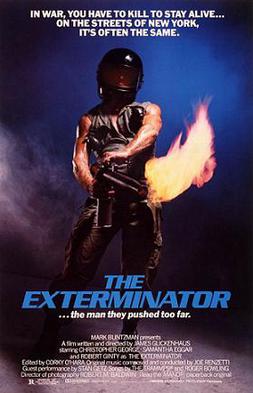
The TSL Grindhouse: The Exterminator (dir by James Glickenhaus)


First released in 1980, The Exterminator begins during the Vietnam War.

Two soldiers, John Eastland (Robert Ginty) and Michael Jefferson (future Cannon Film mainstay Steve James) have been captured by the Viet Cong and can only watch as a third soldier is beheaded by his captors.  (The graphic beheading, in which the camera lingers on the head slowly sliding off the neck, is an early warning of what this film has in store for its audience.)  Jefferson manages to free himself from his bonds and kills most of the enemy soldiers.  After Jefferson frees him, Eastland fires a bullet into the still twitching body of the VC commander.

The film jumps forward to 1980.  Living in New York City, Jefferson and Eastland are still best friends and co-workers at a warehouse.  For a second time, Jefferson saves Eastland’s life when the latter is attacked by a gang calling themselves the Ghetto Ghouls.  When the Ghouls get their revenge by tracking down Jefferson and piecing his spine with a meat hook, Eastland gets his revenge by killing …. well, just about everyone that he meets.

Though The Exterminator was obviously inspired by Death Wish, a big difference between the two films is that Eastland doesn’t waste any time before starting his anti-crime crusade.  In the original Death Wish, Paul Kersey (played by Charles Bronson) starts out as a self-described “bleeding heart” liberal who was a conscientious objector during the Korean War.  Even after his wife and daughter are attacked (and his wife killed) by Jeff Goldblum, Kersey doesn’t immediately pick up a gun and start shooting muggers.  Indeed, it’s not until the film is nearly halfway over that Kersey begins his mission and, in one of the film’s more memorable moments, he reacts to his first act of violence by throwing up afterwards.  While one could hardly call Death Wish an especially nuanced film, it does at least try to suggest that Kersey’s transformation into a vigiliante was a gradual process.

The Exterminator, on the other hand, goes straight from Eastland informing Jefferson’s wife about the attack to Eastland threatening a tied-up Ghetto Ghoul with a flame thrower.  When did Eastland kidnap the Ghetto Ghoul?  Why does Eastland have a flame thrower?  Where exactly has Eastland tied up the Ghetto Ghoul?  None of this is explained and the film’s abruptness gives it an almost dream-like feel.  The film plays out like the fantasy of everyone who has ever been mugged or otherwise harassed.  Magically, Eastland suddenly has the skills and the resources to outsmart not just the criminals but also the police who have been assigned to stop him.  Even the CIA is assigned to take down Eastland because his anti-crime crusade is inspiring people to wonder why the President hasn’t been able to reduce crime.  The film plays out like the type of daydreams that Travis Bickle had when he wasn’t driving his taxi.

Eastland is ruthless in his kills but fortunately, everyone he kills is really, really bad.  The Ghetto Ghouls clubhouse is decorated with a poster of Che Guevara but Che’s revolutionary rhetoric isn’t worth much when the Exterminator’s after you.  A mob boss makes the mistake of not telling Eastland about the Doberman that’s guarding his mansion so into the meat grinder he goes.  New Jersey loses a state senator when Eastland discovers him torturing an underage male prostitute.  The film was shot on location in New York City and the camera lingers over every grimy corner of the city.  A scene where Eastland walks through Times Square takes on a cinéma-vérité feel as people jump out at him and try to entice him to take part in everything the city has to offer.  If Death Wish suggested that Paul Kersey’s actions were saving New York, The Exterminator suggests that we should just let John Eastland burn the whole place down.

With his youthful face, Robert Ginty looks more like a mild-mannered seminarian than a hardened veteran of both Vietnam and the mean streets of New York but, ultimately, that works to the film’s advantage.  If anything, it explains why everyone who meets him trends to underestimate what he’s capable of doing.  B-movie vet Christopher George overacts in his usual amusing way as he plays the detective who has been assigned to catch The Exterminator.  Samantha Eggar plays a doctor who starts dating George for no discernible reason.  The scenes featuring George and Eggar often seems as if they belong in a different film but they do provide some relief from the rather grim and gruesome scenes of The Exterminator killing almost everyone who he meets.

The Exterminator was controversial when it was originally released and it still retains the power to shock.  It’s easy to laugh at some of the film’s more melodramatic moments but there were still more than a few scenes that I watched with my hands over my eyes.  The film’s hard edge grabs your attention from the start and the idea of the CIA sending assassins to take out a neighborhood vigilante is so over the top and ridiculous that it’s kind of hard not to appreciate it.  That the film totally buys into its paranoid worldview (“Washington will be pleased.”) makes the whole thing far more compelling than it should be.

As ludicrous as it all is, The Exterminator is a film that defies you to look away.
McBain (1991, directed by James Glickenhaus)


In the year 1973, Bobby McBain (Christopher Walken) was an American POW, fighting for his life in a North Vietnamese prison camp that was run by a general so evil that he wore a necklace of human ears.  Luckily, on the last day of the war, McBain was rescued by Roberto Santos (Chick Vennerra).  When Bobby asked how he could ever repay Santos, Santos gave him half of a hundred dollar bill and told him that someday, Santos would give him the other half.  McBain swears that he will be ready when the day comes to get the other half.  I guess he’s like Caine in Kung Fu, waiting for the chance to snatch the pebble from his master’s hand.

15 years later, McBain is a welder in New York.  One day, while sitting in a bar, he watches as Santos is executed on live television after a failed attempt to overthrow the dictator of Colombia.  Shortly afterwards, McBain is approached by Santos’s sister (Maria Conchita Alonzo), who asks McBain to help her finish Santos’s revolution.  McBain tells her a long story about attending Woodstock and then reunites with his Vietnam War buddies, Frank (Michael Ironside!), Eastland (Steve James), Dr. Dalton (Jay Patterson), and Gil (Thomas G. Waites).  After killing a bunch of drug dealers, stealing their money, and harassing Luis Guzman, the gang heads for Colombia.

I wonder how many people have watched this movie over the years with the expectation that it would be a live action version of the famous Rainier Wolfcastle film that was featured in several episodes of The Simpsons.  Unfortunately, this movie has nothing to do with the Simpsons version of McBain.  (Sorry, no “Bye, book.”)  Instead, it’s just another strange and overlong action film from director James Glickenhaus.  The film mixes scene of total carnage with dialogue that often seems to be going off on a totally unrelated tangent, like McBain’s musings about what Woodstock ultimately stood for.  Walken doesn’t seem to be acting as much as he’s parodying his own eccentric image.  Walken takes all of his usual quirks and trademark vocal tics and turns them up to 11 for this movie.

Even though the movie is twenty minutes too long, it still feels like scenes are missing.  Alonzo leaves Colombia on a mule and then is suddenly in New York.  (The mule is nowhere to be seen.)  We don’t actually see Walken recruiting the majority of his team.  Instead, they just show up in his house.  Once the action moves to Colombia, it turns out that overthrowing the government is much simpler than it looks.  While the rebels lay down their lives while attacking the palace, McBain and his crew pretty much stroll through the movie without receiving even a scratch.  Maybe welders should be put in charge of all of America’s foreign policy adventures.  It couldn’t hurt.

With its hole-filled plot and confusingly edited combat scenes, McBain isn’t great but 80s action enthusiasts should enjoy seeing Michael Ironside and Steve James doing their thing.  Others will want to see it just for Christopher Walken’s characteristically odd performance.  He may not be Rainier Wolfcastle but, for this movie, Christopher Walken is McBain.

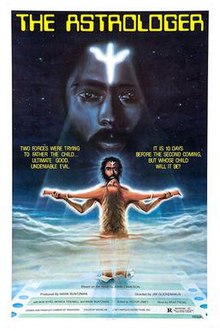
The TSL’s Horror Grindhouse: The Astrologer (dir by James Glickenhaus)


Quite possibly one of the most boring film ever made, 1975’s The Astrologer tells the story of …. well, I’m not really sure what the point of it all is.

Basically, an astrologer named Alexi Abarnel (Bob Byrd) has figured how to combine the zodiac with 70s technology and, as a result, everyone’s potential for good and evil can be determined simply by typing their birthdate into a computer.  The U.S. government funds his agency, which is known as Interzod.  And let’s be honest, that does sound like the type of dumbass thing that the government would fund, especially when the Democrats are in power.

According to the stars, the second coming of Christ is only a few days away.  Alexi is convinced that he has married the woman who is destined to give birth to the Savior.  Because of this, he refuses to consummate his marriage because it’s very important that she remain a virgin.  However, he hasn’t bothered to inform her of any of this so poor Kate (Monica Tidwell) spends all of her time wondering why her husband hasn’t touched her in five years of marriage and why it’s also so important to him that she never tell anyone the actual date of her birth.

Meanwhile, a group of gypsies are traveling the country and, under the leadership of Kajerste (Mark Buntzman), they are both murdering people and also compelling people to commit suicide.  Interzod is concerned about Kajerste because of his “zodiacal” potential but Alexei is also concerned that he doesn’t have Kajerste’s exact birthdate.  But the fact that Kajerste is commanding his followers to kill people should be enough to clue Interzod into the fact that Kajerste is bad guy, regardless of whether he’s a Capricorn or an Aquarius.  Fortunately, Interzod has come up with a plan on how to kill Kajerste, one that involves implanting thoughts in his head via electrodes and tranquilizer dots.  A young congressman (Al Narcisse) wants to help because he’s so interested in Interzod’s work.  However, it turns out that the ludicrously complicated plan to take out Kajerste is …. well, ludicrously complicated.  If my tax money is going to fund Interzod, I would hope they would make better use of it.

The film’s plot definitely has the potential to be interesting but, unfortunately, The Astrologer is a very, very talky film.  It only has a 78-minute running time and the majority of the film is made up people having very long and very dry conversations about how Interzod works and why its work is important.  The problem is that there’s not really any need to convince the viewers that Interzod is important or to show us how it works.  No watching this film is going to be interested in an in-depth examination of a fictional government agency.  Everyone knows that this isn’t 60 Minutes and it’s not like the NSA has hand-picked the correspondent who is going to be reporting on them.  This is a film about spies, astrology, and a killer cult.  It should be a lot of fun but instead it’s incredibly boring.

That’s not to say that it’s a total waste.  This was James Glickenhaus’s first film as a director.  Glickenhaus went to direct some well-regarded action films in the 80s and there are a handful of isolated moments in The Astrologer where it is obvious that the film was made by someone who had a good visual eye.   A cult ceremony scene that is almost totally made up of freeze frames is nicely done.  And, as always, it’s hard not to admire the ambition of someone trying to make a metaphysical thriller and tackle the big questions of existence on a budget.

In the end, though, the most interesting thing about The Astrologer is its insistence on having its characters frequently use the term “zodiacal.”  Take a drink every time that you hear someone say, “zodiacal” but don’t drive afterwards.

A Movie A Day #331: The Soldier (1982, directed by James Glickenhaus)


The Soldier is really only remembered for one scene.  The Soldier (Ken Wahl) is being chased, on skis, across the Austrian Alps by two KGB agents, who are also on skis.  The Soldier is in Austria to track down a KGB agent named Dracha (Klaus Kinski, who only has a few minutes of screen time and who is rumored to have turned down a role in Raiders of the Lost Ark so he could appear in this movie).  The Russians want the Soldier dead because they’re evil commies.  While being chased, the Soldier goes over a ski slope and, while in the air, executes a perfect 360° turn while firing a machine gun at the men behind him.  It’s pretty fucking cool.

The Soldier, who name is never revealed, works for the CIA.  He leads a team of special agents.  None of them get a name either, though one of them is played by the great Steve James.  When a shipment of Plutonium is hijacked so that it can be used it to contaminate half of the world’s supply of oil, The Soldier is assigned to figure out who is behind it.  Because terrorists are demanding that Israel withdraw from the West Bank, Mossad assigns an agent (Alberta Watson) to help out The Soldier.  She gets a name, Susan Goodman.  She sleeps with The Soldier because, she puts it, the world is about to end anyway.

The Soldier was obviously meant to be an American James Bond but Ken Wahl did not really have the screen charisma necessary to launch a franchise.  He is convincing in the action scenes but when he has to deliver his lines, he is as stiff as a board.  Fortunately, the majority of the movie is made up of action scenes.  From the minute this briskly paced movie starts, people are either getting shot or blown up.  Imagine a James Bond film where, instead of tricking the bad guys into explaining their plan, Bond just shot anyone who looked at him funny.  That’s The Soldier, a film that is mindless but entertaining.

Ken Wahl may have been stiff and Klaus Kinski may have been wasted but there are still some interesting faces in the cast.  Keep an eye out for William Prince as the President, Ron Harper as the director of the CIA, Zeljko Ivanek as a bombmaker, Jeffrey Jones as the assistant U.S. Secretary of Defense, and George Straight performing in a redneck bar.  Best of all, one of the Soldier’s men is played by Steve James, who will be recognized by any Cannon Films aficionado.

Surprisingly, The Solider is not a Cannon film.  It certainly feels like one.

6 Trailers That Are Partying…Partying…Partying…Yeah!


As Rebecca Black recently reminded us all, Saturday comes after Friday.  However, she neglected to say anything about the fact that Saturday also means another edition of Lisa Marie’s Favorite Grindhouse and Exploitation trailers.

Stuck-up bitch.

Anyway, it is indeed Saturday and here’s this weekend’s humble offerings…

1) Sweet Jesus Preacherman (1973)

To me, this first offering actually feels more like a parody trailer (like Machete or Hobo With A Shotgun) than an actual trailer.  But no, Sweet Jesus Preacherman appears to be an actual film. 

2) The Soldier (1982)

This was directed by James Glickenhaus, who directed The Exterminator.  According to the commentary track on one of the 42nd Street Forever DVDs, Glickenhaus felt that The Soldier would help him break into mainstream films and, though I’m not a huge fan of action movies, the trailer does look fairly exciting.  Plus, if you watch the whole without blinking, you might catch a split-second appearance from Klaus Kinski.  Supposedly, Kinski was offered a role in both this film and Raiders of the Lost Ark.  Kinski chose to appear in The Soldier.

3) The Great Silence (1968)

Speaking of Klaus Kinski, he’s also featured in our next trailer, The Great Silence.  Directed by Sergio Corbucci, The Great Silence has been acclaimed as one of the greatest spaghetti westerns of all time.  This film’s title refers to the fact that the nominal hero (played by Jean-Louis Trintignant) is a mute.  The trailer also features Ennio Morricone’s excellent score.

4) Flesh Gordon (1974)

There were actually two versions of this film — an explicit one and a slightly less explicit one.  I’m guessing this trailer was used to advertise the slightly less explicit version.

5) The Devil’s Rain (1975)

In this film, William Shatner, Eddie Albert, Tom Skerritt, and Ida Lupino battle Satanists (and Ernest Borgnine) in New Mexico.  Though he’s not mentioned in the trailer, John Travolta made his film debut here.  He plays a member of Borgnine’s cult.  This trailer — with its promise of the greatest ending of all time — is a drive-in classic.

6) Dolemite (1975)

Let’s end how we began, with a blaxploitation trailer.  I do have to say that, as a character, Dolemite looks a bit more interesting that Sweet Jesus Preacherman.  Plus, the Dolemite trailer rhymes.

Remember that Monday is Memorial Day so, if nothing else, take a few minutes to remember the men and women who have fought to allow us to live in a country where we can watch movies like Dolemite, Flesh Gordon, and Sweet Jesus Preacherman.