Retro Television Reviews: The Elevator (dir by Jerry Jameson)


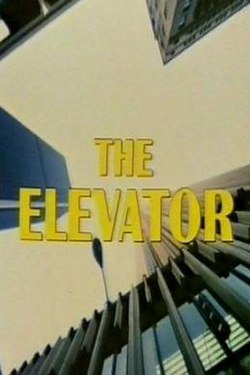
Welcome to Retro Television Reviews, a feature where we review some of our favorite and least favorite shows of the past!  On Sundays, I will be reviewing the made-for-television movies that used to be a primetime mainstay.  Today’s film is 1974’s The Elevator!  It  can be viewed on YouTube!

Marvin Ellis (Roddy McDowall) hates his job.  He’s been assigned to be the manager of a new high-rise office building.  Parts of the building are still under construction but that hasn’t stopped the company that owns it from selling out office space.  When Mrs. Kenyon (Myrna Loy) comes by and asks to look at the top floor penthouse, Ellis agrees.  In public, Ellis is always friendly and always courteous.  It’s only under the most stressful of circumstances that Ellis reveals that he feels as if the building has been built of out lies and cheap material.

Ellis and Kenyon soon find themselves in a stressful situation when they are trapped in an elevator.  Of course, they’re not alone in the elevator.  There’s also Dr. Reynolds (Craig Stevens), his wife (Teresa Wright), and his mistress (Arlene Golonka).  And then there’s Robert Peters (Barry Livingston), a teenager who has inherited a fortune.  And finally, there’s Eddie Holcomb (James Farentino).  Eddie has a suitcase full of money that he’s stolen from an office in the building.  He’s also got a loaded gun.  And, perhaps worst of all, he has an intense fear of tight places.  The longer that he’s trapped in the elevator, the worse his claustrophobia becomes.

Because the building isn’t really finished yet, the elevator’s alarm button doesn’t really work.  Other than the passengers trapped inside, the only people who know about the stalled elevator are Eddie’s partners-in-crime.  Irene (Carol Lynley) is Eddie’s girlfriend and she just wants to get the situation resolved with as little violence as possible.  Pete (Don Stroud) is Eddie’s sociopathic friend.  Pete is not only determined to rescue Eddie and retrieve the suitcase.  He’s also determined to take care of any potential witnesses by killing everyone on the elevator.

The Elevator is a disaster film, along the lines of Airport and The Towering Inferno.  Due to the hubris of a faceless corporation, a group of people find themselves trapped in a potentially catastrophic situation.  Some of them react with bravery.  Some of them react with cowardice.  All of them get a chance to reveal a bit of who they are on the inside.  Some might say that being trapped in an elevator is not quite as bad being trapped in a fiery skyscraper or being a passenger on a airplane that’s being held hostage by a mad bomber.  Technically, they’re right but I am also going to admit right now that I absolutely hate elevators and I try to avoid them whenever I can.  I always say that this is because running up and down several flights of stairs is a good way to keep my legs looking good and certainly that’s part of it.  But an even bigger reason is that I dread the thought of being stuck in a confined space with a bunch of strangers.  If I was on an elevator that was stuck between floors, I would probably lose my mind.  I have a hard enough time just standing in line for longer than 3 minutes.  As directed by Jerry Jameson, The Elevator does as good job of capturing the feeling of being trapped in a small space.  It’s not a film to watch if you have claustrophobia.

As for the cast, Myrna Loy is a delight as the eccentric Mrs. Kenyon.  And seriously, how can you dislike any film that gives Roddy McDowall a monologue about how much he hates skyscrapers?  It’s an entertaining, if undemanding, film.  After watching The Elevator, I’ll keep taking the stairs.

Horror Film Review: Dead & Buried (by Gary Sherman)


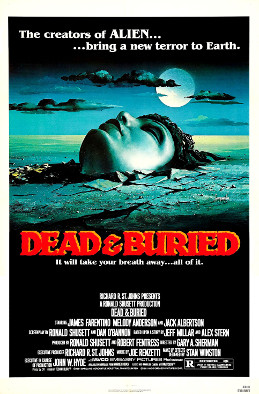
The 1981 horror film, Dead & Buried, takes place in the small town of Potters Bluff.  It seems like it should be a nice place to live.  The people are friendly.  The scenery is lovely.  The town is right on the coast of the ocean so the view is great.  It’s a bit of an artist’s colony, the type of place where you would expect to find Elizabeth Taylor painting the sunset while Richard Burton battles a hangover in the beach house.  It’s the type of small town that used to by very popular on television.  It’s just one Gilmore girl away from being an old CW show.

It’s such a nice town.  So, why are so many people dying?

That’s the mystery that Sheriff Dan Gillis (James Farentino) has to solve.  Actually, it’s one of the many mysteries that Dan has to solve.  There’s also the mystery of why his wife, Janet (Melody Anderson), has been acting so strangely.  And then there’s the mystery of what happened to the person who, one night, Dan ran into with his car.  The person ran away but he left behind his arm.  When Dan gets some skin from the arm analyzed, he’s told that the arm belongs to someone who has been dead for at least four months!

Who can explain all of this?  How about William G. Dobbs (Jack Albertson), the folksy coroner who seems to enjoy his work just a little bit too much.  In fact, Dr. Dobbs seems to be a bit more than just a tad eccentric.  One would necessarily expect a coroner to have a somewhat macabre view of life but Dr. Dobbs seems to take things to extreme.  Is it possible that Dr. Dobbs knows more than he’s letting on?

Dead & Buried has a reputation for being something of a sleeper, a deliberately-paced and often darky humorous horror film that had the misfortune to be released at a time when most horror audiences were more interested in watching a masked man with a machete kill half-naked teenagers.  Because the studio wasn’t sure how exactly to market Dead & Buried, it failed at the box office and it was only years later, after it was released on home video, that people watched the film and realized that it was actually pretty good.  And make no mistake about it, Dead & Buried is a fairly clever horror film, one that is full of effective moments and which does a good job of creating a creepy atmosphere.  If I’m not quite as enthused about this film as others, that’s because I do think that it’s occasionally a bit too slow and the film’s twist ending, while well-executed, didn’t particularly take me by surprise.  This is one of those films that you enjoy despite the fact that you can see the surprise conclusion coming from a mile away.

In the end, Dead & Buried fills like a particularly twisted, extra-long episode of one of those old horror anthology shows, like Night Gallery, Twilight Zone, or maybe even Ghost Story.  It’s a nicely done slice of small town horror, featuring a study lead performance from James Farentino and an enjoyably weird one from Jack Albertson.  Though the film is not heavy on gore, Stan Winston’s special effects are appropriate macabre.  Even if it’s not quite up there with Gary Sherman’s other films (like Vice Squad and Death Line, to name two), Dead & Buried is an entertainingly eccentric offering for Halloween.

In the Line of Duty: A Cop For The Killing (1990, directed by Dick Lowry)


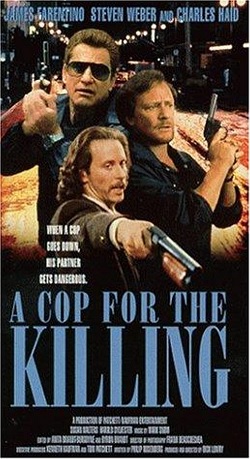
When an undercover narcotics operation goes wrong, a veteran cop (Charles Haid) is killed.  While the cop’s killer goes on trial, the members of the undercover squad struggle to deal with their feelings about what has happened.  The head of the squad (James Farentino) struggles with how much emotion he can show while still remaining a leader.  As his ex-wife puts it, he’s so busy staying strong for everyone else that he hasn’t been able to deal with his emotions.  Meanwhile, the dead cop’s partner (Steve Weber) has the opposite problem and starts to take dangerous risks on the job.  When it looks like the killer might get a plea deal from the district attorney, both Farentino and Weber are forced to come to terms with Haid’s death and their own feelings of anger and guilt.

In the early 90s, there was several “In the Line of Duty” films made for NBC.  They were all based (often loosely) on true stories and they dealt with members of the law enforcement who died while on the job.  The best known of these was probably Ambush in Waco, which went into production while the Branch Davidian siege was still ongoing.

A Cop For The Killing was the second of the In The Line of Duty films.  Unlike the later films in the series, it didn’t deal with a nationally-known case.  Instead, it just focused on one squad of cops and how the death of a member of the squad effected them.  With its ensemble of familiar television actors and Dick Lowry’s efficient but not particularly splashy direction, it feels more like a pilot than an actual movie.  Even though this film features the cops opening up about their feelings, there’s not much to distinguish it from other cop shows of the period.  If someone digitally replaced Steven Weber with Fred Dryer, it would be easy to mistake A Cop For The Killing for a two-hour episode of Hunter.  As with all of the In The Line of Duty films, there are a few scenes designed to show the comradery of the members of the squad but it again all feels too familiar to be effective.  Before Charles Haid dies, he and Steven Weber hang out at a bar and wrestle.  After Haid dies, Weber hangs out at a strip club that’s safe for prime time.  Judging from 90s television cop shows, undercover detectives were solely responsible for keeping most strip clubs profitable.

The cast is adequate.  Farentino is believable as the emotionally withdrawn commander.  Charles Haid makes the most of his limited screen time.  Tony Plana plays a smug drug lord who smiles even when he’s being booked.  It takes a while to adjust to Steven Weber playing a serious role but his courtroom meltdown is the movie’s highlight.  In The Line of Duty: A Cop For The Killing may not have led to a television series featuring Farentino and Weber taking down the bad guys but it did lead to another In The Line of Duty movie that I will take a look at tomorrow.

A Movie A Day #255: Her Alibi (1989, directed by Bruce Beresford)


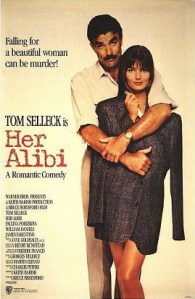
Tom Selleck is Phil Blackwood, a best-selling mystery author who is suffering from writer’s block.  Paulina Porizkova in Nina, a beautiful Romanian who has been accused of murder.  When Phil sees Nina being arraigned in court, it is love at first sight.  He provides her with a false alibi and invites her to stay with him while he writes a book based on her case.  At first, Phil thinks that she is innocent but he soon has his doubts, especially after Nina shows off her skills as a knife thrower.

1989 was a strange year for Australian director Bruce Beresford.  On the one hand, he directed Driving Miss Daisy, which went on to win the Oscar for the best picture.  On the other hand, he also directed Her Alibi, a disjointed comedy that feels like an extended episode of Magnum P.I.  (Even Sellecks’ narration feels like a throwback to his star-making role.  But if Phil is a best-selling writer, why does his narration sound so clunky and clichéd?)  Her Alibi is a predictable film, not really bad but just very bland.  It tries to duplicate the style of a classic screwball comedy but it lacks the bite necessary to make much of an impression.  On the plus side, the great William Daniels was given a few good lines as Phil’s caustic agent and Paulina Porizkova was absolutely beautiful.  The scene where Nina gives Phil a haircut almost makes the movie worth it.

One final note: When watching Her Alibi, be sure to pay attention to the scene where Phil holds up his latest novel.  The book is so thin that it looks like it is only 20 pages long, at the most.