10 Reasons Why I Hated Avatar


(The opinions in this review are mine and mine alone.  They reflect the feelings of Lisa Marie Bowman and not the feelings of any other editor on this site.  To prove that the opinions below are solely mine, check out this very positive review of Avatar that was posted on this very site last December.)

In case you didn’t already know this from my previous reviews, I’m going to confess something here.  I hated Avatar.  It was probably my least favorite film of 2009.  How much did I hate Avatar?  Well, I didn’t care much for The Hurt Locker either but I still cheered when it won best picture because it meant that Avatar didn’t. 

Most of my friends and family loved Avatar and, I’m proud to say, that none of them have allowed our difference of opinion to effect our relationship.  Indeed, most Avatar fans have been very tolerant of my dissenting views.  However, there’s always an exception.  From the 1st time I ever openly admitted to disliking Avatar, I have had to deal with a small but vocal group of people who not only disagree but apparently feel that I’ve committed a crime against humanity.  So, why bring it up now?  Because on Thursday, Avatar is going to be released on DVD and Blu-ray.  In honor of that event, here are 10 reason why I personally hated Avatar

1) Ironically enough, most people who love Avatar will probably agree with the majority of my criticisms.  They’ll argue that yes, the story is predictable and yes, James Cameron is heavy-handed as both a writer and a director but none of that matters because of all the brilliant visual effects.  They’ll argue that Cameron made a whole different world, Pandora, come to life.  To a certain extent, they’re right.  Cameron does manage to make Pandora believable and wow, Pandora certainly turns out to be a boring planet.  Seriously, does that jungle cover the entire freaking planet?  However, regardless of my personal feelings about Pandora, James Cameron is hardly the 1st director to make an alien world believable.  Peter Jackson did it with his Lord of the Rings trilogy and the same can, arguably, be said of the Narnia films.  Even earlier, Mario Bava did it with Planet of the Vampires and he did it with a lot less money.  Of course, none of these films were in 3-D but so what?  Just because the mundane appears to be inches in front of your nose doesn’t make it any less mundane.
2) Speaking of mundane, wouldn’t you be let down if, when you first met the members of a totally alien race, they all turned out to be a bunch of movie stereotypes?  The Na’vi appear to have developed their entire culture as the result of a steady diet of Hollywood westerns, New Age self-help books, and some 16 year-old’s half-assed understanding of what it means to be a Pagan.  I remember when I first saw Avatar, it was impossible for me not to compare it unfavorably with District 9, a film that addressed many of the same themes and issues as Avatar but did it with a much lower budget and a much more intelligent script.  This was especially evident when one compares Avatar’s Na’vi with District 9’s prawns.  While the prawns were believable as both individual characters and as representatives of a totally alien race, the Na’vi are essentially the reflections of James Cameron’s sophomoric noble savage fantasies.

3) District 9 wasn’t the only great science fiction film to come out in 2009.  There was also Moon, which featured a great performance by Sam Rockwell and excellent direction from Duncan Jones.  When /Film asked Jones for his opinion of Avatar, Jones replied, “…at which point in the film did you have any doubt what was going to happen next?”  It’s a good question. 

In all honesty, I’m a horror girl.  I haven’t seen much science fiction and therefore, I’m not as well acquainted with the genre’s clichés as I am with horror.  However, I can still say that, at no point, did anything that happened in Avatar take me by surprise.

Of course, some of my favorite movies were (and are) very predictable.  Georges Polti argued that there were really only 36 basic plots available to use in fiction so its understandable that you’re going to come across the same one used several times.  However, a predictable plot can be forgiven if maybe that plot features at least a few interesting characters or maybe an occasional unexpected line of dialogue.  Avatar, however, can’t even manage this.  Our hero is an impulsive man of action.  The villains are all evil because … well, they just are.  In the manner of most oppressed races in American film, the Na’vi are noble savages who require a white guy to come save them.  The only lines of dialogue that I remember are the ones that made me roll my eyes.  I’m talking about stuff like a bunch of 22nd century marines being greeted with “You’re not in Kansas anymore.”  Well, that and “I see you,” which was apparently included in the script so that it could serve as the title of a syrupy theme song.

4) Strangely enough, even though the movie took absolutely no narrative risks, it was still full of plot holes and things that just didn’t make much sense. 

For instance, why does Quaritich promise to give Jake back his legs (“your real ones”)?  I mean, does Quaritich have them sitting in a freezer somewhere? 

As part of his deal with Quaritich, Jake agrees to make videos about the Na’vi.  Oddly enough, it appears that he’s still making the videos even after he turns against Quaritich and you have to wonder exactly why.  Also, Jake records many of these videos in an isolated, apparently one-room outpost occupied by him and two other scientists yet the scientists are later shocked and outraged when told that Jake was making the videos.  Okay, what did they think he was doing all that time?  Were they just not listening to what he was saying? 

What exactly was the backstory of Sigourney Weaver’s character and when exactly did she join Sully in the Na’vi camp?   And why were the Na’vi willing to let her into their tribe when they would only grudgingly accepted Sully even after the Goddess selected him?  I mean, if Weaver already had such a great relationship with the Na’vi, it seems like she could have saved a lot of time by just taking Sully straight to them.  (Editor’s Note: According to the comments below, this issue actually was addressed in the film. — LMB)

Sully, after the final battle, decides to stay on Pandora and he might as well since the Tree of Souls (good God!) transferred his soul into his Na’vi body.  But what’s in it for Max and Norm?  We seem them at the end (though really, Norm should be dead) standing there pointing guns at all the humans that are leaving.  Norm, at least, could still probably hang out in his avatar but what about Max?  Why is Max, who has had nothing to do with Na’vi, so quick to join the revolution?

I’m sure a lot of this is because scenes were edited out and I know that Cameron has a reputation for reinserting those scenes once his movies come out on DVD and blu-ray.  Well, more power to him.

5) The film suffers from a really bad case of the white man’s burden disease.  This is another one of those films where a caucasian character befriends an oppressed minority and, with remarkably little dissent, manages to appoint himself as the leader of that minority.  It’s a fantasy, one in which members of the bourgeoisie (like James Cameron) can live out their childhood fantasies of being outlaws without having to worry about  (unlike actual “outlaws,”) being punished for taking their stand.

Once again, it’s hard not to compare Avatar with District 9.  Both of them feature lead characters who are transformed into aliens.  The difference is that, with the exception of one brief scene, Jake Sully accomplishes the transformation rather easily and quickly becomes the best Na’vi there is while in District 9, poor Sharlto Copley is terrified by the process and, even though it does lead to him understanding the prawns (and ironically, learning how to show a little humanity), the movie never pretends that Copley isn’t losing his own individuality in the process of transforming.

6) The lead character is named Jake Sully.  Did James Cameron get frustrated and just use a Random Generic Movie Hero Name Generator to come up with that?  I wonder if Nick Sully was Cameron’s 2nd choice.  It’s not that there’s anything wrong with either name.  It’s just that it feels so generic.  Of course, the leader character is going to be named Jake and, of course, he’s not going to be an intellectual and, of course, Sigourney Weaver’s going to spend the whole movie making sarcastic comments about how stupid he is.  Speaking of which…

7) Sigourney plays Dr. Grace Augustine.  Her character and her performance are typical of a rather annoying Hollywood tradition, that of portraying any “strong” female as a total and complete bitch.  If you want the audience to know they’re supposed to take a woman seriously, have that woman spend the entire movie pissed off about something, as if the only way a woman can be strong is by sacrificing anything that might make her unique.  Now, there’s a lot I could say about why, from a cultural perspective, American movies often seem to be so conflicted about how to portray any woman who is neither an Eve nor a Lillith.  But in the case of Avatar, its hard not to feel that it comes down to screenwriter Cameron’s inability to make any of his characters interesting unless something nearby is exploding.

8 ) And while we’re on the subject of misunderstood women…okay, let’s say you discover a planet and this planet is a lush, beautiful paradise.  Why the Hell would you then call it Pandora?  Yes, I understand that newly discovered planets are usually named after mythological figures.  But there’s still usually some sort of vague logic behind the names.  For instance, Mars was named after the God of War because of its red hue.  Venus was often considered to be the most beautiful star in the sky.  Mercury has the fastest orbit.  Jupiter’s the biggest planet.  Pluto (before it got downgraded) was considered the darkest and coldest of the planets.  Pandora, however, was the woman who opened up the jar that released everything terrible, evil, and destructive into the world.  Why would anyone name a planet after her?  It’s possible, of course, that all the good names were taken.  Of course, it’s also possible that this is just another example of how thuddingly obvious Avatar is in its symbolism and subtext.

9) Speaking of obvious, what about the villain played by Stephen Lang?  More specifically, what about that accent?  It’s true that Cameron doesn’t exactly encourage his villains to be subtle.  Just check out Billy Zane in Titanic.  Zane, however, at least appeared to be having a little fun at his director’s expense.  He, alone among the cast, seemed to realize that Titanic was a silly melodrama and so he gave something of a silly performance.  It’s no great secret that it’s often more important to have a good villain than to have a good hero.  A good villain usually has some sort of motivation beyond just being the villain.  This is something that Cameron has never seemed to be able to grasp.  Whenever I see a military figure show up in a James Cameron movie, I get the same feeling that I get whenever a preacher shows up in a Stephen King novel.  Automatically I know that they’re going to turn out to be evil and I find myself dreading having to even waste the time with the “shocking” discovery of that evil. 

10) Perhaps most importantly, this is a movie that wants to preach peace but celebrate war.  Avatar contains all the trendy environmental messages that you’d expect from a Hollywood film but — even though director Cameron seems to be in a state of denial about it — the film’s heart is with its villanous soldiers.  Much as how Titanic, for all the rhetoric about the passengers in third class, was really only interested in portraying the lives (and deaths) of those in first class, Avatar spends a lot of time talking about trees but is much more interested in blowing them up with the destruction of the Home Tree serving as the money shot.

To be honest, I don’t mind a little hypocrisy when it comes to movies.  Most exploitation films celebrate hypocrisy.  The filmmakers knew it and, for the most part, the audiences knew it.  The fact that a movie like Child Bride could be advertised as “an important movie every parent must see!” became something of a shared joke between the filmmaker and his audience.  Rather than being hypocritical, the exploitation filmmaker is simply inviting his audience to join in a conspiracy against the forces of dullness.

Unfortunately, Avatar is not an exploitation film.  If Avatar was simply a B-movie, none of the my previous complaints would matter.  They would add to the film’s rogue charm.  Avatar, however, is too expensive to be considered an exploitation film.  And James Cameron, as he proved when he went ballistic over Kenneth Turan’s negative review of Titanic and as he has continued to prove with his recent comments regarding global warming, does not have the sensibility of a B-movie maker.  Arguably, he once did.  This is a man who, after all, did the special effects for Galaxy of Terror and made his directorial debut with Piranha IIThe Terminator was a great B-movie, right down to the accusations of plagiarism from Harlan Ellison.  However, as he’s become the most financially succesful director in history, Cameron has lost that B-movie sensibility. 

In other words, James Cameron takes himself seriously now and that, ultimately, is the main reason I hated Avatar.  It just takes itself too damn seriously.

Yes, I’ve read quite a few favorable reviews that have argued that Avatar‘s sole purpose is to entertain and that people like me who occasionally expect unique characters and an interesting story should just lie back and enjoy it.  I’ve seen the term “popcorn epic” used in quite a few reviews. 

I’m sorry but I’m not buying it.  If Avatar was truly setting out to be a “popcorn epic,” than I’d be a lot more willing to cut it some slack.  However, when the script contains lines about how on Earth, humans have “destroyed all the green,” and when the villains are accused of launching a “shock and awe” campaign, it’s ludicrous to then argue that Avatar isn’t setting itself up to be judged by a higher standard. 

It becomes hard to escape the fact that Cameron, regardless of how well he handles the special effects, has essentially made a stupid movie about deep issues.

As I said before, the majority of the people I know love Avatar.  I don’t hold it against them or think any less of them because, ultimately, movies are a subjective experience.  Whether or not a movie is good has less to do with the actual movie and more to do with the person watching it.

It would be nice to have the same courtesy extended to me .  Since I first revealed my opinion of Avatar on a non-Avatar related message board, I have found myself frequently attacked by little fanboys who apparently cannot handle the fact that one human being didn’t enjoy Avatar.  I’ve been told that, as a female, I can’t be expected to understand Avatar.  I’ve been accused of being “unimaginative,” “a snob,” “a bitch,” and my personal favorite “the type of cunt who cried at the end of the Blind Side.” 

I realize the risk I’m taking by openly admitting my dislike of Avatar but then again, movies are supposed to inspire conversation and not just pavlovian agreement.  So, in conclusion, I’ll just admit that yes, I am female and yes, I did cry at the end of The Blind Side, and yes, I hated Avatar.

Battle Angel possible next Cameron 3D-epic


With the success of Avatar there’s an ongoing speculation as to what will be James Cameron’s follow-up project. This is a man whose last two films has made a combined 4.2billion dollars (unadjusted) worldwide in theater box-office. There’s already talk of him doing a sequel (or prequel) to Avatar with him as producer and someone else directing.  The one project which seems to be popping up again and gaining traction as Cameron’s next directing gig is the film adaptation of the classic manga title, Battle Angel Alita.

Jon Landau, producer of Cameron’s last two film’s, have spoken to MTV Splashpage about the possibility that Cameron will make the film adaptation of Battle Angel Alita as his next 3D-epic with script collaborator Laeta Kalogridis helping flesh out the screenplay. If the film does become the next Cameron gig then the script will concentrate on the early volumes of the nine-volume manga. A part of the series where the character of Alita has lost her memories and no idea of where she came from and who she really is. One aspect of using this part of the series’ as the core part of the script includes Alita’s time as a participant in the Motorball games. Motorball being a combination Rollerball and NASCAR but with cyborg participants. As the Youtube video of an example of how Motorball looks like it would definitely translate into an awesome sequence in Cameron’s hands and in 3D.

Everyone who has read about Avatar and it’s history knows by now that Cameron originally wanted to do this film adaptation of Battle Angel Alita as his follow-up to Titanic but decided against it when he realized the technilogy to properly do it wasn’t ready. Cameron opted for Avatar instead and used that film to develop and test the tech he needed for Alita. Now that his new film techniques and equipment have succeeded with flying colors there should really be no reason why Cameron should delay adapting Battle Angel Alita.

I, for one, think this manga and Cameron are perfect for each other. Strong female character, dynamic action story and one that needs a filmmaker at home in doing a huge film heavy on tech. Sounds like a Cameron film to me.

Source: MTV Splashpage

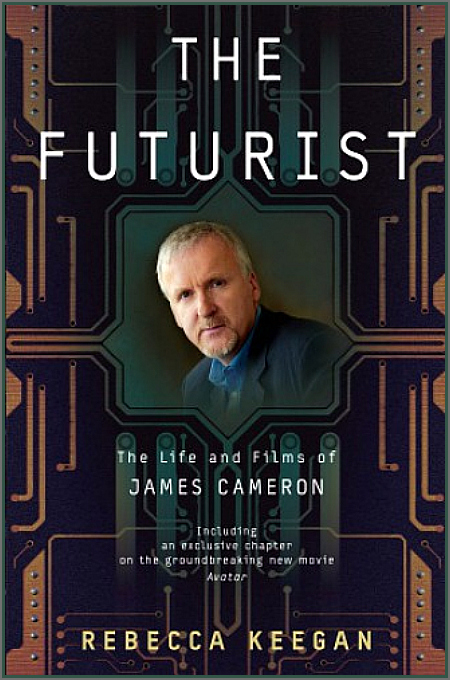
Review: The Futurist – The Life and Films of James Cameron (by Rebecca Keegan)


2009 will probably go down as the year James Cameron returned from a self-imposed exile from feature-lenght filmmaking. It has been 12 years since his last major film for a big Hollywood studio. Titanic became the all-time box-office king with Cameron winning accolades and awards for his efforts. He was no flushed with money which has allowed him to take a break from making films audiences have come to expect from him. Instead he decided to go back to his first true-love growing up in Chippewa, Canada. Cameron went exploring the deepest parts of the ocean not just as a filmmaker but a scientists, researcher and explorer. This time of his life after proclaiming himself “King of the World” in the 1998 Academy Awards shows the dichotomy of James Cameron’s life and personality: the artist and scientist in one body.

It is the task of Rebecca Keegan’s biography of this modern-day renaissance man to give an insight as to how the two sides of Cameron made him the success he is today and one of the pioneers in filmmaking. The Futurist will look back to his childhood and, with unprecedented access to Cameron’s family, close friends, associates and, best of all, James Cameron himself, show us a glimpse at the very reclusive filmmaker. The book doesn’t overly fawn over Cameron’s talents and achievements, but if there was a man deserving such attention it would be Cameron.  Keegan never really points out and concentrate on the negatives of Cameron’s life and personality, but does allow these traits to show how committed and focused an individual Cameron was when it came to his work and demanded nothing less from those who worked with him.

The book details how Cameron’s parents may have had a major influence in how he turned out in life. Born of a father who was a mechanical engineer and an artist of a mother with a self-reliance and powerful personality which would imprint the young Cameron at an early age. In fact, Keegan devotes the early sections of the book to showing how gifted the Cameron brood was from Jim’s parents to his four other siblings. But in the end, it was Cameron who was the take-charge of the litter. Even at an early age it was he who led the other kids on his projects (which included building a plane from scraps and junk around the neighborhood). Right from the beginning Keegan was able to show us the many experiences and influences that both lead to him being one of the world’s foremost filmmakers to one also renowned for his dictatorial-style on the film set.

The Futurist really offers just a glimpse on the life of Cameron. It is a life that could almost be a primer for all young people dreaming to be filmmakers themselves or just whatever they want to do in life with something they love. Keegan’s casual writing style doesn’t have the dry, academic tone of most biographies. She almost treats the biography’s many chapters as a behind-the-scenes look into every film project Cameron has been a part of. From his early days as model builder in Roger Corman’s New World Pictures right up to his latest project for 20th Century Fox, Avatar. While each film discussed was already quite interesting for a fan of the filmmaker and those films, I was even more interested in finding out how Cameron’s own dedication and laser-like focus on each project showed both the genius and madman aspect of the man. Here was an individual so intelligent that he could converse with artists and scientists and keep up, if not, hold his own.

One specific anecdote in the biography which shows a lot about Cameron as a modern renaissance man was his time between Titanic and Avatar. This was a part of Cameron’s life where the scientist in him took precedence. He was working on a Mars film project and had come to work with NASA engineers and scientists on future plans to try and reach the Red Planet. Having access to unofficial papers and technical papers on such a project, Cameron was able to come up with a hybrid Mars lander which would also double as the rover. He submitted the plans and design specs to this “lander rover” to the NASA team who ended up more than impressed. A similar-looking lander rover would soon land on a later Mars mission and all thanks to the outside the box thinking Cameron was able to add to the scientists who had been working for years on the project. One of the NASA engineers was so impressed that he was heard to have commented that if Cameron wasn’t a filmmaker he definitely would’ve turned out to be an exceptional engineer.

It’s that admiration from those who have worked with Cameron which comes up more than once in Keegan’s book. She shows not just his artistic side but his love of science and research. Cameron definitely comes off as the know-it-all in the room. Whether one sees that as a negative or a positive it doesn’t change the fact that he probably does know it all and do it better than most in a room of contemporaries. We learn from Keegan’s inside-look at Cameron’s life how he could easily be a one-man film set. Most filmmakers, even great ones, rarely pick up a camera or become a major part of the editing process. Cameron could do everything that needs to be done on a set minus the acting. The Futurist also goes to great lenghts to point out that while Cameron was great at pretty much anything the needs to be done to make a film as a writer he admits to her how much he struggles at it. He sees the writing side of the film equation as something he wished he could do better and always trying to improve at it. This goes towards the many criticisms about Cameron’s film being cardboard cutouts of stories already done and done better. It goes to explain Cameron’s need to control every aspect of his film projects that he only trusts himself and, maybe close friends, to write the script for his films.

He wants to film his stories, his ideas and not other people. It definitely shows how many in Hollywood could equate that with him being very egocentric in how he deals with his peers. Some may admire this trait and others may see it as a man over his head and banking on the simple taste of the general population to make his films succeed. While I do not subscribe to the latter, I do think that much of the backlash he has received with his last two films go back to his ego and superiority over others. It is not easy for people who think they know what they talk about when it comes to film and everything that goes in making one be made to feel stupid when he makes it known. But then he has made a habit of being vindicated in the end despite these trait flaws. As the saying goes, “Sometimes the truth hurt.” James Cameron definitely comes across in the book as a no-nonsense, bullshit-free dictator who is smarter than everyone else.

In the end, Rebecca Keegan’s The Futurist is an engaging look-inside the mind of the man who has proclaimed himself “King of the World” and who others have called under their breath as a tyrannical dictator of a filmmaker. While the book could’ve been much longer and gone into even more detail about Cameron, his life and his films Keegan has definitely laid down the groundwork on any future Cameron biographies both official and unofficial. There’s definitely more to learn about this unique blending of romantic artists and dedicated science genius in one mind and body. For fans of James Cameron this book is definitely a must-have and read. For those just wanting to know more about this pioneer filmmaker then this book is a great primer to learning more about him.

10 Best Films of 2009


While some have called 2009 as not being so great in terms of quality films, there have been others who think the year was a very good year for films from start to finish. Not all the best films of 2009 came out during the so-called “awards season” from October thru December. Some of the worst films, in my opinion, were released very late in the year and clearly done so to try and force its way into award contention. While the year of 2009 saw some very good films come out early in the year and, to my surprise, even during the popcorn and brainless season of the summer blockbusters.

My list consists of the 10 films I saw in 2009 which I believe to be the best of all them. Some people will probably agree with me on and some won’t. Some of my picks may have been little seen outside of independent arthouse theaters or film festivals but it doesn’t diminish just how much I think it deserves inclusion in a “best of” list. In the end, I thought these films doesn’t just celebrate what’s great about films but also celebrating those filmmakers who show that when given room to breathe and do things their way magic can still happen.

10. Bad Lieutenant: Port of Call – New Orleans (dir. Werner Herzog)

9. The Messenger (dir. Oren Moverman)

8. Collapse (dir. Chris Smith)

7. Moon (dir. Duncan Jones)

6. Der Baader Meinhof Komplex (dir. Uli Edel)

5. Avatar (dir. James Cameron)

4. Up In The Air (dir. Jason Reitman)

3. District 9 (dir. Neill Blomkamp)

2. Inglourious Basterds (dir. Quentin Tarantino

1. The Hurt Locker (dir. Kathryn Bigelow)

Film Review: Avatar (directed by James Cameron)


“Everything is backwards now, like out there is the true world, and in here is the dream.” — Jake Sully

When was the last time a film became an experience for you—not just a story that made you think, but one that swept you up and immersed you completely? The most hyped film of 2009, and likely of this decade, was such an experience for me. James Cameron’s Avatar, a project over fifteen years in the making, more than lived up to the hype that followed it from the earliest production leaks.

Avatar is not the greatest film ever made, nor does it revolutionize filmmaking the way Technicolor did in the late 1950s and early 1960s. What Cameron has accomplished is providing a blueprint for how filmmakers can bring audiences closer to the stories they tell. Stories and ideas once considered unfilmable due to technological limitations are now within reach. Avatar is an experience that should be seen, regardless of whether one embraces its story. The narrative is not original—some may be reminded of an Oscar-winning film directed by Kevin Costner or an animated feature with “Gully” in the title. While the lack of originality is noticeable, the story works within the context of Cameron’s vision. Clichéd and hackneyed dialogue aside, it serves the film well. Cameron’s writing may not rival that of Kaufman or Mamet, but he knows how to tell a simple story and keep the audience engaged.

With that flaw acknowledged, I haven’t felt this way about a film—nor even the best I’ve seen this year—since the first time I watched The Fellowship of the Ring or, before that, Spielberg’s Jurassic Park. Only a few films truly sweep me into their world and hold me there. It didn’t matter that Avatar wasn’t the second coming of Rashomon or this generation’s Citizen Kane. What I watched, I fully bought into. The world of Pandora, imagined by Cameron and brought to life by WETA Digital and ILM, felt real. The detail, clarity, and dedication in its creation gave me hope that creative boundaries once thought uncrossable are now being stepped over.

While the film is also available in 2D for theaters without 3D capabilities, it must be seen in 3D, ideally in IMAX 3D. Cameron’s use of the new “emotion capture” cameras he helped develop achieves a level of CGI photorealism that avoids the “Uncanny Valley” effect seen in films like The Polar ExpressBeowulf, and A Christmas Carol. The groundbreaking “mo-cap” technique, refined by WETA Digital for The Lord of the Rings trilogy, convinced Cameron it was time to make Avatar as he envisioned. The Na’vi are now the most realistic CGI characters ever put on screen, surpassing even Gollum. Cameron demonstrates that the limit of CGI use is not quantity, but how it is implemented. Lucas, Bay, and others who have misused CGI have much to learn from Cameron’s achievement.

It took a few minutes to adjust to the 3D effect, but once my eyes adapted, the film’s magic took hold. The distinction between CGI and live-action scenes blurred and eventually disappeared. Even the best CGI-heavy films sometimes break immersion, but Avatar never did. This total immersion helped me overlook the story’s familiarity and, for some, its ordinariness.

Despite the material, the performances ranged from good to excellent. The villains, while written one-dimensionally, were played with enough conviction to be believable. Giovanni Ribisi’s corporate weasel, a clear echo of Burke from Aliens, was cartoonish in motivation, but Cameron is not known for deep, well-rounded characters. The standout was Stephen Lang as Colonel Miles Quaritch. His scenery-chewing performance was riveting, stealing the film from Sam Worthington’s “hero on a journey.” While Lang’s performance may not win awards, it stands as one of the year’s most memorable, joining the ranks of characters audiences love to hate.

Some may think I’ve joined the Cameron fan club, but I can’t explain why I love this film despite its flaws: the familiar story, clichéd dialogue, and one-dimensional characters. Is Avatar just a technical and visual marvel? Yes, and more. Does the CGI and bombastic climax overshadow the storytelling? No, it actually propels the story forward, much like Jake Sully’s own fragile legs.

In the end, my love for Avatar comes down to the experience it provided—a rare occurrence in modern cinema. Cameron didn’t make a perfect film, nor one better than sliced bread. But he created a filmgoing experience that will be remembered decades from now, much like the first time audiences saw Star Wars and believed in Jedi and space battles, or Superman and believed a man could fly. Cameron’s Avatar made me believe in Pandora, a place I hope to visit, or at least experience through his eyes. I’m eager to see what he—and other filmmakers inspired by his work—will create next.