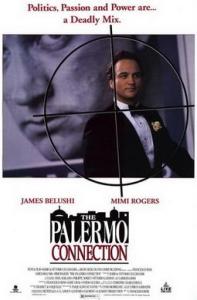
Carmine Bonavia (James Belushi) is an idealistic New York City councilman who wants to be mayor. Despite an easily understood slogan — “Make A Difference!” — his reform campaign is running behind in the polls. Having nothing to lose, Carmine announces that he supports the legalization of drugs. By taking out the profit motive, the Sicilian Mafia will no longer have any incentive to sell drugs in the inner city. Carmine shoots to top of the polls. Now leading by 11%, Carmine marries his campaign manager (Mimi Rogers) and returns to his ancestral home of Sicily for a combination honeymoon and fact-finding tour. The Mafia, realizing that Carmine is serious about legalizing drugs, conspires to frame him for the murder of a flower boy. If that doesn’t work, they are willing to resort to other, more permanent, methods to prevent Carmine from ever becoming mayor.
The Palermo Connection is an unfairly overlooked film from Francesco Rosi, an Italian director who specialized in political controversy. Though The Palermo Connection was sold as a thriller, Rosi was more interested in showing how organized crime, big business, government corruption, the war on drugs, and the poverty of the inner cities are all intricately connected. When Carmine arrives in Palermo, Rosi contrasts the outer beauty of Sicily with the desperate lives of the junkies living there. The pace may be too slow for action movie fans but Rosi gives the audience much to think about. This is probably the last film you would ever expect to star James Belushi but he gives a strong and committed performance as Carmine.
The Palermo Connection, which was co-written by Gore Vidal, is a good film that predates The Wire in its examination of how greed, drugs, poverty, and racism all come together to victimize the most marginalized members of society.
In the 2010 film The Ghost Writer, Ewan McGregor plays a character known as the Ghost. We never actually learn the name of his character and that’s perhaps appropriate. The Ghost has made his living by being anonymous. He’s a ghost writer. He’s the guy who is hired to help inarticulate and occasionally illiterate celebrities write best-selling biographies.
The Ghost has been given a new assignment. He is to ghost write the memoirs of former British Prime Minister Adam Lang (Pierce Brosnan). Despite the fact that Adam is one of the most famous men in the world, the Ghost is not initially enthusiastic about working with him.
First off, there’s the fact that Adam and his wife, Ruth (Olivia Williams), are currently hiding out in America because America is one of the few countries that will not extradite him to be prosecuted for war crimes at the International Criminal Court. It seems that Adam (much like Tony Blair) is a controversial figure because of some of the actions he may have authorized as a part of the war on terror. Not only does the Ghost have political objections to working with Adam but he has to leave his London home and go to Massachusetts in order to do so.
Secondly, there’s the fact that, once the Ghost arrives in America, he discovers that — for such a controversial figure — Adam is actually rather boring and seems to have very little knowledge about anything that he did while he was prime minister. Instead, he seems to be more interested in spending time with his mistress (Kim Cattrall, giving the film’s one bad performance). Ruth seems to be the political (and smart) one in the marriage.
And finally, there’s the fact that the Ghost is actually the second writer to have worked with Adam. The previous writer mysteriously drowned. While that death was ruled to be an accident, the Ghost comes to suspect that it was murder and that the motive is hidden in the first writer’s manuscript…
The Ghost Writer is a favorite of mine, a smart and witty political thriller that features great performances from Ewan McGregor, Olivia Williams, and Pierce Brosnan. Brosnan especially seems to be having a lot of fun sending up his dashing, James Bond image. Roman Polanski directs at a fast pace and maintains a perfect atmosphere of growing paranoia throughout the entire film. In the end, The Ghost Writer proudly continues the tradition of such superior paranoia films as The Conversation, Three Days of the Condor, and the Parallax View.
Incidentally, I have a theory that Adam Lang was also the unseen Prime Minister who was featured in Into the Loop. Watching The Ghost Writer, it’s hard not to feel that Adam really feel apart without Malcolm around to help him out.
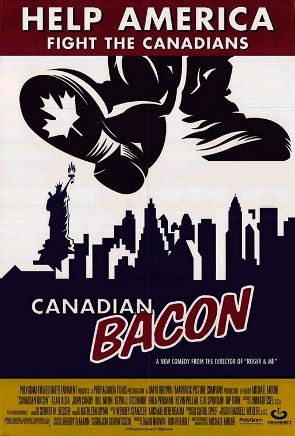
I have mixed feelings about the 1995 films Canadian Bacon.
On the one hand, Canadian Bacon is the only non-documentary to have been directed by Michael Moore. And I’m just going to admit right now that I don’t care much for Michael Moore. I think he’s fake. I think he’s the epitome of the type of limousine liberal who exclusively preaches to the converted and who, when all is said and done, does more harm to his causes than good. Just because he doesn’t shave, dresses like a slob, and apparently has never been to a gym, that doesn’t change the fact that he’s worth $50 million dollars. Just because he may claim to be for the workers, that doesn’t keep him from notoriously overworking and underpaying his own employees. Just because he may make films critical of capitalism, that certainly hasn’t stopped him from investing millions in the very same companies that he claims to oppose. And, quite frankly, it’s hard for me to take seriously a man who rails against income inequality when that man happens to own 9 mansions, none of which are exactly housing the homeless right now.
On the other hand, I love Canada! Canada has produced some of my favorite actors. It’s the country that created Degrassi. It’s the home of Lindsay Dianne and the Becoming A Bolder Being blog! Seriously, how can you not love Canada?
In fact, if a war ever broke out between American and Canada, I’m not sure who I’d support. Then again, hopefully Texas will have seceded from the U.S.A. before that happens. I’m keeping fingers crossed about that. Hopefully, once we have seceded, our first action will be to declare war on Vermont. (Not the rest of America, though. Just Vermont.)
The plot of Canadian Bacon is that the President of the United States (Alan Alda) is suffering from low approval ratings so he decides that America needs to find a new country to be enemies with. Mind you, the President doesn’t necessarily want to go to war. Instead, he just wants to have an enemy that he can always be on the verge of going to war with. After a riot breaks out at a hockey game, the President’s advisors realize that Canada would be the perfect enemy!
(And, while this is played for laughs, there actually is a historical precedent here. The War of 1812 was basically a result of America’s desire to conquer Canada.)
Anyway, American airwaves are soon full of anti-Canada propaganda and, since Michael Moore thinks everyone in America is an idiot except for him, gun-toting rednecks are soon preparing to do whatever it takes to defend America. A patriotic sheriff named Boomer (John Candy) decides to invade Canada on his own. Needless to say, things get even more complicated from there and soon a crazy weapons manufacturer (G.D. Spradlin) is plotting to launch a missile attack on Russia and … oh, who cares?
When Canadian Bacon tries to satirize politics and blind patriotism, it falls flat. Michael Moore has somehow earned a reputation for being a satirist but, if you actually look at his work, it quickly becomes apparent that he really doesn’t have much of a sense of humor. The humor in his documentaries is pretty much based on Moore saying, “Look how stupid everyone is except for me!” Since the people who watch Michael Moore documentaries are usually people who already agree with Michael Moore, they naturally find that to be hilarious because they already think anyone who disagrees with them is a joke. However, that doesn’t mean that Moore himself is a comic genius. He’s just a guy telling a joke to an audience that already knows the punchline.
Canadian Bacon is long on righteous indignation but it’s short on anything that would make you want to spend 90 minutes listening to the same point being made over and over again. Moore did make one good decision, in that he selected Rip Torn to play a crazed general. Rip Torn can deliver militaristic insults with the best of them.
The few times that Canadian Bacon actually works is when it gently (as opposed to indignantly) satirizes Canada’s reputation for being the most polite (and most hockey-obsessed) place on Earth. Dan Aykroyd has a great cameo as a Canadian police officer who pulls over Boomer’s truck and politely reprimands him for not including French translations for all of the anti-Canadian graffiti on the side of the vehicle.
Canadian Bacon could have used more scenes like that.
I’ve been on a mission to see as many obscure and forgotten films as possible, which is why, last night — via Movieplex OnDemand — I ended up watching a 1991 film called Diary of a Hitman.
In Diary of a Hitman, Forest Whitaker plays Dekker, a professional killer. Despite the film’s title, Dekker does not keep a diary. What he does do is talk. A lot. The film is framed by scenes of him telling his story to somebody on the phone. (I was never quite sure who he was supposed to be talking to.) Over the course of the film, he talks to a psychiatrist. He talks to his agent (Seymour Cassel). He talks to a dominatrix. He talks to a corrupt police officer (James Belushi). He talks to a born-again Christian (Lewis Smith) who hires Dekker to kill his wife and a baby that he may or may not be the father of. Eventually, he ends up talking to Jain (Sherilyn Fenn), the woman that he’s been hired to kill. He even has a very brief conversation with Jain’s sister, Kiki (who is played, in a shrill cameo appearance, by Sharon Stone).
With all of the constant talking, it’s not surprising to discover that Diary of a Hitman was based on a stage play. That’s especially obvious during the film’s second act, which almost entirely takes place inside of Jain’s apartment and basically consists of Fenn and Whitaker delivering dramatic monologues about life and death. Director Roy London was an acting teacher (among his students were Sharon Stone and Sherilyn Fenn) and it’s perhaps not surprising that he never found a way to make such obviously stage-bound material feel cinematic. Instead, London directed the film as if he was filming an acting exercise. Just consider the scene where Kiki drops by the apartment unannounced. While watching this scene, I kept having flashbacks to high school theater. I could literally hear one of my old teachers saying, “Okay, for this scene, your motivation is to get her to leave the apartment and your motivation is to stay in the apartment no matter what. And…go!”
That said, Diary of a Hitman is not a total waste of time. Playing the agoraphobic Jain, Sherilyn Fenn (who can be seen playing a far more villainous character in this year’s Raze) gives a sympathetic performance, even managing to redeem a potentially distasteful scene where she attempts to seduce Decker. (I’ve included that scene at the bottom of the review, mostly because — along with Sharon Stone’s cameo — it’s the only scene from Diary Of A Hitman that’s currently available on YouTube.)
And then there’s Forest Whitaker. It’s hard to say whether Whitaker gives a good performance here or not, largely because the character of Decker makes little sense to begin with and he’s required to have a massive change of heart that seems to come out of nowhere. (Whitaker has made a credible killer in several other films, just not this one.) However, what Whitaker lacks in credibility, he makes up for in eccentricity. In the role of Decker, Forest Whitaker gives one of the oddest performances that I’ve ever seen. Delivering the majority of his dialogue in an occasionally incomprehensible rasp and flashing a wide smile at the most inappropriate of moments, Forest Whitaker is a force of misdirected nature in this film. Again, it’s hard to say whether Whitaker actually gives a good performance here but he does make Diary of a Hitman worth seeing.
I have a weakness for films about idealistic educators who try to teach and change lives in the inner city. You know which films I’m talking about. These are the films that always take place in a decaying high school and there’s usually at least one scene where the teacher is warned not to care too much about their hopeless students and then the teacher goes, “Someone has to care!”
Why do these films fascinate me so?
To a large extent, it’s because they take place in a world that is so extremely outside of my high school experience. I was recently doing a search on my school and I came across a video on YouTube that was made by some students from my alma mater:
As I watched this video, I realized that neither the students, the campus, nor the neighborhood had really changed in the 9 years since I graduated.
I also realized that, even though I didn’t realize it at the time, I went to one of the most suburban, white bread high schools in the DFW metroplex. At the time, of course, a lot of my classmates thought they were tough. They would make a big deal about blasting Jay-Z and 50 Cent while they were driving down to Starbucks during lunch. For the most part, though, we put the suburb in suburban.
That, I think, is why I’m fascinated by inner city high school films. It’s even better when those films are totally over-the-top and feature a hero who not only teaches but who kicks some ass as well.
Perhaps that’s why I recently enjoyed watching The Principal.
Originally released way back in 1987, The Principal is one of those films that seems to regularly show up on the lesser known television networks. A few weeks ago, I saw that it was going to be broadcast on Ion Television so I set the DVR to record it and I finally ended up watching it this weekend.
In The Principal, James Belushi plays Rick Lattimore. (You can tell that this movie was released quite some time ago because Belushi has a lot more hair and lot less chins than he does now.) Rick’s a teacher with an anger problem. When he sees his ex-wife out on a date with his divorce lawyer, Rick loses it and physically assaults the lawyer. The next morning, Rick is called into a meeting with the school board. He’s expecting to get fired. Instead, he’s promoted. Rick is now principal of Brandel High.
Brandel High, it turns out, is the most troubled high school ever! Drugs are sold and used openly in the hallways. Few students bother to attend class (but yet they still come to the school). The teachers spend most of their time hiding in either their classroom or the teacher’s lounge. The school’s head of security, Jake (Lou Gossett, Jr.), spends most of his time making sarcastic comments. When Rick pulls up on his motorcycle, the first thing he sees is a fight between rival drug dealers.
Rick responds to all of this by holding a school assembly. As every student at Brandel jeers him, Rick announces that he has only one policy: “NO MORE!” It’s at this point that the school drug lord Victor Duncan (played by Michael Wright) stands up and announces, “You talk too much!”
Things continue to build up from there as Rick divides his time between educating and getting beaten up by resentful students, Jake starts to actually care about his job again, and Victor wanders through the school hallways, dressed like he’s in one of the Underworld films and saying stuff like, “Try to reach me and I’ll just cut off your hand…”
The Principal is such an over-the-top, silly, yet heart-felt film that it’s impossible not to enjoy it in much the same way that you might enjoy eating junk food. As I watched this film, I found myself wondering what had happened to James Belushi in the years since it was originally released because, in The Principal, he’s actually likable. However, the film really belongs to Michael Wright. Seriously, as played by Wright, Victor Duncan is the most evil student in the history of high school cinema. When he tells Rick that he’s willing to cut off his outstretched hand, you believe him.
The Principal is a thoroughly predictable film that promotes a dubious educational policy of zero tolerance. However, it’s also a lot of fun.
In other words, it’s the epitome of a guilty pleasure.