Horror Scene That I Love: The Pool Scene from Cat People


Today’s horror scene that I love comes to us from the 1942 psychological thriller, Cat People!

In this noirish scene, Alice (Jane Randolph) goes for a swim, just to find herself suspecting that she may not be alone.

Be sure to check out my reviews of the original Cat People, the sequel, and the remake by clicking on the links in this sentence!

Horror Film Review: The Leopard Man (dir by Jacques Tourneur)


leopard_man

The 1943 film The Leopard Man is set in a small town in New Mexico.  It’s a place that seems to be hidden away from much of the modern world and where the cultures of Mexico and America mix, occasionally with unease.  Jerry Manning (Dennis O’Keefe) is an American publicity agent who is dating a nightclub performer named, Kiki (Jean Brooks).  Kiki has a rivalry with another performer, the far more flamboyant (read: interesting) Clo-Clo (Margo).  Jerry, however, feels that he’s come up with the perfect way for Kiki to upstage Clo-Clo.  Jerry has rented a leopard!

Unfortunately, it soon becomes obvious that neither Jerry nor Kiki knows how to handle a leopard.  Clo-Clo startles the leopard with her castanets, causing the leopard to escape and flee into the desert.  Now, Jerry has two problems.  Not only is Kiki mad at him but the leopard’s owner, Charlie (Abner Biberman), expects Jerry to pay for the missing animal.

Actually, make that three problems.  Soon after the leopard escapes, a teenage girl is chased to the front door of her house.  When she bangs on the door and begs her mother to let her in, her mother assumes that her daughter is making up a lie to get out of helping around the house.  The mother ignores her until suddenly, her daughter screams and blood starts to seep in from under the door…

All of the locals believe that the girl was killed by the leopard.  Soon, more people in town are also killed.  The police are sure that it’s the leopard but Jerry soon comes to think that something else might be happening.  Could it be that something or someone else is committing the murders and attempting to frame the leopard?

A moody and rather fatalistic film that looks truly impressive for a B-movie that was shot on the studio backlots, The Leopard Man is really more of a mystery than a traditional horror film.  That said, the film is full of atmospheric and creepy scenes, particularly a lengthy sequence in which the townspeople commemorate the anniversary of a centuries-old massacre.  The specter of death, both past and future, hangs over both the town and the film.  That’s not surprising when you consider the The Leopard Man was produced by Val Lewton and directed by Jacques Tourneur, the same time that previously created the original Cat People.  Much like Cat People, The Leopard Man is a film that’s power comes as much from what we don’t see as what we do see.  The Leopard Man is a triumph of atmosphere and tension.

While neither Jerry non Kiki are very interesting characters, the film is full of memorable character roles.  The citizens of that small town in New Mexico are all vividly drawn and portrayed, with the film perfectly capturing the quiet desperation of being both poor and forgotten in American society.  My favorite character was Clo-Clo.  As played by Margo, she is fierce, determined, and — in a few small moments — rather tragic.  If they ever remake The Leopard Man, I’m claiming that role right now.

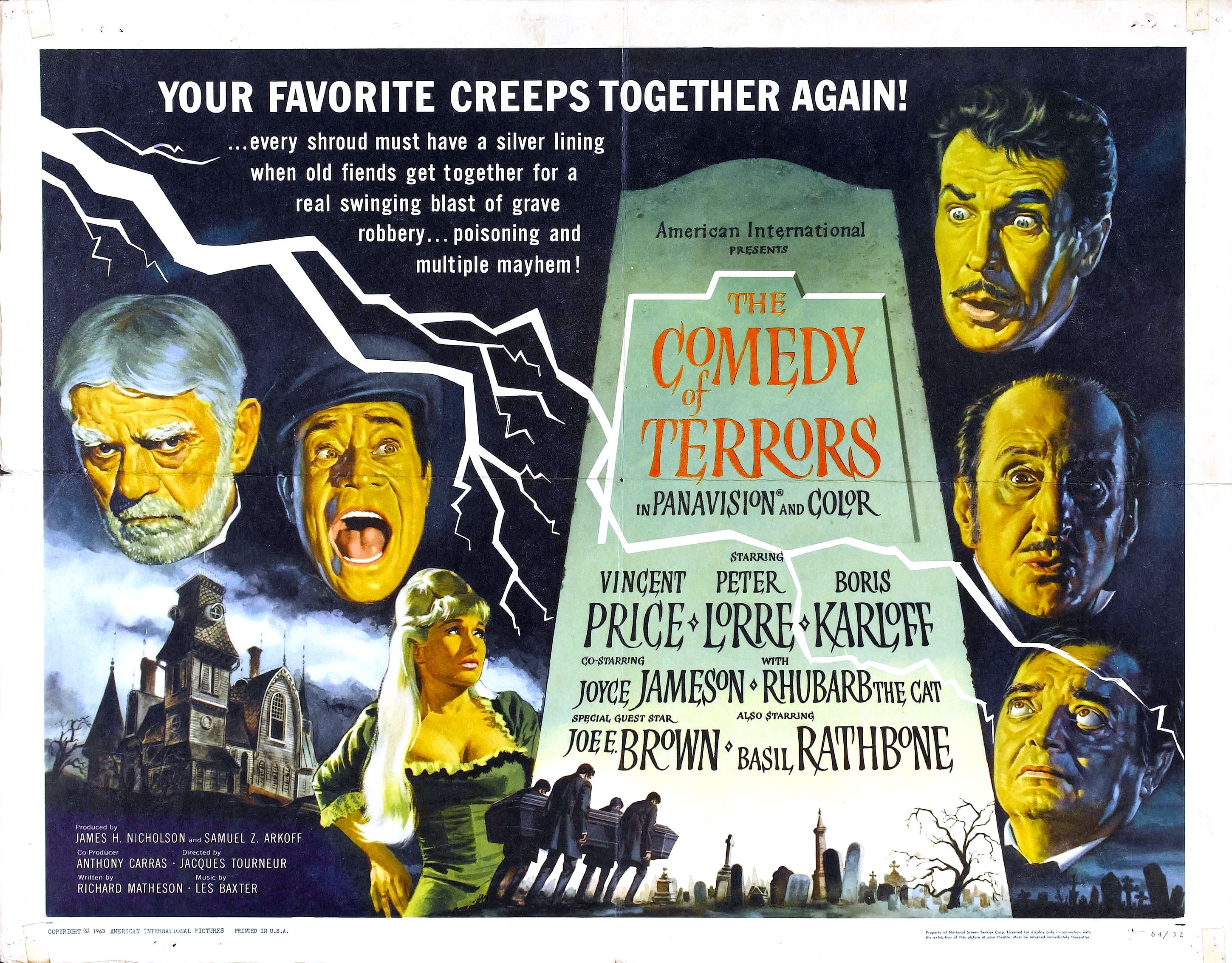
Halloween Havoc!: THE COMEDY OF TERRORS (AIP 1964)


gary loggins's avatarcracked rear viewer

cot1

Vincent Price, Peter Lorre, Boris Karloff, and Basil Rathbone had all appeared together on film in various combinations seven different times, but never all at once until THE COMEDY OF TERRORS. This black comedy masterpiece spoofs AIP’s own Poe flicks and Shakespeare, with the quartet of chiller icons having a grand old time playing Richard Matheson’s delicious screenplay to the hilt. Horror and noir vet Jacques Tourneur gets to direct the old pros, and the supporting cast features classic comic Joe E. Brown and Rhubarb The Cat (more on him later!).

cot2

Price  is Waldo Trumble, the besotted, greedy proprietor of Trumble & Hinchley Funeral Parlor. He’s cruel to wife Amaryllis (Joyce Jameson), a failed opera singer (“I wish her vocal chords would snap”) who he married only to gain control of the company from her doddering old, half-deaf father Amos. “Demon rum will get you yet!”, she tells Waldo, to which…

View original post 727 more words

4 Shots From Horror History: Night of the Demon, Curse of Frankenstein, Horror of Dracula, The Mummy


This October, I’m going to be doing something a little bit different with my contribution to 4 Shots From 4 Films.  I’m going to be taking a little chronological tour of the history of horror cinema, moving from decade to decade.

Today, we reach the end of the 50s and the rise of British horror.

4 Shots From 4 Films

Night of the Demon (1957, dir by Jacques Tourneur)

Night of the Demon (1957, dir by Jacques Tourneur)

The Curse of Frankenstein (1957, dir by Terence Fisher)

The Curse of Frankenstein (1957, dir by Terence Fisher)

 Horror of Dracula (1958, dir by Terence Fisher)

Horror of Dracula (1958, dir by Terence Fisher)

The Mummy (1959, dir by Terence Fisher)

The Mummy (1959, dir by Terence Fisher)

4 Shots From Horror History: Dr. Cyclops, The Wolf Man, Cat People, I Walked With A Zombie


This October, I’m going to be doing something a little bit different with my contribution to 4 Shots From 4 Films.  I’m going to be taking a little chronological tour of the history of horror cinema, moving from decade to decade.

Today, we take a look at the first few years of 1940s.

4 Shots From 4 Films

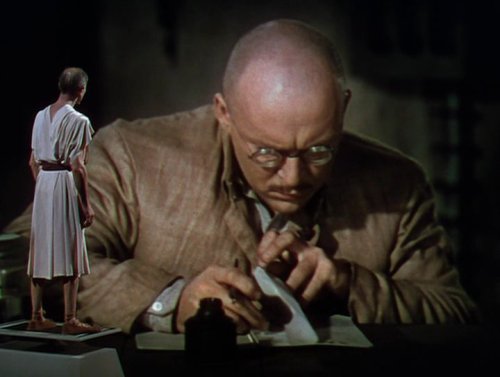
Dr. Cyclops (1940, dir by Ernest B. Schoedsack)

Dr. Cyclops (1940, dir by Ernest B. Schoedsack)

The Wolf Man (1941, dir by George Waggner)

The Wolf Man (1941, dir by George Waggner)

Cat People (1943, dir by Jacques Tourneur)

Cat People (1942, dir by Jacques Tourneur)

I Walked With A Zombie (1943, dir by Jacques Tourneur)

I Walked With A Zombie (1943, dir by Jacques Tourneur)

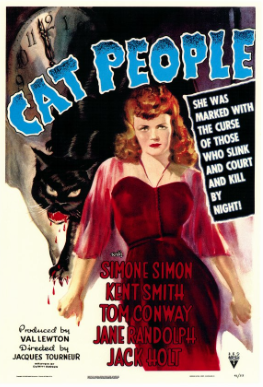
Horror Film Review: Cat People (dir by Jacques Tourneur)


Cat_People_poster

The 1942 horror classic Cat People is often described as being a horror film where, up until the last few minutes, the monsters are mostly psychological.  And there is some definite truth to that.  The title creatures remain a mystery for the majority of the film and, up until those final minutes, the audience would have every right to wonder whether or not they actually existed.  This is a film that seems to take place almost totally in the shadows, a film noir without detectives or gangsters but featuring a memorable and compelling femme fatale.

However, I would argue that there is a monster who is present on-screen long before the audience first sees the shadowy form of a cat person.  That monster is named Louis Judd and he’s the true villain of this story.  As played by Tom Conway, Louis Judd is a psychiatrist and, from the minute we first see him, we know that he’s not to be trusted.  He’s far too smooth for his own good and his soothing tones barely disguise the arrogant condescension behind his words.  If his pencil-thin mustache didn’t make him sinister enough, Dr. Judd also keeps a sword concealed inside of his walking stick.

Irena Reed (Simone Simon) is one of Dr. Judd’s patients.  A fashion designer from Serbia, Irena has recently married an engineer named Oliver Reed (Kent Smith).  Despite the fact that she loves Olivier, she cannot bring herself to be intimate with him.  As Dr. Judd discovers, Irena fears that she has been cursed and, if she ever allows herself to become aroused, she will be transformed into a panther.  Dr. Judd repeatedly tells her that her belief is just superstition and that her fears are the result of repressed trauma from her childhood.  When Irena refuses to accept his diagnosis and continues to insist that she is cursed, Dr. Judd assumes that he can prove her wrong by forcing himself on her.  (Big mistake.)

Meanwhile, Oliver loves Irena but her refusal to consummate their marriage is driving him away.  He finds himself growing more and more attracted to his co-worker, Alice (Jane Randolph).  At first, Irena is upset to discover that Oliver has been telling Alice about their problems.  But eventually Irena realizes that all she can do is watch as Oliver and Alice grow closer and closer.  Irena knows that she can’t give Oliver what he desires but the confident and outspoken Alice can.  As Irena grows more and more jealous, Alice starts to feel as if she’s being watched and followed.  She starts to hear growls in the shadows and when she’s at her most vulnerable — swimming alone at night — she is shocked when Irena suddenly appears and demands to know where Oliver is.

And really, that’s what makes Cat People such a great film.  It’s not necessarily a scary film, at least not to modern audiences.  Sadly, we have seen so much graphic real-life horror and have become so jaded by CGI that we’re no longer scared by the mere cinematic suggestion of a monster.  But the film still works because we can relate to both Irena and Alice.  When I look over my relationships, I can see times when I’ve been both the insecure Irena and the confident Alice.  For a film where the word “sex” is never uttered once, Cat People is a penetratingly honest look at relationships, love, and sexuality.

And it also features a truly memorable monster.

Seriously, that Dr. Judd is the worst!

Happy Birthday Robert Mitchum: OUT OF THE PAST (RKO 1947)


gary loggins's avatarcracked rear viewer

out3

One of my favorite actors, the laconic, iconic Robert Mitchum was born August 6, 1917 in Bridgeport, Connecticut. Rugged Robert had a wandering spirit, riding the rails in the days of the Depression, and even did time on a Georgia chain gang. Mitchum eventually ended up in California , and was bitten by the acting bug. After small roles in Laurel & Hardy comedies and Hopalong Cassidy oaters, Mitchum got noticed in a series of B-Westerns based on the novels of Zane Grey. His big break came as a tough sergeant in 1945’s THE STORY OF G.I. JOE, which he received an Oscar nomination for Best Supporting Actor. But the role that made him a star was world-weary private eye Jeff Bailey in the film noir classic OUT OF THE PAST.

We meet Bailey running a gas station in the small town of Bridgeport, California (an homage to Mitchum’s hometown, perhaps?) He has a mute…

View original post 758 more words

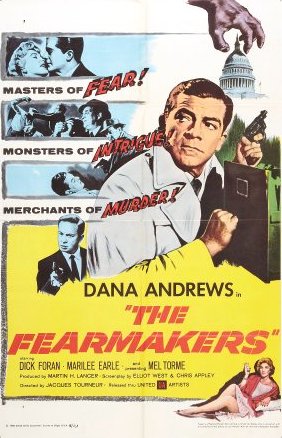
Shattered Politics #13: The Fearmakers (dir by Jacques Tourneur)


The_Fearmakers_film_poster

Did you know that 75% of people are sick of hearing the results of polls about what people think about other polls?  It’s true!

Me, I first got sick of polls back in 2012.  That was when, every day, everyone on twitter would be talking about the result of another political poll.  A poll would come out showing that Obama was ahead of Romney in the presidential election and all of my Republican friends would immediately start tweeting about why the poll could not be taken seriously.  Then 2014 came along and polls started to show that the majority of American citizens did not approve of the job Obama was doing.  And all of my Democrat friends would immediately start tweeting about why those polls could not be trusted.

As for me, I was always more concerned with what the polls said over on Rotten Tomatoes.  Really?I would think.  Only 35% of critics gave California Scheming a good review?  67% of moviegoers want to see the new Transformers film?

Oh my God, I thought, those numbers have to be so fake…

Because, let’s face it.  The only time that we believe a poll is when we agree with it.  Otherwise, we assume that they’re either the result of subtle manipulation, selective interpretation, or just completely and totally untrue.

Believe it or not, this suspicion is not a new phenomena.  I’ve always felt that you can learn a lot about history by watching the movies.  That doesn’t mean that movies are historically accurate.  One need only read my review of Magnificent Doll to see that.  However, movies do reflect the culture and concerns of the time in which they were made.

For instance, The Fearmakers was made in 1958 and it shows that not only has polling been around for a while but so has the fear of being manipulated by a fraudulent poll.

In The Fearmakers, Dana Andrews plays Alan Eaton.  Before the start of the Korean War, Alan owned one of the best and most respected polling firms in Washington D.C.  However, while serving in the army during the war, Alan was captured and held prisoner by the Chinese.  After years of being tortured and perhaps brainwashed, Alan is finally released.

He returns to an America that is far different from the country that he left.  For instance, while on a flight to Washington, D.C., he finds himself sitting next to a shifty scientist (Oliver Blake) who tries to convince Alan to support a group that believes in nuclear disarmament.  Even worse, once the plane lands, Alan discovers that he’s been forced out of his polling firm and that his partner has died under mysterious circumstances.

The firm’s new owner, the outwardly friendly, inwardly cold-hearted Jim McGinnis (Dick Foran), offers to hire Alan as a special consultant.  Alan is at first resistant but then he has a meeting with his old friend, Senator Walder (Roy Gordon).  Walder explains that he suspects that Alan’s old polling firm has been infiltrated by outside forces and that it might be using its polling to try to push communist propaganda on the American people.  Alan agrees to work for Jim and to help track down any and all subversives….

The Fearmakers is better than it sounds.  Beyond the fact that the story remains relevant in our poll-driven times, it was directed by Jacques Tourneur, who directed several atmospheric and intelligent horror films in the 30s and 40s.  He brings a similar atmosphere of doom to The Fearmakers.  Perhaps the film’s best scenes are the ones where Tourneur just focuses his camera on Andrews’s face while Alan struggles to understand the country to which he has returned.  As played by Andrews, Alan is troubled and hardly your typical hero.  You’re never quite sure how much of the film’s danger is real and how much of it is just the result of Alan’s own paranoia.

I first saw The Fearmakers on Netflix.  The next time you’ve got 84 minutes to kill, check it out.

Horror On TV: Twilight Zone 5.19 “Night Call”


In this poignantly haunting episode of the Twilight Zone, Gladys Cooper plays a lonely widow who starts to receive mysterious phone calls from a stranger.

This episode was written by Richard Matheson (and based on his short story Long Distance  Call) and it was directed by Jacques Tourneur.  Tourneur is probably best known for directing moody horror films like Cat People and Curse of the Demon and he brings a similar atmosphere to Night Call.

Night Call originally aired on February 7, 1964.