Late Night Retro Television Review: CHiPs 1.20 “Rainy Day”


Welcome to Late Night Retro Television Reviews, a feature where we review some of our favorite and least favorite shows of the past!  On Mondays, I will be reviewing CHiPs, which ran on NBC from 1977 to 1983.  The entire show is currently streaming on Freevee!

What would CHiPs be like without motorcycles?  We’re about to find out.

Episode 1.20 “Rainy Day”

(Dir by Gordon Hessler, originally aired on March 2nd, 1978)

While riding his motorcycle on the California highway, Baker groans as he feels a drop of water.  He tells Ponch that it’s going to rain and the two of them are going to end up getting stuck in a patrol car.

“It’s only sprinkling!” Ponch replies.

One jump cut later and Ponch and Baker are trapped in the middle of a downpour.  Despite the heavy rain and the fact that they’re getting soaked, they still manage to save a teacher after a car swerves on the slick road and hits her school bus.  (Apparently, in 1978, teachers also had to drive the school buses.)  The teacher is young and attractive so, of course, Ponch tells her that she and her students can drop by the station and see him any time that they want.

As for the rain, it turns out that Baker was right.  After giving them a hard time about their wet uniforms (and not even bothering to acknowledge that those uniforms got wet while Baker and Ponch were saving someone’s life), Getraer assigns them to a patrol car for the day.  It’s a new patrol car so Getraer warns them not to get a scratch on it.  Usually, I can kind of understand why Getraer is a bit weary of Ponch but, in this episode, the guy’s just a jerk about everything.

You can probably already guess what the main problem with this episode is.  The appeal of CHiPs, at least from what I’ve seen so far, is that it features a lot of exciting motorcycle stunts.  Chase scenes involving motorcycles are fun to watch because motorcycles can go extremely fast and they can weave in-and-out of traffic.  The show works best when Ponch and Baker are on their motorcycles.  This episodes put them in a bulky, slow-moving squad car.  Even stuck in the car, Ponch and Baker manage to catch a car thief and they put an end to an illegal gambling casino that’s been hidden inside of an RV.  But it really doesn’t matter because they’re in a squad car.  There’s nothing exciting about a squad car.

And yes, the squad car does get trashed, specifically while Ponch and Baker are chasing a degenerate gambler (Herb Edelman) who was seeking revenge against the RV casino.  Getraer is not happy about the damage to the car, despite the fact that there really wasn’t any way to avoid it and Ponch and Baker managed to prevent a lot of people from getting injured.  Fortunately, Officer Grossman (Paul Linke) accidentally backs into the squad car, leaving it ambiguous as to who is responsible for what damage.  Getraer will just have to get mad at everyone, I guess.

I love the rain so I did appreciate the fact that this episode featured a lot of it.  But otherwise, the whole thing just felt off.  I don’t care how wet it is outside.  Baker and Ponch just do not belong in a car.
Horror Film Review: Empire of the Ants (dir by Bert I. Gordon)


Ants are interesting creatures.  On the one hand, they work hard and they can design and build a complex home in just a matter of hours.  They’re loyal to the other members of their tribe and they all happily do whatever needs to be done to keep their community healthy and moving forward.  They’re family-orientated.  They take care of their children.  They eat earth worms.  They fight other ants.  They can carry several pounds over their own weight.  They like to move in a single-file line.  These are all things that people, in general, admire.  If you had to hire someone to do some yardwork, you would want someone who had the attitude of an ant.

At the same time, ants also have no respect for privacy, they tend to get everywhere, and they bite you and leave behind those ugly red marks that take forever to go away and that can itch like heck.  I was once outside barefoot, helping someone wash his car, when I suddenly felt a really intense pain in my foot.  I looked down and saw that I had stepped straight into an ant hill.  It was not only an ant hill but it was a FIRE ANT HILL!  I grabbed a hose and I washed all of the ants off my foot but it was still one of the most painful experiences of my life.  Ants are hard-working and industrious but they’re also kind of mean and they really don’t like humans.  (Maybe they would like us more if people stopped kicking ant hills and using magnifying glasses to set them on fire.)  Ants will break into your house and then bite you when you tell them to go away.  My point is that you might like ants but ants do not like you and you better remember that!

The 1977 film, Empire of the Ants, is all about humanity’s mixed feelings towards ants.  Joan Collins plays a shady real estate agent who leads a group of potential home buyers into the bayou because she wants to trick them into buying some worthless property on a nearby island.   What Collins and her clients don’t know is that a barrel of radioactive waste was recently dumped off of a nearby boat and when the waste washed on shore, a bunch of ants got into it and it caused them to become giant ants!  The giant ants are industriously creating their own sugar-based society but they’re also attacking and brainwashing humans!

Needless to say, this is a Bert I. Gordon film.  Gordon took his “Mr. Big” nickname quite literally and, as a result, he spent almost his entire career making movies about animals and occasionally humans who were turned into giants by radiation.  Apparently, radiation can do anything!  Empire of the Ants is a typical Gordon film, in that the special effects are just bad enough to be kind of charming.  The ants are either awkwardly super-imposed into the scene or they are clearly made out of plastic.  There’s a scene where an ant grabs a man by his neck and it would be really terrifying if not for the fact that the ant’s head appears to have been made from Styrofoam.  Unfortunately, even though the special effects are bad in an amusing way, Empire of the Ants is still a pretty boring film.  Gordon devotes way too much time to the people heading out to look at Joan Collins’s beachfront property.  No one is watching a film like this for human drama.

This movie is based on a short story by H.G. Wells.  Wells, reportedly, considered it to be the worst thing he had ever written.

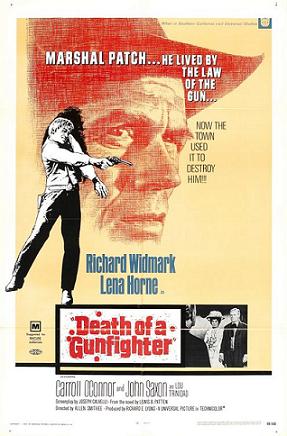
A Movie A Day #244: Death of a Gunfighter (1969, directed by Allen Smithee)


At the turn of the 20th century, the mayor and the business community of Cottonwood Springs, Texas are determined to bring their small town into the modern era.  The Mayor (Larry Gates) has even purchased one of those newfangled automobiles that have been taking the country by storm.  However, the marshal of Cottonwood Spings, Frank Patch (Richard Widmark), is considered to be an embarrassing relic of the past.  Patch has served as marshal for 20 years but now, his old west style of justice is seen as being detrimental to the town’s development.  When Patch shoots a drunk in self-defense, the town leaders use it as an excuse to demand Patch’s resignation.  When Patch refuses to quit and points out that he knows all of the secrets of what everyone did before they became respectable, the business community responds by bringing in their own gunfighters to kill the old marshal.
Death of a Gunfighter is historically significant because it was the very first film to ever be credited to Allen Smithee.  The movie was actually started by TV director Robert Totten and, after Widmark demanded that Totten be fired, completed by the legendary Don Siegel.  Since Totten worked for 25 days on the film while Siegel was only on set for 9, Siegel refused to take credit for the film.  When Widmark protested against Totten receiving credit, the Director’s Guild of America compromised by allowing the film to be credited to the fictitious Allen Smithee.

In the years after the release of Death of a Gunfighter, the Allen (or, more often, Alan) Smithee name would be used for films on which the director felt that he had not been allowed to exercise creative control over the final product.  The Smithee credit became associated with bad films like The O.J. Simpson Story and Let’s Get Harry which makes it ironic that Death of a Gunfighter is not bad at all.  It’s an elegiac and intelligent film about the death of the old west and the coming of the modern era.  It also features not only one of Richard Widmark’s best performances but an interracial love story between the marshal and a brothel madame played by Lena Horne.  The supporting cast is full of familiar western actors, with Royal Dano, Harry Carey, Jr., Larry Gates, Dub Taylor, and Kent Smith all making an impression.  Even the great John Saxon has a small role.  Though it may be best known for its “director,” Death of a Gunfighter is a film that will be enjoyed by any good western fan.

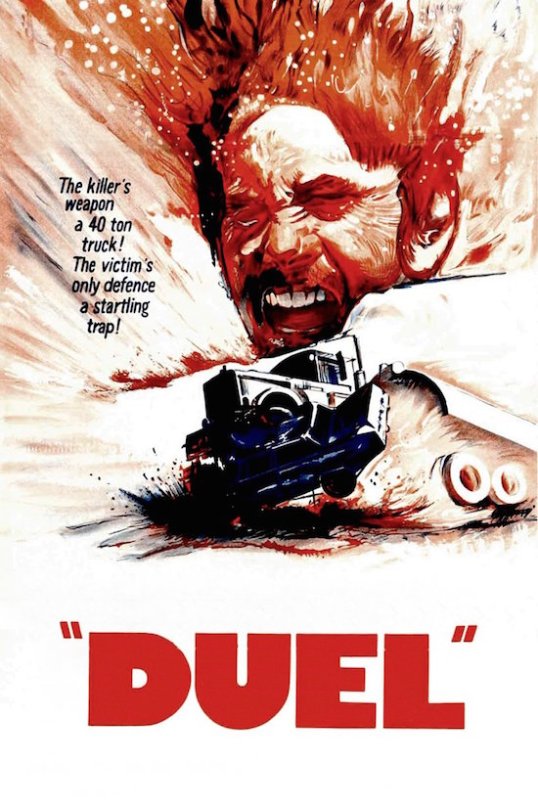
Cleaning Out The DVR Yet Again #24: Duel (dir by Steven Spielberg)


(Lisa recently discovered that she only has about 8 hours of space left on her DVR!  It turns out that she’s been recording movies from July and she just hasn’t gotten around to watching and reviewing them yet.  So, once again, Lisa is cleaning out her DVR!  She is going to try to watch and review 52 movies by the end of Tuesday, December 6th!  Will she make it?  Keep checking the site to find out!)

duel

On November 5th, I recorded the 1971 film Duel off of MeTV!

Duel tells the story of David Mann (played by Dennis Weaver).  The name is probably not a coincidence.  David is an “everyman,” if your idea of an everyman is a workaholic who is incapable of expressing his emotions.  David is driving through the California desert.  When he calls his wife (apparently, he left home in the morning without ever bothering to wake her), he tells her that he’s on a strict schedule and that he might lose an important sale if he’s delayed in any way.  You get the feeling, however, that David’s trip is less about business and more about a desire to get away from his life.  His conversation with his wife is strained and, when we watch him interact with a gas station attendant, we’re struck by how awkward David is.

Indeed, the only time that David seems to be really comfortable and relaxed is when he’s safely inside of his car.  When we first see him, he’s listening to a radio talk show and occasionally commenting on what he’s hearing.  David Mann has a better rapport with an unseen talk show host than he does with his own family.

Later, in the film, David is flagged down by a school bus that has stalled on the side of the road.  The bus driver asks David to give him a push.  For his part, David reacts with visible panic at the sight of several hyperactive children rushing towards his car. When they hop on his hood, David starts to frantically order them off.  It makes sense really.  The car is what he loves.

Of course, it’s not just bratty children that David has to deal with.  There’s also a gigantic truck traveling up and down the highway.  When David gets stuck behind the truck, he honks his horn.  He yells at the unseen driver.  He passes the truck at one point, just to have the truck promptly pass him so that it can continue to block him.  When the driver finally does motion for David to pass him, David changes lanes just to discover another car coming straight at him.

The truck’s driver, it turns out, wants to kill David.  Why does he want to kill David?  We’re never quite sure.  For that matter, we’re never quite sure what the truck is transporting, beyond the fact that it’s apparently flammable.  But the brilliance of Duel is that it doesn’t matter why the truck’s driver is trying to kill David. All that matters is that he’s determined to do so.

And David — the man who can’t even figure out how to have a conversation with his wife — must now try to figure out how to defeat a seemingly unstoppable predator…

Today, Duel is probably best known for being Steven Spielberg’s first film.  (It was a made-for-television production that got a theatrical release in Europe.)  Watching Duel (and Jaws, for that matter) it’s easy to imagine an alternative universe where, instead of becoming America’s best known creator of mainstream entertainment, Spielberg instead became one of America’s best horror director.  Duel is a suspense-filled thrill ride, one that’s scary because it remains rooted in reality.  Seriously, who hasn’t gotten nervous when they’ve found themselves sharing the road with a gigantic truck?

(If anything, I’d argue that Duel is scarier than Jaws.  I mean, I live in Dallas so it’s not like I have to worry about getting attacked by a shark.  On the other hand, I drive my car nearly every day.)

Dennis Weaver plays the archetype of what would become the typical Steven Spielberg protagonist and he does an excellent job in the role.  Weaver is on screen throughout the entire movie.  We see the entire story unfold through his eyes and Weaver gives a harrowing performance as a man who is slowly but steadily pushed to the verge of a breakdown by an enemy that he cannot even begin to comprehend.

If you haven’t seen Duel, you need to.