Film Review: City Heat (dir by Richard Benjamin)


In 1984’s City Heat, Clint Eastwood plays Lt. Speer, a tough and taciturn policeman who carries a big gun, throws a mean punch, and only speaks when he absolutely has to.

Burt Reynolds plays Mike Murphy, a private investigator who has a mustache, a wealthy girlfriend (Madeleine Kahn), and a habit of turning everything into a joke.

Together, they solve crimes!

I’m not being sarcastic here.  The two of them actually do team up to solve a crime, despite having a not quite friendly relationship.  (Speer has never forgiven Murphy for quitting the force and Murphy has never forgiven Speer for being better at everything than Murphy is.)  That said, I would be hard-pressed to give you the exact details of the crime.  City Heat has a plot that can be difficult to follow, not because it’s complicated but because the film itself is so poorly paced and edited that the viewer’s mind tends to wander.  The main impression that I came away with is that Speer and Murphy like to beat people up.  In theory, there’s nothing wrong with that.  Eastwood is legendary tough guy.  Most people who watch an Eastwood film do so because they’re looking forward to him putting the bad guys in their place, whether it’s with a gun, his fists, or a devastating one-liner.  Reynolds also played a lot of tough characters, though they tended to be more verbose than Eastwood’s.

That said, the violence in City Heat really does get repetitive.  There’s only so many times you can watch Clint punching Burt while various extras get gunned down in the background before it starts to feel a little bit boring.  The fact that the film tries to sell itself as a comedy while gleefully mowing down the majority of the supporting cast doesn’t help.  Eastwood snarls like a pro and Reynolds flashes his devil-may-care smile but, meanwhile, Richard Roundtree is getting tossed out a window, Irene Cara is getting hit by a car, and both Kahn and Jane Alexander are being taken hostage.  Tonally, the film is all over the place.  Director Richard Benjamin was a last-minute replacement for Blake Edwards and he directs without any sort of clear vision of just what exactly this film is supposed to be.

On the plus side, City Heat takes place in Kansas City in 1933 and the production design and the majority of the costumes are gorgeous.  (Unfortunately, the film itself is often so underlit that you may have to strain your eyes to really appreciate it.)  And the film also features two fine character actors, Rip Torn and Tony Lo Bianco, are the main villains.  For that matter, Robert Davi shows up as a low-level gangster and he brings an actual sense of menace to his character.  There are some good things about City Heat but overall, the film is just too messy and the script is a bit too glib for its own good.

Burt Reynolds and Clint Eastwood had apparently been friends since the early days of their careers.  This was the only film that they made together.  Interestingly enough, Reynolds gets the majority of the screentime.  Eastwood may be top-billed but his role really is a supporting one.  Unfortunately, Reynolds seems to be kind of bored with the whole thing.  As for Clint, he snarls with the best of them but the film really doesn’t give him much to do.

A disappointing film, City Heat.  Watching a film like this, it’s easy to see why Eastwood ended up directing himself in the majority of his films.

April Noir: Blue Velvet (dir by David Lynch)


First released in 1986 and still regularly watched and imitated, Blue Velvet is one of the most straight forward films that David Lynch ever made.

For all the talk about it being a strange and surreal vision of small town America, the plot of Blue Velvet is not difficult to follow.  After his father has a stroke that leaves him confined to a hospital bed, Jeffrey Beaumont (Kyle MacLachlan) returns home from college.  Lumberton appears to be a quiet and friendly little town, with pretty houses and manicured lawns and friendly people.  Jeffrey, with his dark jacket and his expression of concern, appears a little out-of-step with the rest of the town.  He’s been away, after all.  One day, while walking through a field, Jeffrey discovers a rotting, severed ear.  Jeffrey picks up the ear and takes it Detective Williams (George Dickerson).  Detective Williams, who looks like he could have stepped straight out of an episode of Dragnet, is such a man of the innocent 1950s that his wife is even played by Hope Lange.

“Yes, that’s a human ear, alright,” Williams says, deadpan.

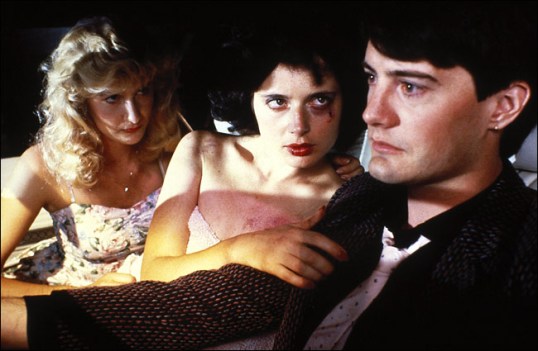
Blue Velvet (1986, dir by David Lynch, DP: Frederick Elmes)

With the help of Detective Williams’s blonde and seemingly innocent daughter, Sandy (Laura Dern), Jeffrey launches his own investigation into why the ear was in the field.  He discovers that Lumberton has a teeming criminal underworld, one that is full of men who are as savage as the ants that we saw, in close-up, fighting over that ear in the field.  Jeffrey discovers that a singer named Dorothy (Isabella Rossellini) is being sexually blackmailed by a madman named Frank Booth (Dennis Hopper).  When Dorothy discovers Jeffrey hiding in her closet (where he had been voyeuristically watching her and Frank), it leads to Jeffrey and Dorothy having a sadomasochistic relationship.  “Hit me!” Dorothy demands and both the viewer and Jeffrey discover that he’s got his own darkness inside of him.  “You’re like me,” Frank hisses at Jeffrey at one point and, if we’re to be honest, it almost feels like too obvious a line for an artist like David Lynch.  Lynch once described the film as being “The Hardy Boys in Hell,” and the plot really is as straightforward as one of those teenage mystery books.

That said, Blue Velvet also features some of Lynch’s most memorable visuals, from the brilliant slow motion opening to the moment that the camera itself seems to descend into the ear, forcing us to consider just how fragile the human body actually is. The film goes from showcasing the green lawns and blue skies to Lumberton to tossing Jeffrey into the shadowy world of Dorothy’s apartment building and suddenly, the entire atmosphere changes and the town becomes very threatening.  We find ourselves wondering if even Detective Williams can be trusted.  That said, my favorite visual in the film is a simple one.  Sandy and Jeffrey walk along a suburban street at night and the camera shows us the dark trees that rise above them, contrasting their eerie stillness to Sandy and Jeffrey’s youthful flirtation.

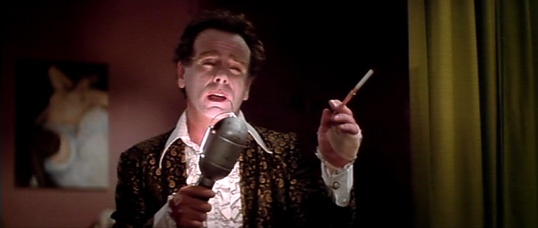
Dean Stockwell in Blue Velvet

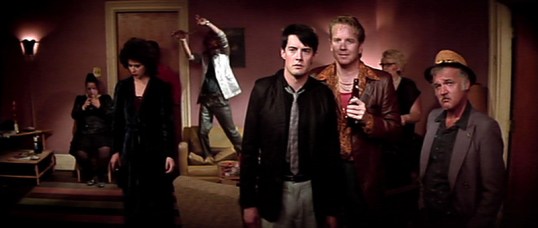
Dean Stockwell shows up as Ben, an associate of Frank’s who lip-synchs to Roy Orbison’s In Dreams while Frank himself seems to have a fit of some sort beside him.  In retrospect, Blue Velvet played a huge role in Dennis Hopper getting stereotyped as an out-of-control villain but that doesn’t make him any less terrifying as Frank Booth.  Hopper, recently sober after decades of drug abuse and self-destructive behavior, summoned up his own demons to play Booth and he turns Frank into a true nightmare creature.  Isabella Rossellini is heart-breaking as the fragile Dorothy.  That said, the heart of the film belongs to Kyle MacLachlan and Laura Dern and both of them do a wonderful job of suggesting not only the darkness lurking in their characters but also their kindness as well.  For all the talk about Lynch as a subversive artist, he was also someone who had a remarkable faith in humanity and that faith is found in both Jeffrey and Sandy.  MacLachlan and Dern manage to sell moments that should have been awkward, like Sandy’s monologue about the returning birds or Jeffrey’s emotional lament questioning why people like Frank have to exist.  Both Jeffrey and Sandy lose their innocence but not their hope for a better world.

Blue Velvet is a straight-forward mystery and a surreal dream but mostly it’s an ultimately hopeful portrait of humanity.  The world is dark and full of secrets, the film says.  But that doesn’t mean that it can’t be a beautiful place.


Blue Velvet (1986, dir by David Lynch, DP: Frederick Elmes)

Film Review: Eraserhead (dir by David Lynch)


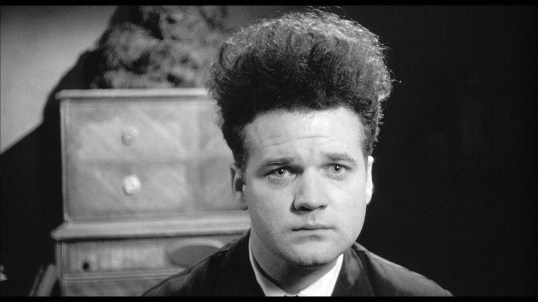
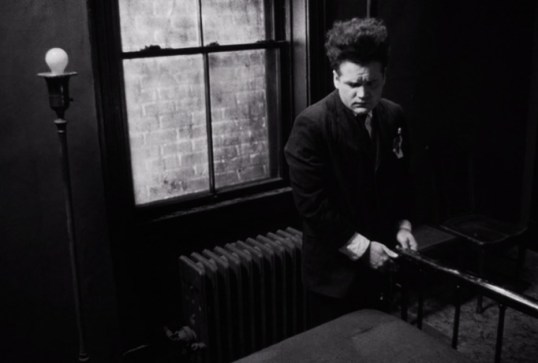
Jack Nance in David Lynch’s Eraserhead

I’ve been thinking about Eraserhead ever since I first heard the news about David Lynch’s passing.

Filmed in harsh but beautiful black-and-white and first released in 1977 (after a production period that lasted for seven years), Eraserhead tells the story of Henry Spencer (Jack Nance), an awkward young man who has the haircut that gives the film it’s name and who wanders through the film like an alienated character in a Kafka story.  He lives in an industrial landscape and almost every scene seems to have the sound of machinery droning away in the background.  He lives in an dark apartment and it appears that there’s a woman living in a radiator who sings that, “In heaven, everything is fine,” while stomping on sperm creatures.  Occasionally, a mysterious woman in the hallway talks to him.  Henry doesn’t seem to have a job or any sort of interests.  He doesn’t really have much of a personality.  Jack Nance, who would go on to become a member of David Lynch’s regular ensemble, has a permanently dazed expression on his face.  It’s hard not to feel sorry for Henry, even if he isn’t quite sympathetic.  In Heaven, everything is fine but in Henry’s world, it’s much different.

Henry has a girlfriend named Mary X (Charlotte Stewart).  Mary lives with her parents in an apartment near the train tracks.  When Henry goes over to her place for dinner, her father shows off how he can’t feel anything in his arm.  Eating a piece of chicken becomes awkward when it appears to be alive and bleeding.  Mary seems to have some sort of seizure.  Mary’s mother informs Henry that Mary has had a mutant baby and Henry must take care of it.  The baby (represented by a grotesque puppet) has no arms or legs or, it would appear, skin.  It cries constantly, despite Henry’s attempts to care for it.  The baby is the only truly sympathetic character in the film.

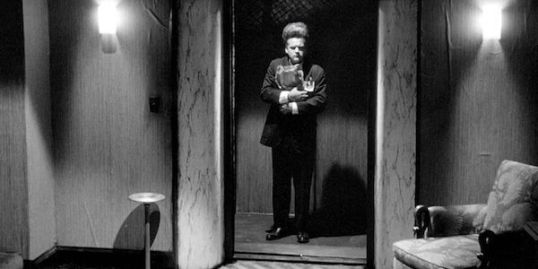
Eraserhead is often described as being a film that’s difficult to understand but, by Lynch standards, it’s not that hard to figure out.  Lynch himself said that the film was fueled by his own anxiety over being a father and, throughout the film, Henry tries to take care of the baby but everything he does just makes things worse.  As is often the case with Lynch’s film, many viewers get caught up in wondering why when they should just be paying attention to what happens.  Why is the baby a mutant?  Because it is.  Why does Henry live in the middle of an industrial park?  Because he does.  Who is the scarred man who appears at the start of the film and who apparently pushes the levers that lead to Mary’s pregnancy?  Again, it’s less important who he is and more important that he’s there and now, Henry is a father despite being woefully unprepared.  Even if the viewer learned the scarred man’s identity (or if Henry even learned of his existence), it wouldn’t change Henry’s situation.  (Technically, of course, the man is Sissy Spacek’s husband and frequent Lynch collaborator, Jack Fisk.)  Eraserhead is a visually surreal film but it’s also an very emotionally honest one.  Henry may be stuck in, as Lynch once put it, a “dream of dark and disturbing things,” but his fears and his anxiety are portrayed realistically  That emotional honesty is something that would appear in all of Lynch’s work and it’s why he was one of our most important filmmakers.

Sadly, David Lynch is now gone.  So is Jack Nance.  But their work will live on forever.

Eraserhead (1977, dir by David Lynch, DP: Frederick Elmes, Herbert Cardwell)

Song of the Day: I Dreamed I Saw Jack Nance Last Night by Dumb Numbers


Eraserhead (1977, dir by David Lynch)

Today would have been the 80th birthday of Jack Nance, the talented but troubled actor who was a favorite of David Lynch’s and who died under mysterious circumstances in 1996.  Born in Massachusetts but raised in Texas, Nance first won acclaim as a star of the stage show, Tom Paine.  The director of Tom Paine later received a fellowship to the American Film Institute where he met a young director named David Lynch and recommended that Lynch cast Nance as the lead character in his film, Eraserhead.  Lynch and Nance were kindred spirits, two all-American eccentrics with their own unique view of the world.  Lynch went to use Nance in almost every film that he made up until Nance’s death.  Nance would also appear in small roles in films from other directors, usually cast as quirky and obsessive characters.  Outside of his role in Eraserhead, Nance is probably best known for playing Pete Martell on Twin Peaks.  Pete’s discovery of Laura Palmer’s body launched the entire saga.

Twin Peaks 1.1 — The Pilot (dir by David Lynch)

Now, sadly, I can’t share any clips from Eraserhead on this site.  I wanted to share the scene where Jack Nance, as Henry, first has dinner with his future in-laws but I couldn’t find any uploads of that scene that were not age-restricted.  So, I’m just going to recommend that you see Eraserhead if you haven’t yet.

In my search for an Eraserhead scene, I did come across this song about Jack Nance and, in honor of Jack’s talent and legacy, I am making it today’s song of the day!

The Demolitionist (1995, directed by Robert Kurtzman)


In the future, America is overrun by crime.  Mad Dog Burne (Richard Grieco) and his brother, Little Henry (Randy Vasquez) escape from California death row.  Mayor Eleanor Grimbaum (Susan Tyrell) wants the Burne brothers captured and she wants to be able to show the voters that she’s tough on crime.  When brave police officer Alyssa Lloyd (Nicole Eggert) is killed by Mad Dog Burne’s gang, she is brought back to life in cyborg form by Prof. Crowley (Bruce Abbott) and, after a training montage, she is let loose on the streets as a police-backed vigiliante.

The Demolitionist owes an obvious debt to Robocop, with Nicole Eggert miscast as an expressionless cyborg who launches a one-woman/one-machine war on crime.  The main problem is that The Demolitionist has none of Robocop‘s wit or its subversive subtext.  Nicole Eggert is no substitute for Peter Weller and Richard Grieco is no Kurtwood Smith.  “Booker’s a good cop!” I said whenever Grieco showed up.

The only interesting this is about the cast, which is full of horror veterans.  Jack Nance plays the prison priest who counsels the Burne brothers before they escape their scheduled executions.  Reggie Bannister plays the warden.  Sarah Douglas plays  a surgeon.  Joseph Pilato is one of Mad Dog’s followers.  And playing Mad Dog’s second-in-command is none other than Tom Savini.  Finally, the city’s most popular journalist is played by Heather Langenkamp!

The Demolitionist demolishes almost the entire town but she still can’t come up with any way to make this stale Robocop rip-off feel fresh.


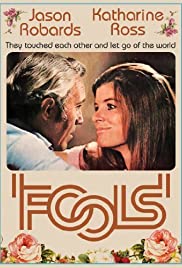
Fools (1970, directed by Tom Gries)


What the Hell, 1970?

In this self-conciously hip and with-it portrait of life in San Francisco at the tail end of the hippie era, Jason Robards plays Matthew South, a veteran B-movie actor who is fed up with everyday life and who is prone to long monologues about how the machines are taking over.  (Just imagine how Matthew would feel about the world today.)  When Matthew gets into an argument with two people in a park, Anais Appleton (Katharine Ross) comes to his rescue and soon, they’re in the middle of a falling in love montage.  Actually, there are several falling in love montages and they’re almost all scored by Kenny Rogers and the First Edition.  It’s easy listening with a hippie tinge.

Fools follows Matthew and Anais as they wander around San Francisco and have several strange encounters, none of which make much sense.  For instance, there’s a scene where two FBI agents suddenly burst into the room and then admit that they’re at the wrong address.  Why is that scene there?  What does it mean?  Later, Matthew and Anais go to a dentist and they listen to a patient try to seduce her psychiatrist (who is played by Mako).  Why is that scene there?  What does any of it mean?  Everywhere that Matthew and Anais go, they see evidence that society is dumb and that the answer to all life’s problems is a love song from Kenny Rogers.  Matthew never stops talking and Anais never stops looking pretty (she’s Katharine Ross after all) but neither ever becomes a strong enough character to ground Fools in any sort of reality.  It’s a movie that preaches nonconformity while so closely imitating A Thousand Clowns and Petulia that the entire thing feels like plagiarism.

Anais has a husband, an emotionally distant lawyer named David (Scott Hylands).  David isn’t prepared to let Anais leave him, no matter how tired she is of their marriage.  He hires a detective to follow Anais around.  It all leads to an act of violence that doesn’t fit the mood of anything that’s happened before.  Cue another falling love montage before the end credits role.

Fools is one of those films that probably would never have been made without the success of Easy Rider.  Everyone wanted a piece of the counterculture in 1970 and Fools tries so hard that it’s painful to watch.  Of course, neither Matthew nor Anais are really hippies.  They do eventually come across some hippies playacting in the street.  One of them is played by future David Lynch mainstay Jack Nance so that’s pretty cool.  Otherwise, Fools deserves to stay in 1970.


Cinemax Friday: Meatballs IV (1992, directed by Bob Logan)


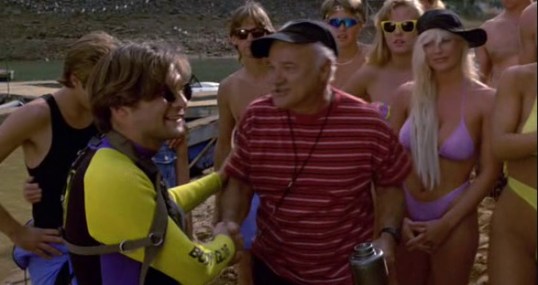
Neil (Jack Nance … yes, Eraserhead Jack Nance) owns a summer camp where he teaches people how to water ski.  Unfortunately, it’s been a while since Neil’s been a success.  The camp is old and run down and Neil is just too good-hearted to enforce any discipline on his campers or his counselors.  The evil Monica Shavetts (Sarah Douglas) owns the water ski camp on the other side of the lake and she is determined to put Neil out of business.  Fortunately, Neil does have one ace up his sleeve.  One of his former campers, Ricky Wade (Corey Feldman), has gone to become one of the top water skiers in the world and he has returned to help Neil save the camp!

Meatballs IV covers all the usual summer camp hijinks.  The fat kid learns how to believe in himself.  The female counselors all appear in topless.  There’s a shower scene, of course, and there’s also a lot of humor centering around flatulence.  When you’re 11 years old, this movie is pretty cool.  Of course, saving the camp means winning a competition against the evil camp.  At least Sarah Douglas appears to be relishing her evil role.  There is one funny joke where Corey Feldman attempts to hit on a girl by telling her, “I was in Goonies.”  I guess even back then, Feldman knew which one of his movies people would actually remember.

Jack Nance is his usual eccentric self in the role of Neil but he doesn’t get to do much.  Sadly, it was while he was in upstate New York making this film that his then-wife, Kelly Van Dyke, committed suicide in Los Angeles.  Reportedly, Nance had been on the phone consoling her and trying to talk her down.  Unfortunately, a lightning storm knocked out the phones in the middle of Nance’s conversation with Kelly and she hung herself immediately afterwards.  For many of us, Jack Nance would be the main reason we would sit through something like Meatballs IV but knowing that story makes it difficult to watch him in this film.  Both Jack Nance and his wife deserved better.

Meatballs IV started out as a movie called Happy Campers, which was intended to be a low-budget rip-off of the original Meatballs.  Then, someone realized that an even better idea than ripping off a successful film would simply be to change your movie’s title and turn it into a sequel.  Meatballs IV tells the same basic story as the original Meatballs, with a bunch of plucky outsiders proving themselves over the summer.  The main difference is that Meatballs IV has a lot more T&A than the original film and that the first film has Bill Murray as a camp counselor while this one has to settle for Corey Feldman.  It’s not that Feldman’s bad in the role, of course.  Despite what happened to his career in the 90s and beyond, Corey Feldman has always been capable of giving good performances, even if he often didn’t.  (I can’t really blame him.  Would you make much of an effort if you were appearing something like Dream A Little Dream 2?)  It’s just that Corey Feldman is no Bill Murray.  When Ricky first shows up at the camp, he energizes the campers by doing an elaborate dance routine, which he ends by shouting, “Elvis has left the building!”  It has the same energy as that episode of The Simpsons where Homer is hired to voice Poochie on Itchy & Scratchy.  It feels desperate, like the film is trying too hard to convince us that Ricky Wade is as cool as everyone says he is.  If you have to work that hard to convince people that you’re cool, then you’re probably not.

Film Review: The Hot Spot (dir by Dennis Hopper)


As befits the title, the 1990 film, The Hot Spot, is all about heat.

There’s the figurative heat that comes from a cast of characters who are obsessed with sex, lies, and murder.  There’s the literal heat that comes from a fire that the film’s “hero” sets in order to distract everyone long enough so that he can get away with robbing a bank.  And, of course, there’s the fact that the film is set in a small Texas town that appears to be the hottest place on Earth.  Every scene in the film appears to be drenched by the sun and, if the characters often seem to take their time from getting from one point to another, that’s because everyone knows better than to rush around when it’s over a hundred degrees in the shade.  As someone who has spent most of her life in Texas, I can tell you that, if nothing else, The Hot Spot captures the feel of what summer is usually like down here.   I’ve often felt that stepping outside during a Texas summer is like stepping into a wall of pure heat.  The Hot Spot takes place on the other side of that wall.

The Hot Spot is a heavily stylized film noir, one in which the the traditional fog and shadows have been replaced by clouds of dust and blinding sunlight.  Harry (Don Johnson) is a drifter who has just rolled into a small Texas town.  Harry’s not too bright but he’s handsome and cocky and who needs to be smart when you’ve got charm?  Harry gets a job selling used cars, though he actually aspires to be a bank robber.  Harry finds himself falling in love with Gloria (Jennifer Connelly), a seemingly innocent accountant who is being blackmailed by the brutish Frank Sutton (William Sadler).  Meanwhile, Harry is also being pursued by his boss’s wife, Dolly (Virginia Madsen), an over-the-top femme fatale who is just as amoral as Harry but who might be a little bit smarter.  Complicating matters is that, while Harry’s trying to rob a bank, he also ends up saving a man’s life.  Only Dolly knows that Harry isn’t the hero that the rest of the town thinks he is.  She tells him that she’ll keep his secret if he does her just one little favor….

The Hot Spot was directed by Dennis Hopper (yes, that Dennis Hopper) and, from the start, it quickly becomes apparent that he’s not really that interested in the film’s story.  Instead, he’s more interested in exploring the increasingly surreal world in which Harry has found himself.  The Hot Spot plays out at a languid pace, which allows Hopper to focus on his cast of small-town eccentrics.  (My particular favorite was Jack Nance as the alcoholic bank president who also doubles as the town’s volunteer fire marshal.)  The film is so hyper stylized that it’s hard not to suspect that every character — with the possible exception of Harry — understands that they’re only characters in a film noir.  For instance, is Dolly really the over-the-top femme fatale that she presents herself as being or is she just a frustrated housewife playing a role?  Is Gloria really an innocent caught up in a blackmail scheme or is she just smart enough to realize that the rules of noir requires her to appear to be Dolly’s opposite?  And is Harry being manipulated or is he allowing himself to be manipulated because, deep down, he understands that’s his destiny as a handsome but dumb drifter in a small town?  Do any of the characters really have any control over their choices and their actions or has everyone’s fate been predetermined by virtue of them being characters in a film noir?  In the end, The Hot Spot is more than just a traditional noir.  It’s also a study of why the genre has endured.

It’s a long and, at times, slow movie, one that plays out at its own peculiar pace.  As a result, some people will be bored out of their mind.  But if you can tap into the film surreal worldview and adjust to the languid style, The Hot Spot is a frequently entertaining and, at times, rather sardonic slice of Texas noir.

Corey Feldman Goes To College: Voodoo (1995, directed by Rene Eram)


Andy Chadway (Corey Feldman) is an aspiring writer who is attending college in the UK.  When he meets Rebecca (Diane Nadeau), he is so smitten with her that he transfers to a school back in the States so that he can be near her.  Of course, Andy doesn’t bother to tell her ahead of time so, when he arrives at his new school, he’s shocked to discover that Rebecca doesn’t seem to be happy to see him and that, since she lives in a sorority house, he can’t stay with her.

Desperately needing a place to live, Andy checks out the local fraternities but he discovers that there’s only one frat that is willing to take him.  It’s the worst frat on campus, a collection of weirdos led by Cassian Marsh (Joel J. Edwards).  Andy joins anyway but soon discovers that the frat is actually a voodoo cult that is more interested in human sacrifice than raging keggers.

Corey Feldman made a huge number of strange movies in the 90s.  They were all released straight-to-video and almost all of them featured Feldman trying to get away from his teen idol image.  In Voodoo, Feldman battles zombies and voodoo priests and Corey Haim is nowhere to be seen.  Feldman is actually not bad in Voodoo.  He’s always been a better actor than he’s given credit for but he also brings so much personal baggage to every role that it’s impossible to see him as being anyone other than Corey Feldman.  That is definitely the case with Voodoo.

The premise of Voodoo is an interesting one and it had a lot of potential.  The film deserves credit for taking its plot seriously and there is one good sequence where Marsh uses mind control to destroy a rival fraternity.  However, Voodoo has too many scenes that seem like filler and it never fully explores its premise.

Keep an eye out, however, for Jack Nance.  One of the original members of David Lynch’s stock company, Nance played the title role in Eraserhead and also played Pete Martell on Twin Peaks.  Nance plays the father of a former member of the fraternity and he’s the one who warns Andy to be weary of Marsh.  Nance and Feldman previously co-starred in Meatballs 4 and Nance’s eccentric presence livens up their scenes in Voodoo.  This was one of Nance’s final roles before his untimely death in 1996.

4 Shots From 4 Films: Special Jack Nance Edition (Eraserhead, Twin Peaks — The Pilot, Whore, Meatballs 4)


In honor of the late, great Jack Nance’s birthday, here are…

4 Shots From 4 Films

Eraserhead (1977, directed by David Lynch)

Twin Peaks 1.1 “The Pilot” (1990, directed by David Lynch)

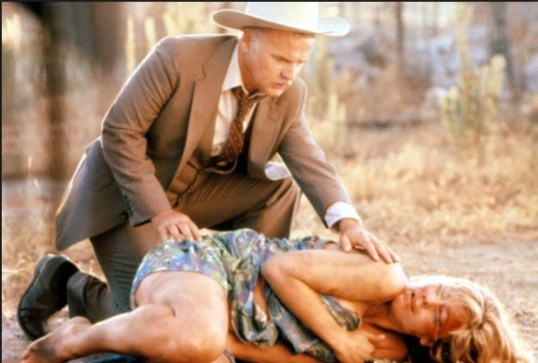
Whore (1991, directed by Ken Russell)

Meatballs 4 (1992, directed by Bob Logan)