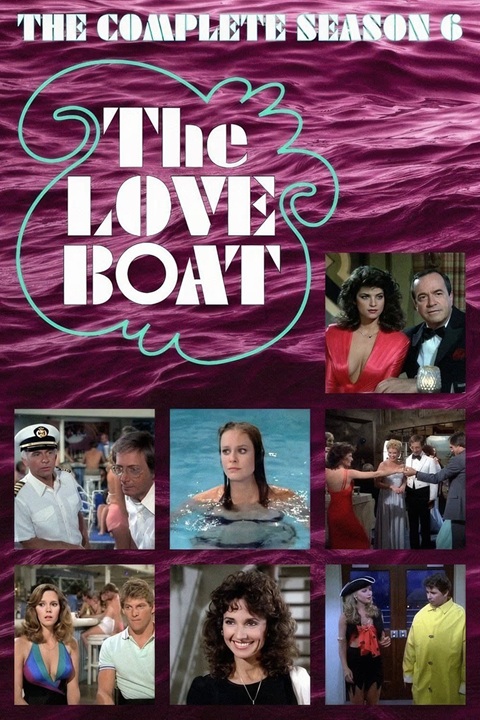
Retro Television Review: The Love Boat 6.4 “The Same Wavelength/Winning Isn’t Everything/A Honeymoon for Horace”


Welcome to Retro Television Reviews, a feature where we review some of our favorite and least favorite shows of the past!  On Wednesdays, I will be reviewing the original Love Boat, which aired on ABC from 1977 to 1986!  The series can be streamed on Paramount Plus!
Come aboard, we’re expecting you….

Episode 6.4 “The Same Wavelength/Winning Isn’t Everything/A Honeymoon for Horace”

(Dir by Robert Scheerer, originally aired on October 23rd, 1982)

Yeesh!  This episode!  Because I’m on vacation, I’m going to lay out the facts quickly and simply.

  • Julie’s hair still looks awful.  Seriously, she looks like she should be playing the demanding gymnastics coach in a Peter Engel-produced high school sitcom.
  • Horace (Jack Gilford) and Twinkie (Nancy Walker) board the boat.  They’re in their 80s and they’re newlyweds!  Awwwww!  Horace is nervous about his honeymoon because it’s been forever since he’s kissed a woman so he asks Julie if he can practice on her.  Julie, her eyes oddly glazed over, agrees.
  • Twinkie, who loves to party, tells Julie that she’s actually been married to Horace for 30 years and he just said that he was a newlywed to trick Julie into kissing him.
  • Later, when confronted by Doc and Julie, Horace and Twinkie confess that they’re not actually married.  However, they are brother and sister.  WHAT!?
  • Turns out that Twinkie “likes to party” and Horace “likes to kiss pretty girls” so they lied so that they could do both.
  • Horace, you’re going to jail!  Oh wait, no, he’s not.  The Love Boat crew has a good laugh over it and Julie, to be honest, seemed to be pretty coked up in this episode so perhaps she had a good reason for wanting to avoid dealing with the cops.  Okay, Julie, do what you have to do, I guess.
  • Meanwhile, psychic Tess Macgill (Connie Stevens) falls in love with passenger Mike Gordon (Charles Seibert).  Unfortunately, Mike is still in love with his wife, despite the fact that they’re now separated.  It’s a good thing that there’s a psychic on board to let Mike know that his marriage is over.
  • Finally, Jack Bronson (David Doyle) boards the boat with his teenage son, Chip (Matthew Labyorteaux).  Jack is an old friend of Captain Stubing’s and he’s convinced that winning is everything!  As for Stubing, he’s just happy that Vicki will finally have someone her own age to spend some time with.  I’m happy too.  Seriously, Vicki hardly ever gets to talk to anyone under the age of 50.
  • Jack is convinced that Chip is a world-class athlete but that’s just because Chip has been lying to his father.
  • Vicki is great a table tennis.  Jack pressures Chip to play her.  Chip fakes a wrist injury to get out of it.
  • Eventually, Chip tells his father the truth and Jack realizes that he’s been pushing his son way too much.  That’s not a bad lesson but David Doyle is miscast as a competition-obsessed father.  He comes across as being too nice.  Jack is a role for Bo Svenson.

This episode …. bleh.  The psychic story was bland and the story with the elderly siblings was creepy.  The Jack and Chip story was, at least, tolerable.  Julie’s terrible new haircut continues to annoy me.  This was not the best cruise in the history of The Love Boat.
Film Review: Save The Tiger (dir by John G. Avildsen)


1973’s Save The Tiger tells the story of Harry Stoner (Jack Lemmon).

When Harry was a young man, he loved baseball and he felt like he could conquer the world.  He saw combat in World War II and spent the final part of the war on the Island of Capri, recuperating after being wounded in battle.  Harry went on to partner up with Phil Greene (Jack Gilford) and they started a clothing company in Los Angeles, Capri Casuals.

Now, Harry is a middle-aged man who is still haunted by nightmares about the war.  He’s married.  He has a daughter attending school in Switzerland.  He’s respected in the industry.  He lives in a nice house in Beverly Hills.  And he’s totally miserable.  He wakes up every day and wonders what is happening to the country.  He talks about witnessing a wild pitch at a baseball game, missing the days when something like that could seem like the most important thing in his life.  He spends all of his time at work, cheating to balance the books and keeping clients happy by setting them up with a sophisticated prostitute named Margo (played, with a weary cynicism, by Lara Parker).

Save The Tiger covers just a few days in the life of Harry Stoner, as he searches for some sort of meaning in his life.  He gives a ride to a free-spirited hippie (Laurie Heineman) who offers to have sex with him.  (Harry replies that he’s late for work.)  He accepts an award at an industry dinner and, as he tries to give his acceptance speech, he is haunted by the sight of dead soldiers sitting in the audience.  With Phil, he debates whether or not to balance the books by setting fire to one of their warehouses in order to collect the insurance.  Harry sees a poster imploring him to “Save the Tigers.”  Who can save Harry as he finds himself increasingly overwhelmed by the realities of his life?

As I watched Save the Tiger, I found myself thinking about two other films of the era that featured a middle-aged man dealing with a midlife crisis while searching for meaning in the counterculture.  In Petulia and Breezy, George C. Scott and William Holden each found meaning in a relationship with a younger woman.  And while Petulia and Breezy are both good films, Save The Tiger is far more realistic in its portrayal of Harry’s ennui.  There is no easy solution for Harry.  Even if he accepted the hippie’s offer to “ball” or if he acted on the obvious attraction between himself and Margo, one gets the feeling that Harry would still feel lost.  Harry’s problem isn’t that he’s merely bored with his life.  Harry’s problem is that he yearns for a past that can never be recaptured and which may only exist in his imagination.  If George C. Scott and William Holden were two actors who excelled at playing characters who refused to yield to the world’s demands, Jack Lemmon was an actor who played characters who often seemed to be desperate in their search for happiness.  Save The Tiger features Lemmon at his most desperate, playing a character who has yielded so often and compromised so much that he now has nowhere left to go.

It’s not exactly a cheerful film but it is one that sticks with you.  Jack Lemmon won his second Oscar for his performance as Harry and he certainly deserved it.  Lemmon does a wonderful job generating some sympathy for a character who is not always particularly likable.  Many of Harry’s problems are due to his own bad decisions.  No one forced him to use “ballet with the books” to keep his business open and no one is forcing him to hire arsonist Charlie Robbins (Thayer David, giving a performance that is both witty and sinister at the same time) to burn down not only his warehouse but also an adjoining business that belongs to an acquaintance.  Harry could admit the truth and shut down his business but then how would he afford the home in Beverly Hills and all the other symbols of his success?  Harry yearns for a time when he was young and his decisions didn’t have consequences but that time has passed.

This isn’t exactly the type of film that many would expect from the director of Rocky but director John G. Avildsen does a good job of putting the viewer into Harry’s seedy world.  I especially liked Avilden’s handling of the scene where Harry hallucinates a platoon of wounded soldiers listening to his awards speech.  Instead of lingering on the soldiers, Avildsen instead uses a series of a quick cuts that initially leave the audience as confused as Harry as to what Harry is seeing.  Both Rocky and Save The Tiger are about a man who refuses to give up.  The difference is that perhaps Harry Stoner should.

“You can’t play with us, mister!” a kid yells at Harry when he attempts to recreate the wild pitch that so impressed him as a youth.  In the end, Harry is a man trapped by his memories of the past and his dissatisfaction with the present.  He’s made his decisions and he’ll have to live with the consequences but one is left with the knowledge that, no matter what happens, Harry will be never find the happiness or the satisfaction that he desires.  The tigers can be saved but Harry might be a lost cause.

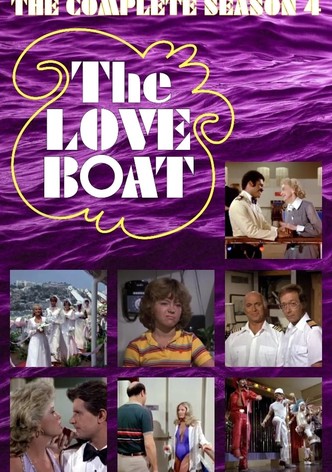
Retro Television Review: The Love Boat 4.24 “That Old Gang of Mine/Love with a Skinny Stranger/Vicki and the Gambler”


Welcome to Retro Television Reviews, a feature where we review some of our favorite and least favorite shows of the past!  On Wednesdays, I will be reviewing the original Love Boat, which aired on ABC from 1977 to 1986!  The series can be streamed on Paramount Plus!

This week, Vicki learns how to gamble.

Episode 4.24 “That Old Gang of Mine/Love with a Skinny Stranger/Vicki and the Gambler”

(Dir by Richard Kinon, originally aired on April 11th, 1981)

It’s an anniversary cruise!

Captain Stubing and Vicki are celebrating the anniversary of Vicki coming to live on the boat with her father.  Captain Stubing has already picked out the gift that he’s going to give Vicki, a beautiful and valuable pearl necklace.  As for Vicki, there’s a watch in the boat’s gift shop that she would love to give her father but she can’t afford it.  Then again, Vicki is the Captain’s daughter.  Can’t she just take whatever she wants?  I mean, who is going to snitch on the Captain’s daughter?  Add to that, it was only two weeks ago that the manager of the gift shop was juggling three lovers on one cuise.  Who is she to judge anything Vicki might do?

Admirably, Vicki is an honest person and does not want to just steal something for her father.  But when her father’s old friend, Wade Hubbard (Gene Barry), boards the ship, he shows Vicki that she can easily make enough money to buy the watch by betting on a horse race!  Wade, it turns out, is a compulsive gambler and Vicki soon falls under his influence.  Captain Stubing is not happy about that so Wade pretends to lose all of his money (and Vicki’s necklace!) in order to trick Vicki into not only hating him but also hating gambling.

You know, Wade and Captain Stubing could have just told Vicki not to gamble anymore.  Vicki seems like she’s pretty smart and level-headed so I’m sure she would have listened if Wade and the Captain had just told her that they didn’t want her placing bets as a minor.  Instead, Wade created an elaborate lie and basically traumatized Vicki for life.  That seems a bit extreme to me but, then again, I don’t have a gambling problem.

As for the other passengers, Patty Beller (Vicki Lawrence) is stunned when she discovers that her long-distance boyfriend, Phil Manning (Charles Siebert), has spent the last month at a fat farm and is now totally athletic and handsome.  Patty always took it for granted that Phil would only have eyes for her but suddenly, every other woman on the cruise appears to be trying to get his attention.  This story would have perhaps worked better if Patty hadn’t come across as being so self-centered.  Phil explains that he lost the weight because he was worried about his health and tired of people making fun of him.  To me, it seems like Phil should be applauded for his self-discipline and his desire to make a better life for himself.  Instead, Patty gets upset that Phil is taking care of himself.  Seriously, Phil — you can do better!

Finally, three old-time crooks (Jack Gilford, Jesse White, and Kaye Ballard) board the cruise and make plans to rob the safe.  That shouldn’t be too hard since Gopher is the person in charge of watching the safe.  However, the crooks are all elderly and out-of-touch with life in the swinging 80s.  The safecracker has gone deaf and needs someone else to listen as he turns the dial.  It’s all a bit silly but it was kind of a sweet story, largely due to the performances of Gilford, White, and Ballard.

The safecracker’s story aside, this episode of The Love Boat was a bit of a sour ride.  Between Wade lying to Vicki and Patty wishing that her boyfriend was at risk for heart disease, this just wasn’t a very likable cruise.  Hopefully, next week will be a bit more fashionable.  Considering that the upcoming episode guest stars Glorida Vanderbilt, Bob Mackie, and Halston, I imagine it will be.

Cleaning out the DVR: Anna to the Infinite Power (dir by Robert Wiemer)


Curious film, this one.

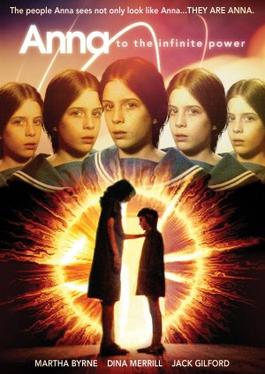
In this 1983 film (which was based on a book), Anna Hart (played by Martha Byrne, a child actress who later grew up to star on a few soap operas) is a 12 year-old musical prodigy who has a hard time fitting in with normal children. She suffers from frequent headaches, especially whenever she’s near an open flame. She loses her temper quickly. She has disturbing nightmares about World War II, an event that occurred long before she was even born. Perhaps most alarmingly, she’s a compulsive shoplifter.  (Admittedly, when I was in high school, it was rare that I paid for all of the makeup that I slipped into my purse whenever I skipped school at Target.  But, then again, I was kind of a brat….) When a music teacher named Michaela DuPont (Donna Mitchell) moves in next door, she takes a curiously intense interest in Anna. She starts to give Anna lessons

Anna just happens to see a story on the news about another 12 year-old musical prodigy. She’s named Anna Smithson and, like Anna Hart, she’s the daughter of a musician and a scientist. Anna Smithson also just happens to look just like Anna Hart!

Can we say cloning?

It turns out that Anna Hart is one of five Annas, a part of an experiment to clone Anna Zimmerman. Anna Zimmerman was a musical prodigy who spent her childhood in a Nazi concentration camp and who died in a mysterious fire 20 years earlier. All five of the Annas are being raised by similar families and under similar circumstances, all in an attempt to bring Anna Zimmerman back to life. Shocked by the news, Anna struggles to figure out who she is — is she Anna Hart or is destined to grow up to be Anna Zimmerman? And, if she decides that she wants to live her own life, will she allowed to do so? How far will the scientist who cloned Anna go to protect their secrets?  And why was Anna cloned to begin with?

Anna To The Infinite Power is an odd little film. It has got more than enough conspiracies and traumatic flashbacks to qualify as a hybrid of the horror and science fiction genres but it’s also a rather unconventional coming-of-age story. Anna has to decide whether or not she’s okay with the idea of her entire life having been plotted out for her. Can Anna escape destiny?  Even if she can escape it, should she do it? It is an intriguing question and the film’s intelligent script quickly grabs your interest.

Unfortunately, the film’s direction is not as strong as the script. Visually, Anna to the Infinite Power has a bland and rather flat look. It would be easy to mistake it for a special, extended episode of an 80s television show.  (In fact, I assumed that the movie was a pilot until I looked it up on the imdb.) Still, Martha Byrne is sympathetic as the multiple Annas while character actor Jack Gilford does a good job as the scientist responsible for the experiment. It’s an intriguing film and one to keep an eye out for.

Comedy Tonight: A FUNNY THING HAPPENED ON THE WAY TO THE FORUM (United Artists 1966)


gary loggins's avatarcracked rear viewer

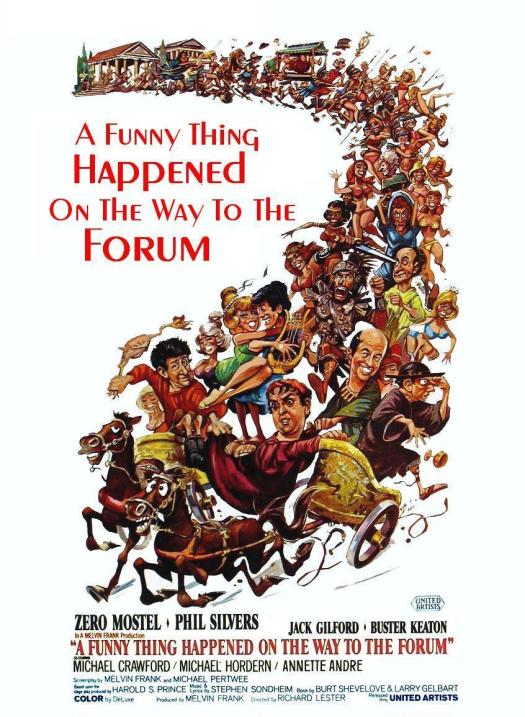
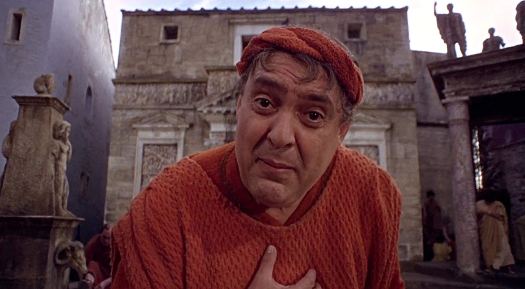
Director Richard Lester made the jump from The Beatles to Broadway in filming A FUNNY THING HAPPENED ON THE WAY TO THE FORUM, but it wasn’t that far a leap. In adapting the Tony-winning musical comedy to the screen, Lester energizes the film with his unmistakably 60’s cinematic style, resulting in one of the decade’s best comedies, aided and abetted by a cast of pros including Zero Mostel , Phil Silvers, Jack Gilford, and the great Buster Keaton in his final film performance.

The credits roll to the tune of Stephen Sondheim’s “Comedy Tonight”, which may be my favorite song from any musical, as Zero introduces us to the main players. He’s Psuedolus, a slave owned by young Hero (Michael Crawford), son of unhappily married Senex (Michael Hordern) and his shrewish (not Jewish) wife Domina (Patricia Jessel, who’s a riot!). Hero has fallen in love with Philia (Annette Andre), the…

View original post 586 more words

Embracing The Melodrama #22: The Incident (dir by Larry Peerce)


The Incident

The 1967 film The Incident could just as easily have been called Train of Fools.  Much like Ship of Fools, it’s an ensemble piece in which a group of people — all of whom represent different aspect of modern society — find themselves trapped in their chosen mode of transportation and forced to deal with intrusions from the outside world.

That intrusion comes in the form of two sociopaths who have decided to spend the entire ride tormenting their fellow passengers.  The more dominant of the two is Joe (played by Tony Musante, who would later star in Dario Argento’s Bird With The Crystal Plumage), who the film hints might also be a pedophile.  His partner is Artie (Martin Sheen), who is less intelligent than Joe but just as viscous.  (And yes,even though he does a good job in the role,  it is odd to see an intelligent and reportedly very nice actor like Martin Sheen playing a character who is both so evil and so stupid.)

Among the passengers:

Bill (Ed McMahon) and Helen (Diana Van Der Vills) are only on the train because Bill refused to pay the extra money to take a taxi back home. Now, they’re stuck on the train with their young daughter who, in one of the film’s more disturbing scenes, Joe starts to show an interest in.

Teenage Alice (Donna Mills) is on a date with the far more sexually experienced Tony (Victor Arnold).  When Joe and Artie start to harass her, her date proves himself to be pretty much useless.

Douglas McCann (Gary Merrill) is a recovering alcoholic who, before Artie and Joe got on the train, was spending most of his time scornfully watching Kenneth (Robert Otis), a gay man who previously attempted to pick Doug up at the train station and who will eventually fall victim to one of Artie’s crueler jokes.

Muriel Purvis (Jan Sterling) resents her meek husband, Harry (Mike Kellin) and see the entire incident as another excuse to cast doubts upon his manhood.

Sam and Bertha Beckerman (played by Jack Gilford and Thelma Ritter) are an elderly Jewish couple who, over the course of a lifetime, have already had to deal with far too many bullies.  Sam’s attempt to stand up to Joe and Artie results in both he and his wife being trapped on the train.

Arnold (Brock Peters) and Joan (Ruby Dee) are the only black people on the train.  Arnold, at first, enjoys watching the white people fight among each other and even turns down a chance to get off the train because he finds it to be so entertaining.  But finally, Joe turns on him as well.

And then there’s the two soldiers, streetwise Phil (Robert Bannard) and his best friend, Felix (Beau Bridges).  Felix speaks with a soft Southern accent and has a broken arm.

And finally, there’s the bum.  When we first see the bum (Henry Proach) he is asleep.  He doesn’t even wake up when Joe and Artie attempt to set him on fire.

One-by-one, Joe and Artie attack and humiliate every single person on the train.  The other passengers, for the most part, remain passive.  Even when some try to stand up to Joe and Artie, their fellow passengers don’t offer to help.  It’s only when one last passenger finally stands up to the two that the rest of them show any reaction at all and even then, it’s not necessarily the reaction that anyone was hoping for.

The Incident, which shows up on TCM occasionally, is a heavy-handed but effective look at what happens when good people choose to do nothing in the face of evil.  Joe and Artie can be viewed as stand-ins for any number of distasteful groups or ideologies and both Tony Musante and Martin Sheen are believable as dangerous (if occasionally moronic) petty criminals.  For that matter, the entire film is well-acted with the entire cast managing to bring life to characters that, in lesser hands, could have come across as being one-dimensional.  The entire film basically takes place in that one subway car but fortunately, the harsh black-and-white cinematography and the continually roaming camera all come together to keep things visually interesting.

The Incident may not be a great film (it’s occasionally bit too stagey and, after watching the first 30 minutes, you’ll be able to guess how the movie is going to end) but it’s still one to keep an eye out for.

Martin Sheen in The Incident