I review THE EIGER SANCTION (1975) – starring Clint Eastwood and George Kennedy!


Here at The Shattered Lens, we’re definitely celebrating Clint Eastwood’s May 31st  birthday. As part of that celebration, I decided to revisit his 1975 film, THE EIGER SANCTION. 

Clint Eastwood is art professor Jonathan Hemlock, a retired assassin, who agrees to take one last “sanction” from a shadowy agency to avenge his friend’s death. A skilled mountain climber, Hemlock learns that the killer is part of a group of men who are attempting to climb the treacherous Eiger mountain in Switzerland. The Eiger has defeated Hemlock two times already, but he’s hoping the third time will be the charm. He goes to see his friend Ben (George Kennedy) in Arizona, who gets him in the shape he needs to be in to climb the Eiger. The time finally comes to go to Switzerland, climb the mountain, identify the man who killed his friend, and take him out. None of it goes easy, and Hemlock can only hope he will live long enough to avenge his friend! 

THE EIGER SANCTION finds Clint Eastwood in James Bond territory. The “agency” is run by the over-the-top albino villain “Dragon,” who can never see any daylight, but seems to enjoy the sanctioning of death. He sends a beautiful woman named Jemima Brown (Vonetta McGee) to steal Hemlock’s money and put him in no position to turn down the agency’s request. Luckily for Hemlock, in true Bond fashion, the beautiful “Aunt” Jemima decides to bed him as part of her assignment. I must admit that I found myself quite enraptured by the beautiful Vonetta McGee. This is some pretty good stuff, but I prefer my 70’s Bond action to come from Sean Connery or Roger Moore. Eastwood is always great (the man had the best head of hair in the business), but I enjoy his movies more when they’re set in the real world of cops and criminals. It’s still a fun movie, and I especially like Hemlock’s relationship with Kennedy. There are some amazing shots of Eastwood and Kennedy in Arizona’s Monument Valley as they prepare for the Eiger and drink some warm beer together on the Totem Pole rock formation! The shots of the men climbing the Eiger are also amazing, but we don’t really know the characters so the drama isn’t strong during this portion of the film. The visuals are absolutely amazing though. The final reveal of the man that Hemlock is after isn’t very surprising. Any person who has seen more than a couple of “mystery” films will figure it out quite easily. 

At the end of the day, I enjoyed THE EIGER SANCTION. Eastwood is always worth watching and this film contains several moments of his unique toughness and dry sense of humor. It’s just not as engaging as his very best work. Eastwood is tying to do something a little different, and while I commend him for that, it’s not quite as good as his other work during this time. I’d still give a solid 7 out of 10. The trailer is included below:
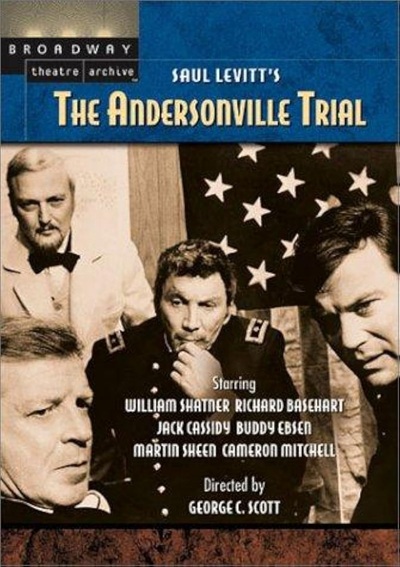
On Stage On The Lens: The Andersonville Trial (dir by George C. Soctt)


1970’s The Andersonville Trial takes place in one muggy military court room.  The year is 1865.  The Civil War is over but the wounds of the conflict are still fresh.  Many of the leaders of the Confederacy are still fugitives.  Abraham Lincoln has been dead for only a month.  The people want someone to pay and it appears that person might be Captain Henry Wirz (Richard Basehart).

Originally born in Switzerland and forced to flee Europe after being convicted of embezzlement, Henry Wirz eventually ended up in Kentucky.  He served in the Confederate Army and was eventually named the commandant of Camp Sumter, a prison camp located near Andersonville, Georgia.  After the war, Captain Wirz is indicted for war crimes connected to his treatment of the Union prisoners at the camp.  Wirz and his defense counsel, Otis Baker (Jack Cassidy), argue that the prison soon became overcrowded due to the war and that Wirz treated the prisoners as well as he could considering that he had limited resoruces.  Wirz points out that his requests for much-needed supplies were denied by his superiors.   Prosecutor Norton Chipman (William Shatner) argues that Wirz purposefully neglected the prisoners and their needs and that Wirz is personally responsible for every death that occurred under his watch.  The trial is overseen by Maj. General Lew Wallace (Cameron Mitchell), the same Lew Wallace who would later write Ben-Hur and who reportedly offered a pardon to Billy the Kid shortly before the latter’s death.  Wallace attempts to give Wirz a fair trial, even allowing Wirz to spend the trial reclining on a couch due to a case of gangrene.  (Agck!  The 19th century was a scary time!)

The Andersonville Trial started life as a 1959 Broadway production.  On stage, George C. Scott played Chipman, an experience he described as difficult because, even though Chipman was nominally the play’s hero, Wirz was actually a much more sympathetic character.  When the play was adapted for television in 1970, Scott returned to direct.  Admittedly, the television version is very stagey.  Scott doesn’t make much effort to open up the play.  Almost all of the action is confined to that courtroom.  We learn about the conditions at Fort Sumter in the same way that the judges learned about the conditions.  We listen as the witnesses testify.  We listen as a doctor played by Buddy Ebsen talks about the deplorable conditions at Fort Sumter.  We also listen as a soldier played by Martin Sheen reports that Wirz has previously attempted to suicide and we’re left to wonder if it was due to guilt or fear of the public execution that would follow a guilty verdict.  We watch as Chipman and Baker throw themselves into the trial, two attorneys who both believe that they are correct.  And we watch as Wirz finally testifies and the play hits its unexpected emotional high point.

As most filmed plays do, The Andersonville Trial demands a bit of patience on the part of the viewer.  It’s important to actually focus on not only what people are saying but also how they’re saying it.  Fortunately, Scott gets wonderful performances from his ensemble cast.  Even William Shatner’s overdramatic tendencies are put to good use.  Chipman is outraged but the play asks if Chipman is angry with the right person.  With many of the Confederacy’s leaders in Canada and Europe, Wirz finds himself standing in for all of them and facing a nation that wants vengeance for the death of their president.  Wirz claims and his defense attorney argues that Wirz was ultimately just a soldier who followed orders, which is what soldiers are continually told to do.  The Andersonville Trial considers when military discipline must be set aside to do what is morally right.

Admittedly, when it comes to The Andersonville Trial, it helps to not only like courtroom dramas but to also be a bit of a history nerd as well.  Fortunately, both of those are true of me.  I found The Andersonville Trial to be a fascinating story and a worthy production.

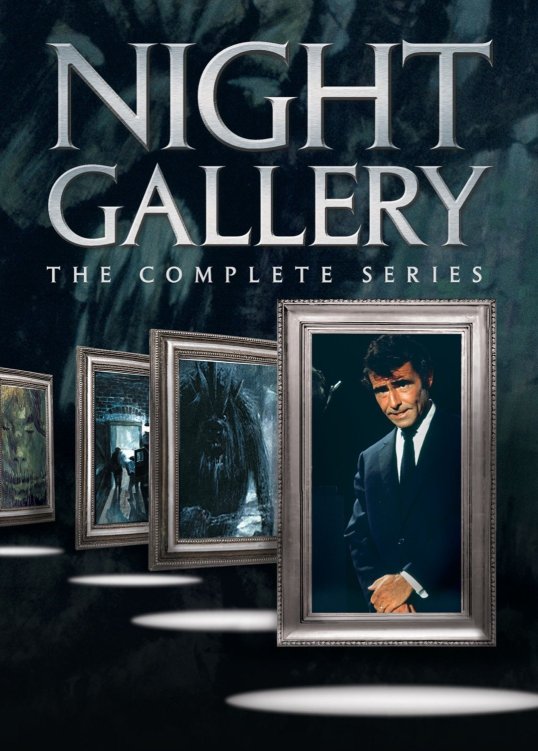
TV Review: Night Gallery 1.6 “They’re Tearing Down Tim Riley’s Bar/The Last Laurel)


The first season of Night Gallery came to a conclusion on January 20th, 1971.  Though the first season was undoubtedly uneven, it did end on a high point.  The first segment in the 6th episode, They’re Tearing Down Tim Riley’s Bar, is widely considered to be the best episode of Night Gallery and one of Rod Serling’s best teleplays.  It also brought Night Gallery one of it’s few Emmy nominations when it was nominated for Outstanding Single Program of the year.  (It lost to The Andersonville Trial, a theatrical adaptation that was produced for PBS.)

They’re Tearing Down Tim Riley’s Bar (dir by Don Taylor, written by Rod Serling)

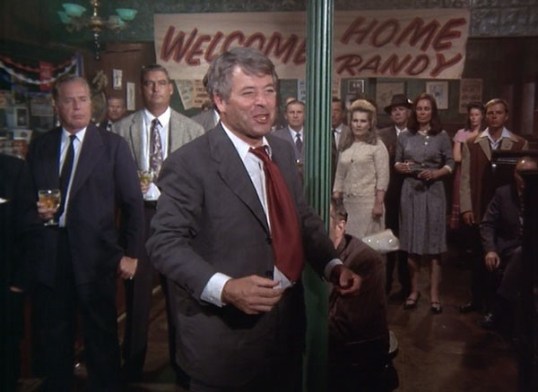
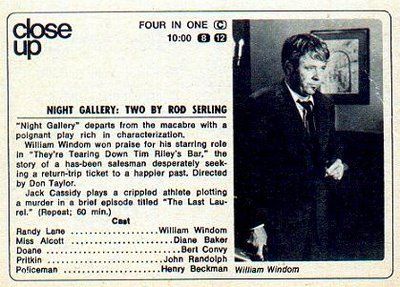
They’re Tearing Down Tim Riley’s Bar tells the story of Randy Lane (William Windom).  In 1945, Sgt. Randy Lane returned home from serving in World War II, a war hero who had a wonderful future ahead of him.  He had just gotten married.  He had just gotten a good job at an up-and-coming company called Pritzker Plastics.  When he came home, the first place he went was Tim Riley’s Bar, where his father and the other bar patrons toasted him and told him to look forward to the future.

Twenty-five years later, the middle-aged Randy Lane is looking at his life and asking, “Is this as good as it gets?”  He’s now a sales director at Pritzker Plastics but his boss (John Randolph) doesn’t appreciate him, his assistant (Bert Convy) is plotting to steal his job, and the only person who seems to care about him is his sympathetic secretary (Diane Baker).  Randy’s wife died in 1952, while Randy was out of a sales call.  Randy now lives alone.  Even his neighborhood bar — Tim Riley’s Bar — has closed and been abandoned.  With the bar schedule to be torn down, Randy wonder what happened to all of the promise and happiness of the past.

When Randy goes by the deserted bar and looks through the front window, he’s shocked to see all of his old friends and his father waving at him.  But when Randy rushes into the bar to join them, he discovers the bar is deserted.  Later, Randy is at work when suddenly, he sees Pritzker Plastics the way it was back in 1948.  Even later, when he enters his house, he finds himself standing in a hospital hallway in 1952, once again getting the news that his wife has died.

In many ways, They’re Tearing Down Tim Riley’s Bar is an atypical Night Gallery segment.  Though there are hints of the supernatural throughout the story, it’s hardly a work of horror.  Instead, it’s a rather melancholy meditation on aging, disappointment, and regret.  Is the past forever lost?  Can things ever be as good as they once were?  These are the questions that are raised in this well-directed and well-acted segment.

The Last Laurel (dir by Daryl Duke, written by Rod Serling)

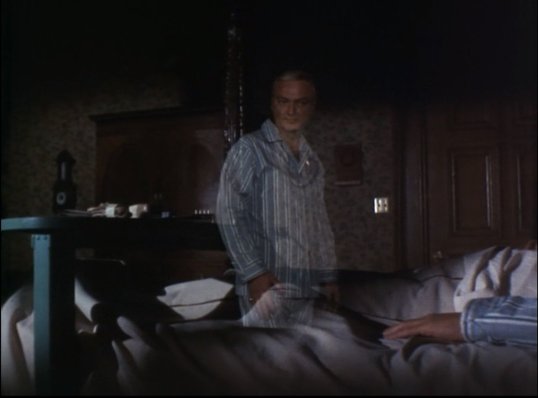
Clocking in at 8 minutes, The Last Laurel is yet another segment about a bitter man (in this case, Jack Cassidy) who suspects that his wife (in the case, Martine Beswick) is cheating on him with his doctor (in this case, Martin E. Brooks) so he teaches himself a supernatural skill in order to get revenge.  In this case, it involves astral projection.  Not surprisingly, it ends with a twist that’s pretty much dependent on one of the characters doing something extremely stupid.

The Last Laurel is well-acted but predictable.  It’s not bad but, especially when compared to something like They’re Tearing Down Tim Riley’s Bar, it feels rather insubstantial.  It feels like filler.

The first season of Night Gallery came to an end with an excellent episode.  Starting tomorrow — season 2!

Previous Night Gallery Reviews:

  1. The Pilot
  2. The Dead Man/The Housekeeper
  3. Room With A View/The Little Black Bag/The Nature of the Enemy
  4. The House/Certain Shadows on the Wall
  5. Make Me Laugh/Clean Kills And Other Trophies
  6. Pamela’s Voice/Lone Survivor/The Doll

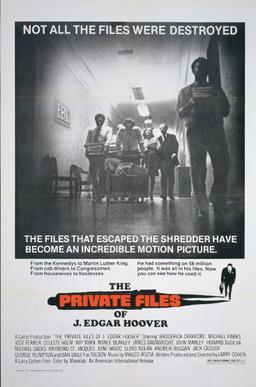
18 Days of Paranoia #3: The Private Files of J. Edgar Hoover (dir by Larry Cohen)


The 1977 film, The Private Files of J. Edgar Hoover, opens in 1972.

J. Edgar Hoover, the much-feared and long-serving director of the FBI, has just been found dead at his home and it seems like the entire city of Washington, D.C. is scrambling.  Not only are people jockeying for Hoover’s job but they’re also wondering what might be found in his secret files.  As quickly becomes apparent, Hoover had a file on everyone.  While Presidents lauded him and the press portrayed him as hero, Hoover spent nearly 50 years building up a surveillance state.  Hoover said it was to fight criminals and subversives but mostly, it was just to hold onto his own power.  Even President Nixon is heard, in the Oval Office, ordering his men to get those files.

Hoover may have known everyone’s secrets but, the film suggests, very few people knew his.  The film is narrated by a former FBI agent named Dwight Webb (Rip Torn).  Dwight talks about how he was kicked out of the FBI because it was discovered that he not only smoked but that he was having an adulterous affair with a secretary.  “You know how Hoover was about that sex stuff,” he says, his tone suggesting that there’s more to the story than just Hoover being a bit of a puritan.

We flash back to the 1920s.  We see a young Hoover (James Wainwright) as a part of the infamous Palmer Raids, an early effort by the Justice Department to track down and deport communist subversives.  Though Hoover disagrees with the legality of the Palmer Raids, he still plays his part and that loyalty is enough to eventually get him appointed, at the age of 29, to be the head of the agency that would eventually become the FBI.  Hoover may start out as a relatively idealistic man but it doesn’t take long for the fame and the power to go to his head.

Hoover (now played by Broderick Crawford) serves a number of Presidents, each one worse the one who proceeded him.  Franklin Delano Roosevelt (Howard Da Silva) is an avuncular despot while the Kennedy brothers (William Jordan as John and Michael Parks as Bobby) are two rich brats who think that they can control Hoover but who soon discover that Hoover is far more clever than they realize.  Hoover finds himself a man out-of-place in the 60s and the 70s,  Suddenly, he’s no longer everyone’s hero and people are starting to view the FBI as being not a force for law enforcement but instead an instrument of oppression.

Through it all, Hoover remains an enigma.  He demands a lot of from his agents but he resents them if they’re too successful.  Melvin Purvis (Michael Sacks) might find fame for leading the manhunt that took down Dillinger but he’s driven to suicide by Hoover’s cruel treatment.  Unlike Clint Eastwood’s film about Hoover, The Private Files of J. Edgar Hoover suggests that Hoover was not gay but that instead, that he was so repressed that he was essentially asexual.  When one woman throws herself at him, he accuses her of being a subversive and demands to know how anyone could find him attractive.  He’s closest to his mother and when she dies, he shuts off his emotions.  His own power, for better and worse, becomes the one thing that he loves.  He’s married to the FBI and he often behaves like an abusive spouse.

The Private Files of J. Edgar Hoover is an interesting film.  It’s an attempt to do a huge American epic on a less than epic budget.  At the start of the film, the low budget is undeniably distracting.  The 1920s are essentially represented by a back lot and two old cars.  The scenes of the FBI dealing with gangsters like Dillinger and Creepy Karpis feel awkward and slapdash.  But, as the film’s timeline gets closer to what was then the modern era, the film’s story tightens up and so does Larry Cohen’s direction.  (One get the feeling that Cohen was, perhaps understandably, more interested in the Hoover of the 60s and the 70s than the Hoover of the 20s and 30s.  There’s a sharpness to the second half of the movie that is just missing from the first half.)  Broderick Crawford gives a chilling performance as a man who is determined to hold onto his power, just for the sake of having it.  The scenes were Hoover and Bobby Kennedy snap at each other have a charge that’s missing from the first half of the film.  Michael Parks does a great job portraying RFK as basically being a spoiled jerk while Crawford seems to relish the chance to play up the resentful, bitter old man aspects of Hoover’s personality.  The film ultimately suggests that whether the audience previously admired RFK or whether they previously admired Hoover, they were all essentially duped.

Though the film never quite overcomes the limits of its low budget, it works well as a secret history of the United States.  In 1977, it undoubtedly took guts to make a film that portrayed Roosevelt and Kennedy as being as bad as Nixon and Johnson.  (It would probably even take guts today.  One need only rewatch something like The Butler or Hyde Park on Hudson to see the ludicrous lengths Hollywood will go to idealize presidents like Kennedy and dictators like FDR.)  While this film certainly doesn’t defend J. Edgar Hoover’s excesses, it often suggests that the president he served under were just as bad, if not even worse.  In the end, it becomes a portrait of not only how power corrupts but also why things don’t change, regardless of who is nominally in charge.  In the end the film’s villain is not J. Edgar Hoover.  Instead, the film’s villain is the system that created and then enabled him.  The man may be dead but the system remains.

Previous entries in the 18 Days of Paranoia:

  1. The Flight That Disappeared
  2. The Humanity Bureau