Horror Film Review: Godzilla (dir by Luigi Cozzi, Inshiro Honda, and Terry Morse)


The year was 1976 and the flamboyant Italian producer, Dino de Laurentiis, was drumming up a lot of publicity for his remake of the monster classic, King Kong.  In Italy, the journalist, screenwriter, and director Luigi Cozzi assumed that the King Kong remake would be a huge hit and decided to get in on the action himself.  If Italian audiences loved a film about a big monkey, how about a film about a big radioactive lizard?

Cozzi’s original plan was to buy the distribution rights to Gojira but Toho Studios turned him down.  They did, however, agree to allow Cozzi to distribute the American cut of Gojira, Godzilla, King of the Monsters.  (That’s the version where Raymond Burr appears as American reporter Steve Martin and, through some clever editing tricks, appears to be interacting with the characters from the original Japanese version.)

Cozzi immediately ran into two huge problems when it came to distributing Godzilla, King of the Monsters.  First off, the film was in black-and-white and most Italian theater owners refused to show black-and-white films.  Cozzi’s solution was to “colorize” the film by putting translucent gel over the frame, resulting in random splotches of color that gave the entire film what could generously be called a radioactive glow.  Secondly, the American cut was considered to be too short for theatrical distribution.  Cozzi proceeded to re-cut the re-cut, adding in scenes of actual war footage and clips from other 50s monster movies.  As a result Cozzi’s film opens not with Tokyo on fire but instead stock footage of Hiroshima before the bomb was dropped.  Later, footage of actual victims of the bomb would he used as footage of victims of Godzilla.

Having re-cut the film, Cozzi then decided that the movie could use a synthesizer-heavy soundtrack, which was provided by Vince Tempera, Fabio Frizzi, and Franco Bixio.

The end result …. well, the end result is a mess but it’s a mess that fascinating for fans of Godzilla.  The colorization creates an odd effect, in which the images are all familiar but still seem different, as if being viewed in a dream.  Often times, the splashes of color are so harsh and random that it makes it difficult to actually see what’s happening in the scene.  I had to look away a few times, due to the harshness brightness of some of the yellows.  There are a few times — and by that, I mean a very few times –when the color effects oddly work.  In those rare moments, Godzilla’s atomic nature seems to be radiating through the entire movie.

As for the “new footage,” it’s thoroughly tasteless to use actual footage from Hiroshima and Nagasaki but, at the same time, it also serves to remind the viewer of the national trauma that inspired the creation of Godzilla in the first place.  The footage reminds the viewer of the horrors of war while also leaving viewers wondering they really should be watching it used in the way that it’s used in this movie.  (For his part, Cozzi said he used actual war footage because modern audiences would expect more violence and destruction than was present in the original film.  It’s reasonable to assume that any subtext was purely accidental.)

Finally, the soundtrack …. actually, I like this version’s score.  It’s wonderfully ominous, especially at the start of the film.

Nicknamed Cozilla by Cozzi himself, 1977’s Godzilla is a bizarre experiment that doesn’t quite work but I would say it’s still one that should be seen by anyone who is interested in the history of either Godzilla or exploitation films in general.  (And make no mistake, this version of Godzilla is definitely an exploitation film.)  For years, the film was impossible to see outside of Italy.  Now, of course, you can find a copy on just about every torrent site.

Previous Godzilla Reviews:

  1. Godzilla, King of the Monsters (1958)
  2. Godzilla Raids Again (1958)
  3. King Kong vs Godzilla (1962)
  4. Mothra vs. Godzilla (1964)
  5. Ghidorah: The Three-Headed Monster (1964)
  6. Invasion of the Astro-Monster (1965)
  7. Godzilla vs. The Sea Monster (1966)
  8. Son of Godzilla (1967)
  9. Destroy All Monsters (1968)
  10. All Monsters Attack (1969)
  11. Godzilla vs Hedorah (1971)
  12. Godzilla vs Gigan (1972)
  13. Godzilla vs Megalon (1973)
  14. Godzilla vs Mechagodzilla (1974)
  15. The Terror of Mechagodzilla (1975)
  16. Godzilla vs. Mothra (1992)
  17. Godzilla vs. Destoroyah (1995)
  18. Godzilla, Mothra, and King Ghidorah: Giant Monsters All-Out Attack (2001)
  19. Godzilla (2014)
  20. Godzilla: Planet of the Monsters (2017)
  21. Godzilla, King of the Monsters (2019)
  22. Godzilla vs Kong (2021)
  23. Godzilla Minus One (2023)

Horror Film Review: Terror of Mechagodzilla (dir by Ishiro Honda)


Megchagodzilla has returned!

The robot version of Godzilla, Mechagodzilla made his debut in 1974’s Godzilla vs. Mechagodzilla.  In that film, it was revealed that Mechagodzilla was built and controlled by a bunch of aliens who wanted to use him to subjugate humanity so that the aliens could take over the Earth.  The real Godzilla put an end to those plans, not only saving the world from an alien invasion but also tossing Mechagodzilla into the ocean.

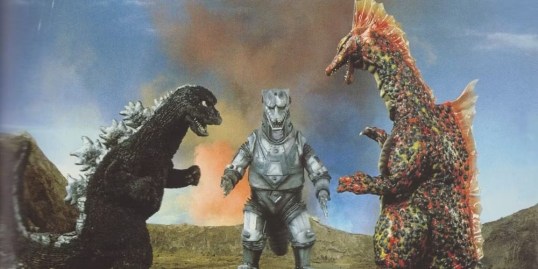
Unfortunately, it would appear that Godzilla didn’t do a good enough job taking care of his robotic counterpart because, in 1975’s Terror of Mechagodzilla, the aliens are able to resurrect Mechagodzilla and they once again sent it out to destroy humanity, starting with Japan.  Working with the aliens is a mad scientist named Dr. Mafune (Akihko Hirata).  Mafune’s daugther, Katsura (Tomoka Ai0), is a cyborg who has a mechanical and mental connection to Mechagodzilla.  Whenever her eyes glow, Mechagodizlla does something destructive.  The aliens team Mechagodzilla up with a new monster, the fearsome Titanosaurus.


Mechagodzilla and Titanosaurus work together to once again destroy Japan and it must be said that they appear to be quite capable of doing just that.  Say what you will about the special effects in these films, the scene where Mechagodzilla blows up an entire city block does pack a punch.  If Mechagodzilla is laser-focused on blowing stuff up, Titanosaurus just seems to be looking for a fight with someone.  Titanosaurus is a very enthusiastic monster, like a previously bullied kid who has just hit a growth spurt and now can’t wait to beat up everyone on the playground.  Eventually, Godzilla shows up to give Titanosaurus the fight that he’s looking for.

This film is one of the ones where Godzilla is firmly established as being humanity’s champion.  The atomic beast who once represented the trauma of the nuclear attacks on Hiroshima and Nagasaki is now a friend to all humans.  That said, it’s hard not to notice that it takes Godzilla a while to actually show up.  He allows Mechagodzilla and Titanosaurus to blow up a lot of buildings and probably kill a lot of people before he finally puts in an appearance and orders them to stop.  It’s nice that Godzilla showed up in time to save a group of children from Mechagodzilla but you have to wonder how many of those children are now orphans because Godzilla wasn’t willing to do anything while Mechagodzilla was blowing up apartment buildings.

The majority of this film centers not on Godzilla but instead on some Interpol agents who are trying to figure out what the professor and the aliens are planning on doing.  (To me, it seemed pretty obvious that the aliens were planning on using a bunch of giant monsters to destroy humanity but maybe Interpol had some information that I didn’t.)  The agents do eventually manage to track down the aliens and the professor.  There’s some sub-James Bond style action as the agents attack the evil lair.  Despite everything that Interpol does in this film, it’s obvious that Godzilla is man’s only hope.

This was the last of the original Godzilla films.  After this film came out, it would be nearly ten years before the monster was revived and returned to once again being a threat to humanity as opposed to being a friend.  Sadly, Terror of Mechagodzilla doesn’t feature enough giant monster action.  When the monsters are onscreen and fighting, this movie is a lot of fun.  Godzilla’s visible frustration with having to deal with Mechagodzilla again is very endearing.    Unfortunately, the majority of the film gets bogged down with the humans searching for the bad guys and trying to figure out their extremely simple plot.  In the end, the movie leaves the viewer thankful for Godzilla but also frustrated that he didn’t get more to do.

Previous Godzilla Reviews:

  1. Godzilla, King of the Monsters (1958)
  2. Godzilla Raids Again (1958)
  3. King Kong vs Godzilla (1962)
  4. Mothra vs. Godzilla (1964)
  5. Ghidorah: The Three-Headed Monster (1964)
  6. Invasion of the Astro-Monster (1965)
  7. Godzilla vs. The Sea Monster (1966)
  8. Son of Godzilla (1967)
  9. Destroy All Monsters (1968)
  10. All Monsters Attack (1969)
  11. Godzilla vs Hedorah (1971)
  12. Godzilla vs Gigan (1972)
  13. Godzilla vs Megalon (1973)
  14. Godzilla vs Mechagodzilla (1974)
  15. Godzilla vs. Mothra (1992)
  16. Godzilla vs. Destoroyah (1995)
  17. Godzilla, Mothra, and King Ghidorah: Giant Monsters All-Out Attack (2001)
  18. Godzilla (2014)
  19. Godzilla: Planet of the Monsters (2017)
  20. Godzilla, King of the Monsters (2019)
  21. Godzilla vs Kong (2021)
  22. Godzilla Minus One (2023)

Horror Film Review: Mothra vs. Godzilla (dir by Ishiro Honda)


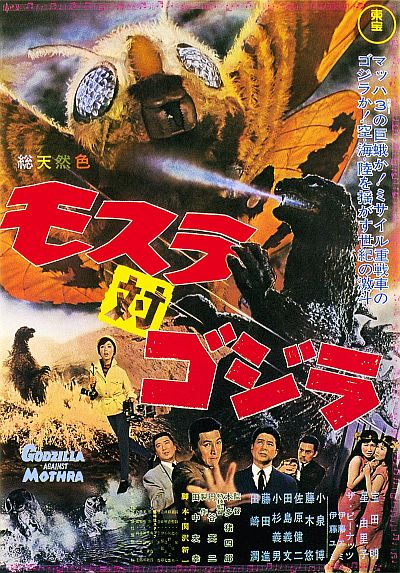
The 1964 film, Mothra vs. Godzilla, opens with a beach in Japan getting hit by a typhoon.

It’s certainly not the worst disaster that has ever hit Japan, though a government bureaucrat does show up to take credit for the recovery effort.  Instead of covering his speech, a reporter and a photographer stumble across a mysterious egg that has washed up on the beach.  The egg is beautiful and a local entertainment company, Happy Enterprises, has decided that they are going to build an entire amusement park and center it around the egg.

Then, the Shobijin, two twin fairies, show up and inform everyone that the egg belongs to Mothra, a giant moth who has actually been a pretty good friend to humanity in the past.  They explain that the egg was washed away from Mothra’s home on Infant Island.  Mothra really needs the egg back because the current Mothra is coming to the end of her lifespan and the egg contains the larvae who will become the newest version of Mothra.  Unfortunately, the Happy Enterprisises businessmen say that they’re going to keep the egg and that they really don’t care what Mothra wants.  Mothra flies over to Japan and takes the faeries back to Infant Island.  As they leave, the faeries say, “Goodbye, sorry you were so selfish!”

Unfortunately, shortly after Mothra and the faeries leave, Godzilla suddenly appears on the beach and starts destroying buildings and people with his radioactive breath.  Realizing that the only way to stop one monster is to bring in another monster, the humans head out to Infant Island and ask Mothra to help them.  When they arrives at Infant Island, they discover that the island itself has been turned into a wasteland by frequent nuclear testing.  The natives tells their visitors that they have no desire to allow Mothra to help them out with Godzilla.  The faeries say, “Tough.”  However, in the end, it’s Mothra’s decision whether or not to save humanity and Mothra, being the kindest of all the monsters, takes off to stop Godzilla.

It’s not really October without watching at least Godzilla film and Mothra vs. Godzilla is a good example of an old school Godzilla film, one that was released by Toho before Godzilla was reimagined as being a friend of humanity.  Indeed, a major message of Mothra vs. Godzilla seems to be that humanity doesn’t really deserve any friends.  It takes some nerve to refuse to allow Mothra to have her egg and to then expect Mothra to battle Godzilla for you.  That Mothra is willing to help is a reminder that, of all the big Japanese monsters, Mothra was the most friendly and willing to give humanity a second chance.  Godzilla, meanwhile, is just in a permanent bad mood.  In this film, he still represents the trauma of a nation that, less than 20 years previously, had been hit by two atomic bombs.  Godzilla fully represents the destructive power of the atomic age while Mothra, who is continually sacrificing her life so that she can be reborn, represents the hope for some sort of renewal.  In the end, both monsters fight their battle for the benefit of humanity and it’s exciting and fun to watch.  For a giant moth, Mothra is an agile combatant.  That said, most viewers will probably be Team Godzilla because he’s reminding humanity of the randomness of fate.  Myself, I was just happy with the knowledge that, regardless of who won the fight, they would both be back for future films.