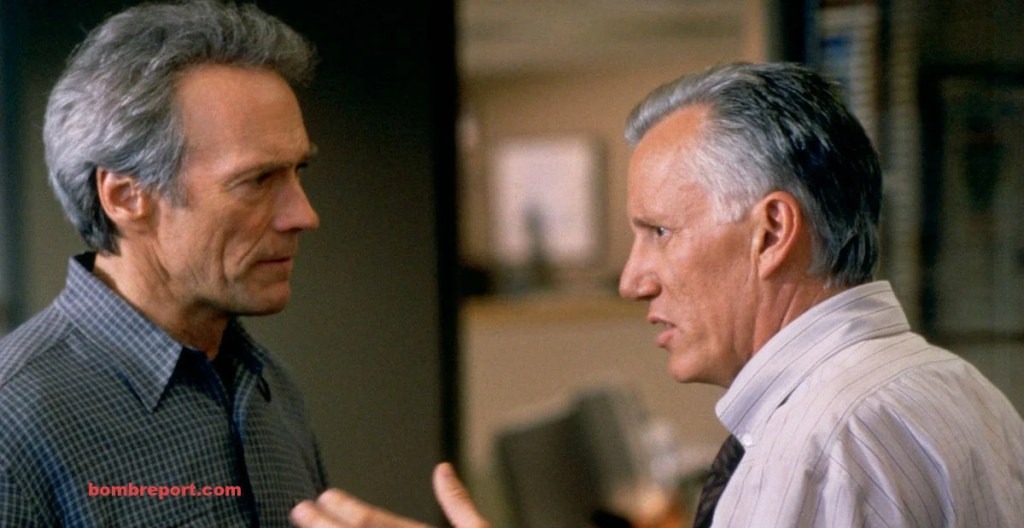
I review TRUE CRIME (1999) – starring Clint Eastwood and James Woods!


Here at The Shattered Lens, we’re celebrating Clint Eastwood’s birthday on May 31st. I decided to revisit his 1999 film, TRUE CRIME. 

Clint Eastwood directs and stars as ace journalist, Steve Everett, who also happens to be a bad friend, a terrible dad, and an even worse husband. Literally the only thing that he’s got going for him is his “nose,” his ability to sniff out a story where no one else can. Even that has begun to fail him, mostly due to his recents bouts with alcoholism, which he seems to somewhat have a handle on at the time of this story. When a young, beautiful colleague tragically passes away in an auto accident, Steve is given her previous assignment to cover the execution of convicted murderer Frank Beechum (Isaiah Washington). Not the kind to write a human interest “puff piece” like the Oakland Tribune is wanting, Everett begins digging into the past and pretty soon that nose of his starts telling him that Beechum is a victim of circumstantial evidence. Despite his editor Bob Findley’s (Denis Leary) objections, he’s able to convince his newspaper boss Alan Mann (James Woods) to let him dig deeper into the story. As he tries to juggle his myriad personal problems with his growing belief in Beechum’s innocence, Everett is also facing a clock that is ticking down to the midnight execution. Will he be able to find the crucial piece of evidence that will set Beechum free?

TRUE CRIME appears to be somewhat of a forgotten Clint Eastwood film. I saw it at the theater when it came out in 1999, but it was not financially successful, only bringing in $16 Million at the box office. Regardless of that, I still love the film. It’s certainly not perfect. It’s probably too long, Beechum is probably too angelic after being “born again,” and the resolution may be a little unrealistic, but I still enjoyed every second of it. One of the coolest things about Clint Eastwood is his willingness to play such flawed men on screen, yet we still love him. He’s great in this film! Anyone who’s read much of my work knows that my love of actor James Woods goes back to being in junior high and renting his movies BEST SELLER and COP. It’s such a treat seeing the legendary pair on screen together even if Woods’ role is sort of a glorified cameo. Woods is hilarious in his limited screen time. My last shout out is to Isaiah Washington as the innocent man who’s about to be put to death. After all these years and appeals, he’s accepted his fate, but the scene where he tells Everett his story and Everett tells him that he believes he’s innocent is so powerful. Add to that Washington’s scenes with his wife and daughter, and I was very much emotionally invested in this film. Washington’s performance was key to the film working, and he’s great!

Overall, TRUE CRIME is a film that takes its sweet time, but it ultimately tells a tense, engrossing story that ratchets up the tension to 10 prior to its last second resolution. I consider it very underrated and highly recommend it. I’ve included the trailer below:
Retro Television Review: Homicide: Life on the Street 2.3 “Black and Blue”


Welcome to Retro Television Reviews, a feature where we review some of our favorite and least favorite shows of the past!  On Sundays, I will be reviewing Homicide: Life On The Street, which aired from 1993 to 1999, on NBC!  It  can be viewed on Peacock.

This week, Pembleton gets a confession.

Episode 2.3 “Black and Blue”

(Dir by Chris Menaul, originally aired on January 20th, 1994)

In this week’s episode, Pembleton manipulates a man into confessing to a murder that he didn’t commit.  Pembleton does it with the full knowledge that the man is innocent and that, if the man is indicted and goes to trial, he will undoubtedly be found guilty as a result of that coerced confession.  Pembleton does it to prove a point to Giardello.

The man is Lane Staley (Isaiah Washington), who has been identified (by his grandmother, who was just trying to be helpful) as an eyewitness to the shooting of Charles Courtland Cox.  Pembleton is convinced that Cox was shot by a policeman and he only wants to interrogate Staley as a witness.  Giardello, who feels that Pembleton is to obsessed with his cop theory and who, as a proud member of the police force, does not want Pembleton to be right, insists that Pembleton treat Staley as a suspect.  Pembleton responds by going into the Box and pretending to be sympathetic to Staley’s situation.  He and Staley talk about how they’re both expected to always be polite and careful about what they say around white detectives.  Pembleton jokes that he always has to be extra polite when he comes to work.

Staley starts to open up to Pembleton and eventually admits that he was present when Cox was shot.  That’s when Pembleton starts shouting at Staley, accusing him of being responsible and basically browbeating Staley until Staley is in tears.  Pembleton makes Staley feel guilty for not doing more to protect Cox and continues to yell at him until, eventually, Staley feels that Cox’s murder was his fault.  Staley finally signs a confession, even though it’s obvious that the sobbing man is not a murderer.  Pembleton hands Giardello the confession and reminds him that’s the way that the police have been getting confessions out of young black suspects for years.

It’s a powerful moment and one that took me totally by surprise.  Andre Braugher and Yaphet Kotto both gave excellent performances in this episode.  The dynamic between Pembleton and Giardello has always been one of the more interesting parts of the show.  The fact that both of them are black and both of them are portrayed as being fully aware of the racism surrounding them brings an extra edge to their debate as to whether or not the black Cox was shot by a white policeman. (At one point, Giardello snaps at Pembleton to speak to him as respectfully as he speaks to the white lieutenants and it’s the exact type of moment that most shows would never have the courage or insight to portray.)  Pembleton is a great detective because he’s laser-focused on getting a confession, to the exclusion of worrying about anything else.  Giardello is a great lieutenant because he’s enough of a pragmatist to understand that some battles are not worth the price of victory.  In the end, Giardello comes to realize that Pembleton is right about the shooting but one still has to wonder what would have happened in Giardello hadn’t torn up Staley’s confession.  The murder of Cox would have disappeared from the headlines but the innocent Staley would have disappeared into the system.

The scenes with Pembleton and Staley were so electrifying that it made up for the fact that this is yet another episode that features Bolander feeling sorry for himself after his divorce.  Fortunately, for Bolander, he meets and befriends a young waitress named Linda (Julianne Margulies) who mentions that she plays the violin.  Bolander reveals that he plays the cello — WHAT!?  Since when has Bolander, someone who has expressed no interest in art or creativity or even music during his entire time of the show, become a cello player?  The episode ends with Bolander and Linda playing their instruments together and it’s a sweet scene but it’s still a bit hard to buy that apparently every woman in Baltimore is instantly attracted to a middle-aged, balding cop who spends all of his time talking about his divorce.  Ned Beatty was one of the great character actors but it sometimes feels like Homicide wasn’t sure what to do with his character.

But, hey, maybe Bolander will finally stop being so whiny.  That’s my hope.  This episode found Munch breaking up with his girlfriend after he accidentally gave her a carnivorous fish that ate all of her other fish.  At one point, Munch says that he can’t accept the idea of Bolander being happier than him.  Seriously, Munch, don’t jinx this.  I’ve been listening to Bolander complain nonstop for 15 episodes.  If he’s happy now, let him have it!

Next week …. life on the street continues!

Horror Scenes I Love: Ghost Ship


Ghost Shp

Ghost Ship came out in 2002 and it was part of that very brief wave of Dark Castle Entertainment which began in 1999 with their remake of House On Haunted Hill and then petered out with 2005’s Gothika.

While not one of the better horror films to come out during the first decade of the new millennium, Ghost Ship was still entertaining enough to become a sort of guilty pleasure for horror aficionados.

Part of why some horror fans seem to enjoy this film, mediocre as it is through much of it’s running time, is the opening scene which takes on a grand guignol meets the Road Runner brilliance in its execution.

Just take a gander for yourself and try not to either vomit in disgust or smile gleefully at such a ludicrous gory sequence.

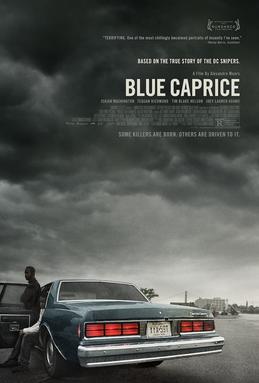
Sundance Film Review: Blue Caprice (dir by Alexandre Moors)


(The Sundance Film Festival is currently taking place in Utah.  This week, I am reviewing films that premiered at and/or received a prize at Sundance.  Tonight, I take a look at the 2013 film, Blue Caprice.)

When we first meet Lee (Tequan Richmond), he is fifteen years old and living in poverty in Antigua.  One morning, he watches as his mother gets in a car with a strange man.  Before she goes, she tells Lee that she has no choice but to leave and that she will return.  Lee says nothing as his mother is driven away.

Lee’s mother doesn’t return.  Lee spends his time sitting in an empty house.  He wanders through the nearby woods.  Sometimes, he goes to a nearby town and walks around aimlessly.  It’s in that town where he first sees John (Isaiah Washington).  John is an American who is living on the island with his three children.  John spots Lee watching him and soon, Lee is eating dinner at John’s house.  John’s children ask if Lee is going to be living with them.  John says that he doesn’t know.  They ask if they can see their mother.  John explains that, if they see their mother, they’ll no longer be able to spend time with him.

Months later, John and Lee are in Tacoma, Washington.  The children are back with their mother.  John tells Lee that America is full of lies.  He says that all women lie.  He says that the army lied to him.  John says that he just wants to get his children back.  John tells everyone that they meet that Lee is his son.  John says that he loves Lee but, when John visits an old girlfriend, he has no hesitation about telling Lee to go walk around for a while.  Lee ends up staring at the speaker at a fast food drive-through in amazement.  “Do you have cheap burgers?” he asks.

John and Lee keep moving and eventually end up living with an old army friend of John’s.  Ray (Tim Blake Nelson) is a good-natured redneck.  He enjoys playing video games, smoking weed, and shooting guns.  When Lee shoots one of Ray’s guns, Ray declares Lee to be a natural.  John stares at the gun in Lee’s hand.

When he’s not trying to track down his ex-wife and children, John trains Lee.  He ties Lee up and abandons him in the woods, forcing Lee to figure out how to escape.  (“DAD!” Lee shouts as John walks away from him.)  He gives Lee a sniper manual to study.  He explains to Lee that the first step to destroying society is to make people panic.  He says that it’s important to kill random people.  After killing a man, they’ll kill a woman.  After killing a woman, they’ll kill a child.  No one will feel safe.  When Lee shows reluctance about John’s plans, John demands to know if Lee loves him…

Blue Caprice is based on a true story.  In 2002, John Muhammad and Lee Malvo shot 27 people in Maryland, Virginia, and Washington, D.C., killing 17 of them.  The title of the film comes from the car that Muhammad and Malvo lived in during their shooting spree.  Significantly, throughout the film, John and Lee are referred to only by their first names. Though the film may have been inspired by their actual crimes, Blue Caprice never claims to be an exact recreation of what happened.  Instead, the film speculates about how John was able to turn a directionless teenager into a killer.

It makes for a chilling film.  Isaiah Washington plays John as being a chameleon, a man who is so empty on the inside that he’s become very good at fooling people into believing that he’s whatever they want him to be.  John is the type who can spend the morning plotting to overthrow the government, the afternoon trying to fool a school principal into telling him where his children are now living, and the evening grilling burgers and laughing with the neighbors.  The film leaves no doubt to John’s evil but it’s attitude towards Lee is more ambiguous.  Tequan Richmond captures the transformation of Lee from being a withdrawn teenager to a cold-blooded killer.  Was Lee capable of being a killer before he met John or was he transformed by the older man?  That’s the question that both the film and the audience struggles with.

Blue Caprice got good reviews when it played at the 2013 Sundance Film Festival, thought it was ultimately overshadowed by Fruitvale Station.  It’s a disturbing film and not an optimistic one, which is perhaps why, post-Sundance, it never received quite as much attention as it deserved.  It may not be a pleasant film to watch but it is one that definitely leaves an impression.

Previous Sundance Film Reviews:

  1. Blood Simple
  2. I Don’t Feel At Home In This World Anymore
  3. Circle of Power
  4. Old Enough