Immediately following the Civil War, a group of U.S. soldiers and a group of former Confederates have to work together to survive an Apache ambush. The leader of the soldiers is Sgt. Matt Blake (Scott Brady) and he’s escorting a gunrunner (Baynes Barron) to a nearby fort. Leading the former Confederates is Sam Prescott (Frank Gerstle). The two groups are, at first, suspicious of each other. Confederate Judge Stanfield (Irving Bacon) thinks that Blake should just give the gunrunner and his guns to the Apaches, since that’s what they want. When Blake disagrees, Prescott tries to encourage a young and angry former Confederate named Keith (Clint Eastwood) to challenge Blake’s command. In the end, the former enemies have to learn how to set aside their differences to survive and to make it to the fort.
This was one of Eastwood’s earliest performances and only the fourth time that his name actually appeared in the opening credits. (Eastwood had appeared, uncredited, in several films before this one.) Eastwood later called Ambush at Cimarron Pass “the lousiest western ever made” and claimed that he hated the film so much that he almost gave up on acting after seeing it. I think he’s being too hard on the movie. It’s a low-budget B-movie that pretty much takes place in one location and it has an tending that feels tacked-on but, when it concentrates on the action and the hostility between the two groups, it’s not that bad. It feels more like an episode of Death Valley Days than an actual movie but Scott Brady is a convincing hero and his brawl with Eastwood is one of the movie’s highlights. As for Eastwood’s performance, he’s stiff but convincing when he’s angry. It’s obvious that, in 1958, Clint Eastwood still had a long way to go an actor but his physical presence makes him stand out whenever he’s in a scene. Ambush at Cimarron Pass is nothing special but it’s good enough to work for fans of the genre who might be looking for a brief diversion that features a handful of familiar faces.
After appearing in this film, Eastwood would land the role of Rowdy Yates on Rawhide and spend the next six years on television. His next film would be A Fistful of Dollars, a western that made a much deeper impression on audiences than Ambush At Cimarron Pass.
When a gang of outlaws attempt to rob a bank in the small frontier town of Plainview, the local sheriff is one of the first people to get gunned down. It falls upon two local men, George Henderson (Frank Ferguson) and storeowner Jack Wright (Fred MacMurray), to run the outlaws out of town. While most of the gang escapes, Jack and Henderson manage to kill the gang’s leader, Alvin Dennis.
At first, Jack and Henderson are declared to be heroes and Henderson is appointed sheriff. However, when Henderson is found murdered, the town realizes that Alvin’s brother, Bob (Skip Homeier), has returned to get revenge. The inevitable confrontation is delayed by the arrival of a U.S. marshal who stays in town for two weeks to maintain the peace but everyone knows that, once he leaves, Bob is going to be coming after the mild-manned Jack. The townspeople go from treating Jack like a hero to shunning him. They even offer Jack and his wife (Dorothy Malone) money to leave town but Jack refuses to give up his store or to surrender to everyone else’s fear.
At Gunpoint is a diverting variation on High Noon, with Fred MacMurray stepping into Gary Cooper’s role as the upstanding man who the town refuses to stand behind. What sets At Gunpoint apart from High Noon is that, unlike Cooper’s Will Kane, MacMurray’s Jack Wright isn’t even an experienced gunslinger. Instead, he’s a mild-mannered store owner, the old west’s equivalent of an intellectual, who just managed to get off a lucky shot. If he can’t find a way to get the cowardly town to back him up, there’s no way that he’s going to be able to defeat Bob and his gang.
At Gunpoint features an excellent cast of Western character actors, including John Qualen, Irving Bacon and Whit Bissell. Especially good is Walter Brennan, playing one of the only townspeople to have any integrity. While this western may not have the strong political subtext or the historical significance of High Noon, it’s still a well-made example of the genre. It’s a western that even people who don’t normally enjoy westerns might like.
(With the Oscars scheduled to be awarded on March 4th, I have decided to review at least one Oscar-nominated film a day. These films could be nominees or they could be winners. They could be from this year’s Oscars or they could be a previous year’s nominee! We’ll see how things play out. Today, I take a look at the 1940 best picture nominee, The Grapes of Wrath!)
How dark can one mainstream Hollywood film from 1940 possibly be?
Watch The Grapes of Wrath to find out.
Based on the novel by John Steinbeck and directed by John Ford, The Grapes of Wrath tells the story of the Joad family and their efforts to neither get sent to prison nor starve to death during the Great Depression. When they lose their farm in Oklahoma, they head for California. Pa Joad (Russell Simpson) has a flyer that says someone is looking for men and women to work as pickers out west. The 12 members of the Joad Family load all of their possessions into a dilapidated old truck and they hit the road. It quickly becomes apparent that they’re not the only family basing all of their hopes on the vague promises offered up by that flyer. No matter how much Pa may claim different, it’s obvious that California is not going to be the promised land and that not all the members of the family are going to survive the trip.
Tom Joad (Henry Fonda) is the oldest of the Joad sons. He’s just been released from prison and he’s killed in the past. Having been in prison during the start of the Great Depression, Tom doesn’t realize how bad things truly are until he arrives home and sees someone he grew up with using a tractor to knock down a house. (It’s just business, of course. The owners of the house can’t pay their bills so the house gets destroyed.) The film’s story is largely told through Tom’s eyes and Henry Fonda gives a sympathetic performance, one the gets the audience to empathize with and relate to a character who is a total outsider.
As for the rest of the Joad Family, Ma (Jane Darwell) is the glue who holds them together and who refuses to allow them to surrender to despair. (And yet even Ma is forced to make some tough choices when the starving children of one work camp ask her to share her family’s meal with them.) Rosasharan (Dorris Bowdon) is pregnant while Grandpa (Charley Grapewin) is too sickly for the trip but doesn’t have anywhere else to go. And then there’s Casy (John Carradine), the former preacher turned labor organizer. Casy is not blood-related but he soon becomes a member of the family.
The Joads have a healthy distrust of the police and other authority figures and that turns out to be a good thing because there aren’t many good cops to be found between Oklahoma and California. Instead, the police merely serve to protect the rich from the poor. Whenever the workers talk about forming a union and demanding more than 5 cents per box for their hard work, the police are there to break heads and arrest any troublemakers on trumped up charges. Whenever a town decides that they don’t want any “Okies” entering the town and “stealing” jobs, the police are there to block the roads.
The Grapes of Wrath provides a portrait of the rough edges of America, the places and the people who were being ignored in 1940 and who are still too often ignored today. John Ford may not be the first director that comes to mind when you think of “film noir” but that’s exactly what The Grapes of Wrath feels like. During the night scenes, desperate faces emerge from the darkness while menacing figures lurk in the shadows. When the sun does rise, the black-and-white images are so harsh that you almost wish the moon would return. The same western landscape that Ford celebrated in his westerns emerges as a wasteland in The Grapes of Wrath. The American frontier is full of distrust, anger, greed, and ultimately starvation. (Reportedly, the film was often shown in the Soviet Union as a portrait of the failure of America and capitalism. However, it was discovered that Soviet citizens were amazed that, in America, even a family as poor as the Joads could still afford a car. The Grapes of Wrath was promptly banned after that.) John Ford is often thought of as being a sentimental director but there’s little beauty or hope to be found in the images of The Grapes of Wrath. (Just compare the way The Grapes of Wrath treats poverty to the way Ford portrayed it in How Green Was My Valley.) Instead, the film’s only hint of optimism comes from the unbreakable familial bond that holds the Joads together.
As dark as it may be, the film is nowhere near as pessimistic as the original novel. The novel ends with a stillborn baby and a stranger starving to death in a barn. The film doesn’t go quite that far and, in fact, offers up some deus ex machina in the form of a sympathetic government bureaucrat. (Apparently, authority figures weren’t bad as long as they worked for the federal government.) That the book is darker than the movie is not surprising. John Steinbeck was a socialist while John Ford was a Republican with a weakness for FDR. That said, even though the film does end on a more hopeful note than the novel, you still never quite buy that things are ever going to get better for anyone in the movie. You want things to get better but, deep down, you know it’s not going to happen. Tom says that he’s going to fight for a better world and Fonda’s delivers the line with such passion that you want him to succeed even if you know he probably won’t. Ma Joad says the people will never be defeated and, again, you briefly believe her even if there’s not much evidence to back her up.
Even when viewed today, The Grapes of Wrath is still a powerful film and I can only guess what it must have been like to see the film in 1940, when the Great Depression was still going on and people like the Joads were still making the journey to California. Not surprisingly, it was nominated for best picture of 1940, though it lost to Alfred Hitchcock’s Rebecca.
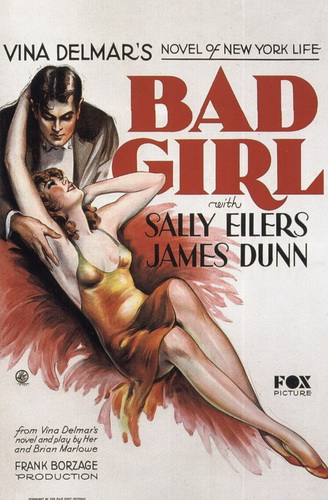
Seeing as how I started this day by watching Fifty Shades Darker, it seemed appropriate to end the day by watching yet another film about the difficulty of finding love and commitment. This film came out a little bit earlier than Fifty Shades of Grey. In fact, it even predates the whole concept of fan fiction. This film came out in 1931 and it would probably be totally forgotten today if not for the fact that, 85 years ago, it was nominated for Best Picture.
Of course, that’s not to say that Bad Girl is particularly well-known. Until I came across it on my list of best picture nominees, I didn’t know that it even existed. According to Wikipedia, it was based on a novel and a play and it did rather well at the box office. The Academy apparently liked it, awarding it Oscars for both Best Director and Best Adapted Screenplay. It’s currently available on YouTube. That’s where I saw it. But, despite all of that, it definitely appears to be one of the more obscure films to have ever been nominated for best picture.
Bad Girl opens with Dorothy Hailey (Sally Eilers) in a wedding gown. However, she’s not getting married. Instead, she’s a store model and, in a rather surreal little sequence, Dorothy and her co-workers walk through the store in their bridal gowns while sleazy men leer at them. As Dorothy complains to her best friend, Edna Diggs (Minna Gombell), men are “only interested in one thing.” When Dorothy’s boss propositions her, Dorothy claims to have a prizefighter husband waiting for her at home. In truthfulness, Dorothy lives with her overprotective brother (William Pawley), a judgmental brute who accuses her of being a tramp if she stays out too late.
At Coney Island, Edna makes a bet that Dorothy won’t be able to get surly Eddie Collins (James Dunn) to talk to her. Dorothy takes the bet and then proceeds to go over to Eddie and play a ukulele, until Eddie gets annoyed enough to tell her to be quiet. Eddie claims to not like women and he accuses Dorothy of being a tease. “Listen, sister,” he tells her, “if you don’t want guys to salute, take down the flag.”
Wow, Eddie sure does seem to be a jerk, doesn’t he?
Well, don’t worry. It turns out that Eddie isn’t as bad as he seems, it’s just that he’s often in a bad mood because he doesn’t have much money and he wants to open up his own radio store. However, Eddie and Dorothy quickly fall in love and soon, they’re married…
But, of course, things never go that smoothly. It turns out that Eddie is proud and stubborn. Fortunately, he’s played by a charming actor named James Dunn because, without Dunn’s considerable working class charm, Eddie would probably be insufferable. Dorothy, meanwhile, fears letting Eddie know that she’s pregnant…
And you know what?
I liked Bad Girl.
On the one hand, Bad Girl is definitely a dated film. Any film released in 1931 is going to seem dated when watched in 2017. But, at the same time, that also means that Bad Girl works as a nice little time capsule. Watching Bad Girl was like stepping into a time machine. And it turns out that the 1930s weren’t that bad! Everyone wore nice clothes and talked like James Cagney.
But, dated it may be, there is also an almost timeless quality to Bad Girl. Even decades after the film was originally released, the likable chemistry between James Dunn and Sally Eilers feels real and you really do care about what happens to them. You feel like they belong together and it’s hard not to worry when they fight or when they misunderstand each other’s intentions. (This happens rather frequently.) Furthermore, Bad Girl is a film about people who, often times, are struggling just to make ends meet. That’s something to which everyone can still relate. It certainly sets it apart from a lot of the other films made both then and today.
Bad Girl was nominated for best picture but it lost to a film that was almost its total opposite, Grand Hotel. Unlike most of the other old best picture nominees, I have never seen Bad Girl on TCM but it is on YouTube and you can watch it below!
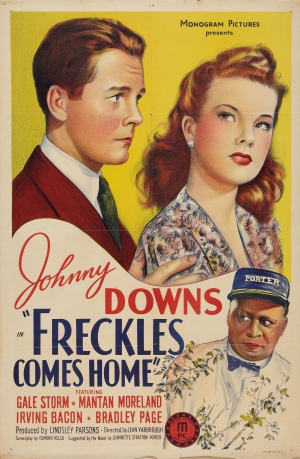
The 23rd film in Mill Creek’s Fabulous Forties box set was an hour-long “comedy” from 1942. The name of the film was Freckles Comes Home and I have to admit that I’m struggling to come up with anything to say about it. That’s the thing about these Mill Creek box sets. Occasionally, you’ll come across a really good movie and, even more frequently, you’ll come across a really bad movie. But often times, you find yourself watching filler. If I had to guess, Freckles Comes Home was probably a movie that was made to act as the 2nd half of a double feature. Not much money nor effort was put into it. It’s not terrible and it’s certainly not good. It’s just sort of there.
With a title like Freckles Comes Home, I was expecting this movie would be about a lost dog but it turns out that I was wrong. Freckles (played by Johnny Downs) is a human being. He’s returning home from college because a friend of his has inherited some real estate and isn’t sure what to do about it. While sitting on the bus home, Freckles spends so much time talking about how much he loves his hometown that the man sitting next to him decides that maybe he’ll make that town his home as well. Unfortunately, that man is Muggsy Dolan (Walter Sande). As you would expect with a name like Muggsy, Dolan is a criminal on the run.
Back in town, Freckles attempts to convince his father not to build a road that will go through his friend’s property. He also romantically pursues a childhood friend named Jane (Gale Storm), despite the fact that everyone insists that Jane can do better than Freckles. (Personally, I was wondering why — in the year 1942 — a young man like Freckles wasn’t overseas, fighting for his country. DON’T YOU KNOW THERE’S A WAR ON, FRECKLES!?) Meanwhile, Muggsy is plotting to rob the town bank…
And then there’s Jeff (Mantan Moreland), who is the porter at the local hotel. Jeff thinks that he has a machine that will allow him to find buried gold. And since Jeff is an African-American in a 1940s film, it’s impossible to watch the way the movie treats him without cringing. There’s a few scenes where Moreland, as an actor, subtly suggests that Jeff is smarter than the movie gives him credit for and certainly, Moreland’s performance is the most memorable in the film but that really doesn’t make the role any less demeaning.
Anyway, Freckles Comes Home was largely forgettable. I assume that audiences in the 1940s may have enjoyed it (especially if it was included on a double bill with a more interesting movie) but, seen today, there’s just not that much to be said about it. It exists, it’s something of a time capsule, and that’s pretty much all there is to say about it.
For those following at home, Lisa is attempting to clean out her DVR by watching and reviewing 38 films by the end of today!!!!! Will she make it? Well, it depends on whether or not she can finish the review below!)
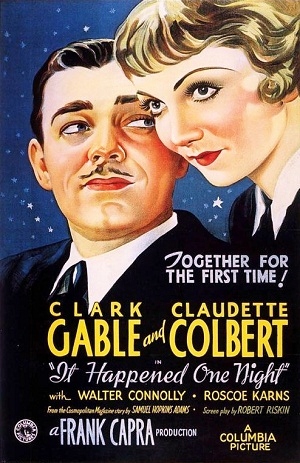
Before I talk too much about the 1934 film It Happened One Night, I want to tell a story about legs.
I’ve always been insecure about having a slightly large nose and once, when I was 17 years old, I was giving my mom a hard time about the fact that I had basically inherited it from her. I was going on and on and being fairly obnoxious about it. (Yes, believe it or not, I can occasionally be obnoxious…)
Finally, my mom held up her hand and said, “Yes, you got your nose from me but you also got my legs so stop crying!”
And you know what? I glanced down at my legs and I realized that she was right and that made me feel a lot better. Ever since then, I’ve taken a lot of pride in having a good pair of legs.
Now, you may be asking yourself what that has to do with It Happened One Night. Well, It Happened One Night is one of the ultimate “good legs” movies. That’s because It Happened One Night features the famous scene in which Claudette Colbert teaches Clark Gable the proper way to hitchhike. (If I ever take up hitchhiking, I’m planning on using the same technique.)
That’s the scene that It Happened One Night is justifiably famous for. However, It Happened One Night is more than just a film about hitchhiking.
It’s also a romance, one that features Claudette Colbert at her wackiest and Clark Gable at his sexiest. Reportedly, the sell of undershirts plummeted after Clark Gable took off his shirt and revealed that he wasn’t wearing one.
It was one of the first road movies and it was such a success that it remains influential to this very day. Any time you watch a movie that features two seemingly different characters getting to know each other on a road trip, you’re watching a movie that exists because of It Happened One Night. (And yes, that includes Tom Hardy and Charlize Theron in Mad Max: Fury Road.)
Frank Capra won his first Oscar for directing this film and It Happened One Night remains one of his most likable and least preachy films. Just compare the unpretentious, down-to-Earth style of It Happened One Night to Meet John Doe.
Perhaps most importantly, It Happened One Night was the first comedy to win the Oscar for best picture. It Happened One Night is a film that announces that a film doesn’t have to be a self-serious, pretentious epic to be great. Before the victory of It Happened One Night, the top prize was exclusively reserved for films like Cimarron and Calvalcade. (Seriously, just try watching some of those early winners today.) It Happened One Night‘s Oscar victory was a victory for the future of entertainment.
(By the way, as I sit here typing up this review, I keep accidentally typing It’s A Wonderful Life instead of It Happened One Night. That’s the power of Frank Capra.)
It Happened One Night tells the story of Pete Warne (Clark Gable). Pete is an out-of-work reporter. Though he may be down on his luck, he’s still confident and lovably cocky in that way that only Clark Gable could be. While riding on a bus from Florida to New York, Pete recognizes one of his fellow passengers as Ellie Andrews (Claudette Colbert), an heiress who has recently eloped with a buffoonish big game hunter named King Westley (Jameson Thomas). Ellie’s father wants to get the marriage annulled and has people all over the country searching for his daughter. Pete agrees not to call Ellie’s father if Ellie will agree to give him an exclusive story when she meets up with Westley in New York.
For the rest of the film, we follow Pete and Ellie as they cross the United States, spending awkward nights in motel rooms, getting kicked off of buses, and hitchhiking. Ellie gives lessons on how to get a car to stop. Pete delivers a long monologue on the proper way to undress before going to bed. Along the way, Pete and Ellie fall in love. It also becomes obvious that Ellie’s father is right about Westley only marrying her for her money.
They also meet a large cast of increasingly eccentric characters. Whether they’re dealing with the passengers on the bus or the cranky people staying at a rest stop or a motorist who won’t stop singing, Pete and Ellie do noy meet anyone who doesn’t have at least one odd quirk. Like many classic screwball comedies, It Happened One Night takes place in a world where everyone — from a bus driver to a desk clerk to a group of women waiting to use a shower at a rest stop — has something to say about everything. Some of the film’s funniest moments come from watching the normally smooth Pete have to deal with the increasingly crazy world in which he’s found himself.
(For her part, Ellie is at her happiest when things are at their strangest. Ellie’s the best.)
The other great moments come from simply watching Gable and Colbert interact. They have an amazing chemistry and it comes through in their performances. It’d odd to read that apparently neither Gable nor Colbert were happy to be cast in It Happened One Night because their performances are so much fun to watch. A love story only works if you love the characters and the love story in It Happened One Night definitely works.
As I stated above, It Happened One Night was the first comedy to win Best Picture. Beyond that, it was also the first movie to win all of the top 5 Oscars: Picture, Director, Actor, Actress, and Adapted Screenplay. (Those were also the only 5 nominations that It Happened One Night received.) For once, the Academy got it right. It Happened One Night remains a delightful film.
(Oh my God, y’all, I did it! That’s 38 films reviewed in 10 days and my DVR now has space to record all sorts of things! And making it all the better is that I finished this project by reviewing a truly wonderful comedy like It Happened One Night!)
“Politicians have remained professionals only because the voters have remained amateurs!” — State of the Union (1948)
Does anyone remember the Americans Elect fiasco of 2012?
Americans Elect was an organization set up by a bunch of businesspeople, attorneys, and out-of-office politicians. Their stated goal was to challenge the political establishment, shake up the two-party system, and elect a president. The idea was that the party would hold a nationwide primary. Any registered U.S. voter could go online and cast their vote on what they thought should be in the party’s platform and who they thought should be the Americans Elect presidential candidate. Whoever won this nationwide primary would be required to 1) run on the platform and 2) pick a vice presidential candidate from the opposite party.
And all would be right with the world, right?
Right.
Anyway, I did register as an American Elect delegate, just because I was curious to see who was getting votes in the nationwide primary and who wasn’t. (And yes, I did cast a vote. I voted for Dallas County Commissioner Elba Garcia.) Looking over the site, I saw that all of the usual suspects were getting votes — Ron Paul, Hillary Clinton, Michael Bloomberg, Donald Trump, and even Barack Obama. None of the big vote getters were exactly nonpartisan or independent figures. With the possible exception of Ron Paul, all of them were members of the very establishment that Americans Elect was claiming to challenge.
Anyway, Americans Elect ended up nominating no one for President and, as we all know, the 2012 election came down to choosing between two candidates who both received money from the same millionaires and, in the end, the status quo was upheld.
To be honest, everyone should have realized that Americans Elect was a sham as soon as the New York Times printed a column praising the effort. Any truly independent political organization would never be praised by the New York Times. Instead, like most so-called independent political organizations, Americans Elect was just a case of certain members of the establishment slumming.
So, the lesson of American Elect would seem to be that any attempt to run outside of the mainstream will, in the end, simply lead you back to the mainstream. That was an expensive lesson for all of the volunteers who devoted their time to getting Americans Elect on the ballot in 28 states. It was a lesson that they could have learned much more easily by watching the 1948 film, State of the Union.
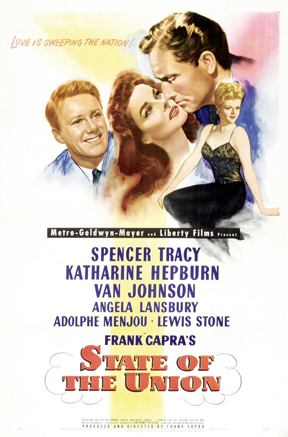
In State of the Union, newspaper publisher Kay Thorndyke (Angela Lansbury) wants to make her lover, Grant Matthews (Spencer Tracy), President of the United States. Grant is a no-nonsense, plain-spoken businessman who is quick to explain that he loves and cares about his country but that he hates partisan politics. (In many ways, it’s impossible not to compare Grant to … well, to just about every single wealthy businessman who has ever run for public office while claiming to essentially be nonpolitical. The big difference is that Grant actually means it.) However, by subtly appealing to both his ego and his patriotism, Kay convinces Grant to run. With the help of sleazy Jim Conover (Adolphe Menjou) and the sardonic Spike McManus (Van Johnson), Kay uses her money and her newspapers to turn Grant into a viable candidate.
The only problem is that Grant is separated from his wife Mary (Katharine Hepburn) and, since this movie was made in the 1940s, everyone knows that Grant has to be seen as being a family man if he’s going to be elected. For the election, Mary and Grant pretend to be happily married.
As the primary season continues, Grant finds himself being more and more manipulated by Kay and Jim. Eventually, Grant is forced to make a decision between his campaign and his integrity…
Following Mr. Smith Goes To Washington and Meet John Doe, State of the Union was the third part of director Frank Capra’s political trilogy. Based on a play (which, itself, was supposedly inspired by the 1940 Republican presidential candidate, Wendell Willkie), State of the Union never quite escapes its stage-bound origins. Add to that, the film was probably a bit more shocking when it was first released in 1948. In 2015, we’re used to idea of politicians being controlled by money. But, in 1948, audiences were perhaps a little bit more innocent.
But, that said, State of the Union is still an entertaining film. Needless to say, Spencer Tracy and Katharine Hepburn have a wonderful chemistry together and Hepburn gets a great drunk scene. (Hepburn had such an aristocratic presence that it’s always fun to watch her do comedy.) Angela Lansbury also does well, playing a character who could very well grow up to be the role she played in The Manchurian Candidate.
67 years after it was first released, State of the Union remains an entertaining film that makes some good and still relevant points. In 2016, when you’re tempted to get involved with the latest version of Americans Elect, watch State of the Union instead.
The idea is that somebody does something nice for you and then they say, “Pay it forward” and suddenly, you are magically required to go out and do something nice for someone else. For one thing, I hate the obligation of it all. I have this fear that as soon as I finally get finished paying it forward, some stranger is going to hand me a Coke and say, “Pay it forward,” and suddenly I’ll have to do it all over again! And really, honestly, I shouldn’t have to pay it forward just because someone gives me a Coke. If you’re going to tell me to pay it forward, at least give me a car or a Victoria’s Secret gift card or something.
Ultimately, “pay it forward” is something that people say to make themselves feel good but it’s actually a pretty shallow concept.
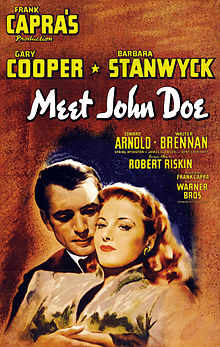
The same thing can be said about John Doeism, the philosophy that rests at the center of the 1941 film Meet John Doe, our latest entry in Shattered Politics. John Doeism is a grassroots political movement that is based around the slogan, “Be a Better Neighbor.” Much like “Pay it forward,” “Be a better neighbor” sounds good and it’s easy to say but its main appeal is that it doesn’t require that much thought. If anything, it sounds like the first step on the road to serfdom…
That said, I still like the film.
Meet John Doe opens with lay-offs at a major metropolitan newspaper. (These lay-offs are signified by a handsome young man who points at people and then runs his finger across his throat.) Among those laid off is columnist Ann Mitchell (Barbara Stanwyck). However, before Ann is officially let go, she is told to write one final column. Understandably angry over her treatment, Ann responds by making something up. She writes and prints a fake letter from a man calling himself “John Doe.” John Doe explains that he’s unemployed and that he will be committing suicide on Christmas Eve.
Well, quicker than you can say twitter death hoax, everyone in the entire country reads John Doe’s letter and demands to know who he is. The newspaper’s editor, Henry Connell (James Gleason), rehires Ann and puts her in charge of finding the real John Doe.
When numerous unemployed and homeless men start to show up at the newspaper, claiming to be the real John Doe, little do they realize that they are, in fact, auditioning. Ann finally decides that Joe Willoughby (Gary Cooper) has what it takes to be the public face of John Doe. Not only does he have a compelling personal story (he’s a former baseball player whose career was ended by an arm injury) but he looks and sounds like Gary Cooper.
(And, as I typed that last sentence, it suddenly occurred to me that Meet John Doe managed to predict American Idol…)
Joe is soon a celebrity, reading speeches that have been written for him by Ann and encouraging people across the nation to be a better neighbor. And Ann is falling in love with Joe. However, Joe is not comfortable with his new role. For one thing, he doesn’t like being a hero for telling a lie. Secondly, he knows that rival newsmen are eager to expose him as being a fraud. And finally, there’s a sinister publisher named D.B. Norton (played by Edward Arnold, who previously played corrupt Boss Taylor in Mr. Smith Goes To Washington) who is eager to be President of the United States. He wants to turn John Doeism into a fascist political movement and, unless Joe endorses him, he’ll reveal that Joe’s a fraud…
Meet John Doe was Frank Capra’s follow-up to Mr. Smith Goes To Washington. It features many of the same themes as Mr. Smith, with the main difference being that Meet John Doe is a lot more preachy. Whereas Mr. Smith saved its big speech for the end, Meet John Doe has several big speeches spread throughout its running time. (There’s also a scene where a guy named Bert tells the story of how he was inspired by John Doe and, I swear, it literally goes on forever.)
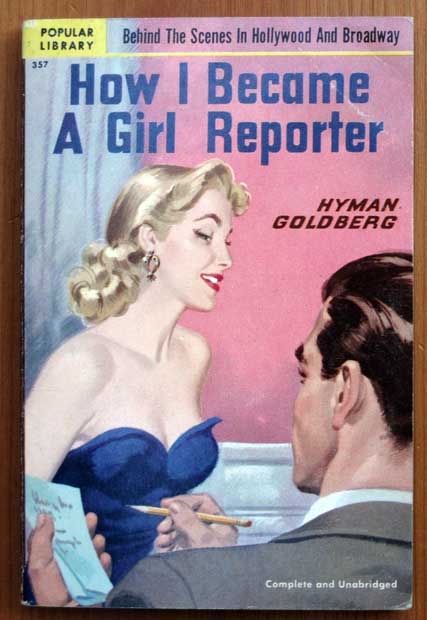
So, no, Meet John Doe is definitely no Mr. Smith Goes Go To Washington but I still liked it, mostly because of the chemistry between Gary Cooper and Barbara Stanwyck. I wanted to be Barbara Stanwyck’s character. Seriously, watching a film like Meet John Doe, leaves me convinced that I was born several decades too late. If I had been born in 1918, I could have been a quick-witted, cynical, and secretly romantic intrepid girl reporter at a major metropolitan newspaper.
Even better, I would never have to worry about ever being told to “pay it forward.”
 Immediately following the Civil War, a group of U.S. soldiers and a group of former Confederates have to work together to survive an Apache ambush. The leader of the soldiers is Sgt. Matt Blake (Scott Brady) and he’s escorting a gunrunner (Baynes Barron) to a nearby fort. Leading the former Confederates is Sam Prescott (Frank Gerstle). The two groups are, at first, suspicious of each other. Confederate Judge Stanfield (Irving Bacon) thinks that Blake should just give the gunrunner and his guns to the Apaches, since that’s what they want. When Blake disagrees, Prescott tries to encourage a young and angry former Confederate named Keith (Clint Eastwood) to challenge Blake’s command. In the end, the former enemies have to learn how to set aside their differences to survive and to make it to the fort.

 Through the Shattered Lens