International Film Review: Revenge in the House of Usher (dir by Jess Franco)


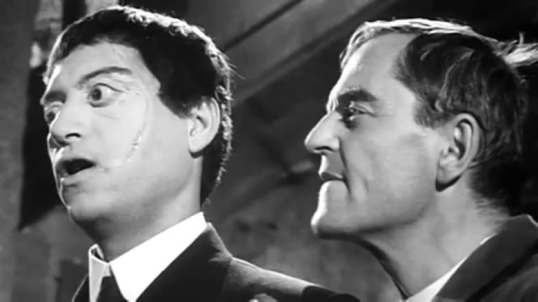
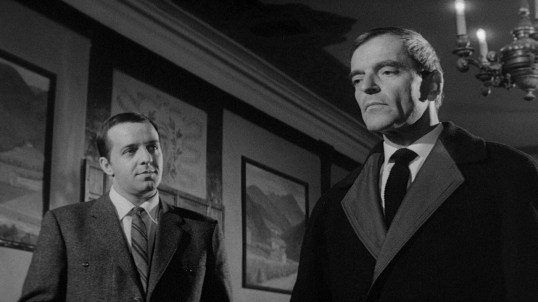
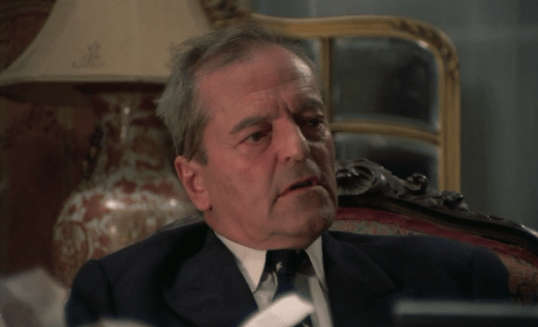
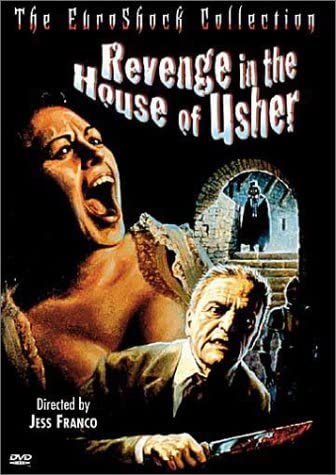
In the 1982 Spanish horror film, Revenge in the House of Usher, Antonio Mayans plays Dr. Alan Harker.  Harker receives an invitation to visit the estate of his former mentor, Prof. Eric Usher (Howard Vernon).  Usher is elderly and in poor health.  He’s attended to by several mysterious servants, including his physician, Dr. Seward (Daniel White).  While trying to figure out what has led to Prof. Usher’s current state, Harker discovers that….

Well, here’s where it gets confusing, as things tend to do whenever one tries to discuss the later films of director Jess Franco.  There are actually three different versions of Revenge In the House of Usher and each one of them tells a totally different story.  In the first version, Usher is revealed to have been a decadent, Giles de Rais-style serial killer who has murdered hundreds of women through the years and who is now being haunted by their vengeful ghosts.  Apparently, that version didn’t go over well when it made its debut at the 1983 Festival Internacional de Madrid de Cine Imaginario y de Ciencia-ficción.  The audience booed and laughed and Franco couldn’t convince any distributors to purchase the film from him.

So, Franco filmed thee more scenes that established that Usher wasn’t just a serial killer but that he was also a vampire!  (This explains why two characters in this Edgar Allan Poe adaptation were suddenly given names from Dracula.)  This reception of this version was not considered to be much of an improvement on the reception of the version where Vernon was just a serial killer.

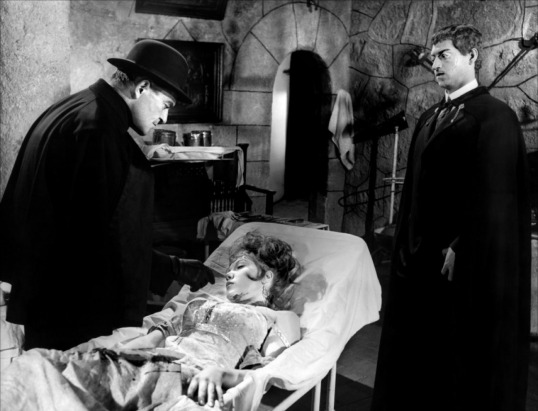
With the backing of Eurocine, Franco then put together a third version of the film.  This time, he turned it into another Dr. Orlof film, though Howard Vernon’s character was still referred to as being Prof. Usher.  In this version, Harker discovers that Usher and his elderly servant Morpho (Olivier Mathot) have spent years abducting women from the village and using their blood to keep Usher’s daughter alive.  This leads to a solid 15 minutes of flashbacks to Usher’s past activities, all of which are taken directly from The Awful Dr. Orlof.  Just as in the other two version of the film, Usher is haunted by the ghosts of his victims.  As his mental state deteriorates, so does his castle.

As far as I know, the third version of the film is the only one that currently exists.  The first version is now considered to be lost.  For his part, Franco claimed that the first version was a misunderstood masterpiece but he was still willing to turn it into another Orlof film so that he could at least make some money off of it.  Franco may have been an often frustrated artist but he was also a pragmatist.

Considering its production history, it’s not surprising that Revenge in the House of the Usher is a bit of a disjointed film.  It’s only 91 minutes long (and 15 of those minutes is taken up with black-and-white footage from The Awful Dr. Orlof) but this film still feels like it has several false endings.  There were so many times that I thought the film had to be over, just for it to keep going.  Watching the film, one can sense that Franco is willing to try almost anything to finally wrap the film’s somewhat incoherent story up.  That said, Howard Vernon brings the right amount of haughty decadence to the role of the decaying Usher and Franco’s decision to film in an actual castle (and to largely utilize natural light) does give the film perhaps a bit more atmosphere than one would expect.  This is a lesser Franco film but it does do a good job of capturing the bizarre logic of dreams.  The film is, at times, so incoherent that it’s actually rather fascinating.

Following this film, Vernon would play Dr. Orloff one final time, in Franco’s surprisingly entertaining Faceless.
International Horror Film Review: Orloff Against The Invisible Man (dir by Pierre Chevalier)


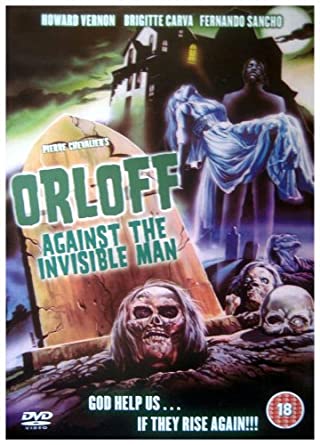
In 1970’s Orloff Against The Invisible Man, Paco Valladares stars as Dr. Garondet, a turn-of-the-century psychologist.  One morning, Garondet is at his office when a mysterious child delivers a letter requesting that he travel to the castle of Prof. Orloff.  Apparently, Orloff’s daughter feels that her father is losing his mind and is in deep need of therapy.

The castle is located in one of those remote villages that always seem to be home to mad scientists and vampires.  As soon as Garondet arrives, he discovers that none of the villagers are willing to talk about Orloff or his castle.  Instead, they all fear him and, if the audience has seen The Awful Dr. Orlof or any of the other dozen or so films that Jess Franco made about the mad doctor, that shouldn’t be a surprise.

What is a surprise is that Franco apparently had nothing to do with this particular Orloff film.  Instead, Orloff Against The Invisible Man was directed by a French director named Pierre Chevalier.  Chevalier does direct in a very Franco-like manner, making frequent use of the zoom lens and often highlighting odd visual details that have nothing to do with the overall plot.  That said, Chevalier also direct with considerably less energy than Franco.  That is a polite way of saying that this is a surprisingly slow movie.

Eventually, Gardonet does reach the castle.  Orloff’s daughter, Cecile (Brigitte Carva), insists that she did not send the message.  Orloff (played by the great Howard Vernon) tells the doctor that he is not only totally sane but that he also lives with an invisible man.  Orloff proves his claim by having the invisible man pick up a few things in a room while Gardonet watches.  Oddly, Gardonet doesn’t seem to be particularly surprised to learn that Orloff has an invisible servant.

Orloff says that he’s going to tell Gardonet the story of how he got an invisible servant but then it turns out that the story actually has very little to do with that.  Cecile, it turns out, was once mistakenly pronounced dead and put in a coffin.  Two of Orloff’s servants decided to break open the coffin and steal Cecile’s jewelry.  However, when they opened the coffin, Cecile woke up and screamed.  One of the gravediggers stabbed Cecile before the two of them ran from the crypt.  Cecile survived but Orloff was so angry that he tracked down the graverobbers.  He killed one and whipped the other.  (Actually, he may have killed both of them.  Due to some truly bad dubbing, the film isn’t clear on this point.)  He then revived the dead servant, turned him invisible, and now uses him to rule over the village.  Or at least, I think that’s what Orloff was claiming.  Again, the editing of the film was so haphazard and the dubbing some incompetent that the plot wasn’t always easy to follow.  Interestingly enough, there is one scene where we briefly do see what the Invisible Man looks like and he looks nothing like the dead servant but instead appears to be some sort of ape.

Orloff Against the Invisible Man is a mess of bad special effects and sexualized violence.  If Jess Franco could be counted on to make films that were sleazy but enjoyably decadent, Orloff Against The Invisible Man is just sleazy and kind of boring.  The best thing that the film has going for it is Howard Vernon, who brings just the right mix of haughtiness and cynicism to the role of Orloff.  Vernon always played Orloff as being an amoral aristocrat, one whose evil is more the result of ennui than actual maliciousness.  Vernon’s the best thing about Orloff Against The Invisible Man.

As with most of the Orloff films, this one has actually been released under several different titles.  My favorite was The Love Life of an Invisible Man.  Interestingly enough, the film’s American tagline was “God Help Us …. If They Rise Again!” despite the fact that the film didn’t feature any zombies or ghosts.  Instead, it just features a few flashbacks and a lot of exposition.  Orloff Against The Invisible Man could have used the demented imagination of Jess Franco.

International Horror Film Review: The Awful Dr. Orlof (dir by Jess Franco)


This 1962 Spanish film opens with a village gripped by terror!  Someone is abducting young dancers from their apartments and sometimes straight off the street!  Who could be responsible for such a terrible act?  Could it be the Mafia?  Could it be the Communists?  Could it be a wayward jazz pianist or maybe an aspiring filmmaker who befriended Orson Welles when the latter moved to Europe to escape the IRS?  Or could it be that awful Dr. Orlof?

Who is Dr. Orlof, you may ask?  He’s a former prison doctor who retired after a fire disfigured his daughter.  Now, he lives in an isolated castle, where he cares for his daughter.  They say that his only companion is Morpho, a blind former convict who wears an emotionless mask over his features and who is often seen wandering around the village in the middle of the night.  Could it be that Dr. Orlof is responsible for the disappearances?

Of course it’s Dr. Orlof!  His name is right there in the title of the film.  In fact, it’s so obvious that Dr. Orlof is sending Morpho out in the middle of the night so that he can abduct beautiful women who are then used in experiments designed to restore the beauty of Orlof’s daughter that you have to wonder why the police just don’t arrest him as soon as the crimes start.  I mean, yes …. I assume that the police need to find some sort of evidence to prove that Orlof is behind the crime but then again, this film was shot in Spain during the years when General Francisco Franco was in charge of the country.  I’m sure the police could have done whatever they wanted.

The Awful Dr. Orlof is considered by many to be the first Spanish horror film.  It was also one of the first films to be directed by Jess Franco, who was no relation to the general.  With both critics and at the box office, this was one of Jess Franco’s most successful films and it was one that he would remake several times over the course of his career.  Dr. Orlof, always played with decadent haughtiness by Howard Vernon, went on to appear in several other Franco films.  (In subsequent films, he added an extra F to his last name.  That’s probably because The Awful Dr. Orlof was released in some countries as The Awful Dr. Orloff.  The double F brings to mind Boris Karloff so it’s not a bad idea to spell it that way but all of the evidence that I’ve read and seen would suggest that Franco originally spelled the name Orlof, with only one F.)  For that matter, Morpho also appeared in quite a few films, some with Orlof and some without him.  In the Awful Dr. Orlof, Morpho is played by Ricardo Valle and he’s a genuinely creepy character.  The blank mask that he wears as he stalks through the night is perhaps the best-known image to come out of The Awful Dr. Orlof.  In fact, if you’ve only seen screenshots of the film, it’s easy to assume that Morpho is the title character, just because of how prominently he is featured in every shot.  It’s impossible to take your eyes away from him.

On the whole, Jess Franco does not have a great critical reputation.  He worked fast.  He made a lot of movies and occasionally, it was obvious that his main concern was getting a paycheck.  Especially when it came to his later films, Franco could be a sloppy and inconsistent director.  And yet, when Franco took his time and when he actually cared about the material, his talent was undeniable.  The Awful Dr. Orlof is one of Franco’s better movies.  While the story won’t win any points for creativity, Franco’s direction is atmospheric and, at it best, the movie feels like a filmed nightmare, full of slightly askew angles and menacing shadows.  The black-and-white cinematography helps, adding a touch of gothic class to the film.  Howard Vernon gives a multi-layered performance as Orlof.  He may be, as the title state, awful but there’s no doubt that his actions are the actions of a desperate parent.  And, of course, Morpho will haunt your nightmares.

All in all, The Awful Dr. Orlof is not awful at all.  It’s a good film to use if you’re tying to introduce Franco to someone who might not be familiar with his work.  Definitely show them Dr. Orlof before showing them A Virgin Among The Living Dead.  Just a suggestion.

International Horror Review: The Sadistic Baron Von Klaus (dir by Jess Franco)


In the small Austrian town of Hoffen, there’s been a murder.

Actually, there’s been more than one murder.  Several women have been killed, stabbed to death by what appears to be an ancient dagger.  The people of Hoffen are convinced that it’s the result of ancient curse, one that states that every male descendant of the original Baron Von Klaus is destined to become a sadistic murderer.  However, there are only two living male descendants.  Max Von Klaus (Howard Vernon, at his decadent best) has an alibi.  Ludwig (Hugo Blanco) wasn’t even in town.  So, if neither Max nor Ludwig committed the murders, then it had to be someone else in town, right?

Or could it be, as the townspeople suspect …. THE ORIGINAL BARON VON KLAUS HAS COME BACK TO LIFE!

Wait …. what?  How stupid are these people?  I mean, I know that small villages are supposed to be a breeding ground of superstition but it seems kind of obvious that it’s probably just some random human serial killer.  Then again, if you believe in a centuries old curse, I guess it’s not that difficult to accept the idea of the dead coming back to life.  I mean, it seems pretty stupid to me but what do I know?

While a police detective and a reporter investigate the crimes, Ludwig is shocked to discover that there’s a torture dungeon in the basement of the Von Klaus castle.  Ludwig is encouraged to be the first member of the Von Klaus family to find the courage the destroy the dungeon and abandon the castle.  Instead, Ludwig finds himself drawn to the dungeon.  Will he be able to resist its musty charms or is he destined to become yet another sadistic Baron von Klaus?

Hmmmm …. a violent and loosely-plotted movie that’s set in a small Austrian village, one that opens with a close-up of two hands playing the piano and which features Howard Vernon as a decadent aristocrat.  Even if you hadn’t already read the title of the review, the plot description alone should be all you would need to hear to know that The Sadistic Baron Von Klaus was a Jess Franco film.

Before he died in 2013, Spanish director Jess Franco was famous for being one of the most prolific directors around.  He’s officially credited with directing 203 films but most sources agree that he was responsible for a lot more.  Franco remains something of a controversial figure.  Many of his films were bad.  Quite a few of them were surprisingly good and atmospheric.  Christopher Lee did several films with him and consistently defended Franco as being an intelligent artist who was often forced to work under less-than-perfect conditions.  Franco was also a member of Orson Welles’s European entourage, with Franco even doing some second unit work on the sublime Chimes at Midnight.  Speaking for myself, I’ve seen plenty of boring Jess Franco films.  But I’ve also seen some surprisingly good ones.  Female Vampire, Faceless, The Awful Dr. Orloff, Nightmares Come At Night, A Virgin Among the Living Dead, all of them are atmospheric, dream-like exercises in cinematic style.

The Sadistic Baron Von Klaus is middle-of-the road Franco.  Despite plot similarities and the presence of Howard Vernon, it’s not as memorable as The Awful Dr. Orloff (which came out the same year) but it’s also clearly put together with more care than some of Franco’s later films.  The plot really doesn’t hang together but that’s to be expected from a Franco film.  For that matter, way too much time is spent with the police inspector and the journalist.  But, visually, the black-and-white cinematography is gorgeous and, as he often did for Franco, Howard Vernon does a great job of epitomizing the decaying aristocracy of Europe.  The film is deliberately paced but Franco does do a good job of creating an feeling of impending doom.  Each scene seems to be leading towards the discovery of a terrible secret, with Hoffen coming to life as a town fueled by superstition and repressed desires.  The scene in which the Von Klaus torture chamber is used is shockingly violent (the film’s title is not kidding about the sadism) but it also highlights the film’s theme about the impossibility of escaping the sins of the past.  Considering that this film was made while Europe was still struggling to rebuild after World War II and when General Franco was still in control of Jess Franco’s native Spain, that was probably intentional on the director’s part.  The Von Klaus curse stands in for the fear that fascism, dictatorship, and war was always destined to rise again.

The Sadistic Baron Von Klaus is not one of Franco’s better-known films but it is one that shows that Franco could make an effective film when he had the time, the money, and the motivation.

International Horror Film Review: Zombie Lake (dir by “J.A. Lazer”)


Oh, Zombie Lake!

I approach this 1981 Spanish-French film with some trepidation because, while it’s undeniably one of the best known of Eurocine’s low-budget horror films, it was also directed by one of my favorite directors and, by most accounts, it was not an experience that he particularly enjoyed being asked about.  He did not care for this film and (spoiler alert) his name was not J.A. Lazer.

In fact, for several years, it was assumed that this film was actually directed by Jess Franco.  And while it’s true that Franco was originally hired to direct Zombie Lake, he left the project because he said the budget was too low to execute his vision.  Consider that.  A budget too low for Jess Franco!  Franco left the project and went on to direct Oasis of the Zombies.  Apparently, the film’s producers did not understand that Franco had actually left the project because, on the first day of shooting, they were shocked to discover that they didn’t have a director.  In a panic, they called another fiercely independent horror director and asked him to come direct the film.  Jean Rollin agreed.

By his own account, Rollin only had a few days to prepare for shooting and since he had already made a classic zombie film called The Grapes of Death, he didn’t worry too much about trying to do anything too spectacular with Zombie Lake.  He simply filmed whatever scenes were required for the day, played the minor role of doomed police inspector, and, six days later, Zombie Lake had been filmed.

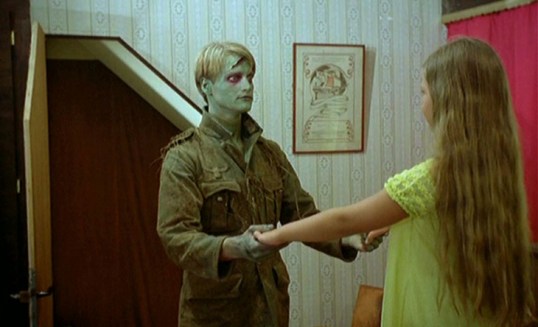
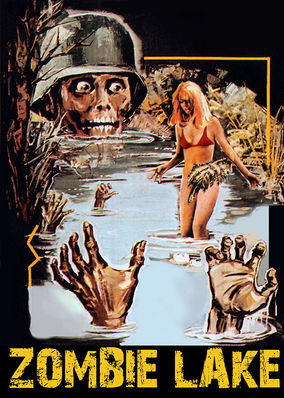
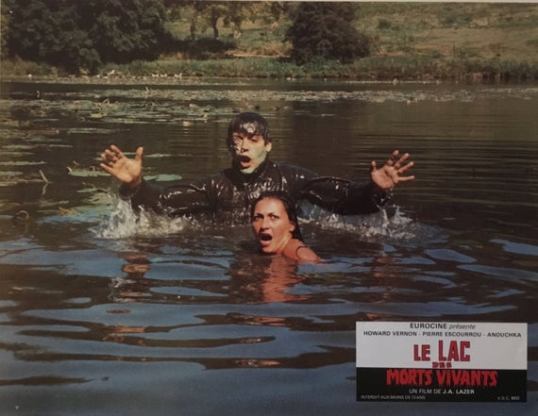
As for the film itself, it takes place in a French village that appears to be exclusively populated by cranky old men and naked young women.  There’s a lake nearby.  Despite seeing (and tossing aside) a big sign with a skull and crossbones on it, one of the naked women decides to go for a swim.  This apparently awakens the green Nazi zombies who lives at the bottom of the lake.  Soon, the zombies are randomly emerging from the lake and killing villagers.  The town’s mayor (Howard Vernon, of all people) is concerned.

It all links back to World War II, when the members of the French Resistance (led by the mayor) gunned down a squad of Nazis and dumped their bodies in the lake.  Somehow, this led to the Nazis coming back as zombies.  One of the Nazis had a daughter with a French woman shortly before he was killed.  Despite the fact that he was killed in 1943 and the movie clearly takes place in 1980, his daughter is only 12 years old.  That’s the type of film that Zombie Lake is.

Watching the film, you can tell why Rollin wasn’t particularly interested in claiming any credit for it.  It’s a messy film, largely because the green zombie makeup keeps washing off whenever the zombies have to emerge from the waters of the lake.  As for the lake itself, the underwater scenes were clearly shot in a swimming pool.  Beyond that, there’s not really any logic as to why the zombies keep emerging from the lake.  Whenever it’s plot convenient, the zombies suddenly emerge and attack anyone who has recently undressed.

Howard Vernon in Zombie Lake

And yet, there are some good things about Zombie Lake.  (Shut up, there are too!)  For instance, it’s kind of charming how each actor cast as a zombie brings their own interpretation to the role.  Some of them walk slowly with their arms outstretched.  Others move a little bit stiffly with a thousand yard stare.  Some of them just casually stroll around, doing their business.  As well, we’re so used to assuming that any character played by Howard Vernon is going to be decadent and sleazy that it’s kind of fun to see him playing an outright hero here.  Finally, even the frequent nudity is so gratuitous that it actually become rather humorous.  One could easily use Zombie Lake to play a drinking game.  Whenever anyone takes off their top, drink!

Finally, even though this was clearly just a film he did for the money, there are a few instances where Rollin’s signature style manage to peak through.  For instance, when we first see the Mayor’s office, the camera lingers on all of the historical artifacts on the wall.  The fact that one of the zombies has cloudy memories of his former lover and only wants to see his daughter actually works a lot better than you might expect, largely because that seems to be the only storyline that Rollin — with his fascination with memory and history — seems to really care about.

Zombie Lake is a mess and certainly not representative of Rollin’s best (or more personal) films.  But I still kind of like it.

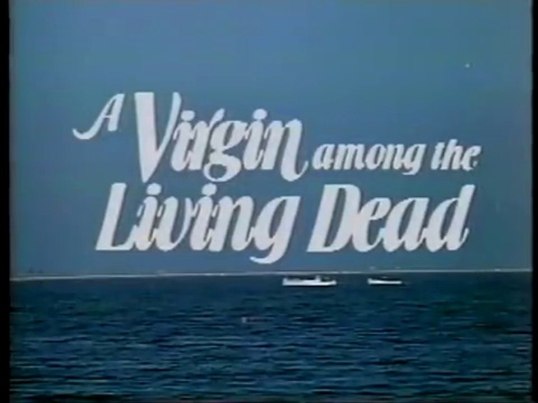
International Horror Review: A Virgin Among The Living Dead (dir by Jess Franco)


This 1973 Spanish-French-Italian production’s title is both its greatest strength and also its greatest weakness.

On the one hand, it’s impossible to forget a title like A Virgin Among the Living Dead.  It’s a title that mixes both horror and sex, which are two things of which audiences simply cannot get enough.  On the other hand, this is a a Jess Franco film and the title — which is so blatant and over-the-top — sounds like it could almost be a parody of Franco’s “unique” style of film-making.  If you were coming up with a fake Franco film, you would probably give it a title that sounded a lot like “A Virgin Among the Living Dead.”  A Virgin In The Castle of Dr. Orloff, perhaps.

Interestingly enough, Franco absolutely hated the film’s title.  It, and quite a few other titles, were slapped onto the film by distributors who were apparently unconcerned with the fact that the film was not meant to be one of Franco’s typical, give-me-my-paycheck exploitation films.  Franco’s title for the film was Night of the Shooting Stars, which is a bit bland but perhaps also a bit more honest.  Incidentally, the film was also released under the titles Christina, Princess of Eroticism and The Erotic Dreams of Christina, which again were titles that Franco disliked.

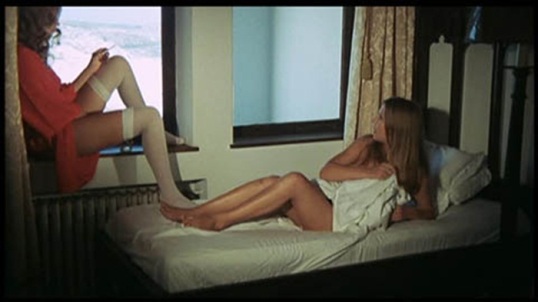
In the version I saw (and, admittedly, there’s several versions floating around), it’s never even stated that the film’s frequently unclothed protagonist, Christina (Christina von Blanc), is a virgin.  When compared to the other decadent members of her family, she certainly is innocent.  For instance, she doesn’t drink blood or engage in strange purification rituals.  When the cheerfully cynical Uncle Howard (Howard Vernon, because this is a Franco film, after all) plays a waltz while another member of the family is dying upstairs, Christina is properly shocked.  But, at no point, is Christina identified as being a virgin.

In fact, Christina is rather uninhibited, nonchalantly greeting strangers (and a rather creepy servant, played by Franco himself) in her underwear, sleeping naked in a room with an unlocked door, and later casually skinny dipping in a nearby swamp.  (When she’s informed that two wide-eyed townspeople were watching her from a nearby hill, she shrugs it off.)  Perhaps she’s meant to be an Eve-like character, unaware of sex or her nudity until she eats from the tree of knowledge.  Am I giving too much credit to Jess Franco?  As is often the case with Franco, it’s hard to say.

As far as the film itself goes …. well, the plot isn’t always easy to follow.  Christina has come to her family’s ancestral home for the reading of her dead father’s will.  Her father hanged himself and, though he’s dead, he keeps showing up.  Christina immediately discovers that the other members of her family are collection of rogues, eccentrics, and blood drinkers.  She also eventually learns that all the members of her family are the living dead and that they’re all worried that Christina will make them leave the estate.  Or are they?  Is Christina just dreaming all of this or is it really happening?  Is the Queen of Night really coming to claim everyone’s soul or is that just a part of Christina’s hallucinations?

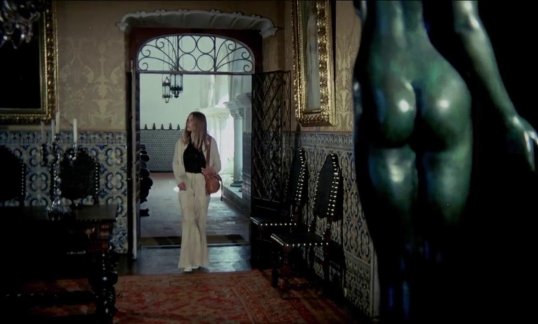
A Virgin Among The Living Dead features all of Franco’s usual directorial quirks.  The story rambles.  Franco alternates between scenes of surreal beauty and scenes of almost indifferent framing.  At times, the score is hauntingly ominous and then, at other times, it sounds like it was lifted from a 70s porno.  Christina comes across as being a beautiful blank but Howard Vernon is memorably perverse as Uncle Howard and all the members of the family are amusingly decadent.  For once, though, all these quirks work to the film’s advantage, creating a surreal dreamscape that truly does seem to exist in a land between life and death.  A Virgin Among The Living Dead truly does become a work of pure cinema, one in which the the visuals and the mood become the narrative as opposed to the film’s story itself.

Franco may have hated the title that was slapped on it but this is actually one of his better films.  Unfortunately, how you react to the film will probably depend on which version you see.  There are several floating around, some of which feature hardcore inserts that were filmed by other directors.  There’s another version that features extra zombie footage that was filmed by Jean Rollin.  The Redemption Blu-ray features Franco’s cut of the film, with no hardcore or extra zombie footage.  That said, the scenes that Rollin shot are included as an extra.  Personally, I like Rollin’s zombie footage but, at the same time, I can also see how its inclusion would have destroyed the film’s already deliberate pace.

(And, of course, it goes without saying that I’m opposed to producers inserting extra scenes into any film, especially when that footage wasn’t directed by the original director.)

Anyway, A Virgin Among The Living Dead never reaches the existential heights of Female Vampire but it’s still one of Franco’s “good” films.  Even if he did hate the title….

The TSL’s Daily Horror Grindhouse: Faceless (dir by Jess Franco)


FacelessPoster1988

Whenever it comes time to review a film like 1988’s Faceless, movie bloggers like me are faced with a very important question.  Which name should we use for this film’s prolific director?  The director was born Jesus Franco Manera and, for a very small handful of his 200+ film, he’s actually credited by his full name.  However, for the majority of his films, he dropped the Manera.  Sometimes, he is credited as Jesus Franco and then other times, the director’s credit reads Jesse Franco or just simply Jess Franco.

Myself, I usually prefer to go with “Jess Franco,” because it just seems to go with his “never give up” style of filmmaking.  At the same time, it seems rather appropriate that Franco is known by more than one name because he was a director with a many different personas, occasionally a serious artist, occasionally a subversive prankster, and sometimes a director-for-hire.  Franco was a lover of jazz and his films often had a similarly improvised feel.  Sometimes, the results were, to put it lightly, not very memorable.  But, for every Oasis of the Zombies, there was always a chance that Franco would give the world a film like Female Vampire.  The imdb credits Franco with directing 203 films before his death in 2013 but it’s generally agreed that he probably directed a lot more.  A lot of his films may not have worked but the ones that did are memorable enough to justify searching for them.

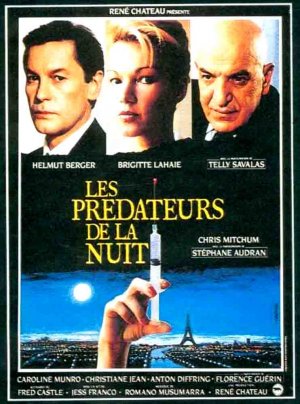
Faceless is Franco’s take on Eyes Without A Face, as well as being something of a descendant of his first film, The Awful Dr. Orloff.  All three of these films deal with a doctor trying to repair a loved one’s disfigured face.  In Faceless, the doctor is Dr. Flammad (Helmut Berger), a wealthy and decadent Paris-based plastic surgeon.  One night, while out with his sister Ingird (Christiane Jean) and his nurse and lover Nathalie (Brigitte Lahaie, the former pornographic actress who appeared in several of Jean Rollin’s best films, including the brilliant Night of the Hunted), Dr. Flammad is confronted by a former patient.  Flammad botched her operation so the patient tries to get back at him by tossing acid in his face.  However, Ingrid shoves Flammad out of the way and ends up getting splashed by the acid instead.

Now disfigured, Ingrid spends her time hidden away in Flammad’s clinic and wearing a mask.  Flammad and Nathalie start to kidnap models and actresses, searching for a perfect face.  Flammad’s plan is to perform a face transplant, giving Ingrid a new and beautiful face.

Needless to say, a face transplant is not a simple thing to do.  In order to get some advice, they go to the mysterious Dr. Orloff (Howard Vernon) and Orloff directs them to a Nazi war criminal named Dr. Moser (Anton Diffring).  Now, if you’re not familiar with Franco’s work, the scene with Dr. Orloff will probably seem like pointless filler.  However, if you are a Francophile, you will feel incredibly relieved to see Howard Vernon suddenly pop up.  When it comes Franco’s films, a Howard Vernon cameo is usually a good sign.

Flammad’s search for the perfect face is complicated by the fact that his assistant, the moronic Gordon (Gerard Zalcberg), keeps accidentally killing and otherwise damaging all of the prospects.  As the bodies continue to pile up, Nathalie even points out that there’s “too many dead bodies” in the clinic.

(Of course, Nathalie isn’t doing much to solve that problem.  When the film got to the moment where Nathalie plunged a syringe into one troublesome patient’s eye, I ended up watching the movie between my fingers.)

Eventually, Nathalie kidnaps a coke-addicted model named Barbara (Caroline Munro).  Flammad thinks that Barbara might finally be the perfect face that they’ve been looking for but there’s a problem.  (Actually, two problems if you count Gordon…)  Barbara’s father (Telly Savalas) is a wealthy industrialist and he wants his daughter back.  He hires an American private investigator, Sam Morgan (Chris Mitchum, looking a lot like his father Robert), to track her down.

Actually, it’s not that much of a problem.  It quickly turns out that Sam is kind of an idiot.  Plus, since he’s American, nobody in Paris wants to help him.  A Paris police inspector orders him to go home, yells at him for always chewing gum, and then adds, “You are not Bogart!”

And things only get stranger from there…

Faceless is one of Franco’s better films, a mix of over-the-top glamour (Faceless was filmed in Paris, after all) and grindhouse sleaze.  Though there is a definite storyline, the film still feels like an extended improvisation, with characters and plot points coming out of nowhere and then disappearing just as quickly.  If we’re going to be totally honest, the film is kind of a mess but it’s a glorious and stylish mess, one that is never less than watchable.

One of the great tragedies of American politics is that Chris Mitchum has twice been defeated when he ran for a seat in the U.S. House of Representatives (though he did come close to winning in 2014).  Not only would it be great to have Robert Mitchum’s son as a member of Congress but it would be even better to know that our laws were being written, in part, by the star of Faceless.  Unfortunately, Chris is sitting out the 2016 election.  Hopefully, he’ll reconsider and file for at least one office.

Run, Chris, run!

Lisa Marie Does 6 Trailers In The Snow


I was so happy today and it didn’t  even have anything to do with the movies, either!  Early this afternoon, I was watching my cat twitch in his sleep (he has very violent dreams, apparently) when I happened to look out my bedroom window and you know what I saw?  Snow!  “Yay!” I yelled, waking up the cat. 

Now, I know that everyone else in the country gets a blizzard every other month but I live in Texas so snow is kind of a big deal to me.  I jumped off my bed, threw my Hello Kitty robe on, and went running down stairs.  I threw open the door, ran out to the front porch, and then slipped and fell right on my backside. 

My neighbor stared at me from his yard.  “Are you okay?” he asked. 

“Yay!”  I replied, “it’s snowing!”

He nodded and then went, “Better hope those power lines don’t ice over or we might be without electricity.”

At that point, I resolved to never speak to my neighbor again.

So, I was very, very happy but now, the snow’s gone.  It’s moved along to Arkansas and Mississippi.  Now, the only thing falling rom the sky is freezing rain and the roads will probably be really icy and scary when I’m going to work tomorrow.  So, as I sit here all kinds of pantsless with a big purple bruise on my ass, I’m cheering myself up by putting together the latest installment of Lisa Marie’s Favorite Grindhouse and Exploitation Trailers.

1) The Dunwich Horror

From 1970: Dean Stockwell kidnaps and brainwashes Sandra Dee and he’s doing it all in the name of all mighty Cthulhu.  This is actually kind of a fun film as long as you can get the image of H.P. Lovecraft spinning in his grave out of your mind.

2) Curtains

I’ve never seen this 80s slasher film but I’ve read about its troubled production on various web sites.  I’m kinda embarrassed to admit it but I actually get scared when I see this trailer.  First off, that mask is disturbing.  And secondly, that doll…

3) Black Belt Jones

Fortunately, even if this world does occasionally give us a demon doll, it can also give us a Black Belt Jones.  I loved the trailer as soon as I saw Gloria Hendry shooting the dishes…

4) Frightmare

From Peter Walker, comes one of the greatest British horror films ever made.  It’s all about cannibalism, psychology, and fire place pokers.

5) Faceless

Jess Franco has directed close to a thousand films and approximately 12 of them are worth watching.  This is one of the lucky dozen, a remake of Eyes Without A Face.  The film gave Brigitte LaHaie her best role outside of the films of Jean Rollin and it also co-stars the great Caroline Munro.  And since it’s a Franco film, Howard Vernon plays a character named Dr. Orloff.  Plus, its got that cute little panther animation at the start of the trailer.

6) Electra Glide In Blue

Finally, it’s up to Robert Blake to restore some order.  This is actually a fairly interesting little movie as long as you realize that it’s such a 70s film, it might as well be wearing a suit with lapels stretching all the way to the end of the shoulders.