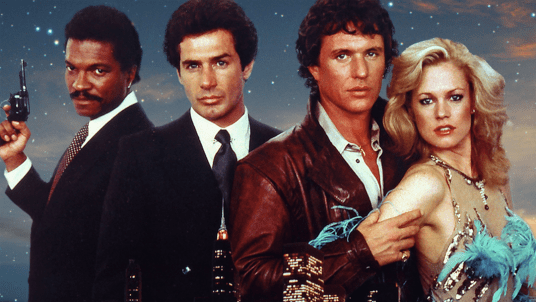
Made For TV Horror: Death Car On The Freeway (dir by Hal Needham)


I, for one, am tired of the stereotype that women cannot drive.

I’m a woman and I can tell you right now that I am an above average driver.  I’ve only had one major accident.  Admittedly, I did smash into a parked car but it was raining and I really couldn’t see that well because I was driving convertible and the window was fogged up.  Plus, whoever parked that car must have done a bad job and left it sitting out in the middle of the street.  For the record, my convertible flipped over on impact so the parked car did far more damage than I did.

Other than that, I usually manage to stop in time for red lights.  I’ve only driven through a few stop signs and that was just because I didn’t notice them. I’ve very rarely been given a speeding ticket.  Instead, the police have always been very polite about just giving me a warning.  And yes, it is true that I have trouble with curbs and turns and going in reverse and all that but I’ve seen plenty of men do the same thing.

The statistics show that, while women are involved in more accidents, the accidents are more likely to be fatal if a man is driving.  Men are also more prone to get upset and pull a gun during a road rage incident whereas women just give other drivers the finger.  Women are not inherently bad or dangerous drivers.  The one exception, at least down here in Texas, are middle-aged women who drive SUVs with faded Beto stickers.  You really don’t want to get stuck behind one of them in traffic.

I found myself thinking about the misogyny behind the “women-are-bad-drivers” stereotype as I watched 1979’s Death Car On The FreewayDeath Car On The Freeway features a madman who is so sick of women driving in Los Angeles that he starts using his Dodge van to cause them to have accidents.  We don’t actually see his face or really learn much about him.  What we do see are his black-gloved hands on his steering wheel, which is a nifty homage to the giallo genre.  (Giallo killers have a thing for black gloves.)  Whenever the driver does try to force a woman into a fatal accident, he pops in an 8-track of hyperactive fiddle music.  The fiddle has never sounded more menacing than it does in Death Car On The Freeway.  It’s almost like prog rock fiddling.  Imagine a country western fiddler who has just done a mountain of cocaine and you’ll get a feeling for this guy’s taste in music.

News reporter Shelley Hack thinks that the public has the right to know that there’s a man causing women to crash their cars.  Her ex-husband, played to smarmy perfection by George Hamilton, thinks that Shelley should quit her current job and come work with him.  Meanwhile, police inspector Peter Graves is concerned that the media going to start a panic and make it more difficult for him to track down the “Freeway Fiddler.”  (One gets the feeling that Graves feels this entire mess could have been avoided if women had never been allowed to drive in the first place.)  At one point, Hack meets with a defensive driver instructor and he’s played by the film’s director, Hal Needham.

Oh, how I love this film!  Seriously, it’s got car chases, car crashes, 70s outfits, George Hamilton, Peter Graves, and a genuinely frightening villain.  This is one of those films where you might be tempted to be dismissive.  Folks like Dinah Shore, Sid Haig, and Abe Vigoda show up in small roles, reminding you that this really is a 70s made-for-TV movie.  But then, that fiddling explodes on the soundtrack, that van starts tailgating someone, and Death Car On The Freeway suddenly becomes a cinematic nightmare.  It’s not a surprise that Hal Needham was able to stage some impressive driving stunts in Death Car On The Freeway.  That was Hal Needham’s thing.  But Needham also manages to craft a compelling and, at times, genuinely frightening film.  Anyone who has ever glanced into their rearview mirror and suddenly realized that another vehicle is following them will be able to relate to the fear of the Fiddler’s victims.

This is a great movie and a reminder that women are not the most dangerous drivers on the streets.  Unless, of course, they’re driving an SUV with a faded Beto sticker….

Doctor Who — The Tomb of the Cybermen (1967, directed by Morris Barry)


In 1966, Doctor Who changed forever.

William Hartnell was in failing health and having difficulty remembering his lines.  He was also not getting along with the current production team and was unhappy with the direction of the show.  (He felt that it was getting too violent and dependent upon the bug-eyed monsters who he had originally been told would have no part of the show.)  It became obvious that Hartnell would not be able to continue as the Doctor.  At the same time, Doctor Who was an unqualified hit and one that the BBC wanted to keep going.

Producer Innes Lloyd and story editor Gerry Davis decided that since the Doctor was an alien, they could just say that he could transform himself physically at will, which would allow them to recast the role.  Hearing the news, Hartnell is said to have replied, “There’s only one man in England who can take over, and that’s Patrick Troughton.”

William Hartnell was correct.  Patrick Troughton, 46 at the time, was a stage-trained character actor who had become a television mainstay.  As opposed to Hartnell, whose Doctor was stern and stubborn, Troughton played the Doctor as being “a comic hobo,” (to quote show creator Sydney Newman).  The Second Doctor enjoyed his travels and had an unquenchable curiosity.  Like an interstellar Lt. Columbo, The Second Doctor often played the fool to get the better of his enemies.  He also become a father figure to many of his companions, a role that Troughton also played offscreen as well.

Unfortunately, many of the Second Doctor’s adventures are missing or are only available in audio form.  When I was growing up, my father and I would watch Doctor Who on PBS.  PBS started with the Fourth Doctor and the Fifth Doctor before then going back to the Third Doctor and then finally broadcasting what they had of The First and Second Doctor.  There were so few of the Second Doctor’s serials available that it only took PBS a month and a half to finish up with Troughton.  People like me got to know Troughton’s Doctor more through his later guest appearances (The Three Doctors, The Five Doctors, The Two Doctors) than through his original adventures.

The Tomb of the Cybermen is the earliest serial known to exist in its entirety to feature Troughton as the Second Doctor.  In this 4-epiosde serial (which also launched the show’s fifth series), The Doctor and his companions Jamie (Frazer Hines) and Victoria (Deborah Watling) materialize on the desolate planet Telos and discover an expedition of humans are trying to enter the Tomb of the Cybermen.

In those days before The Master, The Cybermen were one of the Doctor’s main recurring enemies.  Former humanoids who sacrificed their emotions and individual personalities to become cyborgs, the Cybermen were relentless and ruthless and just as dangerous as the Daleks.  (The Cyberman also had something Daleks lacked, the ability to climb stairs.)  In Tomb of the Cybermen, the expedition assumes that the Cybermen buried in the underground tomb are no longer functioning.  It turns out that the Cybermen are just waiting for someone to revive them.

Tomb of the Cybermen is a classic Doctor Who serial.  The plot borrows considerably from the legends about mummies and cursed Egyptian tombs.  The expedition arrogantly enters the tomb, despite being warned not to.  It turns out that the expedition’s leaders want to use the Cybermen as their own army and their willing to sacrifice everyone with them to try to achieve that goal.  The revived Cybermen aren’t interested in an alliance.  The Doctor and his companions try to escape the crypt while also ensuring that the Cybermen will never escape again.  The plot is simple but exciting.  The Second Doctor pretends to be baffled by the tomb and its technology but later reveals that he always understood more than he let on.

The Tomb of the Cybermen is not only a great Troughton showcase.  It’s also historically important as one of the first serials to really upset Britain’s moral guardians.  Reportedly, British children were left terrified and unable to sleep after witnessing the Cybermen bursting forth from their tombs.  The infamous Mary Whitehouse would often cite Doctor Who as being detrimental programming for children.  The Tomb of the Cybermen was one of the serials that she often cited as just being too violent and frightening.

It’s a shame that we don’t have more of Patrick Troughton’s serials to watch because The Tomb of Cybermen reveals him to be the prototype for almost every Doctor who would follow.  (There’s a small moment where The Doctor, Jamie, and Victoria hold hands while stepping into the Tomb and it says so much about who the Doctor was, post-Hartnell.)  I’m glad, though, that we do have this showcase of the Second Doctor at his best.

Warrior Queen (1987, directed by Chuck Vincent)


The place is Pompeii in the year 79 A.D.

One of the jewels of the Roman Empire, Pompeii is overseen by the decadent Clodius Flaucus (Donald Pleasence).  Despite the warning that the statues of the Temple of Jupiter have been crying salt and that a goat was recently born with the head of a human, Clodius refuses to believe that anything bad could happen to Pompeii.  (“I’d like to see the cow!” Clodius exclaims with  a laugh.)

In the arena, the gladiator Goliath (Marco Tullio Cau) throws deadly frisbees and demands slave girls as his reward for victory.  In the streets, all the women adore Marcus (Rick Hill) but he has eyes only for one of the new slaves, the comely virgin Vespa (Tally Chanel).  Vespa has been purchased by Berenice (Sybil Danning), a former mistress of Caesar who is secretly working to free the slaves.

Warrior Queen was directed by Chuck Vincent.  Vincent was a veteran of the adult film industry and was considered to be one of the best hardcore directors around.  His X-rated films were even positively written up in the New York Times.  In the 80s, he tried to go mainstream and ended up making movies like this one.  Produced by British B-movie impresario Harry Alan Towers and filmed largely in Italy, Warrior Queen was an attempt to capitalize on the minor sword-and-sorcery revival that followed the success of Conan the Barbarian.  There’s plenty of nudity and violence but there’s not much plot and the film feels much longer than its 70-minute run time.  When the volcano does erupt, it’s represented by stock footage and someone shaking the camera while filming the extras.  Pompeii has never looked so cheap.

The main attraction here is Sybil Danning and Donald Pleasence.  Pleasence gives it his all and earns however much he made for this movie.  Danning is only in a handful of scenes and can be seen yawning at several points in the movie.  I think she’s supposed to be the title character but she’s actually neither a warrior nor a queen.  Rick Hill (of Deathstalker fame) and Tally Chanel are at least appealing as the leads, even if Chanel looks more like a lost cheerleader than a Roman slave girl.

The main thing that I learned from watching this film is that the lava that hit Pompeii wasn’t actually that thick, wide, or deep and everyone should have been able to just hop over it and escape.  Anyone who died at Pompeii has no one but themselves to blame.

Horror Scenes That I Love: Neve Campbell in Scream


Today, the Shattered Lens wishes a happy birthday to actress Neve Campbell!

This horror scene that I love comes from 1996’s Scream.  In this scene, Sidney Prescott (Neve Campbell) explains to Ghostface why she doesn’t like horror movies.  Unfortunately, when you’re trapped in the middle of one, it really doesn’t matter whether you enjoy the genre or not.

October True Crime: Cries Unheard: The Donna Yaklich Story (dir by Armand Mastroianni)


In 1994’s Cries Unheard: The Donna Yaklich Story, Jaclyn Smith is miscast as Donna, a naive young woman who is charmed by a cop named Dennis Yaklich (Brad Johnson).  The film is told in flashback and, for some reason, it was decided to have Jaclyn Smith (who was 49 when this film aired) not only play the middle-aged Donna but also to play her where she was just supposed to be in her 30s and looking for a husband.

Anyway, Dennis starts out charming but he soon turns out to have some problems.  He is easily angered.  He spends all of his time lifting weights.  He’s possessive.  He pops pills and shoots up steroids and, by the end of the movie, he’s grown out one of those madman beards that crazy men in movies always end up with.  When Dennis discovers that Patty (Hillary Swank), his daughter from his first marriage, is pregnant, he flies into a rage.  Donna does some research and comes to the conclusion that Dennis murdered his first wife.  When she confronts Dennis with this, he just laughs.

Donna is too frightened to grab her toddler son and run away from home, despite the fact that Dennis is hardly ever at home.  (In fairness, Dennis is a cop so he would definitely have the resources to track her down if she did leave.)  Instead, Donna hires two no-good trailer park boys to shoot Dennis when he comes home from work.  Dennis dies in his driveway, still holding the toy truck that he hoped to give his son.  It’s also raining when he dies because that’s the type of movie this is.

Donna made the mistake of hiring the dumbest people possible to carry out the crime and soon, she is getting arrested and being put on trial for murder.  Later, she tells her story to her now-teenage son, Denny (David Lascher).  Denny is angry because he had to grow up without a dad but he still assures his mother that she’s a wonderful person and the he can’t wait to pick her up from prison in 40 years.

Watching Cries Unheard was an odd experience for me.  By all logic, I should have been on Donna’s side but I found myself getting pretty annoyed with her.  Some of it was because Jaclyn Smith was totally miscast in the role.  Donna is supposed to be naive and meek and easily gaslit by her husband but Jaclyn Smith seemed as if she had just returned from a Paris shopping trip.  The other problem is that the film, which was heavy-handed even by the standards of a made-for-TV movie from the 90s, tried too hard to pretend as if hiring a hitman is something that anyone would have done in Donna’s situation.  The film ends with a Jaclyn Smith voice-over in which she points out that husbands who hire hitmen to kill their wives usually get a shorter sentence than women who do it and I really wanted to throw a shoe at the TV.  Regardless of the circumstances, hiring a hitman is an extreme step to take.  Most people will go through their entire life without ever hiring a hitman.  Most people don’t even know anyone who they could hire to be a hitman.  So, don’t sit there and act like this is the equivalent of women not getting paid as much men for the same amount of work.  I did a little research and discovered that this film was based on interviews that Donna gave in prison.  Dennis’s other daughter– who was not portrayed in the film — called the film a complete fabrication.

I should note that this film was directed by Armand Mastroianni, who also directed some of the best episodes of Friday the 13th: The Series and the classic slasher film He Knows You’re Alone.  (That film was also Tom Hanks’s feature debut.)  His direction embraces the melodrama but it can’t overcome a weak script and a miscast lead.

Horror Film Review: It Hatched (dir by Elvar Gunnarsson)


When I was growing up, I was fascinated by Iceland.

I didn’t really know much about Iceland, other than it was a sparsely-populated island that was known for its volcanic eruptions.  I think the main source of my fascination was the name.  Iceland made me imagine a country that was totally and completely covered in ice.  Of course, I’ve since learned that wasn’t true at all.  Just as Greenland is not entirely green, Iceland is not made of ice.  There’s a legend that the original settlers of the island picked the name “Iceland” as a way to keep other people from coming.  The legend probably isn’t true but still, that’s the type of attitude that I can respect.

The main reason that I watched the 2021 film, It Hatched, was because it’s an Icelandic film.  Iceland actually has a very busy film industry but sadly, few Icelandic films seem to make it over to the United States and, whenever we do get a good one, it’s promptly remade as a Liam Neeson revenge flick.  When I saw that It Hatched was not only an Icelandic film but that it was streaming for free on Tubi, there was no way I could resist watching.

The film tells the story of Petur (Gunnar Kristinsson) and Mira (Vivian Ólafsdóttir), a married couple who are living abroad when we first meet them.  Mira is German while Petur is Icelandic.  Petur has convinced Mira to return with him to Iceland, where he hopes to open a bed-and-breakfast.  Mira is not happy when she discovers that the house is sitting in middle of nowhere and that the nearest store is several miles away.  Petur is convinced that the location will bring a lot of bird watchers who will need a place to stay.  Mira is not sure and, as soon as she looks around the cluttered and messy house that Petur has purchased, you can see her mentally trying to figure out the quickest way to return to Germany.

Mira is not happy when Petur casually mentions that he had found a hole in the basement floor and he’s going to have to call someone to check it out.  Of course, by the time that Petur tells Mira this, she is suffering from morning sickness despite Petur having earlier been told that, with his low sperm count, it was doubtful he would ever get Mira pregnant.  Soon, Mira is giving birth to an egg and that egg is hatching to reveal a baby.  Petur has visions of a naked demon that lives in the hole and starts to lose his mind….

On the plus side, the demon in the hole is truly frightening and the film does a good job of capturing the feeling of being isolated from the rest of the world.  I found it somewhat interesting that, while Petur and Mira spoke to each other in English, all of the demons spoke Icelandic.  On the negative side, the film’s action moved a bit too slowly for its own good and Petur was an amazingly unsympathetic character.  Even before the character started to lose his grip on reality, I was already sick of Petur wandering around with the same dumbass expression on his face.  Towards the end of the film, Petur goes crazy and that would have been effective if not for the fact that Gunnar Kristinsson both looks and sounds like Charlie Day.  As a result, this film felt like a strange episode of It’s Always Sunny In Philadelphia.

Yeah, something like that.

It’s a shame.  It was not a bad premise but the execution was lacking.  (For the record, I am aware that the film is listed as being a “horror-comedy.”  There were definitely some laughs in the film but none of them seemed to be intentional.)  That said, I look forward to watching more Icelandic films in the future.

4 Shots From Horror History: The 1910s


This October, I’m going to be doing something a little bit different with my contribution to 4 Shots From 4 Films.  I’m going to be taking a little chronological tour of the history of horror cinema, moving from decade to decade.

Today, we take a look at the 1910’s.

4 Shots From 4 Horror Films

Frankenstein (1910, dir by J. Searle Dawley)

Frankenstein (1910, dir by J. Searle Dawley)

Dr. Jekyll and Mr. Hyde (1913, dir by Herbert Brenon)

Dr. Jekyll and Mr. Hyde (1913, dir by Herbert Brenon)

The Student of Prague (1913, dir by Stellan Rye and Paul Wegener)

The Student of Prague (1913, dir by Stellan Rye and Paul Wegener)

Eerie Tales (1919, dir by Richard Oswald)

Eerie Tales (1919, dir by Richard Oswald)

Horror Film Review: The Haunting of Julia (dir by Richard Loncraine)


1977’s The Haunting of Julia (also known as Full Circle) opens with a truly horrifying incident.

Julia (Mia Farrow) is an American housewife who is living in London.  One morning, her young daughter Kate starts to choke on her breakfast.  The panicked Julia attempts to perform a tracheotomy (!) on her daughter.  It should be noted that Julia is not a doctor and her attempts to perform a difficult medical operation on her daughter do not go well.  In fact, Kate dies.  The traumatized Julia demands a divorce from her husband Magnus (Keir Dullea).  While Magnus is reluctant to actually sign the papers, he does agree to a separation.

Julia moves into a new home.  As soon as she moves in, strange things start to happen.  There are odd noises.  Appliances turns on by themselves.  At first, Julia blames Magnus but soon, she spots a girl who looks like Kate in a nearby park.  Julia runs after the girl, just to discover that she’s vanished.

Was the little girl Kate or is Julia seeing something else?  Julia starts to research the history of the house and even consults a psychic who, after conducting a seance, informs Julia that she should leave the house immediately.  The mentally fragile Julia refuses to leave the house, feeling that doing so would mean abandoning the spirit of her daughter.  Meanwhile, Julia’s acquaintances are turning up dead….

Based on a novel by Peter Straub, The Haunting of Julia is an atmospheric ghost story.  (While I haven’t read Straub’s original novel, the film version seems to be owe more than a little bit of a debt to Don’t Look Now.)  I think I was eleven years old when I first came across The Haunting of Julia airing on one of the local stations down in Shreveport.  I didn’t watch the entire film.  In fact, I only caught the final ten minutes and I had to watch the movie with the volume turned down very low because my mom didn’t like me watching horror movies.  In this case, my mom was probably correct because what I did see of The Haunting of Julia left me totally traumatized and scared to go to sleep.  No matter what else one might say about this film, it has an absolutely haunting and terrifying ending.  Trying to get that final image out of your head is not easy.

When I recently rewatched The Haunting of Julia on TCM, I discovered that it was still just as frightening as I remembered it being.  I also discovered that, for the most part, Julia is a remarkably unlikable character.  While Julia is not solely responsible for all of the terrible things that happen over the course of this film, it’s still hard not to wonder just how stupid you would have to be to try to perform a tracheotomy with no medical training.  Afterwards, it’s understandable that Julia’s in denial and one can understand how she convinced herself that Kate’s spirit was trying to contact her.  But it’s still hard not to feel that a lot of people end up dying because she’s essentially an idiot.  Mia Farrow gives a typically eccentric performance as Julia, one that suggests that she wasn’t all there before she accidentally killed her daughter.  The rest of the cast is full of dependable British character actors, all of whom bring the film to frightening life.  This is a film where you have more sympathy for the people around the main character than for the main character herself.

That ending still packs quite a punch.  Don’t watch The Haunting of Julia alone.

Horror Film Review: Teenage Zombies (dir by Jerry Warren)


1959’s Teenage Zombies tells the story of a quartet of “teenagers.”

Reg (Don Sullivan), Skip (Paul Pepper), Julie (Mitzie Albertson), and Pam (Brianne Murphy) don’t really look like teenagers.  Julie could probably pass for her early 20s.  Reg looks like he’s getting close to 40.  Pam appears to be about 30.  Skip is maybe in his mid-20s.  One could chalk that up to bad casting on the part of director Jerry Warren but I like to think that the film is actually commenting on the education system.  While most of their contemporaries are out getting jobs and starting careers, these four people have failed their classes so often that they are stuck in permanent teenager mode.  They still hang out at the local malt shop and the owner lets them because money is money.

Our four aging teenagers decide to spend the day waterskiing.  Woo hoo!  What fun!  (I don’t water ski because of my morbid fear of drowning but I do like hanging out at the lake and watching other people risk their lives.)  During their water skiing adventures, the teens come across a mysterious island.  They decide to explore because why not?  They’re 30-something teenagers!  Life is about taking risks.

The Island turns out to be home to Dr. Myra (Katherine Victor).  Dr. Myra, who is apparently working for the Godless communists, has developed a mind-control gas that can turn people into her slaves.  Living on the island with Dr. Myra is a hunched over zombie named Ivan the Zombie (Chuck Niles) and a gorilla (Mitch Evans).  Gorillas really aren’t native to the United States and, even if they were, I doubt you would find one living on an unchartered island in the middle of a lake but then again, you also don’t find many mad scientists at the lake either.  Most mad scientists understand that mountain laboratories are easier to defend than their island equivalent.

With the teens missing, two of their friends go to the local sheriff (Mike Concannon) for help.  Unfortunately, it turns out that the sheriff is actually working with Dr. Myra and has been providing her with prisoners to experiment on!  All of the teenagers realize that they have to stop Dr. Myra before she perfects her mind control gas and uses it to conquer the world!  Unfortunately, the teens themselves are pretty stupid.  Their plan for getting Dr. Myra to tell them how to reverse is the process is to put her in the zombie gas chamber herself.  What they don’t seem to have considered is that the zombies don’t talk so turning Dr. Myra into a zombie isn’t going to be that helpful.

Teenage Zombies is definitely a film of its time, a low-budget mix of teen hijinks and zombie “horror.”  It’s the type of film where the “wild” teens come across as being as wild as a church youth group.  My favorite thing about the film is that the climax depends on a random gorilla attack.  My second favorite thing is that the teens are told that, if they save America, they might even get a chance to meet the President!  Well, I should hope so!

That said, Dwight Eisenhower was pretty cool.  If Eisenhower couldn’t inspire those teens to save America, then nobody could.

Horror Song of the Day: The Dead Are After Me by George Edward Lott


The dead!  Are after me!

The 1986 film, Raiders of the Living Dead, features what may be the greatest song ever written about zombies.  For your listening pleasure, here is George Edward Lott’s The Dead Are After Me!