Knightmare is basically a top-down shooter. You are a knight and your girlfriend has been kidnapped by an evil sorcerer. To rescue her, you must make your way across the grounds of his castle, while avoiding the monsters and guards.
That’s you, in the white armor. The bat and the gray balloons may look harmless but if they touch you, you explode. Fortunately, you have an unlimited supply of arrows that you can shoot at them. You can also use the arrows to destroy obstacles, like those boxes with the question marks. If you shoot an arrow into a black circle and then retrieve it, you get a weapons upgrade.
You will need that weapons upgrade because eventually, these people show up:
The blue knights are considerably faster than the bats and the balloons. It takes more than one arrow to kill them and they have arrows of their own.
It took me a while to get the hang of it.
At the end of each level, there is a boss who must be destroyed. At the end of stage 1, the boss appears to be Medusa.
I have not had much luck against Medusa.
I liked Knightmare. Like all of the best shooters, it is simple but also challenging and extremely addictive. It is a game that you can go back and play again and again, which is what I am going to go down right now.
Originally released way back in 1974, The Texas Chainsaw Massacre continues to be one of the most iconic and influential horror films of all time.
Not only did the film terrify generations of filmgoers, it also undoubtedly inspired many people who lived up north to swear that they would never visit Texas. (Speaking as a Texan, I appreciate it!) So powerful was the impact of The Texas Chainsaw Massacre that it is regularly cited as being one of the first “gore” films, despite the fact that barely a drop of blood is seen throughout the entire film. Instead, what is seen is Sally (played by Marilyn Burns) screaming while running and Leatherface (Gunnar Hansen) dancing with that chainsaw.
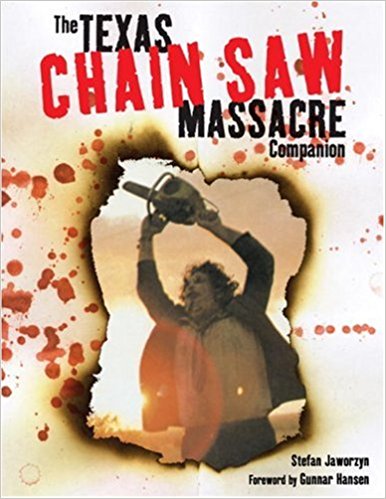
So, how did a group of hippies in Austin come to make one of the most famous movies of all time? That is the question that is answered in the 2004 book, The Texas Chainsaw Massacre Companion. Written by Stefan Jaworzyn and featuring a foreword by Gunnar Hansen, this breezy and entertaining book contains almost everything you could possibly want to know about this film. The book is largely an oral history, featuring lengthy quotes from the film’s cast and crew. (For the most part, Jaworzyn allows the interviews speak for themselves and only occasionally interjects any editorial commentary.) Along with detailing the film’s infamously difficult production (with Marilyn Burns nearly being driven to the point of an actual breakdown and Hansen, an otherwise sensitive poet, coming close to being possessed by his murderous character at one point), the companion also deals with crimes of Ed Gein and Tobe Hooper’s career both before and after his best known film.
Most interesting, to me, were the sections that dealt with how the head of the Texas Film Commission helped to secure The Texas Chainsaw Massacre a national distribution deal. Considering that The Texas Chainsaw Massacre basically portrayed Texas as being a place where you could get killed if you made a wrong turn, the involvement of the Texas Film Commission may seem strange at first. Some of the interviews in the book seem to suggest that the head of the Commission had a crush on Marilyn Burns.
It’s an entertaining book, even if I don’t agree with everything that Jaworzyn says. (He calls Psycho overrated at one point.) With the recent deaths of Marilyn Burns, Gunnar Hansen, and Tobe Hooper, The Texas Chainsaw Massacre Companion now serves as something of a tribute to these three artists and the film that, to the surprise of everyone, changed cinema forever.
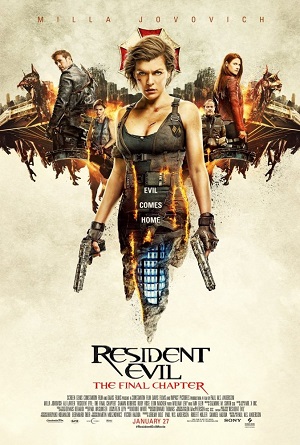
There’s a long tradition of venerable horror franchises claiming that their latest installment is “the final chapter.” The Friday the 13th franchise declared that the fourth part would be the final chapter and then promptly announced that part five would be a new beginning. As long as a franchise is still making a profit, nothing truly ends. Resident Evil: The Final Chapter basically admits that at the end of its final chapter, when one of the surviving characters literally announces that the mission is not over.
Anyway, Resident Evil: The Not-So Final Chapter will probably seem totally incoherent to anyone who has not watched the previous film. To be honest, even though I’ve seen the other Resident Evil films, I always have a hard time working my way through the franchise’s dense mythology. There are times when I suspect that, much like the Underworld films, the Resident Evil films were specifically designed to mess with my ADD. That said, the Resident Evil franchise has never made a secret about being more concerned with spectacle and action than with narrative coherence. If you’re the type who obsesses of the lack of logic and plausibility in a horror-action film based on a video game, then you’re not the right audience for Resident Evil.
The Final Chapter finds Alice (Milla Jovovich) right where the previous Resident Evil film left her, in the ruins of the White House. The world is still zombiefied and monsterfied, all as a result of the nefarious work of the Umbrella Corporation. Alice is contacted by the Red Queen (Ever Gabo Anderson), who explains that Alice needs to return to Raccoon City and invade the Hive before Umbrella releases yet another virus. Alice travels back the Hive, which leads to several of Resident Evil‘s trademark, over-the-top action sequences. Along the way, a lot of familiar faces pop up. Alice is reunited with Claire (Ali Larter). Dr. Alexander Isaacs (Iain Glen) shows up, explaining that the Isaacs who Alice killed a few movies ago was actually just a clone. (No one ever dies in Resident Evil. Instead, they just get cloned.)
Of course, Albert Wesker returns as well. Ever since Resident Evil: Afterlife, Wesker has been played by a Canadian actor named Shawn Roberts. Watching The Final Chapter, it took me only a few seconds to realize that Shawn Roberts also played Dean the Rapist in five episodes of Degrassi: The Next Generation. That storyline, in which Dean raped Paige and it then took two years (and two seasons) for the case to go to trial just to end with Dean getting acquitted and smirking at Paige as he left the courtroom, remains one of Degrassi‘s most powerful storylines. Roberts uses that same smirk while playing Wesker.
Paul W. S. Anderson returns to direct The Final Chapter. Though Anderson seems to be destined to be best known as “that other director named Paul Anderson,” he’s actually pretty good when it comes to directing nonstop action. (For the record, I thought Anderson’s Pompeii was a sadly underrated film.) The Final Chapter is fun and silly as long as you don’t waste any time to thinking about it and Anderson keeps the action coming so quickly that you literally don’t have time to worry about whether or not the movie makes any sense. The film’s prologue, in which a boy gets zombiefied on a cable car, was actually pretty exciting and a reminder of the visceral horror that it is at the heart of all zombie films.
Resident Evil: The Final Chapter was released in January and, despite some decidedly mixed review, it became the highest grossing film in the franchise. In other words, this is definitely not the final chapter…
Lou Cherney (Robert Forster) was a top police detective until a perp with a shotgun shattered his leg. Now, Lou’s a private investigator with a limp, a girlfriend (Caren Kaye), and a learning disabled son named Joey (Philip Glasser). When Lou is hired to track down a missing girl, he discovers that she is now the lover of Nicole St. James (Lydie Denier), the head of a modeling agency. Nicole seduces Lou within minutes of meeting him but, when Lou attempts to return the missing girl to her family, Nicole reveals that she is actually an ancient demon and she possesses Joey. Soon, Joey is carrying an ice pick and throwing people out of windows.
An example of the type of movies that Robert Forster was stuck making before Quentin Tarantino engineered his comeback with Jackie Brown, Satan’s Princess is also noteworthy for having been directed by Bert I. Gordon. Gordon is best known for making cheesy giant monster movies, like The Amazing Colossal Man, Beginning of the End, and Empire the Ants. There are not any giant monsters in Satan’s Princess, which instead emphasizes lesbian sex scenes, possessed children, and Robert Forster using a blowtorch to take on a demon. Satan’s Princess also features the spectacle of a demon fleeing the scene of a crime by stealing a car. Why a demon who can possess people and do almost anything would need to steal car in order to make escape is a question that Satan’s Princess never answers.
Satan’s Princess is even dumber than it sounds but Robert Forster delivers. There is no real reason for Lou to be crippled so I like to think that, one day, Forster announced that if he was not allowed to carry a cane in all of his scenes, he wouldn’t do the movie. Watching Forster give a good performance in even a piece of dreck like Satan’s Princess makes me all the more grateful that Tarantino cast him in Jackie Brown and allowed Forster the chance to once again appear in movie worthy of his talents.
Bert I. Gordon’s career as a filmmaker began in 1954. Satan’s Princess was his 23rd movie and, for over 20 years, it was also his last. In 2014, Gordon finally returned to directing with Secrets of a Psychopath.
The Monster is 2-minute silent film from 1903. Directed by the pioneering French filmmaker, Georges Méliès, The Monster tells the story of an Egyptian prince who brings the dead body of his wife to a sorcerer who apparently likes to hang out in front of The Sphinx. The sorcerer attempts to bring her back to life and, as so often happens in any film directed by Georges Méliès, things don’t quite go as planned.
In my opinion, this is one of the most charming of Georges Méliès’s surviving films. From the simple but crudely effective camera trickery to the nicely surreal Sphinx in the background, The Monster is a chaotic delight.
Seriously, I’ve seen all five of the Underworld films and I’m still not quite sure what’s going on. That’s odd because, in every film, Selene (Kate Beckinsale) spends a good deal of time explaining what has happened and why it’s happened. And yet, every time I try to listen, I’m usually left even more confused than usual. I can’t help it. As soon as I hear someone say, “The war between lycans and vampires,” I zone out.
So, I’ll admit it. I’m the person who, after the movie, is always asking, “Is Selene still a vampire? Why are the lycans and the vampires at war? Oh, wait — that was Selene’s daughter? Why would they want to create a hybrid? So, are they in the real world or are they in an alternate world? Is this movie taking place in the past or the future? Why can’t they just call them werewolves? Wait — that character died? When did that happen?”
What’s funny is that, even though I can never understand what exactly is going on, I still tend to enjoy the Underworld films. It’s not that I think they’re great movies and, to be honest, I tend to forget about them within a day or two of watching them. But, that being said, the Underworld films typically have style to burn and Kate Beckinsale always kicks ass as Selene. Every time I watch an Underworld film, I find myself trying to do slow-motion spin kicks. The Underworld franchise has led to me spraining my ankle more than a few times.
Underworld: Blood Wars, the latest installment in the franchise, was released in January and it played for a few weeks before vanishing from theaters and most people’s minds. It says something about the way the Underworld films are perceived that the latest installments are almost always released in January, a month when most movie goers are more concerned with getting caught up with the Oscar nominees as opposed to seeing new releases. Obviously, the Underworld franchise has made enough money to justify five films. (A sixth installment is currently in pre-production.) But, at the same time, no one will ever mistake this franchise for the MCU. Indeed, in most franchises, the challenge is to make each film bigger and more extravagant than the last. The Underworld movies tend to take the opposite approach. Even by Underworld standards, Blood Wars looks cheap. The entire film takes place in darkness, in castles that look like they’ve been constructed for a community theater production of The Lion in Winter.
Blood Wars starts out with Selene narrating a lengthy recap of the story so far. I tried to pay attention to the recap but as soon as Selene said, “lycans and vampires,” my ADD kicked in and I started playing with my phone. As far as I can tell, in Blood Wars, a member of the Vampire Council named Semira (Laura Pulver) offers to give Selene clemency if Selene will come to her castle and train a new generation of Death Dealers. However, it’s all a trick because Semira actually just wants to drink Selene’s blood and gain all of her powers. Meanwhile, the lycans want to get Selene because they’re trying to track down Selene’s daughter because apparently, they can use her to create some sort of hybrid creature that will allow them to finally destroy the vampires. Meanwhile, there’s a bunch of Nordic vampires running around and they’re all blonde because they’re Nordic. (I do have to admit that part of the film made me laugh. It’s as if the filmmakers said, “What can we do to make sure everyone knows that these are Nordic vampires? Wait a minute! Scandinavia. Blonde hair. I’m getting something here!” If it had been an Irish coven, I assume they all would have had red hair. And if it had been a Texas coven, they all would have been wearing cowboy hats.) As usual, the whole thing leads to a big vampire/lycan battle. Blood spurts. Heads are ripped off of bodies. All in all, it’s a typical Underworld film.
The film is largely forgettable and the plot is borderline incoherent but Kate Beckinsale still gives a remarkably committed performance. As opposed to Daniel Craig in the latest Bond film, Kate Beckinsale still seems to be somewhat invested in her most famous role. In typical Underworld fashion, Blood Wars doesn’t offer anything new but, at the same time, it also doesn’t demand much from the audience.
“Sit back and relax,” the film says, “nothing really matters anyway.”
Terror Tales was originally published by Popular Publications. The first issue was published in September 1934. One of the most successful horror magazines, it was joined shortly afterwards (1935) with its sister horror pulp, Horror Stories, also from the same publisher. Some of the writers whose work appeared in Terror Tales included E. Hoffmann Price, Wayne Rogers, Wyatt Blassingame (who later wrote nonfiction books for children), Ray Cummings, Paul Ernst, Arthur Leo Zagat and Arthur J. Burks. Rudolph Belarski provided several covers for the magazine. Terror Tales ceased publication in March 1941.
Below are just a few covers from Terror Tales. When possible, the cover artist has been identified:
4 Shots From 4 Films is just what it says it is, 4 shots from 4 of our favorite films. As opposed to the reviews and recaps that we usually post, 4 Shots From 4 Films is all about letting the visuals do the talking.
This October, I am going to be using our 4 Shots From 4 Films feature to pay tribute to some of my favorite horror directors, in alphabetical order! That’s right, we’re going from Argento to Zombie in one month!
Today’s director is Roy Ward Baker, one of the masters of Hammer and Amicus horror!
4 Shots From 4 Films
Quatermass and the Pit (1967, dir by Roy Ward Baker)
Today’s horror film is a true classic of its kind, the 1953 science fiction epic Robot Monster.
Now, I should admit that this is not the first time that I’ve shared Robot Monster in October. I share it every year and, every year, YouTube seems to pull the video down in November. That sucks because Robot Monster is one of those weird films that everyone should see. So, I’m going to share it again. And, hopefully, YouTube will let the video stay up for a while.
As for what Robot Monster is about…
What happens with the Earth is attacked by aliens? Well, first off, dinosaurs come back to life. All of humanity is killed, except for one annoying family. Finally, the fearsome Ro-Man is sent down to the planet to make sure that it’s ready for colonization. (Or something like that. To be honest, Ro-Man’s exact goal remains a bit vague.)
Why is Ro-Man so fearsome? Well, he lives in a cave for one thing. He also owns a bubble machine. And finally, perhaps most horrifically, he’s a gorilla wearing a diver’s helmet. However, Ro-Man is not just a one-dimensional bad guy. No, he actually gets to have a monologue about halfway through the film in which he considers the existential issues inherent in being a gorilla wearing a diver’s helmet.
Can humanity defeat Ro-Man? Will Ro-Man ever get his intergalactic supervisor to appreciate him? And finally, why are the dinosaurs there?
All of those questions, and more, are cheerfully left unanswered but that’s a large part of this odd, zero-budget film’s considerable charm. If you’ve never seen it before, you owe it to yourself to set aside an hour and two minutes in order to watch it.
Can you believe it? The first day of Horrorthon is nearly over! I’ve got tears in my mismatched eyes.
You may remember, from previous horrorthons, that I like to end each day in October by sharing a classic example of televised horror. Much as with the the horror movies that I share at the start of each day, it should be remembered that I’m a bit at the whim of YouTube here. If YouTube decides to yank down a video after I share it on this site, there’s nothing that I can do about it. That’s why I encourage everyone to watch these now! Don’t wait until 2024. Who knows if YouTube will even still be a thing in 2024?
Anyway, let’s start things off with The Curse of Degrassi!
This is a special episode of my favorite TV show of all, Degrassi! Originally airing on October 28th, 2008, The Curse of Degrassi features Degrassi’s main mean girl, Holy J Sinclair (Charlotte Arnold), getting possessed by the vengeful spirit of deceased school shooter, Rick Murray (Ephraim Ellis). Chaos follows! Fortunately, Spinner (Shane Kippel) is around to save the day. As any true Degrassi fan can tell you, only Spinner has a chance against the forces of the undead.
Enjoy!
(Before anyone asks, yes, I did share this same episode last October. What can I say? I really like Degrassi and forcing people to watch my favorite Canadian obsession is a bit of a tradition around here. We’re all about tradition here at the Shattered Lens.)


 Lou Cherney (Robert Forster) was a top police detective until a perp with a shotgun shattered his leg. Now, Lou’s a private investigator with a limp, a girlfriend (Caren Kaye), and a learning disabled son named Joey (Philip Glasser). When Lou is hired to track down a missing girl, he discovers that she is now the lover of Nicole St. James (Lydie Denier), the head of a modeling agency. Nicole seduces Lou within minutes of meeting him but, when Lou attempts to return the missing girl to her family, Nicole reveals that she is actually an ancient demon and she possesses Joey. Soon, Joey is carrying an ice pick and throwing people out of windows.


 Through the Shattered Lens