Clash of the Titans (1981, directed by Desmond Davis)


High atop Mt. Olympus, Zeus (Laurence Olivier) and his fellow Gods look down on Earth and jealously manipulate its citizens.  When Zeus impregnates Danae (Vida Taylor), the daughter of the King of Argos, she and her son Perseus (Harry Hamlin) are banished to sea.  Zeus responds by ordering Poseidon (Jack Gwillim) to release the Kraken.

Years later, when Callibos (Neil McCarthy), the son of the Goddess Thetis (Maggie Smith), destroys all but one of Zeus’s flying horses, Zeus transformer Callibos into a tailed monster.  Thetis tries to get her revenge by having Callibos kill Perseus but instead, Perseus chops off Callibos’s hand, comes to possess Pegasus, the last of the flying horses, and also wins the right to marry Andromeda (Judi Bowker).

At the wedding, Cassiopeia (Sian Phillips) declares Andromeda to be even more beautiful than Aphrodite (Ursula Andress).  Big mistake.  Aphrodite demands that Andromeda by sacrificed to the Kraken.  Along with Pegasus, Ammon (Burgess Meredith), Thallo (Tom Pigott-Smith), and robot owl, Perseus goes on a quest to get the snake-haired head of Medusa so he can turn the Kraken into stone.

There’s a lot that I love about Clash of the Titans, from the Ray Harryhausen’s stop-motion special effects to the blind witches who pass one eyepiece among them to Burgess Meredith’s performance as Ammon.  I even like the robot owl.  But the thing that has always made the biggest impression on me is that Mt. Olympus is portrayed as having a shelf that holds a figurine for every human in the world.  The Gods casually move the pieces around and transform them on whims.  Of all the films that have been based on Greek mythology, Clash of the Titans is one of the few that really captures the idea of the Gods essentially being a bunch of petty and jealous libertines who view humans are just being their playthings.

Let’s not overthink Clash of the Titans, though.  The main appeal of Clash of the Titans is that it’s just a good, old-fashioned adventure movie.  In this age of CGI and humorless heroes, it’s hard not love the film’s mix of old-fashion stop-motion animation, strong characters, and occasional moments of humor.  (I like the owl and I won’t apologize for it.)  Also, Medusa has appeared in a lot of movie but she’s never been scarier than in this movie.  Who can forget the yellow glow of her eyes, followed by men turning to stone?  Who can forget the hiss of her tail or the moment when Perseus waits to strike while trying not to look into her eyes?  Beyond Medusa, who can forget the Kraken rising from the sea or the blood of Callibos giving birth to giant scorpions?  Without CGI, Clash of the Titans still captures the feel of living in a different time and a different land.  Clash of the Titans brings mythology to life in a way that few other films have been able to,

I loved the original Clash of Titans when I was a kid.  I rewatched it last month and I happy to say that I love it still.

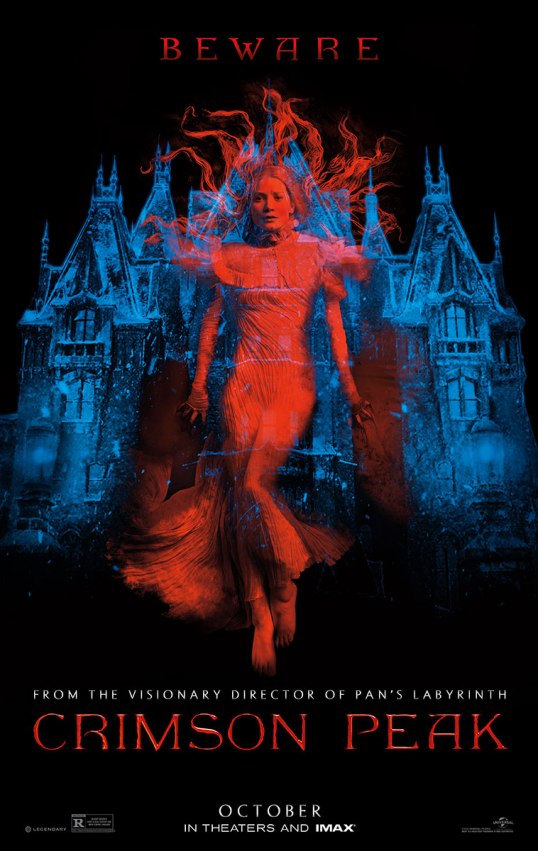
Horror Scenes That I Love: Crimson Peak


Since it’s Guillermo Del Toro’s birthday, it just seems appropriate that today’s horror scene that I love should be one of my favorite scenes from one of my favorite Del Toro movies.

Here’s the opening of 2015’s haunting (and, in my opinion, underrated) Crimson Peak!

October True Crime: Guilty Until Proven Innocent (dir by Paul Wendkos)


This 1991 made-for-TV movie opens with a murder in a Brooklyn park.  The year is 1979 and a group of teenagers are accosted by two men carrying guns.  The men rob the teenagers of their drugs and guns.  One person is killed.  When the police arrive, almost everyone says that it was too dark to see anything.  However, a 15 year-old named Jimmy O’Neill (Tristan Tait) says that he saw the faces of the men.

At the police station, the detective (Mark Metcalf) shows him a picture of a man named Billy Ferro (Zachary Mott) and Jimmy identifies him as one of the gunmen.  The detective then produces a picture of a 19 year-old named Bobby McLaughlin (Brendan Fraser) and asks if Bobby was the other man.  When Jimmy hesitates, the detective says that McLaughlin has been arrested with Billy in the past.

Of course, the truth of the matter is that, while Bobby has been arrested in the past, he’s never been arrested for anything as serious as murder and he’s never met Billy Ferro.  The man who had been arrested in the past with Ferro was named Harold McLaughlin.  The detective accidentally grabbed the wrong picture.

Bobby, a high school drop-out who lives with his foster parents (played by Martin Sheen and Caroline Kava), is arrested and charged with second degree murder.  It doesn’t matter that Bobby passes a polygraph because the results are not admissible in court.  It doesn’t matter what Bobby has an alibi because the prosecutor portrays all of his friends as being a collection of stoners and losers.  It doesn’t matter what Bobby has never even met Billy Ferro because Ferro isn’t going to help anyone out, even someone who he knows is being falsely convicted.  Bobby is convicted of second degree murder and sent to prison.

For the next seven years, while Bobby tries to survive prison, his foster father attempts to prove his son’s innocence.  With the police refusing to help, Bobby’s father is forced to launch his own investigation but it seems like no matter what he discovers, it’s not enough to get Bobby out of prison.  Still, neither he nor Bobby gives up.  Neither one will accept a system in which you’re guilty until proven innocent….

For most people who choose to watch this film, I imagine it will be because of that “Introducing Brendan Fraser” credit.  Fraser gives a very good performance in this film, playing Bobby as basically well-meaning but directionless teenager who finds himself trapped in a nightmare.  Of course, the majority of this film is Martin Sheen yelling about the injustice of it all.  This is the type of crusader role that Sheen has played often.  As was often the case when he was cast in films like this, there’s nothing subtle about Sheen’s performance but it’s not really a role that needs or demands subtlety.

Though this was made-for-television and, as such, is never quite as critical of the system as perhaps it should be (if anything, the film argues that one should trust the system to eventually do the right thing, even if it does so seven years too late), it still shows how one cop’s mistake can ruin an innocent’s man life.  It’s all the more effective because it’s based on a true story.  Of course, I immediately knew the cop shouldn’t be trusted because he was played by Mark Metcalf.  Niedermeyer as a cop?  That’s definitely not going to end well.

4 Shots From 4 Horror Films: 1940s Part One


This October, I’m going to be doing something a little bit different with my contribution to 4 Shots From 4 Films.  I’m going to be taking a little chronological tour of the history of horror cinema, moving from decade to decade.

Today, we take a look at the first few years of 1940s.

4 Shots From 4 Horror Films

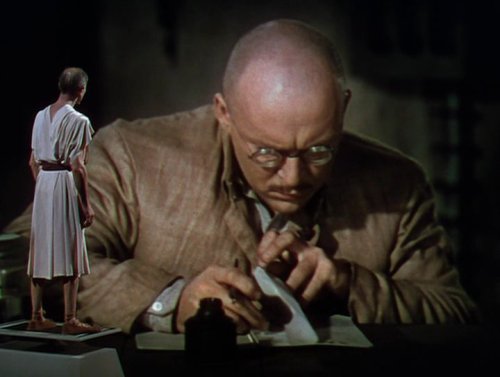
Dr. Cyclops (1940, dir by Ernest B. Schoedsack)

Dr. Cyclops (1940, dir by Ernest B. Schoedsack)

The Wolf Man (1941, dir by George Waggner)

The Wolf Man (1941, dir by George Waggner)

Cat People (1943, dir by Jacques Tourneur)

Cat People (1942, dir by Jacques Tourneur)

I Walked With A Zombie (1943, dir by Jacques Tourneur)

I Walked With A Zombie (1943, dir by Jacques Tourneur)

Horror Film Review: Trilogy of Terror (dir by Dan Curtis)


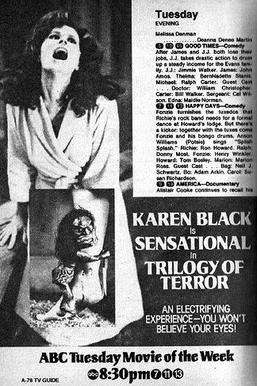
1975’s Trilogy of Terror is a true classic, a rare made-for-television horror film that could have just as easily and effectively been released in theaters.

As one can surmise from the title, it features three stories.  Each story is directed by Dan Curtis and written by Richard Matheson.  Each story also features Karen Black in the lead role, giving Black a chance to play not just one but four very different characters over the course of one film.  One of the things that makes this film work so well is Karen Black’s totally committed performance.  Sadly, Karen Black later expressed some regret about having appeared in the film because it led to her being typecast as a horror actress, which she definitely hadn’t been before.  (One need only watch Karen Black in Five Easy Pieces, Nashville, or Family Plot to see what a good actress she was.  Even in something like Easy Rider, where she had only a small role and very few lines, her talent is obvious.)  As a result, Black was no longer considered for the big studio films that she had appeared in previously and instead, she spent the remained of her career appearing in low-budget horror films.  That’s a shame because Trilogy of Terror really does show what a strong actress Black was.

The first segment features Black as Julie, a seemingly uptight teacher who somewhat surprisingly agrees to go out on a date with Chad (Robert Burton), a sleazy college student.  Chad drugs Julie’s drink during their date and later undresses her and takes pictures which he then uses in an attempt to blackmail Julie into basically being his sex slave.  Julie, however, turns out to have a big secret of her own and Chad discovers too late that he was the one who was being manipulated.  This segment was the least interesting of the three stories but the ending was very satisfying.  Anyone who has ever dated a “nice guy” who turned out to actually be a jerk will enjoy Julie’s revenge.

The second segment is enjoyably sordid, an over-the-top soap opera that I can’t talk too much about without spoiling the plot.  Black plays Millicent, a repressed brunette, who is hatefully obsessed with her twin sister, blonde Theresa (Black again).  Millicent fears that Therese is planning to corrupt and destroy her boyfriend, Thomas (John Karlen).  Millicent explains to her therapist (George Gaynes) all of the terrible things that Therese has done.  Of course, the truth turns out to be much more complicated.  This story was entertaining and featured a surprisingly effective twist.

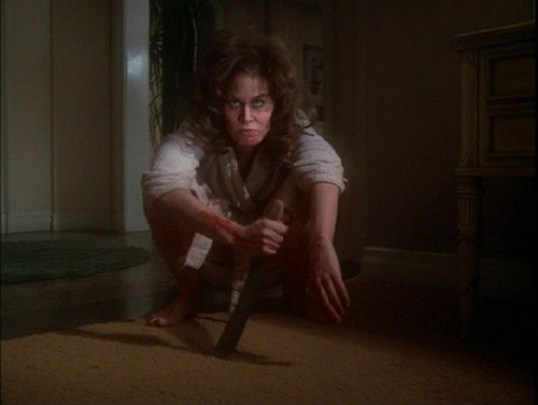
The third segment is the one that everyone remembers.  Amelia (Karen Black) lives alone in a high-rise apartment and has recently purchased, as a present for her anthropologist boyfriend, a wooden fetish doll in the form of a misshapen aboriginal warrior with pointed teeth and a spear.  The doll comes with a scroll that explains that the doll is inhabited by the spirit of a Zuni hunter and that the only thing keeping the doll from coming to life is the gold chain adorning the doll.  Of course, the chain eventually falls off and Amelia finds herself being pursued through her apartment by a viscous doll that is obsessed with killing her.  This is the simplest and the scariest of the Trilogy of Terror’s three stories.  It’s easy to say that it’s just a doll until it pops out of nowhere and stabs Amelia in the ankle.  This story ends on a properly dark note and that final image of Karen Black is haunting.

For a fifty year-old film, Trilogy of Terror holds up remarkably well.  Watch it and witness just how good an actress Karen Black truly was.

Trilogy of Terror (1975, dir by Dan Curtis. DP: Paul Lohmann)

Horror Film Review: The Creation of the Humanoids (dir by Wesley Barry)


Oh, how I love this oddity from 1962.

The Creation of the Humanoids takes place in the 23rd Century.  A nuclear war has wiped out 92% of the human population.  The radiation has caused many of the survivors to become sterile.  The birth rate has plummeted to 1.4% and humanity is at risk of slowly dying out.  The majority of the remaining humans have dealt with this news by becoming lazy and decadent.  They live in luxurious apartments and they basically refuse to do anything themselves.  Instead, all of the work is done by blue-skinned androids, the Humanoids that some dismissively refer to as being “clickers.”  The Humanoids were not designed to have human emotions or thoughts but some appear to be developing them.  The Order of Flesh and Blood want to destroy the Humanoids, especially when they hear rumors that a Humanoid has been created who is indistinguishable from an actual human.  The Order of Flesh and Blood fears that the Humanoids are plotting to take over the world and replace humanity and …. they’re right!

Of course, the film suggests that might not be such a bad thing.  The majority of the humans that we meet in The Creation of the Humanoids don’t seem to have much interest in continuing on with their lives.  Having destroyed most of their civilization with a pointless nuclear war and now being unable to conceive, they seem to be content to laze about and wait for the end to come.  Ironically, the only humans that seem to care about the future of their race are a bunch of fanatics.  The Humanoids may move and speak stiffly but at least they’re making plans for the future and seem to actually care about the world in which they exist.

The Creation of the Humanoids was made for a very low-budget and with only the most rudimentary of sets.  The luxury apartments all look very similar and very simple and yet that adds to the sense of ennui that runs through the entire film.  The same can be said of the costumes, which are largely made up of jumpsuits and Confederate army caps that were reportedly rented from a local costume store.  The drab costumes capture the feel of a society where being creative or imaginative is no longer rewarded and any sign of free thought is considered to be a threat.  It’s the type of society that always seems to follow as a result of the empty promises of Marx and Coca-Cola.  Fortunately, the film’s producers did pay extra so that the film could be shot in color, the better to highlight the blue tint of the Humanoids and the darkness outside of the city. They also wisely hired veteran cinematography Hal Mohr, who brings some visual flair to the project.  Realizing that the film was extremely talky and that it featured characters who didn’t move around a lot, Mohr used creative camera angles and old-fashioned “glamour” lighting to give the film an interesting look.  The film ultimately becomes a work of pop art and it’s not a surprise that Andy Warhol described Creation of the Humanoids as being his favorite film.

I like the film too.  The stilted but philosophical dialogue, the atmosphere of ennui, the casting of Plane Nine From Outer Space’s Dudley Manlove as a Humanoid, and the moment when Dr. Raven (Don Doolittle) breaks the fourth wall to speak directly the audience, it all adds up to something that is wonderfully bizarre and thoroughly unforgettable.

The Creation of the Humanoids (1962, dir by Wesley Barry)

Horror On The Lens: Dementia 13 (dir by Francis Ford Coppola)


1963’s Dementia 13 is a significant film for another reasons.

For one, it’s the mainstream feature film debut of Francis Ford Coppola.  (Coppola has said that he directed two softcore films before Dementia 13 but they’ve been lost to history.)  Both Coppola’s screenplay and his direction were heavily influenced by the early giallo films that were coming out of Italy.  One could argue that this is the first American film to pay homage to Mario Bava.

Dementia 13 is also the first film on which Coppola ever went overbudget.  This film is literally the start of an era.

Coppola himself has been critical of Dementia 13.  Producer Roger Corman was not happy with the first cut of the film and added a few scenes that took away from Coppola’s pacing.  That said, it’s still an atmospheric and creepy forerunner to the American slasher film.  The scene in which Launa Anders goes for a swim has been duplicated in numerous other films and it’s still effective in the way that it chops away at the audience’s sense of security.  It certainly freaks me out.  Of course, I’m not much of a swimmer.  I’m a good drowner, though.

Here is today’s Horror on The Lens, Dementia 13!


Guilty Pleasure #86: The Horror at 37,000 Feet (dir by David Lowell Rich)


I imagine that it should go without saying that, if you’re on an airplane and you’re flying high above the ground, the last thing that you want to deal with is a bunch of angry ghost druids.

And yet, that’s exactly what happens in this made-for-TV horror film from 1973.

The ghost druids are upset because two architects (played by Roy Thinnes and Jane Merrow) have traveled to England, specifically so that they can supervise the deconstruction of ancient druid altar. Now, they’re flying the pieces of the altar back over the ocean so that the altar can be reconstructed in the United States. The spirits of the ancient druids aren’t happy about being moved so they start doing everything they can to make the journey difficult.

First, they attempt to freeze the plane. When that doesn’t work, they decide to rip it in half. One of the passengers, Mrs. Pinder (Tammy Grimes), suggests that maybe the druids will settle down if they’re offered a sacrifice. When the druids reject an offer of a doll, the passengers start to wonder if maybe the spirits would be happier with a human sacrifice.

Although some of the passengers are reluctant to buy into the whole sacrifice thing, a few of them do start to come around. For instance, there’s a perpetually angry businessman who is played by Buddy Ebsen. Once he realizes that the druids aren’t going anywhere, he has no problem with the idea of a human sacrifice. There’s also a cowboy played by Will Hutchins. If sacrificing a human is what he has to do to have another chance to ride the range, that’s what he’s going to do. Paul Winfield plays a distinguished doctor who tries to keep everyone calm while Chuck Connors is stuck in the cockpit, trying to keep the plane in the air while his passengers and crew debate the ethics of human sacrifice.

And then there’s William Shatner.

Shatner plays a former priest who has lost his faith. From the minute he gets on the plane, he starts drinking and he doesn’t stop for almost the entire movie. It doesn’t matter what’s happening on the plane, Shatner always has a glass in his hand. Playing a character who never has anything positive to say, Shatner smirks through the entire film. Shatner delivers all of his lines in his standard halfting and overdramatic fashion and it’s something of a wonder to behold. Shatner has said that The Horror At 37,000 Feet may be the worst movie in which he ever appeared and just one look at his filmography will show why this is such a bold statement.

The Horror at 37,000 Feet is definitely a film of its time. The plane comes complete with a swinging cocktail lounge, William Shatner wears a turtle neck, and all of the flight attendants wear boots and miniskirts. Everything about this film screams 1973. It’s an incredibly silly but undeniably fun movie. With a running time of only 73 minutes, the pace is fast and the druids don’t waste any time getting down to business. The film’s on YouTube so check it out the next time you’ve an hour and 13 minutes to kill.

Previous Guilty Pleasures

  1. Half-Baked
  2. Save The Last Dance
  3. Every Rose Has Its Thorns
  4. The Jeremy Kyle Show
  5. Invasion USA
  6. The Golden Child
  7. Final Destination 2
  8. Paparazzi
  9. The Principal
  10. The Substitute
  11. Terror In The Family
  12. Pandorum
  13. Lambada
  14. Fear
  15. Cocktail
  16. Keep Off The Grass
  17. Girls, Girls, Girls
  18. Class
  19. Tart
  20. King Kong vs. Godzilla
  21. Hawk the Slayer
  22. Battle Beyond the Stars
  23. Meridian
  24. Walk of Shame
  25. From Justin To Kelly
  26. Project Greenlight
  27. Sex Decoy: Love Stings
  28. Swimfan
  29. On the Line
  30. Wolfen
  31. Hail Caesar!
  32. It’s So Cold In The D
  33. In the Mix
  34. Healed By Grace
  35. Valley of the Dolls
  36. The Legend of Billie Jean
  37. Death Wish
  38. Shipping Wars
  39. Ghost Whisperer
  40. Parking Wars
  41. The Dead Are After Me
  42. Harper’s Island
  43. The Resurrection of Gavin Stone
  44. Paranormal State
  45. Utopia
  46. Bar Rescue
  47. The Powers of Matthew Star
  48. Spiker
  49. Heavenly Bodies
  50. Maid in Manhattan
  51. Rage and Honor
  52. Saved By The Bell 3. 21 “No Hope With Dope”
  53. Happy Gilmore
  54. Solarbabies
  55. The Dawn of Correction
  56. Once You Understand
  57. The Voyeurs 
  58. Robot Jox
  59. Teen Wolf
  60. The Running Man
  61. Double Dragon
  62. Backtrack
  63. Julie and Jack
  64. Karate Warrior
  65. Invaders From Mars
  66. Cloverfield
  67. Aerobicide 
  68. Blood Harvest
  69. Shocking Dark
  70. Face The Truth
  71. Submerged
  72. The Canyons
  73. Days of Thunder
  74. Van Helsing
  75. The Night Comes for Us
  76. Code of Silence
  77. Captain Ron
  78. Armageddon
  79. Kate’s Secret
  80. Point Break
  81. The Replacements
  82. The Shadow
  83. Meteor
  84. Last Action Hero
  85. Attack of the Killer Tomatoes

A Blast From The Past: A Trip To The Moon (dir. by Georges Melies)


Let’s celebrate October by taking a trip to the moon with classic film that came out 123 years ago?

Directed and written by Georges Melies, A Trip to The Moon is often cited as the first sci-fi film and the image of the capsule crashing into the eye of the man in the moon is one of the most iconic in film history.  Seen today, the film seems both charmingly innocent and remarkably ahead of its time.

For me, it always takes a minute or two to adjust to the aesthetic of early films.  We’ve grown so used to all the editing tricks that modern filmmakers use to tell their stories that these old silent films, with their lack of dramatic camera movement and obvious theatrical origins, often take some effort to get used to.  Still, the effort is often worth it.

Here then is Georges Melies’s 1902 science fiction epic, A Trip To The Moon.