4 Or More Shots From 4 Or More Films is just what it says it is, 4 shots from 4 of our favorite films. As opposed to the reviews and recaps that we usually post, 4 Shots From 4 Films lets the visuals do the talking!
This October, I’m going to be doing something a little bit different with my contribution to 4 (or more) Shots From 4 (or more) Films. I’m going to be taking a little chronological tour of the history of horror cinema, moving from decade to decade.
Today, we take a look at the late 50s!
8 Shots From 8 Horror Films: The Late 50s
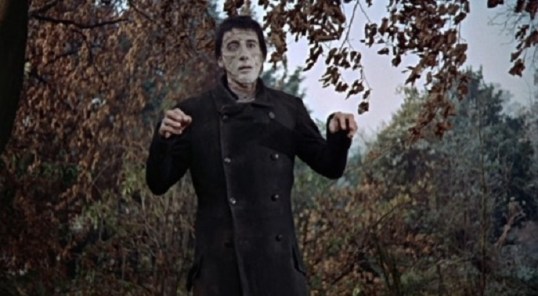
The Curse of Frankenstein (1957, dir by Terence Fisher, DP: Jack Asher)
Plan 9 From Outer Space (1957, dir by Edward D. Wood, Jr., DP: William C. Thompson)
Not Of This Earth (1957, dir by Roger Corman DP: John J. Mescall)
Horror of Dracula (1958, starring Christopher Lee as the Count, Dir by Terence Fisher, DP: Jack Asher)
Night of the Ghouls (1959, dir by Edward D Wood, Jr. DP: William C. Thompson)
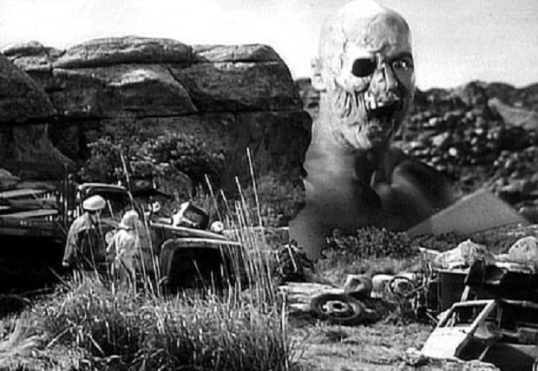
War of the Colossal Beast (1958, dir by Bert I. Gordon, DP: Jack A. Marta)
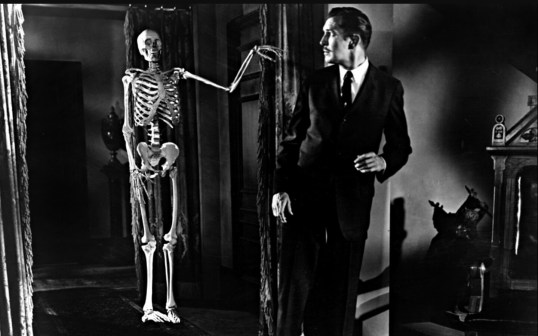
House on Haunted Hill (1959, dir by William Castle, DP: Carl E. Guthrie)
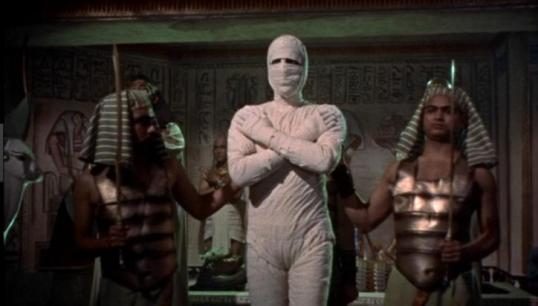
The Mummy (1959, dir by Terence Fisher, DP: Jack Asher)
What to say about the original Children of the Corn?
First released in 1984, this film was based on one of Stephen King’s least interesting short stories. It’s a pretty dumb and poorly-paced movie, featuring villainous puritan children who are more annoying than menacing. The heroes aren’t particularly likable, even if one of them is played by Linda Hamilton. And yet, somehow, Children of the Corn spawned an 11-entry film franchise. (The 11th Children of the Corn film was released in 2020, 36 years after the original.) The original film was remade in 2009 and it continues to be a familiar reference point on the pop cultural landscape. I’ve lost track of the number of Children of the Corn parodies that I’ve seen.
The plot is pretty simple. One day, all of the children in a small rural town get together and kill all the adults. They worship a mysterious entity called He Who Walks Behind The Rows and they sacrifice any adult who is stupid enough to wander into town. The leader of the children is shrill-voiced little twerp named Isaac (John Franklin) and his second-in-command and chief enforcer is the sullen Malachai (played by Courtney Gaies). The children all dress like 1880s settlers and they spend a lot of time staring at each other. Eventually, Malachai overthrows Isaac and ties him to a cross, which leads to a seemingly endless scene of Isaac screeching, “Malachai!” over and over again.
Meanwhile, two adults have accidentally driven into town, Burt (Peter Horton) and his girlfriend, Vicky (Linda Hamilton). They end up running over a child who was trying to flee the cult. They put the body in the trunk of their car and then they kind of forget about it. In their defense, they’ve got a lot to deal with. The children want to sacrifice Vicky and Burt wants to lecture all of the children about how their backwards ways are ruining America. I’m not kidding. This film about children wearing old timey clothes and talking about He Who Walks Behind The Rows tries to convince the viewers that it has a sincere message.
Children of the Corn was not the first movie about killer children but it’s certainly one of the most influential. You have to wonder why because the film itself simply isn’t very good. Beyond the bad acting and the heavy-handed sermonizing, the film’s pacing is all off. A simple story shouldn’t have this many slow spots. Director Fritz Kiersch falls so in love with shots of that haunted cornfield that he forget to use them to tell a compelling story.
And yet, it can’t be denied that there is an audience for this film and the many sequels that followed. I imagine some of it has to do with the fact that people are just fascinated by the idea of evil children. We’re expected to like and forgive the behavior of children, regardless of how obnoxious they may be. Movies like Children of the Corn exploit a real fear that many people have, that children will figure out that they can get away with murder and therefore, they will. It’s a simple and not particularly well-executed idea but it’s one that led to an 11-film franchise so I guess one should never discount the value of keeping it simple.
Today’s Horror on the Lens come to us for director Larry Buchanan.
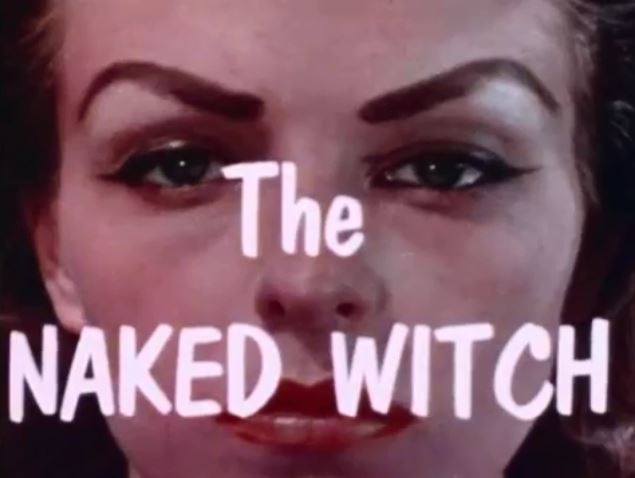
Larry Buchanan was not only born in Texas but he made most of his films here too. In 1964’s The Naked Witch, a college student is doing a research project on the German-speaking villages in Central Texas. It’s while visiting one such village that this idiot accidentally brings an ancient witch back to life. In many ways, this is a typical Buchanan film. The budget is low and the plot is sometimes incoherent. But the film is also fairly atmospheric. In my case, it helps that I’ve actually spent time in Central Texas and I know how creepy things can sometimes get out there.
On tonight’s episode of Ghost Story, Karen Black plays a widow who starts to get mysterious phone calls from a man who sounds just like her late husband. Black later expressed some regret that she ended up getting typecast a horror actress but she definitely did a good job in these roles.
This episode was co-written by Richard Matheson and originally aired on October 6th, 1972.
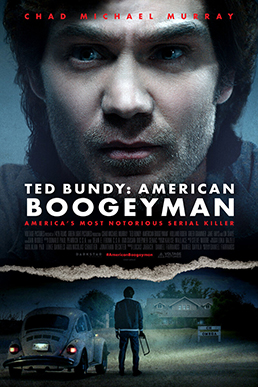
The 2021 film, Ted Bundy: American Boogeyman, is yet another film about the life and crimes of America’s first celebrity serial killer, Ted Bundy.
In this particular film, Bundy is played as being a handsome nonentity by Chad Michael Murray. The film follows Bundy as he moves from Seattle to Utah to Colorado and eventually to Florida, leaving a path of death in his wake. Investigating his crimes are Seattle Detective Kathleen McChesney (Holland Roden) and FBI profiler Robert Ressler (Jake Hays). McChesney not only has to track down Bundy but she also has to deal with her sexist police chief and his idiot son, both of whom think that Bundy’s victims are to blame.
Ted Bundy: American Boogeyman is the latest true crime horror film to be directed by Daniel Farrands. The frustrating thing about Farrands is that, if you can overlook the subject matter of his recent films, he’s actually a talented horror director who knows how to create suspense and who can be counted on to come up with at least one effective jump scare in all of his films. That said, he keeps making films that are almost impossible to defend because they exploit real-life tragedy. Farrands’s best film, The Haunting of Sharon Tate, worked because of Hilary Duff’s committed performance in the title role and the fact that the film itself was fully on Tate’s side. However, Farrands’s The Murder of Nicole Brown Simpson was a tacky piece of exploitation that, despite Farrands’s strong visuals, appeared to have little compassion for the woman whose murder served as the film’s inspiration.
Ted Bundy: American Boogeyman is neither as effective as The Haunting of Sharon Tate nor as bad as The Murder of Nicole Brown Simpson. For the most part, the film plays loose with the facts of the case. At one point, McChesney even shows up at one of Bundy’s crime scenes and takes a shot at him as he flees. (Tarantino also played around with history in Once Upon A Time In Hollywood but, by allowing Brad Pitt and Leonardo DiCaprio to kill the members of the Mason family, he also allowed their victims to live. Ted Bundy: American Boogeyman, on the other hand, is willing to change history to allow McChesney to arrive at the crime scene but it’s not willing to change history to allow any of Bundy’s victims to survive. It’s hard not to feel that the film would have benefitted from following Tarantino’s approach and allowing Bundy’s victims to beat him to death.) There are a few odd scenes in which Bundy is showing fondling several mannequins. The scenes appear to pay homage to William Lustig’s Maniacbut again, it doesn’t seem to be based on anything the actual Bundy did. The film hints at the intriguing idea of Ted Bundy being America’s first celebrity serial killer but it doesn’t really follow up on it. The whole thing feels rushed and rather icky. It certainly doesn’t add any insight into Bundy or killers in general.
That said, our longtime readers know that I hate to end on a totally negative note so I will say that the film uses its low budget to its advantage. The sparse sets and the small cast give the film something of a surreal feel, with Bundy as an evil specter who randomly shows up to haunt the dreams of a nation. Lin Shaye and Diane Franklin appear in small roles. Franklin plays a distraught mom who asks McChesney to kill Bundy rather than arrest him. Shaye plays Bundy’s overprotective mother and gives a nicely creepy performance. As I said earlier, it’s not so much that the film is badly made as the subject matter is so icky and the script is so bereft of any new insight that most viewers will wonder why the film needed to be made at all.
In this work of Interactive Fiction, you take on the role of someone who has just lost their fiancé. You are in mourning and trying to figure out how you can go on with your life even though you’ve lost your reason for living. Staying at home doesn’t help. Going to work doesn’t help. Seeing a therapist doesn’t help. Religion has failed. Group therapy provides only momentary relief.
Then, you find an envelope, addressed to you and in her handwriting. You find the envelope under a park bench that the two of you used to frequent. Unable to open it, you leave it on the mantle next to the wedding invites that you’ll never get to send. (Come on, that’s a powerful image.) Sometimes, the ink on the envelope seems to move, as if the envelope itself is alive. Will you find the courage to open the envelope and see what is inside?
Ink is an enigmatic but intriguing work of Interactive Fiction. I would hesitate to call it a game. It’s a short story that comes with a few options. You can try to make different choices each time that you play but it seems like the story is fated to always reach the same conclusion, no matter how many detours you try to take. The letter, much like mourning, cannot be escaped no matter how much you try. The story is well-written and captures the feeling of being in deep mourning. The inescapable ending carries enough of a kick to stick with you afterwards.
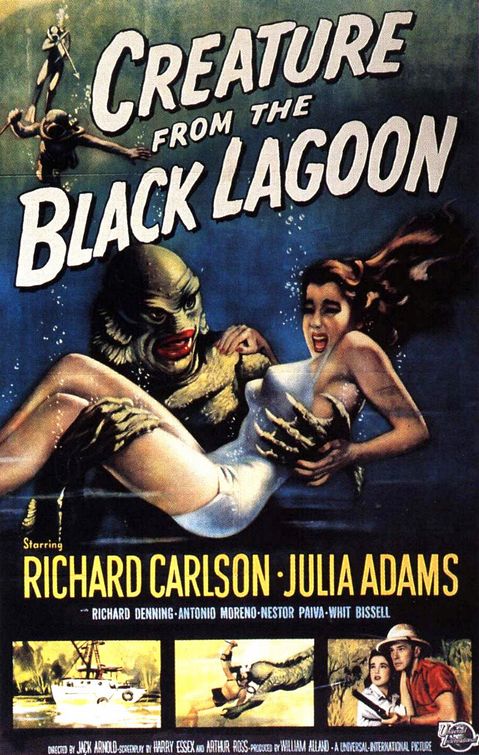
Today’s horror scene that I love comes from one of my favorite films, 1953’s Creature From The Black Lagoon. In this scene, Julia Adams goes for a swim. Little does she realize that, under the water, the Creature is following her every move. Wonderfully directed by Jack Arnold, this creepy yet oddly lovely scene is one of the best of the 50s.
The notorious Dr. Orloff is dying. Orloff was the lead character in director Jess Franco’s The Awful Dr. Orlof. (The spelling of Orlof’s last name changes from film to film.) In the first film, Orlof (played with maniacal relish by Howard Vernon) was a father driven mad by his daughter’s disfigurement. With the help of his mute servant, he murdered women so that he could perform skin transplants in order to give his daughter back her beauty. In Dr. Orloff’s Monster, Dr. Orloff is a more of a generic mad scientist and he is now played Javier de Rivera. Knowing that his time is running out, Orloff passes along his secrets to one of his disciples, Dr. Conrad Jekyll (Marcelo Arroita-Jáuregui).
(In the dubbed American version of the film, Dr. Jekyll’s name is changed to Dr. Conrad Fisherman.)
Dr. Jekyll returns to his own remote Austrian castle. He’s soon joined by his innocent niece Melissa (Agnes Spaak). Melissa is searching for her father, Andros (played by Hugo Blanco). What she doesn’t know is that Dr. Jekyll earlier caught Andros in bed with Jekyll’s wife, Inglud (Luisa Sala). Jekyll murdered Andros. This led to Inglud becoming an alcoholic.
However, thanks to the teachings of Dr. Orloff, Jekyll knows how to bring Andros back to life. Unfortunately, the reanimated Andros is a hulking monster who Conrad uses to kill all of his former mistresses. It turns out that Inglud wasn’t the only one who had trouble sticking to marriage vows. Soon, Inspector Klein (Pastor Serrado) is investigating a growing number of nightclub-related murders. Inspector Klein is also falling in love with Melissa, which has the potential to make things more than a bit awkward.
Dr. Orloff’s Monster (which is also known as The Mistresses of Dr. Jekyll) was Franco’s first sequel to The Awful Dr. Orlof and it was also the tenth film that was he was credited with directing. (As Franco was a prolific filmmaker who used a huge amount of pseudonyms and whose films were often released under several different titles, we will probably never have a definite answer on how many films he actually directed over the course of his long career.) Particularly when compared to Franco’s later films, Dr. Orloff’s Monster seems rather restrained. As always with Franco, there’s a bit of nudity and an emphasis on murder but the violence is rather bloodless and the usual Franco perversions are hinted at without being explicitly shown. Instead, with this film, Franco emphasizes atmosphere over shock. The black-and-white cinematography creates the feel of a perfect noir, with Andros emerging from the shadows to attack his victims and then retreating back into the darkness. This, along with a deliberate pace and Franco’s frequent use of close-ups, gives Dr. Orloff’s Monster the feeling of a languid but menacing dream. With this film, Franco fills the screen with nightmarish ennui.
Unfortunately, the film suffers due to the absence of Franco’s usual villain, the great Howard Vernon. Vernon always brought a hint of old world decadence to his performances and the rather bland Marcelo Arroita-Jáuregui is simply not as interesting as Dr. Jekyll. Despite his death at the start of the film, Dr. Orloff would appear in other Franco films and, fortunately, Howard Vernon would return to play him.
With the arrival of both October and our annual horrorthon, today’s Blast From The Past is here to help us get in the mood with some head action.
In this short film, director Georges Milies plays a magician who can remove his head. Fear not! When he removes his head, another head quickly appears on his shoulder. Pretty soon, our magician has one head on his shoulders and three other heads chatting away on a table. Everything’s fine until it’s discovered that, apparently, the heads aren’t very talented when it comes to singing.
Obviously, today, we know how camera tricks like this are done. We tend to take them for granted. But consider this, when watching The Four Troublesome Heads: this film was made in 1898. At a time when the movies themselves seemed like an act of magic, Georges Melies was removing his head and then trying to perform a song.
Yes, this the same Georges Melies who was played by Ben Kingsley in Martin Scorsese’s Hugo. That’s a great film, by the way. It marks the only time that Christopher Lee appeared in a Scorsese film. Go watch it, if you haven’t already.






 Through the Shattered Lens