6 Shots From 6 Films: Special Clive Barker Edition


4 (or more) Shots From 4 (or more) Films is just what it says it is, 4 (or more) shots from 4 (or more) of our favorite films. As opposed to the reviews and recaps that we usually post, 4 (or more) Shots From 4 (or more) Films lets the visuals do the talking.

Today, we wish a happy 71st birthday to writer and occasional director Clive Barker!  Barker’s stories have provided the basis for several films and Barker himself attempted to build a career of his own as a filmmaker.  Though he pretty much retired from directing after the box office failure of Lord of Illusions, he still has a better directorial track record than Stephen King and his films (along with his stories and his novels) continue to influence new horror storytellers.

Today, we honor both the birthday and the cinematic career of Clive Barker with….

6 Shots From 6 Clive Barker Films

Salome (1973, dir by Clive Barker)

The Forbidden (1978, dir by Clive Barker)

Hellraiser (1987, dir by Clive Barker, DP: Robin Vidgeon)

Nightbreed (1990, dir by Clive Barker, DP: Robin Vidgeon)

Candyman (1992, dir by Bernard Rose, DP: Anthony B. Richmond, based on a short story by Clive Barker)

Lord of Illusions (1995, dir by Clive Barker, DP: Ronn Schmidt)

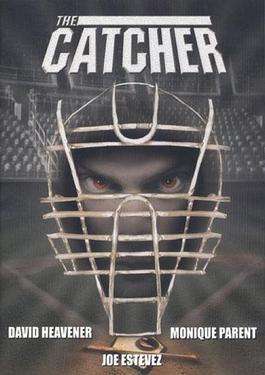
So, I Watched The Catcher (1999, dir. by Guy Crawford and Yvette Hoffman)


I should have known what I was getting into as soon as my sister told me, “You’ll like this, it’s a baseball movie!”

The Catcher is a movie about a little boy who goes crazy when his baseball-obsessed Dad makes fun of his swing.  The boy beats his father to death with a baseball bat.  Years later, catcher David Walker (David Heavener) is told that his contract with the Devils baseball team will not be renewed.  Someone dressed as a catcher starts to murder players, coaches, and one commentator, using baseball equipment as his weapon.  I could have gone my entire life without seeing the scene where one player is sodomized with a baseball bat.  But even if that’s your thing, The Catcher is slow and the acting’s terrible.  I had a hard time buying the idea of a killer catcher.  Outfielders move a lot quicker.  Why does my sister recommend these films to me and why do I watch them?

One thing that I did appreciate about this movie is that, for once, it was only men being killed by the masked maniac.  I get so tired of horror movies that were obviously made by men who never got over being turned down for a date in high school.  The Catcher was a change of pace as far as that’s concerned but otherwise, I wish I had not watched this film.

Horror Film Review: Elevator Game (dir by Rebekah McKendry)


If nothing else, Elevator Game does open with a truly chilling sequence.

A teenage girl named Becki (Megan Best) boards an elevator in an office building.  She’s playing a game, one that, if played correctly, will lead her to the spirit world but, if played incorrectly, will lead to her being torn apart by the spirit of an evil woman.  Why exactly anyone would want to play this type of game, I’m not sure.  I mean, I wouldn’t play it and I don’t even believe in ghosts or spirit worlds.

Anyway, Becki travels from floor to floor, in a specific, pre-determined order.  When she reaches the 5th floor, she is to keep her eyes shut from the moment the elevator doors open until they close.  When she opens her eyes, she is not to look to see if anyone is standing behind her.  It’s on the fifth floor that the game player is supposedly joined by the Fifth Floor Woman.  The Fifth Floor Woman apparently doesn’t have anything better to do than to kill anyone who fails to follow the rules of the game.  It seems like kind of a boring existence.  I mean, if I was the Fifth Floor Woman, I would have an existential crisis about having to spend my entire “life” enforcing the arbitrary rules of an elevator game but again, some people are just really into rules.  Some people have a panic attack if there isn’t a clearly defined rule book for them to follow and I guess that’s just as true among the dead as among the living.  As for Becki, she does keep her eyes closed on the fifth floor but then she makes the mistake of using her phone to check over her shoulder, which gets her in trouble with the Fifth Floor Woman.

Again, the entire opening sequence is very well-done and suspenseful, with Megan Best immediately earning our sympathy as Becki.  The scene where she reaches the fifth floor is genuinely scary, as is the moment when we realize that she is no longer alone on the elevator.  Unfortunately, the opening is so strong that the rest of the film has a difficult time topping it.

After Becki disappears, her brother Ryan (Gino Anania) gets an internship with a group of streamers who film themselves investigating paranormal rumors and visiting places that are supposedly haunted.  They play “scary games in scary places,” but they’ve also managed to tick off their only advertiser and now they desperately need to film something quick and on the cheap.  Ryan, without bothering to share his personal connection to the case, tells them about what happened to Becki and he encourages them to film themselves playing the elevator game.  Ryan is hoping that they can help him find Becki and, it’s hinted, he also wants revenge against of the streamers, Kris (Alex Russo), because Kris is the one who told Becki about the elevator game in the first place.  The streamers play the game but, instead of finding Becki, they instead bring the Fifth Floor Woman into their world.  Death follows.

Elevator Game suffers from a lack of compelling characters.  The streamers are all clichés and not even Ryan is a particularly likable character.  I mean, you really do have to wonder just what exactly Ryan thought would happen when he tricked a bunch of other people into playing the same stupid game that Becki played.  Why did he believe that dragging all of them into it would somehow make it easier to him to find Becki?  Once people start dying, it’s pretty much Ryan’s fault and it’s hard not to get annoyed with the fact that no one really seems to call him out on it.  If anything, Ryan’s actions were so selfish that one could argue that he’s as much of a villain as the Fifth Floor Woman, despite the film’s attempts to portray him as being a loving brother.

That said, there are a few effectively creepy sequences and the scene where Ryan visits the so-called “Red World” was extremely well-done and vividly visualized.  Even though the film tests just how many times a viewer can be expected to watch people ride an elevator from one floor to another, I’ll admit that my heart started to beat a little bit harder whenever anyone stopped at the fifth floor.  “You forgot to shut your eyes!” I yelled at the screen at one point.  Of course, it didn’t do any good.  Rules are rules.

Elevator Game is currently streaming on Shudder.

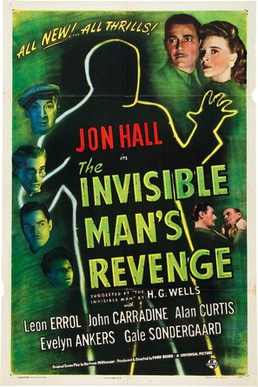
Horror Film Review: The Invisible Man’s Revenge (dir by Ford Beebe)


1944’s The Invisible Man’s Revenge opens with Robert Griffin (Jon Hall) arriving in England.

Despite his last name and the fact that he’s played by the star of Invisible Agent, this Robert Griffin would not appear to be in any way related to the previous invisible men.  Instead, he is someone who has just escaped from a mental institution in South Africa.  He has already murdered two orderlies and now, he’s come to England to take vengeance on Sir Jasper Herrick (Lester Matthews) and his wife, Lady Irene (Gale Sondergaard), two old friends who the paranoid Robert thinks tried to kill him in Africa so that they could steal his money.  When Robert sees Sir Jasper and Lady Irene, he informs them that they can either give him half of their fortune or they can allow him to marry their daughter, Julie (Evelyn Ankers).  Lady Irene responds by drugging Robert and having him kicked out of the house.

Dejected, Robert eventually comes across the cottage of Dr. Peter Drury (John Carradine, giving a surprisingly low-key performance in the mad scientist role).  Dr. Drury reveals to Robert that he has developed a serum that can turn living things invisible.  Drury goes on to “show” Robert all of the invisible pets that he has hanging out around the cottage, from an invisible dog to an invisible parrot.  When Robert asks how long the invisibility lasts, Drury says that it will last until the invisible person dies.  That sounds pretty good to Robert so he volunteers to be Drury’s latest test subject.

Soon, Robert is invisible and going out of his way to haunt that Herrick family.  Some of Robert’s antics are merely playful.  He helps a cobbler (Leon Errol) win a game of darts and later turns the man into his personal servant.  Robert’s other actions are a bit more destructive.  Robert, after all, was a murderer to begin with and using a serum that cause additional insanity is definitely not helping him with his temper.  When Robert decides that he wants to be visible again, he discovers that there’s only one temporary way to do it and it involves a lot of blood.

After being portrayed as being a hero in Invisible Agent, The Invisible Man is once again a villain in The Invisible Man’s Revenge and it just feels right.  There’s just something inherently sinister about the idea of someone being invisible.  Jon Hall, who was so boring in Invisible Agent, is far more compelling here, playing Robert as a paranoid megalomaniac who has so convinced himself of his own cleverness that he can’t even understand that he’s writing the script for his own downfall.  This is a good, solid Universal horror movie.  The true hero of the movie is Drury’s dog, played by a talented canine actor named Grey Shadow.  It takes more than invisibility to fool that dog!

Previous Universal Horror Reviews:

  1. Dracula (1931)
  2. Dracula (Spanish Language Version) (1931)
  3. Frankenstein (1931)
  4. Island of Lost Souls (1932)
  5. The Mummy (1932)
  6. The Invisible Man (1933)
  7. The Bride of Frankenstein (1935)
  8. Dracula’s Daughter (1936)
  9. Son of Frankenstein (1939)
  10. The Invisible Man Returns (1940)
  11. The Wolf Man (1941)
  12. Ghost of Frankenstein (1942)
  13. Invisible Agent (1942)
  14. Frankenstein Meets The Wolf Man (1943)
  15. Son of Dracula (1943)
  16. House of Frankenstein (1944)
  17. House of Dracula (1945) 
  18. Creature From The Black Lagoon (1954)

Horror on the Lens: Phantom Ship (dir by Denison Clift)


In December of 1872, a sailing ship called the Mary Celeste was found adrift and deserted in the Atlantic Ocean.  When the ship left New York in October, it had a captain and a full crew.  The captain’s wife was among the passengers sailing on the ship.  When the Mary Celeste was discovered, not only was no one on board but there was no evidence as to where everyone had gone or what caused them to abandon the ship in the first place.  The crew of the Mary Celeste appeared to have vanished into thin air and none of them were ever seen again.

As you might guess, this led to years of speculation about what happened.  Some people blamed pirates.  Some blamed food poisoning.  Some blamed ghosts and sea monsters.  More modern theorists have blamed UFOs.

First released in 1935 and originally entitled The Mystery of the Mary Celeste, Phantom Ship offers up a theory of its own.  It speculates about what happened during the final voyage of the Mary Celeste and why its crew vanished.  One of the members of the crew is played by Bela Lugosi.  Lugosi was still riding high from his starring role in Dracula when he starred in Phantom Ship and, playing a veteran sailor who appears to be a bit unstable, Lugosi gives an enjoyably over the top performance.  Admittedly, Phantom Ship has its slow spots and, at times, it threatens to get bogged down in a subplot about the love triangle involving the Captain, his wife, and the Captain’s best friend.  But Lugosi makes the film worth watching and, towards the end, there are some wonderfully atmospheric shots of the nearly deserted ship.

Along with being one Lugosi’s non-Dracula horror films, Phantom Ship is also well-known for being one of the first films to be produced by the British film company that would eventually become known as Hammer Pictures.

Enjoy!

Music Video of the Day: Devil Woman by Cliff Richard (1976, directed by ????)


In a song that was a definite change of pace from his usual work, Cliff Richard sings about how he became cursed after seeing a black cat with yellow eyes.  Cliff went to a fortune teller, asking her to lift the curse but it turned out that the fortune teller was the one who cursed him in the first place!

This song was Cliff Richard’s biggest hit in the U.S.  It undoubtedly helped that the song came out while America was still in the grips of Exorcist fever.

The ultimate message is that if it can happen to Cliff Richard, it can happen to anyone.

Enjoy!

Late Night Retro Television Reviews: Monsters 1.1 “The Feverman”


Welcome to Late Night Retro Television Reviews, a feature where we review some of our favorite and least favorite shows of the past!  On Wednesdays, I will be reviewing Monsters, which aired in syndication from 1988 to 1991.  The entire show is streaming on Youtube.

Monsters was an anthology series that ran, in syndication, from 1988 to 1991.  It was produced by Richard Rubinstein and Mitchell Galin, who had previously produced another anthology series called Tales From The DarksideMonsters, unlike Tales, almost exclusively focused horror stories and, as the title suggests, each story featured at least one monster.  As well, each episode opened with a family of monsters sitting around a television and looking for something to watch.

Sounds like fun!  I’m looking forward to watching and reviewing this series for Through the Shattered Lens.

Episode 1.1 “The Feverman”

(Dir by Michal Gornick, originally aired on October 22nd, 1988)

Timothy Mason (John C. Vennema) is in a panic because his daughter (Michele Gornick) has a contracted a fever and is now on the verge of death.  When Mason’s friend, Dr. James Burke (Patrick Garner), is unable to lower the girl’s fever, Mason decides to take her to see the Boyle (David McCallum), the feverman.  A disreputable fellow who is never seen without a glass of liquor in his hand and a dingy crystal hanging out around his neck, Boyle claims that he can pull fevers out of those suffering.  He charges a good deal of money for his services but he also claims that, unlike the doctors of the world, he’s never lost a patient.  Indeed, Boyle claims that, if anyone brought to him died, he would die as well.

Burke goes with Mason to Boyle’s house and, when Boyle announces that he must be alone with Mason’s daughter in order to cure her, Burke denounces him as being a charlatan.  Still, Mason agrees to leave his daughter alone with Boyle in Boyle’s basement.  However, as Burke and Mason wait for Boyle to return from the basement, they grow impatient and Burke pressures Mason to disobey Boyle’s orders.  Finally, Burke and Mason head into the basement and that’s where they catch Boyle wrestling with this thing….

It turns out that Boyle wasn’t lying when he said that he could literally bring the fever out of a patient.  However, when Burke and Mason interrupt him, that allows the fever monster to once again reenter Mason’s daughter.  The crystal necklace falls off Boyle’s neck.  Boyle explains to Burke that he is now dying and he can no longer fight the fever.  And, because it’s all Burke’s fault, it is now Burke’s obligation to wear the crystal and battle the fever.

Realizing that he’s at fault, Burke puts on the crystal and he wrestles with the fever monster.  Burke manages to destroy the monster but, afterwards, he discovers that he cannot take the crystal off.  As Boyle explains it, Burke is the new feverman and he will now wear the crystal until the day he dies.  Mason, happy that his daughter is now cured, still refuses to stick around to talk to Burke afterwards.  Burke is now an outsider.  Resigned to his fate, Burke starts drinking and prepares to meet his next patient.

This was an effective episode, featuring a wonderfully dissolute performance from David McCallum as Boyle and plenty of grimy atmosphere.  Maybe it’s just because I’m still getting over having the flu last week but the fever monster totally freaked me out.  I imagine that creature probably is what a fever really would look like.  This episode was the exact right way to start things off for Monsters!
Horror on TV: The Hitchhiker 4.7 “The Legendary Billy B” (dir by Chris Thomson)


At the tail end of the 60s, the so-called king of acid rock, guitarist Billy Baltimore (Brad Dourif) was assassinated on stage.  Or was he?  When tabloid journalist Jane L. (Kirstie Alley) is told by her morally conflicted photographer, Hodie (Andy Summers of the Police), that he believes Billy Baltimore faked his own death and is actually living in a mansion and plotting his comeback, Jane L. decides to break into the mansion and find out for herself.

That turns out to be a big mistake.  But, as badly as things go for Jane L. and Hodie, this is an entertaining episode that features Kirstie Alley at her most neurotic and Brad Dourif at his most off-beat.  The ending might not make much sense but the journey is still worth it.  For the record, the Hitchhiker (Page Fletcher) really does not like tabloid reporters.

The episode originally aired on March 31st, 1987.

October Hacks: Sorority House Massacre (dir by Carol Frank)


The 1986 film, Sorority House Massacre, tells the story of two people who share a psychic bond.

Beth (Angela O’Neill) is a college student who can’t remember anything about her childhood and who was raised by her aunt.  After her aunt dies, Beth joins a sorority and moves into their house.  Almost from the minute that she arrives, Beth starts to have disturbing visions and dreams of a man with a knife and blood dripping from the ceiling.  With most of the members of the sorority leaving for the Memorial Day weekend, Beth ends up staying with Linda (Wendy Martel), Sara (Pamela Ross), and Tracy (Nicole Rio).  The other girls want to have a fun weekend but instead, they find themselves dealing with Beth and her glum attitude.  Linda and Sara sincerely want to help.  Tracy is a bit annoyed with the whole thing and I don’t blame her.

Meanwhile, a man named Bobby (John C. Russell) is a patient at a mental asylum.  He’s been a patient ever since he was arrested for murdering almost his entire family.  Bobby has been in a rage for the past few days, beating his head on the walls and attacking anyone who enters the room.  Just as Beth finds herself having visions of Bobby, Bobby has visions of Beth.  When Bobby does finally manage to escape from the hospital, the first thing he does is break into a hardware store and steal a hunting knife.  (He uses the knife to take care of the owner of the store.)  Then he steals a car and promptly drives off towards Los Angeles and the sorority house.

Sorority House Massacre was produced by Roger Corman and, just as he did with Slumber Party Massacre, he hired a woman to both direct and write the film.  As such, while Sorority House Massacre has all of the usual scenes of sorority girls taking showers, trying on clothes, and running around in states of undress, it’s still never as misogynistic as some other slasher films.  Beth, Sara, Linda, and Tracy all come across as being fully-rounded characters and the viewer doesn’t want anything bad to happen to any of them.  If anything, in this film, it’s the various boyfriends who are portrayed as being somewhat disposable and easily victimized.  Certainly, not a single one of the guys proves to be particularly useful once Bobby shows up at the sorority house and starts his massacre.

Why is Bobby fixated on the sorority house and Beth in particular?  Director Carol Frank does a good job of portraying the killer’s mental state, with a good deal of the film’s scenes being shot from his own point of view.  (Perhaps the scariest moments are not the ones featuring blood and knives but the ones in which the killer moves from location to location and we see, through his point of view, just how relentless he is.)  Frank also takes us straight into Beth’s mind, showing us her vivid hallucinations as they happen and the end result is that Sorority House Massacre often has an unexpectedly surreal feel to it.  It’s a low-budget slasher film that plays out like a filmed nightmare and it sticks with you, even after the end credits.