AMV Of the Day: Blood//Water (Various)


Halloween will be here in just a day and a half.

It seems like a good time to share an AMV of the day!

Anime: Another, Kyokai No Kanata, Mirai Nikki, Detective Conan, Tokyo Ghoul, Higurashi No Naku Koro Ni Gou

Song: Blood//Water (grandson)

Creator: MK Edits

(As always, please consider subscribing to this creator’s YouTube channel!)

Past AMVs of the Day


Horror on TV: Friday the 13th: The Series 2.21 “Wedding Bell Blues” (dir by Jorge Montesi)


Tonight, for our horror on the lens, we have the twenty-first episode of the 2nd season of Friday the 13th: The Series!

In tonight’s episode, Jack and Ryan are out of town so Micki takes it upon herself to recover a cursed pool cue. Helping her out is Johnny (played by Steven Monarque), who would eventually become a regular in the third season after John D. LeMay left the show. I like this episode because Micki is at the center of the action. I relate to Micki, though I don’t believe in cursed antiques. That’s a good thing because we’ve got a lot of antiques around here.

This episode originally aired on May 15th, 1989.

The TSL’s Grindhouse: Spiral: From the Book of Saw (dir by Darren Lynn Bousman)


I can imagine the pitch sessions for Spiral: From The Book Saw.

“What do people really like the Saw movies?”

“The Jigsaw Killer!”

“Right!  So let’s make a Saw movie without the Jigsaw Killer.  What else do people like about the Saw movies?”

“The gory but clever torture scenes!”

“Right!  So, let’s only have a few torture scenes that are gory but not particularly clever.  What else would make this a good Saw film?”

“A star in the leading role!”

“Right!  So, let’s cast a comedian who is a notoriously terrible actor.”

“YAY!”

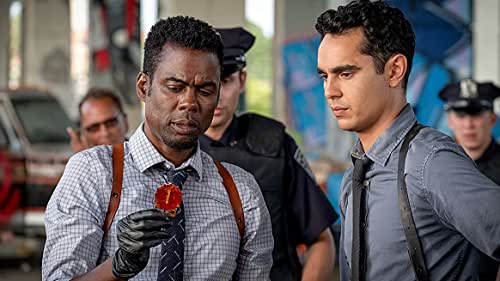
Anyway, Spiral features Chris Rock as a hard-boiled homicide detective who spends almost the entire movie with a scowl on his face.  He does make a few jokes but they’re all of the “This is a New Jack city!” variety.  Rock is living in the shadow of his wildly popular police chief father, played by Samuel L. Jackson.  Rock is a tough cop who does things HIS WAY!  And he can’t trust anyone else on the force because he’s just so honest.

Spiral does not feature Tobin Bell, though we do briefly see a picture of him when someone mentions that the latest round of murders seem like they may have been committed by a Jigsaw copycat.  The thing with copycats is who cares?  They can’t even come up with an original idea.  They have to copy another killer.  I mean, there’s a lot of movies about killers in the woods but people remain loyal to Jason Voorhees because he was the original.  Just like with Halloween. Every reboot, except for the third one, has featured Michael because without Michael, who cares?  You can lose everyone else but Michael, and how people react specifically to Michal, is what the franchise revolves around.  So, with Saw, if Jigsaw is not there …. WHO CARES!?

Listen, I don’t even like the Saw movies but even I was annoyed by this film’s lack of Jigsaw.

Anyway, it’s a dumb movie.  It tries for a bit of political relevancy by making almost all of the victims crooked cops but it’s like Defund Copycat Serial Killers, not the police.  Chris Rock and his new partner are investigating all the murders and Rock tries so hard to give a convincing performance that it becomes painful to watch.  Seriously, if you’re good at comedy, do comedy.  Be proud of it because a lot of people are not good at comedy.  If playing a dramatic character is that much of a struggle for you, don’t do it.  That’s why we’ve got actors like …. uhmmm, that guy who was in that really dramatic movie, whatever it was called.  It was really good and dramatic.  He would have been good for the lead in Spiral.  Actually, Ethan Hawke would have been good as the lead too.  Or maybe Denzel Washington.  But good luck getting them to agree to be in a Saw movie that doesn’t feature Tobin Bell.

Anyway, Spiral was pretty disappointing.  Chris Rock is funny and likable in comedies so maybe that’s what he should stick with for now.  Leave the dramatic crime stuff to the cast of the latest Dick Wolf show, y’know?  And if there is another Saw movie, Jigsaw better come back to life because otherwise, what’s the point?

The Martian Chronicles: Episode 2: The Settlers (1980, directed by Michael Anderson)


The first episode of The Martian Chronicles ended with a dying Jeff Spender (Bernie Casey) warning John Wilder (Rock Hudson) that humans settling on Mars would be the worst thing that could ever happen to the once powerful red planet.

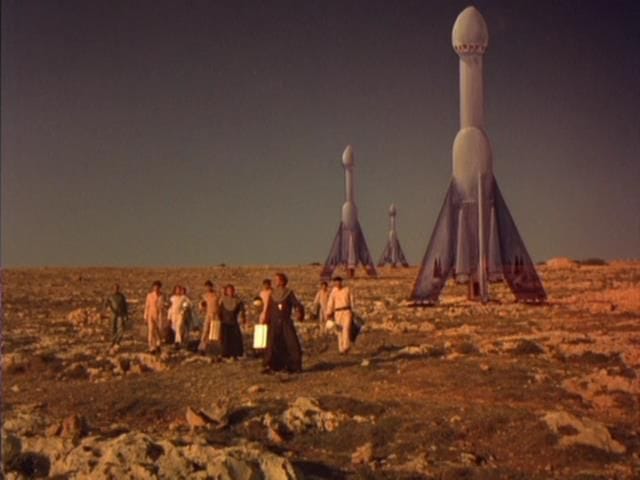
The second episode, called The Settlers, sets about to prove Spender right.  By 2004, humans are desperately leaving the war-torn Earth for a new home on Mars.  They rename all of the Martian landmarks, honoring the men who died exploring the planet.  In one of the few deliberately funny moments of this entire miniseries, it’s revealed that the canal that Briggs threw his beer cans in was eventually named Briggs Canal.  There’s one unfortunate shot of a line of miniature space ships that are supposed to be orbiting Mars and waiting for their chance to land.  The episode then gets down to showing what the settlers do to Mars.

It’s nothing good.  The main town looks like a traveling carnival, full of bars and crime.  Many of the people who come to Mars are people who are fleeing something on Earth and Col. Wilder has his hands full trying to keep the peace.  All of the Martians are believed to be dead but it turns out that there are still a few out there.  Using their mental powers, they disguise themselves as humans.  A large part of the second episode deals with a Martian who approached an elderly couple, disguised as their dead son.  Even though they know that he’s not really their son, they allow him to live in their home.  But, when the Martian goes to the city, he becomes overwhelmed by all the thoughts that bombard his mind.  Everyone sees him as being someone that they care about.  Even the local priest, Father Peregrine (Fritz Weaver), sees the Martian as being Jesus.  (That’s no big deal today but that had to have been controversial in 1980.)  Eventually, the Martian becomes so overwhelmed that he dies while a group of humans gawk at him.

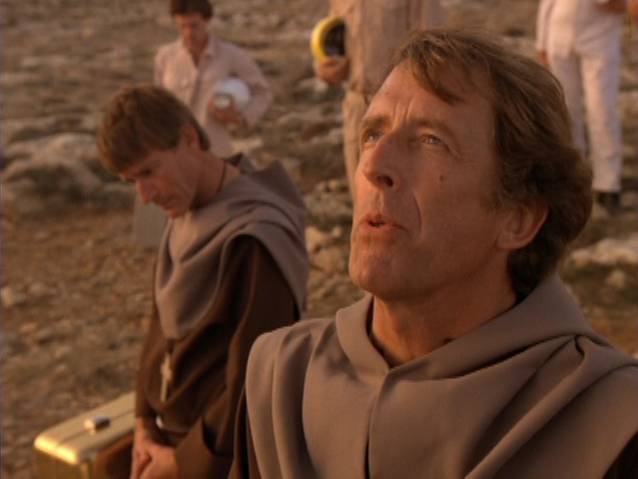
As for Father Peregrine and Father Stone (Roddy McDowall, who spent most of his later years appearing in miniseries like this one), they explore the Martian mountains, searching for three lights that have been reported as hovering in the sky.  When they find the lights, the lights explain that they are ancient Martians who long ago abandoned their corporeal bodies.  They also somewhat implausibly say that they worship the same God as the two priests.  In a departure from Bradbury’s original short stories (in which Bradbury was skeptical about the idea of bringing religion to the Mars), Father Peregrine commits to building a church so that, even on the Red Planet, people can worship.

Finally, Sam Parkhill (Darren McGavin) has achieved his dream of building a restaurant on Mars.  He says that, as soon as more Earthlings arrive, he’ll be rich because every trucker will stop off at his place for a bite to eat.  When a Martian suddenly shows up in the diner, Parkhill panics and shoots him.  When more Martians show up, Parkhill flees.  It’s only when the Martians catch up to him does he learn that they’re giving him a grant for half the land on Mars.  “Tonight’s the night,” they tell him, “Prepare.”  Old Sam Parkhill’s pretty excited until he looks through a space telescope and sees that Earth, the home of his future customers, is now glowing with the sure sign of nuclear fire.  I can’t remember how old I was when I first saw this episode on late night Baltimore TV but I do remember being thoroughly freaked out by the scene where Sam watches as a fiery glow encircles the Earth and the planet’s green surface turns brown.  It’s the most powerful moment in the miniseries and a fitting visualization of Bradbury’s concerns about the nuclear age.

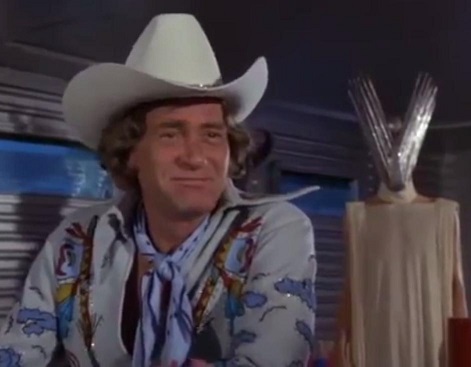
As for the rest of The Settlers, it’s good but it’s not as strong or as cohesive as the first episode.  The Martin shapeshifter story is good but the two priests in the mountains felt like they were included to keep religious viewers happy and their segment takes too many liberties with Bradbury’s original material.  Then, Darren McGavin returns to the story. dressed like a cowboy and getting chased by a Martian sandship and The Martian Chronicles goes back to being one of the coolest miniseries to ever be broadcast.

With Earth dead, would Mars follow?  That was the theme of the next episode of The Martian Chronicles, which we’ll look at tomorrow.

Game Review: Universal Hologram (2021, Kit Riemer)


Universal Hologram is an entrant in 2021 Interactive Fiction competition.  Browse and experience all of the games by clicking here.

Some games just aren’t going to be for everyone and that’s definitely the case with Universal Hologram, a Twine game where you live in a Martian colony and you learn how to astral project.  Astral projection leads to some wild dreams but it also leads to the discovery that you are living in a simulation.  It’s a long game, one that is more concerned with philosophy than it is with its plot.  Each action and decision is a chance for the game’s characters to discuss man’s place in the universe and the nature of reality.  If that’s your thing, you’re going to enjoy the game’s mix of the profane and the profound.  If you’re not into it and just looking for something more straightforward, you may get frustrated with Universal Hologram‘s deliberately enigmatic narrative.

Myself, though, I enjoyed it.  Twine games, by their nature, are best used for games that are like short stories with occasional choices as opposed o traditional puzzle-solving Interactive Fiction.  Twine games, above all else, reward good writing and Universal Hologram is very well-written.  Mars, the simulation, and the eccentric characters all come to life.  The game also includes computer-generated visuals, the better to put you into a dream state.  That the game is willing to risk alienating its players is one of the things that makes Universal Hologram stand out from so many other recent Interactive Fiction games.  I like games that take risks.

Play Universal Hologram.

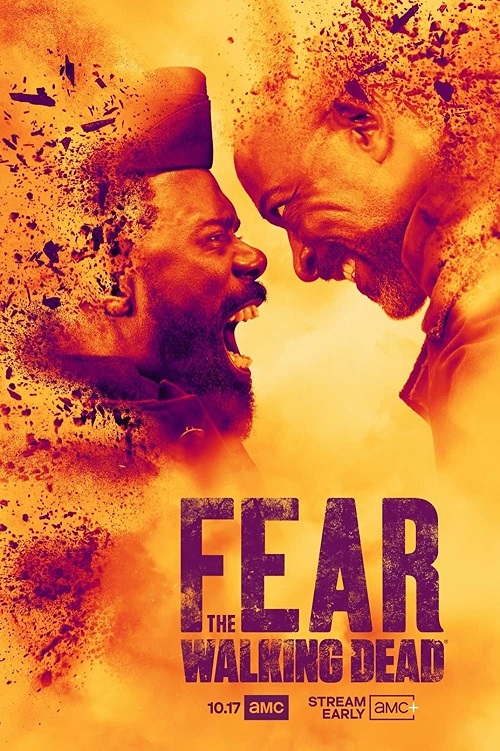
Horror TV Review: Fear the Walking Dead 7.2 “Six Hours” (dir by Michael E. Satrazemis)


Earlier today, I finally got around to watching the most recent episode of Fear The Walking Dead.  Before I write this review, I should probably take a minute to remind everyone that this show is somewhat new to me.  Here’s what I know, after watching two episodes.  Strand and Morgan dislike each other.  Someone bombed Texas with nuclear warheads.  Strand is hiding out in an office building.  Morgan is living on a submarine with Grace.  They are caring for an adopted baby named Mo.

This week’s episode focused on Grace and Morgan.  Apparently, due to the fallout, they can only leave the submarine for six hours at a time.  This episode followed them over the course of one such trip, so we got a lot of yellowish fall-out cinematography and all of the usual abandoned stores that always show up in The Walking Dead and its spin-offs.  It all moved fairly slowly, though Grace and Morgan did eventually run into two survivors, Fred and Bea.  Fred and Bea were dying of radiation sickness.  They’re baby was already dead and had turned into one of the undead, which was pretty depressing.  In fact, it was so depressing that it reminded me of why I stopped watching the original Walking Dead in the first place.

That said, as much as I complain about the grim tone of these shows, a real-life zombie apocalypse would be pretty damn grim so, even if I don’t always enjoy the scenes of misery, I do have to respect the shows for saying true to their theme.  The end of civilization is not something that’s going to be fun, especially when you’re having to shoot your loved ones in the head to keep them from reanimating a zombies.

In the end, the most important thing is that Grace and baby Mo finally bonded.  Yay!  Having a baby is already stressful.  Imagine having to take care of one while facing both a zombie and a nuclear apocalypse!

Bea did mention that there is a place called “Padre,” which, since the show is set in Texas, I’m going to assume that she’s referring to South Padre Island, which is a great place to go for Spring Break.  Before Strand tossed him over the side of the wall last week, it was revealed that Will was also somehow connected to Padre.  At the time, I assumed that was just a joking reference to South Padre but apparently, it’s going to be the season’s big destination.  (Spring Break of the Walking Dead!)  I guess the other big revelation of the episode is that Morgan’s got a stalker who is obsessed with trying to kill him.  I’m not ashamed to say that I had to use Wikipedia to find out that the stalker is apparently the brother of someone who Morgan killed previously.  Morgan kills a lot of people, apparently.

It was an okay episode.  A little slow.  A little depressing.  But the fact that Grace and Mo finally bonded made up for a lot of it.  Even at the worst of times, there is still hope.

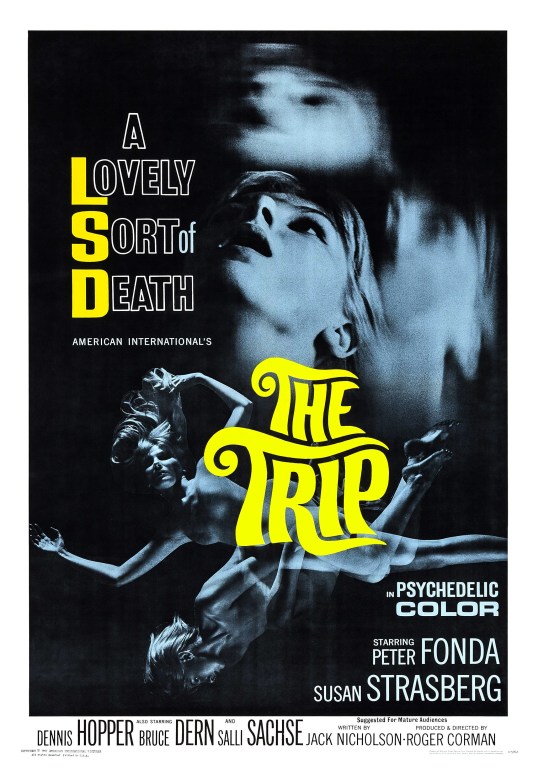
Scenes That I Love: Peter Fonda Explores The City In The Trip


Today’s scene is from Roger Corman’s 1967 film, The Trip. Corman dropped acid himself before filming Peter Fonda doing the same thing in this film. Regardless of how one views Corman’s cinematic recreation of Fonda’s experience with acid, The Trip is considered to be one of the first nuanced drug films. While it doesn’t endorse drug use, it also doesn’t descend into the hysterics of a film like Reefer Madness. Interestingly enough, the script was written by Jack Nicholson.

Here is Peter Fonda, exploring the city on LSD, in The Trip:

Horror Novel Review: The Knife by R.L. Stine


I thought I was done with reading R.L. Stine this October when I finished up Trapped but then I noticed that his 1991 YA novel, The Knife, was still sitting on my desk. Being a completest, I decided to go ahead and read it now, as opposed to leaving it for next year’s Horrorthon. Afterall, it was short and the title promised all sorts of grisly Fear Street fun. It’s not like a title would be misleading, right?

Well, there is indeed a knife in The Knife. It’s being wielded by a man who is chasing the book’s main character, Laurie, at the start of the story. And, later on, a bitchy nurse ends up getting a scalpel shoved in her throat and a scalpel is a type of knife so I guess the title isn’t completely misleading. That said, the book’s use of knives is actually a fairly minor detail. Stine could have just as easily called the book “The Teddy Bear” after the gift that Laurie tries to give to the boy at the center of the book’s plot.

Laurie is volunteering at Shadyside Hospital. She works in the Fear Wing, named after the Fear Family. She becomes attached to a patient named Toby. When Toby is discharged, Laurie is happy that he didn’t die but she is disturbed when Toby tells her that the woman taking him home is not his mother. Laurie decided to investigate Toby’s homelife on her own and, after doing a lot of stalking and basically repeatedly beaking the law, she stumbles across one of those huge crime rings that always seemed to popping up all over Shadyside.

It’s an okay book. If you’ve seen enough Lifetime films, you’ll be able to figure out what’s going on with Toby and his fake mother. And you’ll also figure out who murdered the nurse. There aren’t many surprises to be found but it’s a quick read and it’s kind of fun to watch Laurie try to balance getting a new boyfriend with cracking the case of an international crime ring. It’s like those weird episodes of Saved By The Bell where Lisa Turtle worked at her mom’s hospital. Technically, there are knives in the book so let’s give Stine credit for that.

And now, I think I’m done with reading about Fear Street for this month.

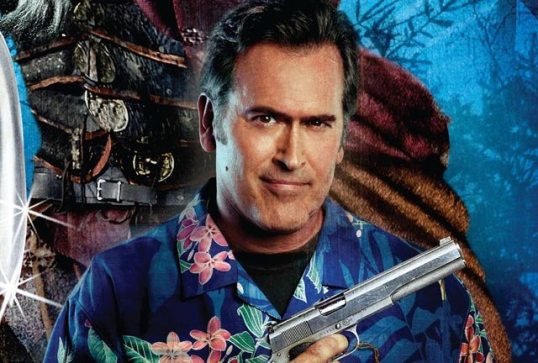
Book Review: If Chins Could Kill: Confessions of a B-Movie and many other books by Bruce Campbell


Everyday, we should give thanks to Bruce Campbell is not a jerk.

Seriously, can you imagine how disappointing it would be to discover that Bruce Campbell — ASH!  GROOVY BRUCE! — was not a laidback, blue collar actor who appreciated his fans, had a sense of humor about his films, and who enjoyed ending the day with maybe a can of beer and a nicely rolled joint?  It would be awful!  Bruce Campbell going on and on about the method while telling people not to see his early films?  Unthinkable!  Bruce Campbell demanding a huge trailer and bad-mouthing his co-stars?  That’s not our Groovy Bruce!

No, Bruce Campbell is pretty likable and appears to be downright nice.  That’s a huge part of his appeal.  He’s an actor but he’s also a fan.  He’s talented but he’s also level-headed.  He loves his films but he doesn’t pretend that they were anything that they weren’t.  Other actors would hide the chin.  Bruce shows it off every chance he get.  He even named his first memoir after the chin!

And it’s quite a good memoir too, If Chins Could Kill is,  Bruce discusses growing up.  He discusses the first films that he made with Sam Raimi.  The Coen Brothers make an appearance.  There’s stuff about Bubba Ho-Tep and Maniac Cop.  Really, it’s the definitive overview of the first part of Bruce Campbell’s amazing career and it’s a fun read.  Campbell has a sense of humor about both himself and his movies but, at the same time, he also has a deep love and appreciation for indie filmmakers.  It’s the humor that makes the book entertaining but it’s the love that will keep your reading.  And, after you finish the first memoir, move on to Campbell’s subsequent books — How To Make Love the Bruce Campbell Way, Hail to the Chin, and The Cool Side of My Pillow.  They’re all good books.  They’ll make you appreciate not only Bruce and the movies but also the art of writing about yourself without acting like a pompous jackass.  Bruce pulls it off and we’re all the better for it!

International Horror Film Review: Lisa and the Devil (dir by Mario Bava)


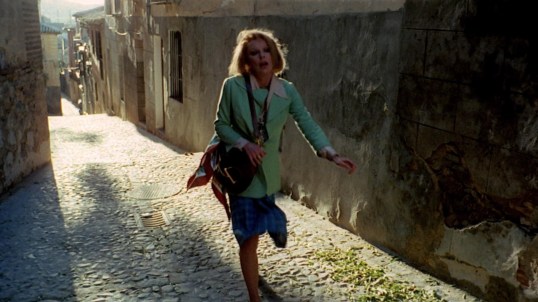
Originally filmed in 1972 and tragically not seen the way it was intended to be seen until years after Mario Bava’s death, Lisa and the Devil tells the story of Lisa (Elke Sommer), a tourist who is visiting the city of Toledo, Spain with a friend.  From the first minute we see Lisa walking through the streets of the city, something seems to be off.  The city seems strangely deserted.  The streets themselves seem menacing, in much the same way that streets of Vienna did in The Third Man.

Lisa leaves her tour group and goes in a store.  A menacing, bald man (Telly Savalas) gives Lisa a strange look as he buys a dummy.  The man resembles a portrait of the devil that Lisa saw earlier.  Running from the shop, Lisa runs into another man (Espartaco Santoni) who appears to be following her.  The man appears to fall to hi death but, despite that, the man will return later.  People have a way of returning in Lisa and the Devil.

Lisa’s tour group appears to have vanished.  She eventually runs into a seemingly friendly couple (Sylvia Koscina and Eduardo Fajardo) who, along with their driver (Gabriee Tinti), agree to take Lisa back to her hotel.  But instead, they somehow end up outside of a dilapidated, mannequin-filled mansion.  When the car breaks down, the group is invited to spend the night by the Countess (Alida Valli, who also appeared in The Third Man), who lives in the mansion with her strange but handsome son, Maximilian (Alessio Oriano).  Maximilian is still mourning his ex-girlfriend, Elena.  Elena, we’re told, bore a striking resemblance to Lisa.

However, it turns out that the Countess and Maximilian are not alone in the mansion.  Also living in the house is the Countess’s second husband, Carlos, who just happens to be the same man that was following Lisa in the city!  And finally, there’s the butler, Leandro, who is the same man who Lisa earlier saw in the shop!

Lisa and the Devil is one of my favorite Italian horror films.  Yes, some of that is because I shared the same name as the movie’s main character and I love it when people say my name a lot.  But I would love this film even if Elke Sommer was playing someone named Annalise or Tiffany.  Mario Bava said that this film, or at least his version of the film, was one of his most personal works and the entire movie does feel like a puzzle that only one person could possibly solve.  In the movie, only Leandro seems to full understand what’s happening in both the city and the house.  In real life, it’s likely that only Mario Bava understood everything that happened in the film.  The film mixes a giallo mystery (because people do soon start to die the mansion) with a surreal exploration of memory, regret, sin, and guilt.  The movie plays out like a waking dream, leaving us to wonder just who exactly Lisa truly is and who the Devil of the title might be.  It’s easy to spot the Devil.  It’s less easy to spot which parts of the film are meant to be reality and which parts might simply be happening in Lisa’s mind.

Unfortunately, the film’s producer had no idea what to do with Bava’s surreal masterpiece.  The few people who saw the film were baffled.  The Italian censors demanded massive cut for both sex and violence and, as a result, Lisa and the Devil was one of the few Bava films not to get a theatrical release in his native country.  It apparently did play in South Korea and Spain, though the Spanish version did not feature Bava’s original, mind-twister of an ending.

Even worse, for the film’s American release, the film’s producer requested that Bava add some exorcism scenes so that the film could take advantage of the popularity of The Exorcist.  By now realizing that his preferred version of the film would probably never be seen, Bava agreed.  With the help of his son, Lamberto, Mario Bava shot several scenes featuring Elke Sommer acting possessed while a priest played by Robert Alda tried to exorcise the demon.  The original Lisa and the Devil footage was presented as being scenes from the dimension Lisa’s soul had been sent to while the demon controlled her body.  The film was retitled House of Exorcism in Amercia.  And here’s the thing — House of Exorcism is hardly a bad movie.  Bava is Bava, afterall.  Sommer does a convincing job acting possessed and the mix of new and old footage is edited together fairly well.  But it’s still not the film that Bava set out to make.

Sadly, Bava’s original version of Lisa and the Devil would not get a proper video release until decades after his death.  It’s not always an easy film to follow.  I’ve seen it several times and there are still things about it that I still don’t fully understand.  It’s a surreal masterpiece, one that is perhaps not meant to be fully understood and the type of dream-film that shows why Bava is one of the few directors that David Lynch has regularly cited as being an influence on his own work.  Lisa and the Devil is a trip through a world dominated by dark and disturbing things and it’s one of the best Italian horror films to come out of the 70s.  Thankfully, it can now be seen the way that Bava intended.