Film Review: Asteroid City (dir by Wes Anderson)


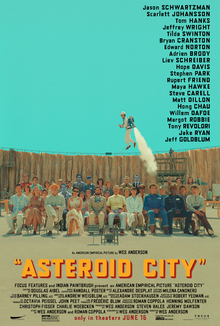
Asteroid City opens with black-and-white footage of Bryan Cranston, wearing a suit and speaking in the authoritative tones of someone who has made his living on television.  Cranston informs us that we are about to see a televised production of a play by the famed but enigmatic playwright named Conrad Earp (Edward Norton).

The play, which is seen in stylized color, opens with Augie Steeback (Jason Schwartzman) driving his family through the desert.  He is taking his son, Woodrow (Jake Ryan), to a Junior Stargazers convention that is being held at Asteroid City, a tiny town that is best-known for being the location of an impact crater.  Along for the ride are Augie’s three daughters, who are all pretending to be witches.  What Augie hasn’t told his children is that their mother has died, her cremated remains are in a Tupperware container, and that they will be moving in with their wealthy grandfather (Tom Hanks).

There’s not much to the town of Asteroid City.  There’s a motel that’s managed by a man (Steve Carell) who sells land deeds out of a refurbished Coke machine.  There’s a diner.  There’s a group of helpful cowboys, led by the polite and helpful Montana (Rupert Friend).  There’s a mechanic (Matt Dillon) who is called into duty when Augie’s car breaks down.  The Junior Stargazer convention is the event of the year for Asteroid City.  Young geniuses from all around the country have descended on the town and have brought their parents.  One of them, Dinah (Grace Edwards), is the daughter of actress, Midge Campbell (Scarlett Johansson).  When an alien (played, at one point in the film, by Jeff Goldblum) shows up and steals the town’s meteorite, General Gibson (Jeffrey Wright) declares a quarantine.  Some people handle the lockdowns better than others.  Augie takes pictures and thinks about his wife.  Midge rehearses for her next role, one that is centered around her character dying.  The genius children play a memory game that they realize will never end because they’re all geniuses.  A teacher (Maya Hawke) tries to teach her students about the Milky Way, just to discover that the kids only want to talk about the alien.  One of the fathers (Liev Schreiber) ends up with a useless plot of desert land and the death ray that his son recently invented.

Throughout it all, Bryan Cranston appears in black-and-white footage that gives us a look into what went on behind the scenes during the production of Asteroid City.  The director (Adrien Brody) was a lech.  The actor playing Augie struggled to understand what the play was about and who his character was meant to be while the actress (Margot Robie) hired to play his wife ended up in another play after her scenes were cut from Asteroid City.  Only once does Bryan Cranston’s host appear in the color sections of Asteroid City, just to sheepishly admit that he’s not supposed to be there before ducking off camera.

Even if his name wasn’t in the opening credits, the viewer could probably easily guess that this is a Wes Anderson film.  It features all of Anderson’s trademarks, all of the things that viewers will automatically love or hate depending on how they feel about Anderson’s quirky aesthetic.  It’s a visually impressive, pop art-flavored, all-star comedy with an undercurrent of profound melancholy, one in which the fanciful strangeness of the alien’s “invasion” is compared and contrasted with the very real-life strangeness of how humans deal with life, loss, death, and uncertainty.  Scenes of clever wordplay are mixed with scenes in which we see Augie still very much struggling to come to terms with the death of his wife and the actor Augie very much struggling to understand what is actually going on in his character’s head.  As far as recent Anderson films go, Asteroid City is not quite as humanistic as Rushmore or Grand Budapest Hotel but, at the same time, it’s still more accessible than The French Dispatch.

If you’re not a fan of Anderson’s style, this film won’t convert you.  That said, I am a fan of Anderson’s style and I absolutely loved Asteroid City.  As with so many of Anderson’s films, the main focus is on how we try to deal with the uncertainties of life by trying to maintain an illusion of control over every aspect of our lives.  Playwright Conrad Earp writes because that way he can have a world that follows his own rules.  The actors follow a script that tells them how to react to everything that happens around them.  In the play, the Junior Stargazers fall back on science while Augie’s father-in-law falls back on religion and Augie’s daughter convince themselves that spells will bring back or, at least, protect their mother.  Even General Gibson falls back on his belief in the government and the military to deal with the sudden appearance by the alien.  The alien is the unknowable and his arrival reminds everyone that life is unpredictable, regardless of how much you try to control your own story.  Indeed, while the film takes place in the 50s and is full of comments about the Red Scare and atomic bomb testing, it’s hard not to see Asteroid City as being a commentary on the recent COVID lockdowns and the debate over whether people could ever go back to living the way that they did before the pandemic.  Much as with the Coen Brothers’s similarly stylized A Serious Man, the ultimate message seems to be that the only way to deal with the unpredictability of life is to embrace it.

It’s also a very funny film, one that is full of small details that reward repeat viewing.  If one focuses on the background characters, it quickly becomes apparent that there are actually several stories unfolding in the film and, much as with life, the viewer just has to be willing to look for them.  (I particularly enjoyed the romance between The Teacher and Montana.)  Jason Schwartzman is compelling as both Augie and the actor playing Augie and Scarlett Johansson plays both Midge and the actress playing Midge with the perfect amount of cool detachment.  To the film’s credit, none of the character’s become caricatures.  They remain individuals, regardless of how bizarre the film’s story may sometimes seem.  Everyone gets a moment to reveal a little depth, from Jeffrey Wright’s sincere (if misplaced) faith in the lockdown policy to the moment when Tom Hanks’s previously unsympathetic father-in-law reveals that he’s as much in mourning as Augie.  The all-star cast also includes Tilda Swinton, Liev Schrieber, Stephen Park, Willem DaFoe, Hong Chau, and Margot Robbie and all of them add to the film’s portrait of quirky but ultimately relatable humanity.

Again, with this film, it undoubtedly helps to already be familiar with and to like Wes Anderson’s way of doing things.  If  you’re not a fan of his film, this one probably won’t change your mind.  That said, for those of us who do enjoy his style, this is Anderson at his best.

Horror Film Review: Flatliners (dir by Joel Schumacher)


“Our sins have come back in a physical form … and they’re pissed!”

That one line pretty much sums up the original 1990 version of Flatliners.  It’s a good line in that it’s one that you remember and it’s a line that you can use in almost any situation.

Have you gotten a phone call from an unknown caller?  “Our sins have come back in physical form … and they’re pissed!”

Have you and your boyfriend recently been driving across Texas and suddenly noticed that a car has been following you all the way from Lake Dallas to the border of Oklahoma.  “Our sins have come back in physical form … and they’re pissed!”

Have you ever had a stranger fail to hold a door open for you?  There’s only one possible reason for that rudeness.  “Our sins have come back in physical form .. and they’re pissed!”

And don’t even get me started on people who leave negative comments under my reviews.  We all know what’s going on with that!  “Our sins have come back in physical form … and they’re pissed!”

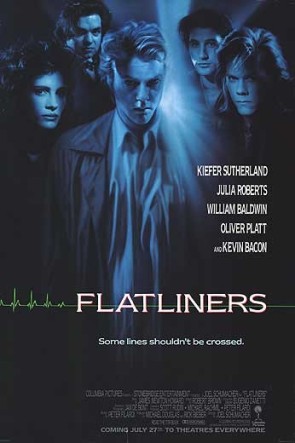
It’s a line that is both oddly memorable and also deeply stupid.  The same description can be applied to Flatliners.  It’s a film about a group of medical students (played by Julia Roberts, William Baldwin, Oliver Platt, and Kevin Bacon) who help Kiefer Sutherland investigate whether or not there’s actually an afterlife.  Sutherland believes that there is but he needs an atheist to be a part of the group, that’s where Kevin Bacon comes in.  And he needs a potential love interest and a Baldwin brother to be a member of the group as well, that’s why Julia Roberts and William Baldwin are there.  And, of course, someone has to provide comedic relief whenever things start to get too dark.  Say hello to Oliver Platt!  Anyway, Sutherland’s plan is to die for a minute or two and then have his fellow medical students bring him back to life.  It sounds like kind of a dumb idea but everyone agrees to it.

Anyway, it turns out that the afterlife looks a lot like an overproduced student film, full of weird camera angles, tinted lighting and disembodied voices.  When Sutherland dies, he sees a boy that he used to bully.  Julia Roberts sees her father, who committed suicide when she was younger.  Kevin Bacon sees a little girl that he used to bully.  (There are a lot of bullies in this movie.)  William Baldwin, a sex addict who is chronically unfaithful to his fiancée, sees hundreds of women, all saying, “But you said you loved me.”  Oliver Platt never actually gets to die and therefore, he sees nothing.  He does make a joke about how his vision would probably involve an angry babysitter.  I laughed.

What happens next?  “Our sins have come back in physical form … and they’re pissed!”

Flatliners has an intriguing premise but oh my God, is it ever a silly film.  It’s not really a spoiler to tell you that all of these returned sins want the characters to either atone for their mistakes or make peace with their past.  For Kevin Bacon, this means tracking down the girl that he used to bully and allowing her to bully him.  For Julia Roberts, it means getting an apology from her Dad and understanding that he was addicted to heroin.  For William Baldwin, it means making peace with never being as well-known as either Alec or Steven.  As for Kiefer … well, things are a bit more complicated for Kiefer Sutherland.

Flatliners starts out as a horror film but then it turns into a squishy movie about letting go of bitterness and learning how to forgive oneself.  It’s kind of annoying that the film couldn’t just stick to being scary because the first half of the film does have some effectively tense moments.  However, it all gets lost as the film’s plot sinks into sentimental, New Age-y quicksand.

Flatliners was directed by Joel Schumacher, who generally does well with shallow films that 1) don’t really mean anything and 2) don’t involve super heroes.  And really, the only film that I can think of that’s more shallow than the original Flatliners is the remake.  (But we’ll talk about that later…)  Schumacher’s direction here is not particularly bad — everyone looks good and the film is never boring.  It’s a very, very pretty film and one that doesn’t add up to much.

I would suggest watching it with your sins, especially after they take physical form.  Maybe they’ll be a little less pissed off afterward.

Review: The Newsroom S1:E3 – “The 112th Congress”


Though I’m a registered Democrat (which I did before realizing I could be Independent) and my family’s mostly Republican, Politics tend to make my eyes glaze over and a lot of it goes over my head. My reasoning is that no matter who you have in office, neither side has everything right and you’ll find corruption and/or underhanded deals no matter what side is chosen. It’s because of this that makes The Newsroom a little difficult for me to write about from a political standpoint, but on an entertainment standpoint, I’m having fun. This show is getting a little tighter with every episode.

This episode, titled “The 112th Congress”, opens with a statement taken from the 9/11 Commission back in 2004. Will makes an apology to the American viewing public on the way News Night has been, stating that they failed to give the right news – “A leader in an industry that miscalled election results, miscalled hyped up terror scares, ginned up controversy, and failed to report on tectonic shifts in our country”. Will stresses that they will be concentrating on giving the news, and opinions that also contrast his own. I liked the way this scene moved, jumping back and forth through the events of writing out the speech, getting everyone up for their morning meeting, cleaning it all up and providing it to Charlie before the actual broadcast. This is all while the speech is given. The opening editorial lays down the template to the News Night viewers on where it’s headed.

The following scene is a conference room with Charlie, Reese, another associate and Leona (Jane Fonda) in a debriefing meeting on the News Night changes. This takes place on November 3rd, 2010. The show moves to this location, the Bigwig Conference, a number of times as we go over the months since NN2.0’s inception. I have to admit I really liked the movement of the scenes back and forth here. Don approaches Jim and gives him a little flak on why he wasn’t in the loop on Will’s speech, given that his own show that comes afterward is also trying to be the one to move up to that treasured 8pm slot. Don also has something of an issue with Maggie on this as well, but it only lasts for a moment.

Reese goes on to mention that since the News Night change, Will’s lost about a good 7% of his audience. Though they’re doing what they feel is the right thing, it is costing them from a viewer’s standpoint. I liked how Leona really doesn’t speak up until the middle of the episode, her character just kind of taking in all of the information that’s given.

There’s a very interesting conversation between Will and Charlie, talking about the changes in the Tea Party’s progression. Granted, this all requires first level research for stronger opinions & statements to be formed, but from the way The Newsroom presents it (and my interpretation of it), the Tea Party kind of swooped in and changed the Republican landscape (or was at least trying to at the time) for their own pursuits. That Will, being a Republican himself, decides to make this the top story felt like it added to the “all the facts” angle the NN2.0 was shooting for. For the record, were he a Democrat, I’m pretty sure that they could have done the same thing for that party, using a story on gun control or something like that.

Getting back to the story, it’s revealed in the Bigwig conference that Will is treating his interview subjects like members in a courtroom and that at one point in his life, he was a prosecutor. I liked this, but the information seemed sudden to me, as if Sorkin and crew were in their writing room and the question came of “Well, how is Will so good at this?”, and they came up with the lawyer angle. Then again, to counter that, we learned 4 episodes into Mad Men that Don Draper’s name wasn’t his and his past wasn’t his either. I suppose it makes sense here too.

Mac meets one of Will’s new dates and overreacts a little with the compliments, inquiring on who she is. Turns out that the lady works for the New York Jets as a choreographer. Mac and Will move to Will’s office, where she berates him on his dating choice for the evening. There’s a bit of cute back and forth banter before she nearly storms out and Charlie catches her, telling them both the keep up what they’re doing with the Tea Party pressure. Will asks how the 44th floor (The Bigwig Conference) is handling this, and Charlie lies to him about it. Undoubtedly, this will end up being a problem later on in the season. The relationship angles still appear a little blurry. We learn that Maggie’s issues are attributed to Panic Attacks, which opens a nice scene between she and Jim on the terrace of the building. I already touched on the Sorkin Girls in the last episode. I’ll let it go here, but it does kind of show why she’s been the way she’s been. The problem here is that with the forward momentum the scene made, it takes two steps back in having her with Don still by the end of the episode. I’m not saying they should be in each other arms by now, but I wouldn’t mind seeing thing forward just a little more.

The story moves ahead to June 18, 2010, where Will goes after a senator regarding statements made on AIDS and it’s spread. The Bigwigs are not pleased at all on this. After the broadcast, Mac finds another date waiting for Will, who Will points out is an actual brain surgeon. That was actually worth a chuckle, indeed.

At the Bigwig Conference, Reese points out that there was a party every year he and his mother were invited to at Telluride that they didn’t receive an invite for this time around. Reese points out that Will’s broadcasts has cost them Koch Industries, which happens to be close to the Lansing’s (Reese and Leona).

Near the end of the Bigwig Meeting, Leona finally speaks up, letting Charlie know that Will needs to back off as the parent company, AWM has special interests with of the parties that Will has been attacking. Leona threatens to fire Will, which of course would be a problem due to a special clause in his contact that prevents him from working for 3 years. That was kind of cool, reminding me of what happened with Conan O’Brien when he left NBC. So now, the stakes are raised. Do they continue doing what they’ve planned and face being fired or revert back to the old format?

While I still have the same complaints as before (Sharpen up the girls, etc.), the episode ramped up things with some of the actual broadcasts that were done. The Bigwig Conference scenes were some of the strongest parts there, I felt. We’ll see where this all goes.