Film Review: The Chase (dir by Arthur Penn)


The Chase, a small-town Texas melodrama from 1966, opens with Robert Redford escaping from prison.

Redford is playing Bubber Reeves. Bubber, we’re told, has spent the last few years in a tough Texas prison, convicted of a murder that he didn’t commit. Now, he’s on the run and he’s probably returning to his hometown. His wife, Anna (Jane Fonda), still lives there, though Anna is now having an affair with Jake Rogers (James Fox). Jake is the son of the most powerful man in town, Val Rogers (E.G. Marshall). Jake also used to be Bubber’s best friend but now, he’s wracked with guilt about his affair with Anna.

Meanwhile, the townspeople are all worried that Bubber is going to seek revenge on the people who were responsible for him going to prison. Some of them know that he was actually innocent and some of them think that he’s actually the killer that he’s been made out to be but what they all have in common is that they’re worried about what Bubber’s gong to do when he shows up. Maybe they should have thought about the possibility of him getting mad and vengeful before they gave him a nickname like Bubber.

Anyway, Sheriff Calder (Marlon Brando) is convinced that Bubber is innocent but the townspeople still want him to allow them to gun Bubber down as soon as they see him. Sheriff Calder, however, is determined to keep the peace and make sure that the law prevails. He’s a man of unimpeachable integrity, working in a town full of people who are too cowardly to concern themselves with doing the right thing.

As everyone waits for Bubber to arrive. tempers come to the surface, a good deal of alcohol is consumed, and secrets are revealed. It all ends in tragedy, of course. One of the final scenes clumsily recreates the assassination of Lee Harvey Oswald. The Chase wouldn’t be an achingly self-serious film from 1966 if it didn’t.

There’s a few obvious problems with The Chase, the main one being that Robert Redford, who was 30 years-old when The Chase was released, looks surprisingly good for someone who has spent the last few years locked away in a tough Texas prison. Redford manage to escape from prison and run through a swamp without getting one single hair out of place. There’s nothing particularly dangerous about Redford in this film, which is surprising when you consider that The Chase was made just three years before Redford’s convincing turn as a laconic (if charming) killer in Butch Cassidy and the Sundance Kid. For The Chase to work, Bubber Reeves would have to be a force of nature but, whenever Redford’s on screen, you just find yourself wondering how someone who looks that good got stuck with a nickname like Bubber. The townspeople talk about Bubber like he’s a wild outlaw but Redford is just too laid back to pull it off. He comes across less like a wanted criminal and more like a California surfer who has somehow found himself in rural Texas.

As for the rest of the cast — well, there’s a lot of them. It’s a big ensemble film and good luck to anyone trying to keep track of who is related to who. Surprisingly enough, Marlon Brando is very convincing as a Texas sheriff, never allowing Sheriff Calder to turn into a stereotype. Less surprising is the fact that Robert Duvall, playing an frustrated husband, is also convincing in his role. Brando and Duvall, of course, would both go on to co-star in The Godfather. (Supposedly, when shooting of The Godfather began, Duvall was the only member of the cast with no fear of joking around with Brando, largely because they had bonded while working on The Chase.) Unfortunately, as good as Brando and Duvall are, they’re both let down in the hair department. Brando gets stuck with a hairpiece while Duvall is forced to go with a comb-over.

Some of the other performers are good and some of them are bad but none of them are particularly convincing as the residents of a small Texas town. James Fox, for instance, is very British. Jane Fonda and Angie Dickinson (cast as Calder’s wife) seem to be bored. E.G. Marshall is believably rich but never believably Southern. The other performers all tend to overact, especially once the people in town start drinking, shooting, hitting, and, in some cases, dancing. Somehow, Shelley Winters is not in the film, even though it seems like she should be.

The Chase was directed by Arthur Penn and written by Lillian Hellman. (The screenplay was based on a play and novel by Horton Foote.) Penn would follow up The Chase with Bonnie and Clyde and Alice’s Restaurant, two films that also dealt, for more successfully, with The Chase‘s themes of violence, community hypocrisy, and outlaw romanticism. Jane Fonda would go on to play Lillian Hellman in the 1977 film, Julia. For Julia, Fonda was nominated for an Oscar. For The Chase, she was not.

The Chase is one of those films that wants to say something important but doesn’t seem to be quite sure what. It’s a long and dramatic movie that doesn’t really add up to much. In the end, I think the main lesson to be learned here is not to allow your children to get a nickname like Bubber. There’s just no escape from a bad nickname.

Film Review: The Fountainhead (dir by King Vidor)


I don’t know if I’ve ever seen Gary Cooper look as miserable in any film as he did in the 1949 film, The Fountainhead.

In The Fountainhead, Gary Cooper plays Howard Roark.  Roark is an architect who we are repeatedly told is brilliant.  However, he’s always has to go his own way, even if it means damaging his career.  At the start of the film, we watch a montage of Howard Roark losing one opportunity after another.  He gets kicked out of school.  He gets kicked out of the top design firms.  Howard Roark has his own vision and he’s not going to compromise.  Roark’s a modernist, who creates sleek, powerful buildings that exist in defiance of the drab, collectivist architecture that surrounds them.

Howard Roark’s refusal to even consider compromising his vision threatens the rich and the powerful.  A socialist architecture critic with the unfortunate name of Ellsworth Toohey (Robert Douglas) leads a crusade against Roark.  And yet, even with the world against him, Roark’s obvious talent cannot be denied.  Dominique Francon (Patricia Neal) finds herself enthralled by the sight of him working in a quarry.  Fellow architect Peter Keating (Kent Smith) begs Howard to help him design a building.  Newspaper publisher Gail Wynard (Raymond Massey) goes from criticizing Howard to worshipping him.

Have I mentioned that Howard Roark doesn’t believe in compromise?  If you have any doubts about this, they’ll be erased about halfway through the movie.  That’s when Roark responds to a company altering one of his designs by blowing up a housing project.  Roark is arrested and his subsequent trial soon turns into a debate between two opposite philosophies: individualism vs. collectivism.

So, let’s just start with the obvious.  Gary Cooper is all wrong for the role of Howard Roark.  As envisioned by Ayn Rand (who wrote both the screenplay and the novel upon which it was based), Roark was meant to be the ideal man, a creative individualist who has no doubt about his vision and his abilities.  Cooper, with his down-to-Earth and rather modest screen persona, often seems to be confused as to how to play such a dynamic (some might say arrogant) character.  When Roark is meant to come across as being uncompromising, Cooper comes across as being mildly annoyed.  When Roark explains why his designs must be followed exactly, Cooper seems to be as confused as the people with whom Roark is speaking.  It doesn’t help that the 47 year-old Cooper seemed a bit too old to be playing an “up-and-coming” architect.  In the book, Roark was in his 20s and certainly no older than his early 30s.  Cooper looks like he should be relaxing in a Florida condo.

Who, among those available in 1949, could have been convincing in the role of Howard Roark?  King Vidor wanted Humphrey Bogart for the role but if Cooper seemed to old for the part, one can only imagine what it would have been like with Bogart instead.  Henry Fonda probably could have played the role.  For that matter, William Holden would have been an interesting pick.  Montgomery Clift and John Garfield would have been intriguing, though Garfield’s politics probably wouldn’t have made Ayn Rand happy.  If Warner Bros. had been willing to wait for just a few years, they could have cast a young Marlon Brando or perhaps they could have let Douglas Sirk make the movie with Rock Hudson and Lana Turner.  (Or, if you really wanted to achieve peak camp, they could have let Delmer Daves do it with Troy Donahue and Sandra Dee.)

If you can overlook the miscasting of Gary Cooper, The Fountainhead‘s an entertaining film.  King Vidor directs the film as if it’s a fever dream.  The film’s dialogue may be philosophical but the visuals are all about lust, with Pat Neal hungrily watching as a shirtless Gary Cooper breaks up rocks in the quarry and Vidor filling the film with almost fetishistic shots of phallic Howard Roark designs reaching high into the sky.  If Cooper seems confused, Neal seems to be instinctively understand that there is no place for underplaying in the world of The Fountainhead.  The same also holds true of Robert Douglas, who is a wonderfully hissable villain as the smug Ellsworth Toohey.  Interestingly, the film ends with a suicide whereas the novel ended with a divorce because, under the production code, suicide was apparently preferable to divorce.  I guess that’s 1949, for you.

Because America is currently having a socialist moment, there’s a tendency among critics to be dismissive of Ayn Rand and her worship of the individual above all else.  Rand’s novels are often dismissed as just being psychobabble, despite the fact that, in some ways, they often seem to be borderline prophetic.  (Barack Obama’s infamous “You didn’t build that!” speech from 2012 could have just as easily been uttered by Ellsworth Toohey or one of the many bureaucrats who pop up in Atlas Shrugged.)  Here’s the thing, though — as critical as one can be of Rand’s philosophy, there’s still something undeniably appealing about someone who will not compromise their vision to the whims of the establishment.  It’s goes beyond politics and it gets to heart of human nature.  We like the people who know they’re talented and aren’t afraid to proclaim it.  (Modesty, whether false or sincere, is a huge turn off.)  We like the people who take control of situations.  We like the people who are willing to say, “If you don’t do it my way, I’m leaving.”  In a way, we’re all like Dominique Francon, running our hands over architectural models while trying to resist the temptation to compromise and accept something less than what we desire.  We may not want to admit it but we like the Howard Roarks of the world.

Even when they’re played by Gary Cooper.

Halloween Havoc!: WEREWOLF OF LONDON (Universal 1935)


gary loggins's avatarcracked rear viewer

Lon Chaney Jr.’s Lawrence Talbot wasn’t Universal’s first Wolf Man . That honor goes to Henry Hull in WEREWOLF OF LONDON, a chilling but lesser film in the Universal canon. This one reminds me more of DR. JEKYLL & MR. HYDE than any of Chaney’s lycanthropic outings, and Jack Pierce’s makeup job is a little light in the hirsute department (more on that later).

British botanist Wilfred Glendon travels to Tibet to search for the rare mariphasia lumina lupina, a flower that only blooms in moonlight. Trekking into a forbideden valley, he is attacked and bitten by a werewolf. Returning to London with his find, Glendon is confronted by the mysterious Dr. Yogami, who says they’ve met before. Unbeknownst to Glendon, Yogami is the werewolf in question, who wants the phosphorescent moonflower as an antidote for his own lycanthropy. Yogami manages to steal the two blooms, leaving Glendon to transform…

View original post 374 more words

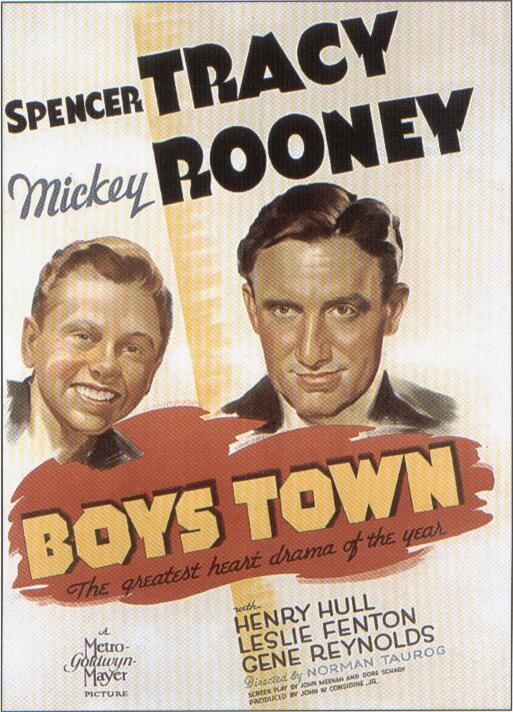
Lisa Reviews An Oscar Nominee: Boys Town (dir by Norman Taurog)


boys_town

Before writing about the 1938 film Boys Town, I want to share a story that might be false but it’s still a nice little story.  Call this an Oscar Urban Legend:

Boys Town is about a real-life community in Nebraska, a home for orphaned and homeless boys that was started by Father Edward Flanagan.  In the film, which was made while Father Flanagan was still very much alive, he was played by Spencer Tracy.  Boys Town was a huge box office success that led to the real Boys Town receiving a lot of favorable publicity.  When Tracy won his Oscar for Boys Town, his entire acceptance speech was devoted to Father Flanagan.

However, a problem arose when an overeager PR person at MGM announced that Spencer Tracy would be donating his Oscar to Boys Town.  Tracy didn’t want to give away his Oscar.  He felt that he had earned it through his acting and that he should be able to keep it.  Tracy, the legend continues, was eventually persuaded to donate his Oscar on the condition that he would get a replacement.

However, when the replacement arrived, the engraving on the award read, “Best Actor — Dick Tracy.”

That’s a fun little story, one that is at least partially true.  (Tracy’s Oscar — or at least one of them — does currently reside at the Boys Town national headquarters.)  It’s also a story that, in many ways, is more interesting than the film itself.

Don’t get me wrong.  Boys Town is not a bad movie.  For me, it was kind of nice to see a movie where a priest was portrayed positively as opposed to being accused of being a pederast.  In a way, Boys Town serves as a nice counterbalance to Spotlight.  But, with all that said, there’s not a surprising moment to be found in Boys Town.  It’s pretty much a standard 1930s juvenile delinquency melodrama.

The movie opens when Father Flanagan giving last rites to a man who is about to be executed.  (Boys Town takes a firm stand against the death penalty, which is one of the more consistent and laudable stands of the modern Church.)  The man says the he never had a chance.  From the time he was a young boy, he was thrown into the reform school system.  Instead of being reformed, he just learned how to be a better criminal.  Father Flanagan is so moved by the doomed man’s words that he starts Boys Town, under the assumption that “there’s no such thing as a bad boy.”

Father Flanagan’s techniques are put to the test when Whitey Marsh (Mickey Rooney ) arrives.  Whitey is angry.  He’s rebellious.  He tries to run away every chance that he gets and, during one such escape attempt, he even gets caught up in a bank robbery.  Can Father Flanagan reach Whitey and prove that there’s no such thing as a bad boy?

Well, you already know the answer to that.  As I said, there’s really nothing surprising to be found in the plot of Boys Town.  It’s just not a very interesting movie, though there is a great shot of a despondent Whitey walking past a several lines of former juvenile delinquents, all kneeling in prayer.  As Father Flanagan, Spencer Tracy is the ideal priest but his role is almost a supporting one.  Believe it or not, the film is dominated by Mickey Rooney, who gives a raw and edgy performance as the angry Whitey Marsh.

(That said, it’s hard to take Whitey seriously as a future gangster when he’s always wearing a bowtie.  Then again, that may have been the height of gangster style in 1938.)

Boys Town was nominated for best picture but lost to You Can’t Take It With You.

Flight of Fancy: Vincent Price in MASTER OF THE WORLD (AIP 1961)


gary loggins's avatarcracked rear viewer

motw1

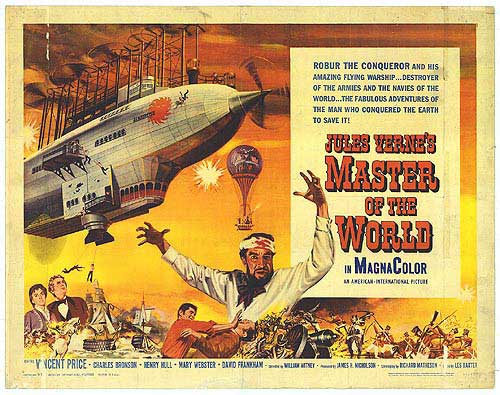
MATSER OF THE WORLD is AIP’s answer to Disney’s 20,000 LEAGUES UNDER THE SEA . Both are based on the works of Jules Verne, and involve fanatical protagonists commanding futuristic ships (an airship in this case). The difference is in budget, as studio honchos Samuel Z. Arkoff and James Nicholson didn’t have the financial means to compete with the mighty Walt Disney. They did have Vincent Price though, and within their monetary constraints came up with an entertaining mini-epic enhanced by another solid Richard Matheson script.

motw2

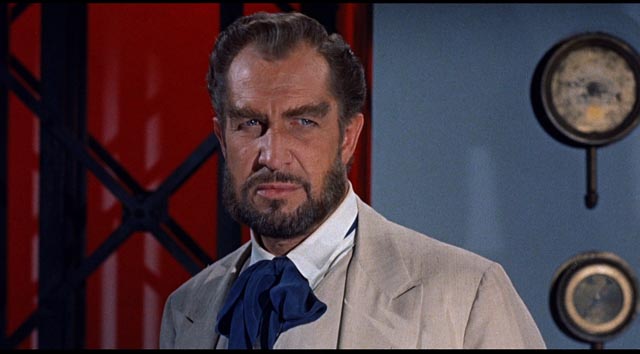
Price stars as Captain Robur, who’s fantastic flying airship Albatross rules the skies of 1868. When his amplified voice bellows some scripture from a mountain (does this make Vinnie the Voice of God?), balloon enthusiasts Mr. Prudent, daughter Dorothy, and her fiancé Phillip Evans, along with government agent John Strock, investigate, only to be shot down by Robur’s rockets and taken prisons aboard his flying fortress.

View original post 419 more words