Horror Film Review: The Ape Man (dir by William Beaudine)


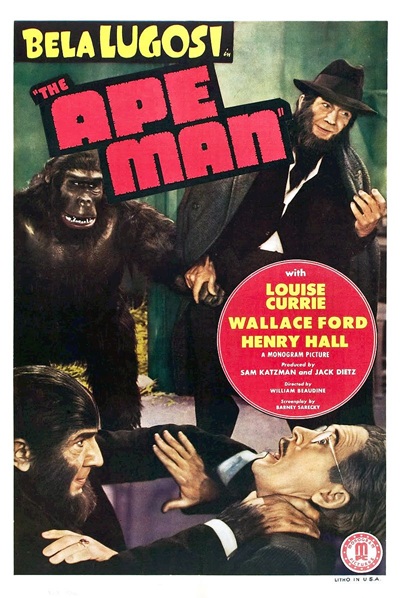
In this 1943 film, a mysterious man suggests to reporter Jeff Carter (Wallace Ford) that he should go out to the mansion of Dr. James Brewster (Bela Lugosi) and look into the recent disappearance of the doctor.  Dr. Brewster’s sister (Minerva Urecal) is a well-known ghost hunter and Carter’s editors likes the idea of Carter and photographer Billie Mason (Louise Currie) heading out to the mansion and getting a picture of a ghost.

Carter is upset because he’s having work with a — gasp! — woman.  Bliie is not impressed by the fact that Carter is still in America while all the other men his age are fighting overseas.  Carter explains that he’ll be enlisting in the Navy in a week.  Billie realizes that Carter is not an unpatriotic coward and we, the viewers, are reminded that this film was made during World War II.  I like the fact that America was so unified during World War II that even fictional characters were expected to explain what they were doing for war effort.

For the record, Dr. Brewster’s mansion is not haunted by ghosts.  Instead, the problem is that Dr. Brewster’s experiments have turned him into a man-ape hybrid.  He has a beard, he walks like a monkey, and he fears that he’s turning more into an ape everyday.  He spends almost all of his time locked up in a cage with a gorilla.  Dr. Brewster has (somehow) discovered that the only way to reverse the process is to get regular injections of spinal fluid.  However, it’s impossible to extract the spinal fluid without also killing the donor.  Dr. Brewster’s colleague, Dr. Randall (Henry Hall), refuses to be a party to murder but he still wants to help Brewster.  Unfortunately, Brewster is beyond saving and he’s also losing his mind as he finds himself slowly becoming more and more of an ape.

The Ape Man was directed by William Beaudine, a filmmaker who directed 179 movies over the course of his long career.  Beaudine worked in all genres, starting off as a major director during the silent era before then becoming a prolific B-movie maker during the sound era.  As a B-movie director, Beaudine was famous for rarely doing second take.  If someone flubbed a line or a piece of scenery nearly fell over, that was too bad.  Of course, it should be noted that Beaudine was working for various Poverty Row production companies and he probably didn’t have the budget to do multiple takes.  His job was to get the film shot quickly and for as little money as possible.

That certainly seems to be the philosophy between The Ape Man, which is only a little over an hour long and which features all of the usual plot holes and continuity eras that one might expect to find in a film that was tossed together in just a few days.  That said, The Ape Man is kind of a fun movie.  Bela Lugosi does his best, even when he’s wearing a totally ludicrous beard.  Wallace Ford and Louise Currie deliver their lines in the rat-a-tat fashion that seemed to be popular with journalists in the films of the 30s and 40s.  The plot’s cheeful lack of coherence actually becomes rather charming and the story ends with a nice moment of 4th wall breaking, as the film itself is saying, “Hey, we had fun, didn’t we?”
Horror Film Review: Voodoo Man (dir by William Beaudine)


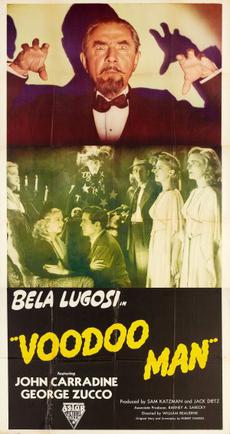
In 1944’s Voodoo Man, Michael Ames stars as Ralph, a screenwriter who has been asked to write a treatment based on the real case of several “girl motorists” who have disappeared in the surrounding area.  Ralph turns down the assignment because he’s busy planning his wedding to Betty (Wanda McKay).  However, when Betty’s maid of honor, Stella (Louise Currie), vanishes, Ralph and Betty set out to investigate.  As Ralph puts it, he’s become a part of the story that he earlier rejected.

What has happened to Stella and all of the other women?  They’ve been abducted by Toby (John Carradine) and Grego (Pat McKee), two lunkheads who work for Dr. Marlowe (Bela Lugosi).  Dr. Marlowe lives in an isolated mansion where he is cared for by his loyal housekeeper (Mici Goty).  Twenty-two years ago, Dr. Marlowe’s wife, Evelyn (Ellen Hall), died but Marlowe has been able to keep her body in a sort of suspended animation ever since.  Marlowe is kidnapping women because, through the use of voodoo and mad science, he hopes to take their “will to live” and transfers it into Evelyn.  Helping Marlowe out is a voodoo priest named Nicholas (George Zucco).

Lugosi, Carradine, and Zucco!  Obviously, the main appeal of Voodoo Man is that it brings together three great names in horror. Even if the story doesn’t really make much sense (and it doesn’t), the film gets a lot of mileage out of the combination of Lugosi, Carradine, and Zucco.  While Lugosi does seem to be a bit bored with his role, Carradine and Zucco really throw themselves into their characters.  John Carradine, in particular, seems to be having the time of his life as he shuffles around the mansion and replies, “Yes, master,” to every command from Dr. Marlowe.  It’s the type of entertaining performance that could only be delivered by a trained Shakespearean slumming in a low-budget, B-grade horror film.  As for Zucco, he plays Nicholas with a certain amount of ruthless erudition.  Zucco is playing the Boris Karloff role here and he definitely seems to understand what that means.

As for the film itself, it has its moments.  Legend has it that director William Beaudine’s nickname was “One Shot” because he was usually only willing to do one take of each scene.  As a result, he filmed quickly and he didn’t spend a lot of money and that was probably a good thing for a production like Voodoo Man.  It also meant that if someone flubbed a line or bumped into a piece of furniture, that take would still be the one that showed up in the film.  My favorite moment of Voodoo Man was when the local sheriff (Henry Hall) referred to Dr. Marlowe as being “Dr. Martin,” and Bela Lugosi, who appeared to be struggling not to laugh, quickly said, “It’s Marlowe.”  The sheriff corrected himself.  That’s the type of fun you don’t get in movies made by people who do more than one take.

Voodoo Man has a quick 61-minute running time.  To enjoy it, it probably helps to already be a fan of low-budget, B-horror films from the 40s.  Lugosi, Carradine, and Zucco are combination that deserves to be seen.

Boss of Hangtown Mesa (1942, directed by Joseph H. Lewis)


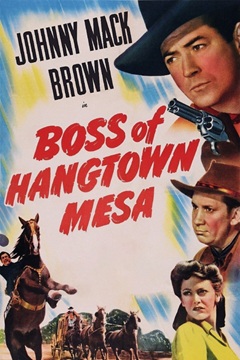
The telegraph company has come to the frontier town of Hangtown Mesa and soon, the citizens will be connected to the rest of the world.  The wealthy men who run the town don’t want that to happen because then people might discover how corrupt they are.  They hire a gunman known as the Utah Kid (Hugh Prosser, not looking much like a kid) to come to town and kill the owner of the telegraph line, John Wilkins (Henry Hall).  The Utah Kid steals the clothes of engineer Steve Collins (Johnny Mack Brown) and frames him for Wilkins’s murder.  With the help Betty Wilkins (Helen Deverell) and traveling medicine man Dr. J. Willington Dingle (Fuzzy Knight), Steve sets out to clear his name.

This is a pretty good Johnny Mack Brown western.  The plot isn’t half-bad as far as Poverty Row westerns are concerned and director Joseph H. Lewis keeps things lively.  Lewis not only gets good performances from his cast but he also makes Hangtown Mesa seem like an actual, growing frontier town.  Lewis even manages to create some suspense as The Utah Kid and Steve Collins switch identities.  Comparing Lewis’s westerns to the ones directed by Sam Newfield shows how much difference a good director can make, even within the confines of a poverty row production.  Even Fuzzy Knight is used well!

Boss of Hangtown Mesa is one of the better Johnny Mack Brown westerns, featuring a good story and an interesting idea behind it as it shows how far the bad guys will go to keep their own private fiefdom from connecting with the rest of the world.  Brown is convincing, whether he’s riding a horse or holding a gun.  He’s playing an educated man here, an engineer, but Brown is still a cowboy through-and-through.

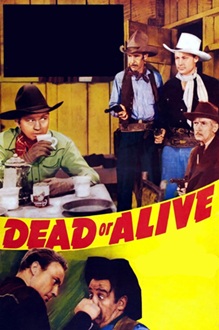
Dead Or Alive (1944, directed by Elmer Cifton)


In this Poverty Row western, the Texas Rangers, a trio of western do-gooders who appeared in a handful of films, are sent to a small town to stop the Yackey Gang, led by the town’s saloon keeper (Ray Bennett).

The Texas Rangers are led by Tex Haines (Tex Ritter), who is known as the Idaho Kid despite apparently being from Texas.  Tex goes undercover as a lawyer and tries to rally the community to stand up the Yackey Gang.  Tex also sings some songs because he’s a singing cowboy along with being a cowboy who can hold his own in bar brawl.  Maybe if he didn’t sing so much, there wouldn’t be as many brawls.  Dave Wyatt (Dave O’Brien) is the younger Ranger who goes undercover and joins that Yackey Gang.  Panhandle Perkins (Guy Wilkinson) is the comic relief, who loses a lot of money at Yackey’s casino but only to help Dave maintain his cover.  The film was an obvious rush job and the plot is far more difficult to follow than any 54-minute film should be.  The kids at the matinee probably enjoyed it, though.  It delivers exactly what fans of the old B-westerns expect, including Charles King as yet another villain.

Tex Ritter, who appeared in a lot of these films, was also the father of actor John Ritter.  In 1970, long after the days of the poverty row westerns, Tex Ritter ran for the Senate in Tennessee but he lost the primary.  If he had won, he would have been the Republican candidate against Al Gore’s father.  That would have been a battle for the ages.

Chip of the Flying U (1939, directed by Ralph Staub)


In this B-western, Johnny Mack Brown plays Chip Bennett, the foreman of the Flying U Ranch.  The ranch is owned by J.G. Whitmore (Forrest Taylor) and his daughter (Doris Weston), who has just returned from college and who has eyes for Dusty (Bob Baker), a singing ranchhand.

Ed Duncan (Anthony Warde) and his gang are in the arms smuggling business.  To make their business a success, they need access to the ranch, which sits on the shore of a lake.  Knowing that Chip would never let them take over, Duncan tries to frame Chip for a bank robbery and murder.  Chip responds by kidnapping two of Duncan’s men, leading to a final and explosive shootout.

Chip of the Flying U is a western that doesn’t seem to know what era it’s supposed to be taking place in.  Chip, Duncan, and all of the other ranch hands dress like they’re in the late 1800s.  Doris Weston dresses like she’s just stepped out of a 1930s photoshoot.  Duncan is trying to smuggle hand grenades, which were invented in 1908 but not commonly used until World War I.  The movie’s time period is all over the place but that was frequently the case with the B-westerns of the 30s.  Shot on studio backlots and for a very low budget, these films were not concerned with historical accuracy.  Instead, they were about shootouts and a few songs.  Chip of the Flying U offers up both, along with Fuzzy Knight as the comedic sidekick who turns out to be very good with a rifle.

With lots of horse chases and bloodless shoot-outs and not too much romance, this movie may seem creaky by today’s standards but probably thrilled the kids who caught while spending an afternoon at the movies in 1939.  Today, the appeal of movies like this is that the good guys are unquestionably good and the bad guys are unquestionably bad.  They remind us of a simpler time that may have never existed but we all hope it did.

Challenge of the Range (1949, directed by Ray Nazarro)


On the frontier, someone is raiding the homes of ranchers like Jim (Henry Hall) and Judy Barton (Paula Raymond).  The Homeowners Association summons Steve Roper (Charles Starrett) to bring a stop to the raids.  Everyone suspects that Cal Matson (Steve Darrell) and his son, Rob (Billy Halop), are behind  the raids but Steve, as the Durango Kid, discovers that a third party is trying to set everyone at war with each other for his own benefit.

The entry in the Durango Kid series was Charles Starrett’s 103rd western.  It’s not a particularly distinguished entry, relying heavily on stock footage.  I did find the idea of the film’s bad guy trying to manipulate the Bartons and the Matsons into destroying each other to be interesting but the movie doesn’t do much with it and the identity of main villain will be obvious to anyone who watches the film.  There is one good scene where Steve disarms three bad guys and then makes them walk all the way back to town without their boots on.  Steve doesn’t mess around.

Smiley Burnette provides the comic relief and a few songs.  This time, Smiley’s a dime store writer researching his next book.  Musically, he is accompanied by The Sunshine Boys.  103 movies in and Smiley still hasn’t figure out that Steve and Durango are one of a kind.