Holidays On The Lens: Beyond Tomorrow (dir by A. Edward Sutherland)


After three eccentric businessman arrange for a young couple to get together right before the holidays, a plane crash kills the three men.  However, their ghosts remain on Earth to watch over the couple and to take care of some unexpected holiday business.  The film is a holiday film and a comedy and a romance and a musical and a ghost story and a melodrama and finally an oddly sincere meditation on life and death.

From 1940, here’s Beyond Tomorrow!

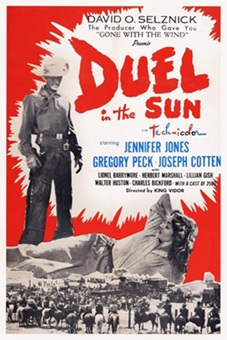
Duel In The Sun (1946, directed by King Vidor)


After her father is executed for killing her mother and her mother’s lover, “half-breed” Pearl Chavez (Jennifer Jones) is sent to live with her father’s second cousin, Laura Beth McCanles (Lillian Gish).  Laura is the wife of rancher, politician, and all-around racist Senator Jackson McCanles (Lionel Barrymore).  Worried that Pearl’s beauty and uninhibited manner will get her into trouble, Laura arranges for Pearl to meet with a minister known as The Sinkller (Walter Huston) who instructs Pearl on how to be a “good” girl.

Wanting to make Pearl bad and his, Lewton “Lewt” McCanles (Gregory Peck) becomes obsessed with Pearl and is soon forcing himself on her on a regular basis.  When the good McCanles brother, Jesse (Joseph Cotten), leaves the ranch despite being in love with Pearl, Pearl tries to find a good husband in the form of Sam Pierce (Charles Bickford).  Lewt responds by gunning Sam down and then goes on the run.  It all leads to an overwrought duel in the sun as the two doomed lovers take aim at each other.

Duel In The Sun is credited to veteran director King Vidor and there are a few shots of the western landscape that do feel typical of Vidor’s work.  However, Duel In The Sun’s true auteur was its producer, David O. Selznick.  Still looking to recapture his earlier success with Gone With The Wind and eager to make his future wife, Jennifer Jones, into an even bigger star than she was, Selznick obsessed over every detail of Duel In The Sun, pushing Vidor and a host of other directors (including Josef von Sternberg, William Dieterle, William Cameron Menzies, Otto Brower, and Sidney Franklin)  to make the film more steamy, more melodramatic, more violent, and more visually epic.  Reportedly, while Video was trying to shoot the film’s titular duel, he had to call cut several times when Selznick ran into the scene with a water bottle to spray more “sweat” onto Jones and Peck.  Today, the stiff Peck seems miscast as the black sheep of the family, the reserved Jones is even more miscast as a mestiza, and the plot is clearly too simplistic to carry the film’s epic ambitions.  A few impressive shots aside, Duel In The Sun is just boring,  In the 40s, though, the film’s relative openness about sex generated enough controversy to make Duel In The Sun into a box office hit.  It was one of the two top-grossing westerns of the 40s, beating out Red River, My Darling Clementine, Fort Apache, The Ox-Bow Incident, and several other films that were actually good.

Unlike Jones, Peck, and even usually reliable stalwart like Lionel Barrymore and Walter Huston, Joseph Cotten at least emerges from this film with his dignity intact.  Playing the good brother, Cotten gets to underplay while everyone else is overplaying and it turns out to be the right approach for him.  Surviving Duel In The Sun was no easy feat but Cotten pulled it off.

Holiday Spirit: Beyond Tomorrow (dir by A. Edward Sutherland)


After three eccentric businessman arrange for a young couple to get together right before the holidays, a plane crash kills the three men.  However, their ghosts remain on Earth to watch over the couple and to take care of some unexpected holiday business.  The film is a holiday film and a comedy and a romance and a musical and a ghost story and a melodrama and finally an oddly sincere meditation on life and death.

From 1940, here’s Beyond Tomorrow!

Holiday Film Review: Beyond Tomorrow (dir by A. Edward Sutherland)


I’m standing at the edge of tomorrow
And its all up to me how far I go
I’m standing at the edge of tomorrow

I’ve never seen such a view before
A new world before my eyes
So much for me to explore
It’s where my future lies

Today I’m standing at the edge of tomorrow
From here the future looks bright for me
And it’s all up to me how far I go
It’s my time to break away
I’m standing at the edge of tomorrow
Today

Beyond Tomorrow is a strange film from 1940.  Technically, it is a holiday film.  It takes place during the Christmas season and there’s a lot of very peppy scenes featuring people celebrating the holidays.  I watched the movie with my friends in the Late Night Movie Gang.  We’re a pretty sentimental group but even we felt that some of the characters went a bit overboard with the holiday cheer.  The film is also comedy and a romance and a musical and a ghost story and a melodrama and finally an oddly sincere meditation on life and death.  That’s a lot of weight for one film to carry and there were more than a few times that Beyond Tomorrow seemed like it might collapse in a heap of Christmas ambition.  Fortunately, the film always righted itself and, in the end, it actually managed to be …. well, definitely more interesting than what any of us were expecting!

The film opens with three businessmen (Harry Carey, C. Aubrey Smith, and Charles Winninger) living in a mansion with their Russian housekeeper (played by Maria Ouspenskaya, who was also the old gypsy lady in The Wolf Man).  As almost something of a lark, the three men arrange for James (Richard Carlson) to meet Jean (Jean Parker).  Jean is a teacher.  James is a singing cowboy from Texas.  Together, with the encouragement of the three businessmen, Jean and James get together.  Awwwww!

Unfortunately, the three businessmen are then all killed in a plane crash.  However, their ghosts remain on Earth and watch over the growing love between James and Jean.  Unfortunately, James become a singing sensation on the radio and soon, he’s being tempted to cheat.  Meanwhile, Jean’s ex-husband is running around with murder in his heart and a gun in his hand!  This romantic comedy has suddenly taken a very dark turn!

While the three ghosts look after James and Jean, they consider why they’re still on Earth and not in the afterlife.  One ghost is eventually greeted by his son, who died during the Great War.  Another one of the businessmen is haunted by vaguely defined sins and, even in death, he refuses to repent because he feels that he doesn’t deserve to go to Heaven.  Instead, he continually walks off into the darkness.  The last businessman continually tries to push James and Jean on the right path but it turns out that it’s not easy for the dead to talk sense to the living.

You can probably give yourself whiplash trying to keep up with the film’s tonal changes.  It starts out with romance and comedy and then suddenly, it’s turns into an existential rumination of love, forgiveness, and guilt.  Once the three businessmen die, it becomes a totally different story.  Suddenly, soldiers are returning from the dead and the gates of Hell are beckoning.  And, on top of that, James keeps breaking out into song every few minutes!

It’s a very strange film.  Unfortunately, from the start, the pacing feels off.  By today’s standards, Beyond Tomorrow gets bogged down in all of the songs and the scenes of holiday mirth-making.  That may not have been as much of a problem for audiences in 1940 but I have to say that, speaking as someone trying to watch this film in 2020, Beyond Tomorrow made my ADD go crazy.  If not for my friends and their patient willingness to inform me what was going on in the film, I probably wouldn’t have been able to follow the film’s storyline.

That said, the film was fairly well-acted and the final scenes, with the heavenly gates in the sky, are undeniably effective.  Speaking as a history nerd, I found it interesting to see how the shadow of World War I still hung over a film that was made 21 years after that war ended.  As the scenes in which one of the ghosts is a reunited with son showed, America was still dealing with trauma and horror of the first modern war.  (One year after the release of Beyond Tomorrow, Japan would bomb Pearl Harbor and America entered World War II, a conflict that many hoped to avoid precisely because they remembered the all of the men who didn’t make it home during the previous war in Europe.)  Messy though the film may be, Beyond Tomorrow functions well as both a historical document and a bit of sentimental wish fulfillment.

Compared to holiday classics like the original Miracle on 34th Street and It’s A Wonderful Life, Beyond Tomorrow is relatively unknown.  Certainly, it’s no classic.  But, for fans of both Christmas and old movies, it’s still an interesting trip into the past.
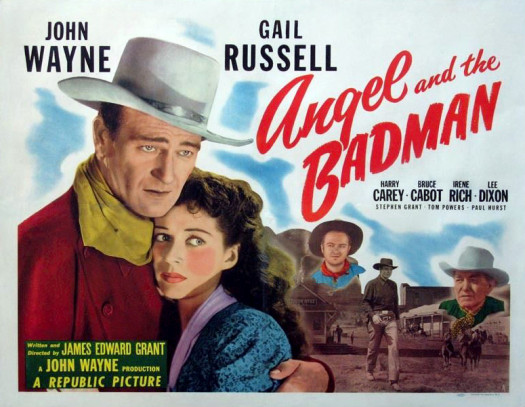
Redemption Song: John Wayne in ANGEL AND THE BADMAN (Republic 1947)


gary loggins's avatarcracked rear viewer

John Wayne  starred in some of the screen’s most iconic Westerns, but I’ve always had a soft spot in my heart for ANGEL AND THE BADMAN. Perhaps it’s because the film fell into Public Domain in the mid-70’s, and I’ve had the opportunity to view it so many times. Yet I wouldn’t keep coming back to it if it weren’t a really good movie. It’s Wayne’s first film as producer, and though it has plenty of that trademark John Wayne action and humor, it’s a bit different from your typical ‘Big Duke’ film.

Wayne plays Quirt Evans, an outlaw on the run. The wounded Quirt encounters a Quaker family, the Worths, who take him to file a land claim before the big guy finally passes out. They bring him back to their family farm to nurse him back to health, and pretty daughter Penny, unschooled in the ways of the…

View original post 762 more words

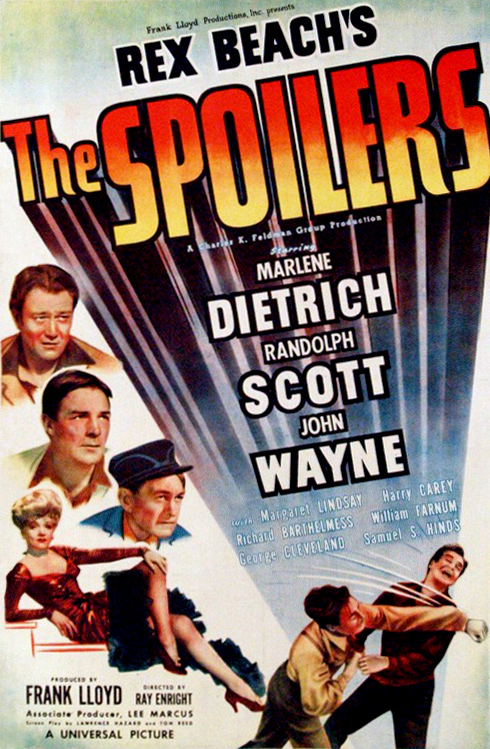
Yukon Gold: THE SPOILERS (Universal 1942)


gary loggins's avatarcracked rear viewer

What’s this?? A “Northern” Western set in 1900 Alaska Gold Rush territory starring my two favorite cowboys, John Wayne and Randolph Scott ? With the ever-enticing Marlene Dietrich thrown in as a sexy saloon owner? Count me in! THE SPOILERS is a big, brawling, boisterous film loaded with romance, action, and, most importantly,  a sense of humor. It’s the kind of Hollywood entertainment epic that, as they say, “just don’t make ’em like that anymore”. I’ve never been quite sure who “they” are, but in regards to THE SPOILERS, they’re right – and more’s the pity!

Rex Beach’s popular 1906 novel had been filmed three times before (1914, 1923, 1930), and would be one more time after (in 1955), but with The Duke, Rugged Randy, and La Dietrich on board, this has got to be the best of the bunch. Even though audiences were more than familiar with the story…

View original post 697 more words

Tall (Tales) in the Saddle: THE LAW WEST OF TOMBSTONE (RKO 1938)


gary loggins's avatarcracked rear viewer

lawwest1

Cowboy star Harry Carey had been around since motion pictures were knee-high to a cactus. He made his first film in 1908, working with pioneer director D.W. Griffith. He was already one of silent film’s biggest sagebrush stars by the time he made 1918’s STRAIGHT SHOOTER, the directorial debut of John Ford. When the  talkies rolled around, Carey was over fifty and his leading man days were behind him. He transitioned into a fine character actor, and his talents are given a good showcase in the low-budget Western THE LAW WEST OF TOMBSTONE.

lawwest2

Carey is champion liar Bill Barker, a charming rascal who spins tall tales of his bravery fighting bloodthirsty Indians. The old windbag gets himself thrown out of New York circa 1881 when he tries to run a con on Wall Street tycoon Sam Kent. Not even his ex, a former saloon girl now passing herself off as continental singing…

View original post 531 more words

The Fabulous Forties #27: Sundown (dir by Henry Hathaway)


40s

You may remember how, back in April, I started on a mission to review all 50 of the films included in Mill Creek’s Fabulous Forties box set.  I actually got off to a pretty good start and, by the end of the month, I was about halfway through.  Yay me!

However, then the month of May began.  And May turned out to be a very, very busy month.  As I sit here writing this, it’s been 27 days since I last posted a Fabulous Forties review.  That review was …. well, I can’t even remember what it was.  After I post this, I’ll click on this link to find out.

However, things have calmed down a bit and now I can go ahead and finish up the Fabulous Forties box set.  And that’s a good thing because, between me and you, I am more than ready to move on to the Nifty Fifties box set!

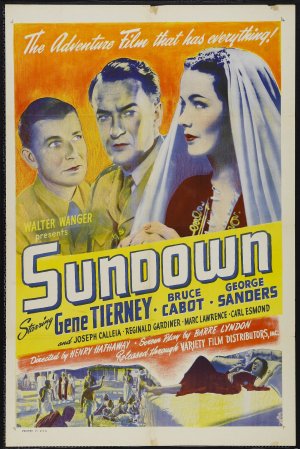
Anyway, without further ado, let’s consider the 27th film in Mill Creek’s Fabulous Forties, 1941’s Sundown!

Poster_of_the_movie_Sundown

Sundown was released by United Artists in 1941.  It’s a propaganda film, telling the story of British soldiers in North Africa and their attempts to both maintain the peace among the natives and to keep the Axis powers from arming the local rebels.  Bruce Cabot is the experienced soldier who knows how things work in Africa.  George Sanders is the new commander who is a bit more by-the-book.  At first, you think that the film is going to be dominated by the rivalry between Sanders and Cabot but actually it’s not much of a rivalry.  For the most part, they get along just fine and I guess that’s to be expected considering that the film was made at a time when the emphasis was on everyone remaining unified against the Nazis.

Speaking of the Axis powers, they’re always in hovering in the shadows of the film but it’s rare that we actually see any enemy soldiers.  Perhaps this is because the film was made at a time when the United States was technically neutral.  Joseph Calleia plays a prisoner of war who has rejected fascism and instead just wants to sing opera and cook for Sanders and Cabot.  Calleia’s character is specifically identified as being an Italian.  If not for that (and the fact that the film was made in 1941), it would be just as easy to assume that Sanders and Cabot were fighting the French or maybe the Russians.

There’s an enemy agent in one of the tribes and it’s up to Sanders and Cabot to figure out who.  Helping them out is the local big game hunter, played by Harry Carey.  And, on top of that, there’s also a mysterious native woman played by Gene Tierney.  Gene Tierney is totally miscast but that adds to this film’s odd charm.

And, for modern viewers, it definitely is an odd charm.  I watched Sundown twice and I’m still not sure exactly what happened in the film.  Sundown is one of those films that doesn’t so much have a plot as it just has a lot of scenes that kind of tell a story, assuming that you have the patience and concentration to figure out how they all link together.  Between Cabot’s roguish smile, Sanders’s stiff upper lip performance, Calleia’s enjoyable overacting, and Gene Tierney’s otherworldly beauty, Sundown is unexpectedly dream-like.  The film even features a sudden sermon in which a clergyman (Sir Cedric Hardwicke) exhorts everyone to fight.  The clergyman is never seen again.

Sundown was a strange movie, one that I often found myself struggling to follow.  It was also apparently a box office bomb, though it did receive 3 Oscar nominations.  One of those nominations was for Charles Lang’s cinematography and it was definitely deserved.  Even the version I saw (which suffered from a typically poor Mill Creek transfer) was still impressive to look at.

Shattered Politics #4: Mr. Smith Goes To Washington (dir by Frank Capra)


mr-smith-goes-to-washington

So, when you read that I was going to be reviewing 94 political films here at the Shattered Lens, you probably knew that one of them would have to be the 1939 best picture nominee, Mr. Smith Goes To Washington.

So, we all know that story right?  The senator from an unnamed state dies.  The weak-willed Governor (Guy Kibbee) has to appoint a new senator.  Political boss Jim Taylor (Edward Arnold) demands that the governor appoint one of his cronies.  The state’s reformers demand that the Governor appoint a never-seen crusader named Henry Hill (who, whenever I hear his name, makes me think of Ray Liotta snorting cocaine in Goodfellas).  The Governor’s children demand that he appoint Jefferson Smith (James Stewart, of course!), who is the head of something called the Boy Rangers.  The Governor flips a coin.  The coin lands on its edge but it also lands next to a newspaper story about Jeff Smith.

So, of course, Mr. Smith goes to Washington.

Now, as the movie quickly makes clear, Jeff Smith is immediately out-of-place in Washington.  For one thing, he’s actually excited to be there.  He’s convinced that he’s there to make America a better place.  When a bunch of drunken reporters (led by the great Thomas Mitchell) make Smith look foolish, Smith responds by running around Washington and punching them out.  (That whole sequence probably serves as wish fulfilment for a lot of politicians.)  When his cynical legislative aide Saunders (Jean Arthur) tells him that he’s too naive to survive in Washington, he wins her over with the purity of his idealism.  When his mentor, Senator Paine (Claude Rains), is revealed to be a part of Washington’s corrupt culture, Smith is stunned.  When Taylor tries to destroy his political career, Smith responds by giving the filibuster to end all filibusters.  He’s one man standing up against a culture of corruption and…

And there’s a reason why, 76 years later, aspiring political candidates still attempt to portray themselves as being a real-life, modern Jefferson Smith.

This is one of those films that everyone seems to agree is great and, of course, there’s many reasons to love Mr. Smith Goes To Washington.  There’s the lead performance of Jimmy Stewart, of course.  While this may not be his best performance (I prefer the more layered characterization that he brought to It’s A Wonderful Life and Anatomy of a Murder), it is Stewart at his most likable and, most importantly, he makes you feel Jeff Smith’s pain as he discovers that Washington is not the great place that he originally assumed it to be.  Claude Rains was always great when it came to playing good men gone wrong and he’s perfect as Sen. Paine.  Thomas Mitchell and Jean Arthur are perfectly cast and I always enjoy seeing the bemused smile on the face of Vice President Harry Carey as Smith conducts his filibuster.

But I think the best thing about Mr. Smith Goes To Washington is that it actually makes you believe that there are Jeff Smiths out there who actually could make a difference.  And, until Judd Apatow gets around to remaking the film with Adam Sandler, audiences will continue to believe.

http://www.youtube.com/watch?v=sm9qaEJ3MBc

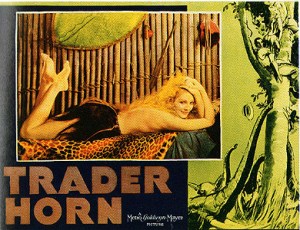
What Lisa Marie Watched Last Night: Trader Horn (dir. by W.S. Van Dyke)


Last night, as I attempted to drift off to sleep, I switched over to TCM and watched the 1931 film Trader Horn.

Why Was I Watching It?

I’m on a mission to see every film ever nominated for best picture and Trader Horn was nominated back in 1931.  (It lost to the first western ever to win best picture, Cimarron.)  Trader Horn is a bit of an oddity among Oscar contenders in that it received no other nominations save for best picture and it has never been released on DVD.  When I saw it on TCM’s schedule last night, I figured that might very well be my only chance to see this forgotten best picture nominee.

What’s It About?

So Trader Horn (Harry Carey) is a heroic ivory hunter.  Yes, this film was made a long time ago. He makes his living in Africa where he spends his time killing animals and explaining how, whenever the natives start playing their drums, it means that “every black devil is in the bush.”  Again, this film was made a very loooooooong time ago.

Anyway, at the start of the film, Trader Horn is introducing his apprentice (Duncan Renaldo) to the facts of life in Africa.  Eventually, they meet a missionary (Olive Golden) who is looking for daughter who was kidnapped by a tribe years ago.  When Golden is killed, Trader Horn takes it upon himself to find her daughter (played by Edwina Booth) and bring her back to civilization.

What Worked?

Trader Horn was the first non-documentary to be filmed on location in Africa and, as you watch the movie, it quickly becomes apparent that the film’s plot is really just an excuse to show off all the nature footage that director W.S. Van Dyke managed to capture.  Countless time the film’s story comes to a complete halt while Carey and Renaldo simply stop to watch a grazing giraffe or to watch a leopard hunt a wildebeest.  Normally, this is the sort of thing I would complain about but, in this case, the story was so predictable and silly that I was happy for the interruption.  It helps that the 80 year-old nature footage is still visually impressive and exciting to watch.   According to the research I did on the Internet after seeing the film, Trader Horn’s footage was used as a stock footage in countless “jungle” films over the next three decades in much the same way that the same old distressing mondo footage tends to show up in every single Italian cannibal film.

There’s a scene were Renaldo finds a lion cub and oh my God, it’s just the most adorable little kitty ever!

Trader Horn actually has an interesting production history and I enjoyed reading about it after I watched the movie.  Apparently, Van Dyke spent seven months in Africa making this film and almost the entire crew ended up falling ill.  At least two cameramen were killed while filming the wild animals and Edwina Booth returned so sick that her film career was pretty much ended. 

On one final note, there was apparently a pornographic remake of this film in the late 60s.  Its title?  Trader Hornee.

What Didn’t Work?

Did I mention this film was made a really looooooong time ago?  Because, seriously, it was.  On occasion, I’ve heard an old film described as being “creaky.”  I never really understood what that meant until I saw Trader Horn because, quite frankly, this film is amazingly creaky.   It moves slowly, the performers are rather melodramatic (though Harry Carey does a good job), and. while the cultural attitudes may have been acceptable in 1931, they now come across as extremely racist and its hard not to feel really uncomfortable with scenes where Renaldo ogles the bare-breasted native women and says, “Why, they’re not savages at all!  They’re like little children!”

Bleh.

“Oh My God!  Just Like Me!” Moments:

I would have wanted to adopt that lion cub too.

Lessons Learned:

1931 was a long, long time ago.