THE WITCHES (also called THE DEVIL’S OWN) was the last film of Oscar winner Joan Fontaine. This Hammer entry in the “older actress do horror” sweepstakes is a low-key, atmospheric thriller about devil worshippers in the English countryside that holds up right until its (for me) unsatisfying finale. But we’ll get to that later.
Miss Fontaine plays Gwen Mayfield, a missionary in darkest Africa attacked in the midst of an uprising by a voodoo cult. After suffering a nervous breakdown, Gwen interviews for a job as a teacher at a private school in Heddaby run by siblings Alan and Stephanie Bax. Alan wears a clerical collar, though Gwen soon discovers when she gets the job he’s not a reverend after all. In fact, the local church is in ruins. She receives a note from Ronnie Dorsett, a gifted student in need of tutoring, about Linda Riggs, a girl he’s sweet on. The note…
Last year, Gary reviewed the first of the Hammer Frankenstein films, The Curse of Frankenstein.For today’s horror film review, I’m going to take a look at the second movie in Hammer’s Frankenstein series, 1958’s The Revenge of Frankenstein!
The Revenge of Frankenstein opens where The Curse of Frankenstein ended. The monster (played by Christopher Lee in the first film) has been destroyed and Baron Frankenstein (Peter Cushing) has been sentenced to be executed for the monster’s crimes. However, the Baron escapes the guillotine. Instead, he arranges for a priest to be beheaded in his place. Working under the name Dr. Stein, the Baron escapes to another village and, after several years, re-establishes himself as a wealthy and respected doctor. While most of his patients are rich, Dr. Stein also helps the poor and the disabled. By all accounts, he’s doing wonderful work but he’s also deliberately enigmatic, refusing to join the local doctors council.
Right from the beginning, we’re reminded of just how different Hammer’s Baron Frankenstein was from Universal’s version of the good doctor. In the Universal films, Dr. Frankenstein — regardless of whether the doctor in question was Henry, Wolf, or Ludwig — was always portrayed as being misguided but ultimately noble. If any of the Universal Frankensteins had been sentenced to death, it’s probable that they would have put on a stoic face, walked to the guillotine, and allow their head to roll. In fact, they would have felt so responsible for the actions of the Monster that they probably would feel it was their moral duty to allow themselves to be executed.
That’s not the case when it comes to Hammer’s Baron Frankenstein. Baron Frankenstein feels no guilt over what the Monster has done. Go the guillotine? No way! Baron Frankenstein is determined to create life and if creating life means that other, lesser mortals end up dead … well, so be it. As opposed to the Universal Frankensteins, who all developed god complexes after the success of their experiment, Baron Frankenstein has his god complex from the beginning. And if Baron Frankenstein is a god, why shouldn’t a priest be sacrificed for the good of the Baron’s work?
Anyway, Dr. FrankenStein and his assistant, Dr. Kleve (Francis Matthews) are determined to once again bring the dead back to life. This time, the plan involves transplanting the brain of hunchback Karl (Oscar Quitak) into a physically strong body (played by Michael Gwynn). Dr. Kleve is worried that a brain transplant could lead to unforseen complications. For instance, one of Dr. Stein’s chimpanzees reacts to being given an orangutan’s brain by turning into a cannibal. However, Stein tells Dr. Kleve not to worry about it. After all, what could go wrong?
Well, a lot goes wrong. It’s a Frankenstein movie, after all.
I have to admit that, while I love Hammer’s Dracula films, I’ve never been a huge fan of their take on Frankenstein. While Peter Cushing always makes for a wonderfully compelling and often chillingly evil Baron Frankenstein, the majority of the Hammer Frankenstein films always seem to move way too slowly. Whenever I watch one of them, I always find myself growing rather impatient with the endless scenes of grave robbery and body stitching. “HURRY UP AND BRING THAT DAMN THING TO LIFE!” I’ll find myself shouting.
However, I was actually pleasantly surprised by how well The Revenge of Frankenstein holds up. That Cushing would give an excellent performance as Baron Frankenstein is to be expected. But really, the entire film is well-acted and both Oscar Quitak and Michael Gwynn give poignant performances as Frankenstein’s latest experiment. It’s a visually vibrant and nicely paced horror film, one that never drags like some of the later Hammer Frankenstein films.
The Curse of Frankenstein and The Revenge of Frankenstein make for a great double feature, especially in October!
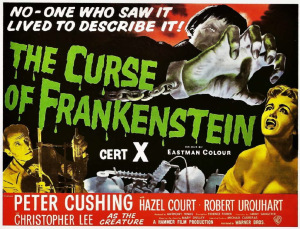
Hammer Films Ltd. knew they were on to something with the release of 1957’s THE CURSE OF FRANKENSTEIN. The Gothic horror was box office gold on both sides of the Atlantic, and Hammer wasted no time finding a follow up. Reuniting CURSE OF FRANKENSTEIN costars Peter Cushing and Christopher Lee with director Terence Fisher, the company set its sights on giving the full Eastmancolor treatment to Bram Stoker’s immortal Count Dracula.
When Britain’s Hammer Films began in the early 1930’s they were just another movie production company. After finding some success with the 1955 sci-fi adaptation THE QUARTERMASS EXPERIMENT, they chose to make a Gothic horror based on Mary Shelley’s classic 1818 novel about a man obsessed with creating artificial life. FRANKENSTEIN had been filmed many times before, most notably Universal’s 1931 version that brought eternal fame to Boris Karloff. This time however, the producers shot in vibrant color, with blood and body parts on gory display. Tame stuff compared to today’s anything goes horrors, but in the fifties it was considered quite shocking.
Peter Cushing and Christopher Lee had appeared in two films before, Lawrence Olivier’s 1948 HAMLET and John Huston’s 1952 MOULIN ROUGE, though not as a team. Once CURSE OF FRANKENSTEIN was unleashed upon the public, they were paired another nineteen times, making Cushing and Lee terror’s all-time tandem. HORROR OF DRACULA came next, with…
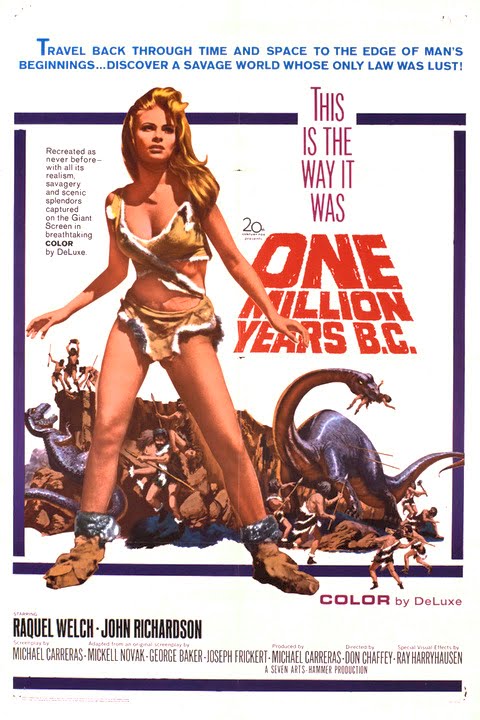
JURRASIC WORLD and its CGI dinosaurs have stomped their way to box office domination this year, raking in over five hundred million dollars (and counting). The youth market just eats up those computer generated special effects. But for my money, you just can’t beat the prehistoric hijinks of Hammer Films’ 1966 ONE MILLION YEARS BC. Two reasons: Ray Harryhausen and Raquel Welch.
Ray Harryhausen (1920-2013) learned the art of stop motion animation from the master, KING KONG’s own Willis O’Brien. After assisting O’Brien on 1949’s MIGHTY JOE YOUNG, he struck out on his own, using his Dynamation process on such sci-fi/fantasy flicks as BEAST FROM 20,000 FATHOMS, IT CAME FROM BENEATH THE SEA, and 7TH VOYAGE OF SINBAD. Later films included VALLEY OF GWANGI, GOLDEN VOYAGE OF SINBAD, and his last, 1981’s CLASH OF THE TITANS.
The second reason is Raquel. Full disclosure: I had a huge crush on Raquel Welch during my adolescence. I had the iconic poster of her in her fur bikini from this movie on my bedroom wall through most of the Seventies. I also had pictures of her from TV GUIDE taped in my locker at school, which got me in hot water with my 6th grade teacher. What a prude! Oh well, it may have been my first time in trouble at school, but it certainly wasn’t the last.
But I digress. Let’s take a trip back to the dawn of time in ONE MILION YEARS BC. There’s a prehistoric tribesman named Tumak (John Richardson) who’s ousted from his people due to a sibling rivalry with brother Sakana. He wanders aimlessly into an unknown world, encountering giant lizards and spiders along the way. Tumak reaches the seashore, where he meets up with a tribe of blonde beauties led by Raquel and her fur bikini. A giant turtle attacks the girls on the beach and Raquel blows her seashell, summoning the blonde males of the tribe. They, along with Tumak, chase the turtle away with their rocks and sticks. The tribe decides to accept Tumak as one of their own.
Which is good for Raquel, because the fur-bikini clad damsel has developed a thing for Tumak. This, however, makes her blonde boyfriend Ahos very jealous. After saving a little girl from a hungry Allosaurus, , Tumak and Ahos duke it out over possession of the victory spear. Tumak gets banished yet again, but this time he’s accompanied by Raquel and her fur bikini.
Across the wasteland we go again, as the couple run into a band of unevolved ape-men, and a battle between a Triceratops and a T-Rex. Tumak and Raquel (and the bikini) are ambushed by Tumak’s old tribe, and Tumak vanquishes Sakana. But a Pterodactyl attacks and carries Raquel off, fur bikini and all! The lovers are separated as the flying terror tries to feed poor Raquel to it’s babies. Eventually, they’re reunited, just in time for a fight between the rival tribes. The battle’s just getting underway when a volcano erupts, spitting lava and causing massive earthquakes. The villages now all destroyed, the two tribes band together and march toward an uncertain destiny.
ONE MILLION YEARS BC may be pretty goofy, but it does has some bright spots. Harryhausen’s special effects are always a joy to behold, and I’ll still take them over CGI any day of the week. John Richardson makes a sturdy leading man, even with dialogue that mostly consists of grunts and groans. There’s a scene with the lovely Martine Beswick (DR JEKYLL & SISTER HYDE) doing a sort of Jurrasic watsui that’s a highlight. Oh, and did I mention Raquel and her fur bikini…..
The picture above is Christopher Lee in the 1998 film Jinnah. In this epic biopic, Lee played Muhammad Ali Jinniah, the founder of modern Pakistan. Up until yesterday, I had never heard of Jinnah but, after news of Lee’s death broke, Jinnah was frequently cited as being Lee’s personal favorite of his many roles and films.
Consider that. Christopher Lee began his film career in the 1940s and he worked steadily up until his death. He played Dracula. He played The Man with the Golden Gun. Christopher Lee appeared, with his future best friend Peter Cushing, in Laurence Olivier’s Oscar-winning Hamlet. He played Seurat in John Huston’s Moulin Rouge. He appeared in both The Lord of the Rings and the Hobbit trilogies. He appeared in several films for Tim Burton. He even had a small role in Martin Scorsese’s Hugo. He appeared in two Star Wars prequels. He appeared in the original Wicker Man (and reportedly considered it to be his favorite of his many horror films). He appeared in Oscar winners and box office hits. And, out of all that, Christopher Lee’s personal favorite was Jinnah, a film that most people have never heard about.
Unless, of course, you live in Pakistan. When I did a google search on Christopher Lee, I came across several Pakistani news sources that announced: “Christopher Lee, star of Jinnah, has died.”
And really, that somehow seems appropriate. Christopher Lee was the epitome of an international film star. He worked for Hammer in the UK. He worked with Jess Franco in Spain and Mario Bava in Italy. He appeared in several movies in the United States. And, in Pakistan, he played Jinnah. And I haven’t seen Jinnah but I imagine he was probably as great in that role as he was in every other role that I saw him play. Over the course of his long career, Christopher Lee appeared in many good films but he also appeared in his share of bad ones. But Christopher Lee was always great.
It really is hard to know where to begin with Christopher Lee. Though his death was announced on Thursday, I haven’t gotten around to writing this tribute until Friday. Admittedly, when I first heard that Lee had passed away, I was on a romantic mini-vacation and had promised myself that I would avoid, as much as possible, getting online for two days. But, even more than for those personal reasons, I hesitated because I just did not know where to start when it came to talking about Christopher Lee. He was one of those figures who overwhelmed by his very existence.
We all know that Christopher Lee was a great and iconic actor. And I imagine that a lot of our readers know that Lee had a wonderfully idiosyncratic musical career, releasing his first heavy metal album when he was in his 80s. Did you know that Lee also served heroically during World War II and, after the war ended, helped to track down fleeing Nazi war criminals? Did you know that it has been speculated that Lee may have served as one of the role models for James Bond? (Ian Fleming was a cousin of Lee’s and even tried to convince Lee to play Dr. No in the first Bond film.) Christopher Lee lived an amazing life, both on and off the screen.
But, whenever one reads about Christopher Lee and his career or watches an interview with the man, the thing that always comes across is that, for someone who played so many evil characters, Christopher Lee appeared to be one the nicest men that you could ever hope to meet. Somehow, it was never a shock to learn that his best friend was his frequent screen nemesis, Peter Cushing.
Christopher Lee is one of those great actors who we assumed would always be here. The world of cinema will be a sadder world without him.
Legends together
Here is a list of Christopher Lee films that we’ve reviewed here on the Shattered Lens. Admittedly, not all of these reviews focus on Lee but they do provide a hint of the man’s versatility:
Sir Christopher Lee was 93 years old and he lived those 9 decades in the best way possible. As long as there are film lovers, he will never be forgotten.
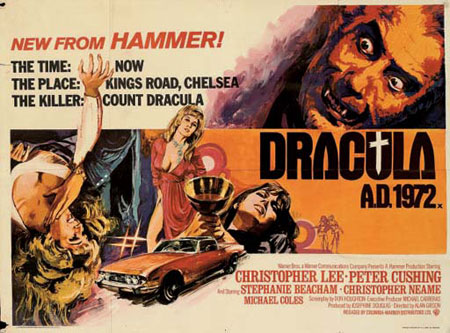
Dracula A.D. 1972 opens in 1872 with a genuinely exciting fight on a runaway carriage that ends with the death of both Count Dracula (Christopher Lee) and his nemesis, Prof. Van Helsing (Peter Cushing). However, as Van Helsing is buried, we see one of Dracula’s disciples (played by Christopher Neame, who had an appealingly off-kilter smile) burying Dracula’s ashes nearby. The camera pans up to the clear Victorian sky and, in a sudden and genuinely effective jumpcut, we suddenly see an airplane screeching across the sky.
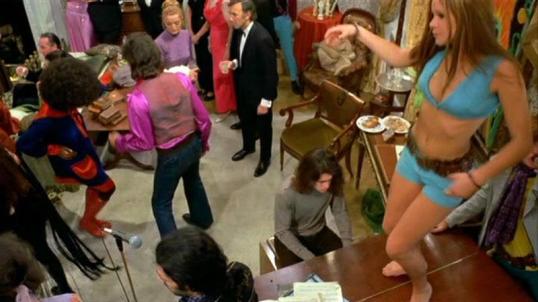
Well, it’s all pretty much downhill from there. Suddenly, we discover that a hundred years have passed and we are now in “swinging” London. The city is full of red tourist buses, hippies wearing love beads, and upright policemen who always appear to be on the verge of saying, “What’s all this, then?” We are introduced to a group of hippies that are led by a creepy guy named Johnny Alculard (also played — quite well, actually — by Christopher Neame). One of those hippies (Stephanie Beacham) just happens to be the great-great-granddaughter of Prof. Van Helsing. Apparently, she’s not really big on the family history because she doesn’t notice that Alculard spells Dracula backwards. Then again, her father (played by Peter Cushing, of course) doesn’t either until he actually writes the name down a few times on a piece of a paper.
Anyway, the film meanders about a bit until finally, Alculard convinces all of his hippie friends to come take part in a black mass. “Sure, why not?” everyone replies. Well, I don’t have to tell you how things can sometimes get out-of-hand at black mass. In this case, Dracula comes back to life, kills a young Caroline Munro, and eventually turns Johnny into a vampire before then setting his sights on the modern-day Van Helsings.
Dracula A.D. 1972 was Hammer’s attempt to breathe some new life into one of its oldest franchises and, as usually happens with a reboot, its critical and (especially) commercial failure ended up helping to end the series. Among even the most devoted and forgiving of Hammer fans, Dracula A.D. 1972 has a terrible reputation. Christopher Lee is on record as regarding it as his least favorite Dracula film. And the film definitely has some serious flaws. Once you get past the relatively exciting pre-credits sequence, the movie seriously drags. There’s a hippie party sequence that, honest to God, seems to last for about 5 hours. As for the hippies themselves, they are some of the least convincing middle-aged hippies in the history of fake hippies. You find yourself eagerly awaiting their demise, especially the awkward-looking one who — for some reason — is always dressed like a monk. (Those crazy hippies!) But yet…nothing happens. All the fake hippies simply vanish from the film. Yet, they’re so annoying in just a limited amount of screen time that the viewer is left demanding blood. Add to that, just how difficult is it to notice that Alculard is Dracula spelled backwards? I mean, seriously…
To a large extent, the charm of the old school Hammer films comes from the fact that they’re essentially very naughty but never truly decadent. At their heart, they were always very old-fashioned and actually quite conservative. The Hammer films — erudite yet campy, risqué yet repressed — mirrors the view that many of my fellow Americans have of the English. For some reason, however, that Hammer naughtiness only works when there’s the sound of hooves on cobblestone streets and when the screen is populated by actors in three-piece suits and actresses spilling out of corsets. Dracula A.D. 1972 did away with the support of the corset and as a result, the film is revealed as a formless mess with all the flab revealed to the world.
Still, the film isn’t quite as bad as you may have heard. First off, the film — with its middle-aged hippies — has a lot of camp appeal. It’s the type of film that, once its over, you’re convinced that the term “groovy” was uttered in every other scene even though it wasn’t. As with even the worst Hammer films, the film features a handful of striking images and Christopher Neame is surprisingly charismatic as Alculard.
As with the majority of the Hammer Dracula films, the film is enjoyable if just to watch the chemistry between Christopher Lee and Peter Cushing. Both of these actors — so very different in image but also so very stereotypically English — obviously loved acting opposite of each other and whenever you see them on-screen together, it’s difficult not to enjoy watching as each one tried to top the other with a smoldering glare or a melodramatic line reading. As actors, they brought out the best in each other, even when they were doing it in a film like Dracula A.D. 1972. In this film, Cushing is like the father you always you wished you had — the stern but loving one who protected you from all the world’s monsters (both real and cinematic).
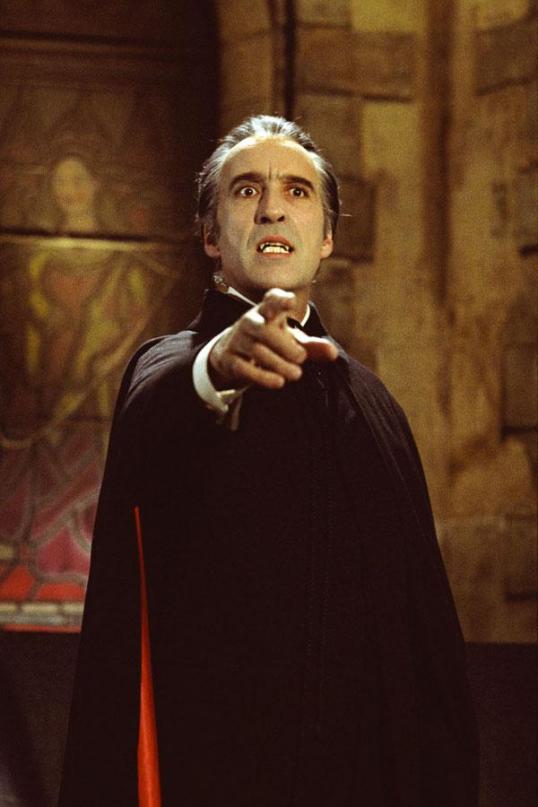
As for Lee, he’s only in six or seven scenes and he has even fewer lines but, since you spend the entire film wondering where he is, he actually dominates the entire movie. Lee apparently was quite contemptuous of the later Hammer Dracula films and, oddly enough, that obvious contempt is probably why, of all the Draculas there have been over the years, Lee’s version is the only one who was and is actually scary. F0rget all of that tortured soul and reluctant bloodsucker crap. Christopher Lee’s Dracula is obviously pissed off from the minute he first appears on-screen, the embodiment of pure destructive evil. And, for whatever odd reason, the purity of his evil brings a sexual jolt to his interpretation of Dracula that those littleTwilight vampires can only dream about. Even in a lesser films like Dracula A.D. 1972, Christopher Lee kicks some serious ass.
So, in conclusion, I really can’t call Dracula A.D. 1972 a good film nor can I really suggest that you should go out of your way to see it.. I mean, I love this stuff and I still frequently found my mind wandering whenever Cushing or Lee wasn’t on-screen. However, it’s not a terrible movie to watch if you happen to find yourself trapped in the house with 90 minutes to kill.
Two years after being temporarily destroyed at the end of Dracula Has Risen From The Grave, Dracula returned in 1970’s Taste The Blood of Dracula! Returning in the role and uttering only a handful of lines, Christopher Lee gave one of his most intimidating performances in the role of everyone’s favorite vampire.
Picking up where Dracula Has Risen From The Grave ended, Taste the Blood of Dracula opens with a sleazy merchant named Weller (Roy Kinnear) upsetting his fellow passengers during a carriage ride through Eastern Europe. After they forcefully toss him out of the carriage, Weller comes across a crucifix-impaled Dracula. Weller watches as Dracula dissolves into red dust. Weller gathers up the dust and Dracula’s ring and brooch.
A few months later, the plot picks up with three wealthy men in England. Hargood (Geoffrey Keen), Paxton (Peter Sallis), and Secker (John Carson) pretend to be charitable church goers but, in reality, they spend most of their spare time down at a wonderfully ornate brothel. One night, at the brothel, they meet a disgraced nobleman named Courtley (Ralph Bates), who was disinherited for attempting to hold a black mass. Intrigued by Courtley’s promise to give them an experience that they’ll never forget, the three men agree to purchase Dracula’s blood from Weller.
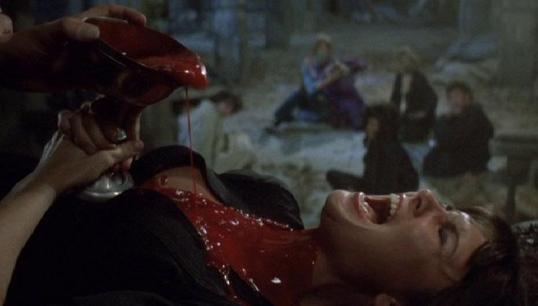
When they go to meet Courtley in a desecrated church, things suddenly go wrong. Courtley attempts to force the three men to drink from a goblet containing a mix of his and Dracula’s blood. After all three of the men refuse, Courtley himself drinks the blood. The men respond by beating Courtley to death and then fleeing from the church. After the men are gone, Courtley’s dead body transforms into a now living Dracula. Dracula announces that those who have destroyed his servant will now be destroyed themselves.
And he proceeds to do just that, turning the men’s children into vampires and then commanding them to kill their parents. Among those possessed are Alice (Linda Hayden), Hargood’s daughter for whom the film suggests Hargood may have incestuous feelings. Alice is in love with Paul (Anthony Corlan), the son of Paxton. When both Alice and his sister Lucy (Isla Blair) disappear, Paul sets out to find them and instead, comes across Dracula…
Taste the Blood of Dracula features Dracula at his cruelest (which, of course, makes it all the more ironic that his main motivation here is to avenge the death of his servant). Whereas Dracula could probably very easily kill all three of the men himself, his decision to use their children to get his revenge adds a whole new level of horrific ickiness to the film. Fortunately, none of the three men are particularly likable but still, it’s hard not to be disturbed when you’re confronted by the image of a vampirized daughter driving a stake into her own father’s heart.
But then again, that’s a part of the appeal of the old Hammer films, isn’t it? Hammer films actually “go there” in a way that the period’s American horror films would probably never quite dare.
As for Taste the Blood of Dracula, there’s a lot to recommend it. Director Peter Sadsy keeps the action moving, both the sets and the supporting cast are properly baroque, and how can you go wrong with Christopher Lee playing Dracula? Christopher Lee is one of those actors who could do so much with just a glare and the fact that his Dracula says very little only serves to make him all the more intimidating and frightening.
Christopher Lee, of course, has never made a secret of the fact that he didn’t particularly care much for the Hammer Draculas, often complaining that the films failed to stay true to the spirit of Bram Stoker’s conception of the character. Undoubtedly, Lee does have a point and the Hammer Draculas did decline in quality over the years. (Just wait until we get to Dracula A.D. 1972.) But Taste the Blood of Dracula is still a pretty effective vampire film. Hammer’s Dracula may not have been Stoker’s Dracula but, as played by Lee, he still dominates our dreams and nightmares.
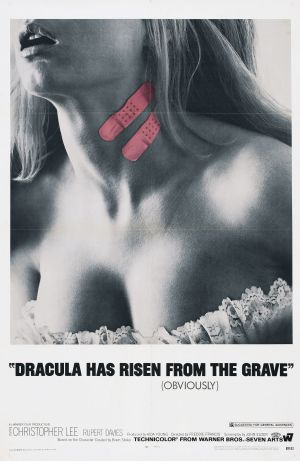
There’s a scene in 1968’s Dracula Has Risen From The Grave in which Maria (Veronica Carlson), the innocent niece of Monsignor Muller (Rupert Davies), sneaks out of her bedroom window and walks across the rooftops of a small village in Eastern Europe. She’s making her way to the bedroom of her boyfriend Paul (Barry Andrews), who the Monsignor has ordered her to stop seeing on account of the fact that Paul is an atheist. The camera views Maria from above with her pink dress and blonde hair contrasting against the gray city streets below her. It’s a beautiful scene and it is so visually stunning that you can forgive the fact that it doesn’t really move the story forward.
In its way, this scene is the epitome of everything that works about Dracula Has Risen From The Grave. Director Freddie Francis was an award-winning cinematographer who stepped in, at the last moment, to direct after original director Terrence Fisher broke his leg. Dracula Has Risen From The Grave is full of stunning imagery — shadow-filled forests, beautifully ornate bedrooms, and decaying castles and churches. When Christopher Lee’s Dracula shows up on screen, he literally seems to emerge from the shadows and when he attacks one barmaid who has made the mistake of disobeying him, the entire image is briefly tinted a blood red. When Dracula approaches his victims, his bloodshot eyes fill the entire screen. The film is full of so many memorable images that it’s easy to forgive the fact that, dramatically, Dracula Has Risen From The Grave is somewhat inert.
Picking up from where Dracula, Prince of Darkness left off, Dracula Has Risen From The Grave shows what happens when Monsignor Muller and a cowardly priest (Ewan Hooper) perform an exorcism at Dracula’s castle. The priest, frightened by thunder, attempts to flee but instead just ends up slipping and banging his head on a rock. The priest’s blood awakens Dracula (Christopher Lee) who, after putting the priest under his mental control, then seeks revenge on Muller by making Maria his bride. It’s up to Paul to try to save Maria’s life but, unfortunately, Paul is such an atheist that he refuses to recite a prayer even after he drives a stake through Dracula’s heart. This leads to perhaps the most dramatic staking fail in the history of vampire cinema.
Seriously, don’t trust atheists to kill your vampires…
How you respond to Dracula Has Risen From The Grave will probably depend on how much originality you demand from your 1960s British vampire films. Storywise, the film is nothing that you haven’t seen before and Barry Andrews doesn’t exactly make for an exciting hero. But, for me, the film’s visuals make up for the occasional weakness of the plot.
Add to that, Christopher Lee is in top form as Dracula. I’ve been trying to figure out the appeal of Lee’s Dracula because, unlike a lot of other actors who have played the role, Lee never attempts to turn the vampire into a sympathetic character. There is no romance to Lee’s Dracula. Unlike other cinematic vampires, Lee’s Dracula doesn’t spend his time mourning for a lost love or yearning for a release from having to be a prisoner to his undead state. Lee’s Dracula doesn’t even have the sense of humor that modern audiences have come to expect from their iconic villains. Instead, Lee’s Dracula is pure evil and yet, at the same time, Lee is such an imposing and charismatic actor that he makes evil compelling.
As I watched Dracula Has Risen From The Grave, I realized why Lee’s Dracula has such appeal. Lee’s Dracula sees what he wants and he takes it. He doesn’t allow anything to stand in his way and whenever boring mortals like Paul or the Monsignor attempt to stop him, he simply tosses them out of the way.
Of all the monsters who have appeared in horror cinema, Count Dracula is perhaps the most iconic. Reportedly, Dracula first appeared on film in 1920, in a silent Russian film that is now considered to be lost. In 1921, he would appear in a Hungarian film called Dracula’s Death and in 1922, he would be renamed Count Orlok for the German masterpiece Nosferatu. Indeed, by the time Bela Lugosi gave his famous performance in Tod Browning’s Dracula, the count had been appearing in films for at least 11 years. In nearly 100 years of filmmaking, a countless number of actors have brought Dracula to life.
We could spend hours debating who was the best Dracula and certainly, there are some worthy contenders. Bela Lugosi brought a continental sophistication to the role, while John Carradine was properly intimidating and theatrical. Udo Kier, Gary Oldman, Thomas Kretschmann, Leslie Neilsen, Zandor Vorkov, and Frank Langella have all played the prince of darkness, to varying degrees of success.
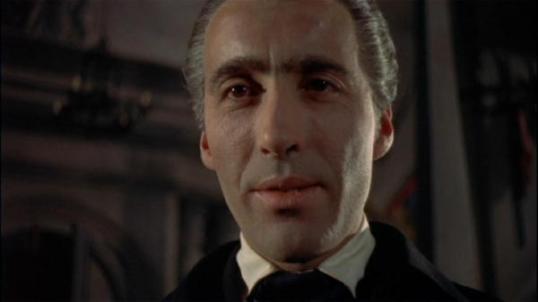
Yet for me, as worthy as any of those actors may be, there is only one true Dracula and he was played by Christopher Lee.
Lee famously played Dracula in seven movies for Hammer Films and, though he has often complained about the quality of these films (especially the later ones, which tended to mix Dracula with hippies), they were largely responsible for making Christopher Lee into the iconic figure that he remains today. It’s also largely due to Lee’s performance that horror fans like me continue to discover and appreciate the films of Hammer today.
As played by Christopher Lee, Dracula was pure evil. Lee’s Dracula had no use for self-pity and one can only imagine what his reaction would have been if he had ever run into the self-torturing vampires of Twilight. Lee’s Dracula had no use for doubt or regret. Instead, he was a determined animal who was driven by a singular lust for blood.
And yet, at the same time, Lee brought an intelligence to the role that was often lacking in previous performances. Lee’s Dracula may have been an animal but he was a cunning animal. Whereas it’s easy for me to imagine escaping from the clutches of Bela Lugosi, I know that if Lee’s Dracula wanted me then he would have me. There’s no escape from Lee’s Dracula. He’s too quick, determined, and intelligent.
His animal nature made Lee’s Dracula frightening but it was his cunning and determination that made him dangerous and, ultimately, even sexy. (While I’ve read that audiences in 1931 swooned over Bela Lugosi, whatever sex appeal he may have had is lost on modern viewers like me.) It has often been argued that Bram Stoker meant for Dracula to be a symbol of all the desires that were repressed by Victorian society. That’s certainly true when it comes to Christopher Lee’s carnal and viscous portrayal of the character.
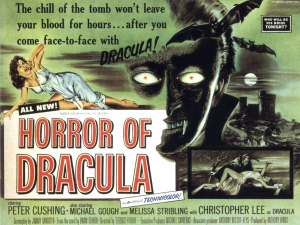
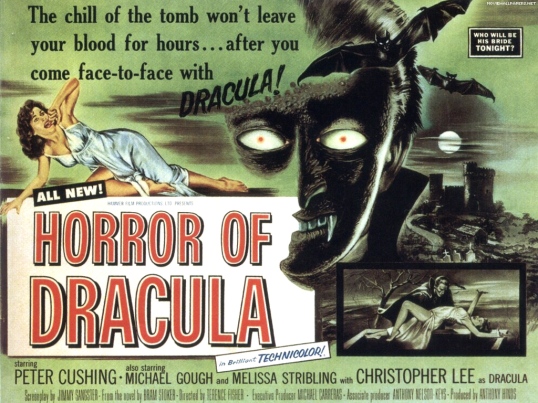
Of the seven Dracula films that Christopher Lee made for Hammer Films, the first remains the best. Released in 1958 and known as Dracula in the UK and the Horror of Dracula in the US, it revitalized the horror genre and helped to make stars of both Christopher Lee and Peter Cushing. Especially when compared to some of the sequels that Hammer subsequently produced, it remains one of the best Dracula films ever made.
The film is a very loose adaptation of Stoker’s original novel. Jonathan Harker comes to Dracula’s castle in Romania. Though posing as a librarian, Harker has actually come to the castle to drive a stake through the heart of both Dracula and his vampire bride. However, no sooner has Harker staked the bride than he’s overpowered and bitten by Dracula. Significantly, all of this occurs within the first 10 minutes of the film. As opposed to certain other Dracula films, Horror of Dracula gets straight to the point. And why shouldn’t it? After all, anyone watching the film already knows that Dracula’s a vampire so why waste time trying to convince us otherwise? We don’t watch Dracula for the familiar story as much as we watch to discover how different filmmakers will choose to tell that story.
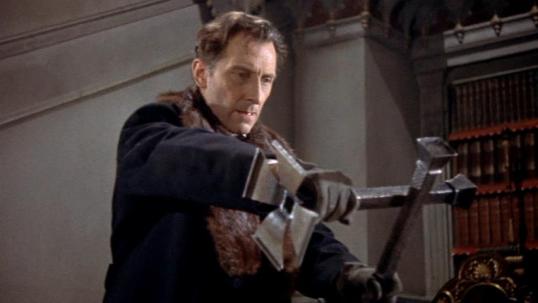
When Harker’s colleague, Prof. Van Helsing (played with the perfect amount of intensity by Peter Cushing) shows up at the castle, he discovers that Harker is now a vampire and that Dracula is nowhere to be found.
Dracula, needless to say, is out for revenge. He stalks Harker’s fiancee Lucy, as well as Lucy’s brother Arthur Holmwood (Michael Gough) and his wife Mina (Melissa Stribling). Much as in Stoker’s original novel, Lucy is eventually turned into a vampire and it’s up to Van Helsing and Arthur to stop both her and her new master.
(Of course, in Stoker’s original novel, Harker is not turned into a vampire and instead marries Mina while the aristocratic Arthur is one of Lucy’s three suitors. However, I have to say that I always thought the literary Harker was a bit on the dull side and that Arthur was always my favorite character so I’m happy that he gets to be the hero here.)
If I had to pick one film to epitomize everything that I love about the Hammer brand of horror, it would be Horror of Dracula. As directed by Terrence Fisher, the film moves at an exciting, non-stop pace while the traditionally lush cinematography is almost bombastically colorful. Cushing and Lee, who were the best of friends off screen, make for formidable opponents, with Cushing embodying good just as effective as Lee embodied evil. Though it’s been over 50 years since Horror of Dracula was originally released, the film remains effective and, not coincidentally, a lot of fun.
Quite simply put, this is a film that, for so many reasons, remains a true pleasure to watch.
One final note — I often find myself lamenting that I was born several decades too late and I realize just how true that is whenever I watch a film like Horror of Dracula. Seriously, I would have loved to have been a Hammer girl, showing off my cleavage and getting hypnotized by Christopher Lee.






 Through the Shattered Lens