The TSL Horror Grindhouse: The Chill Factor (dir by Christopher Webster)


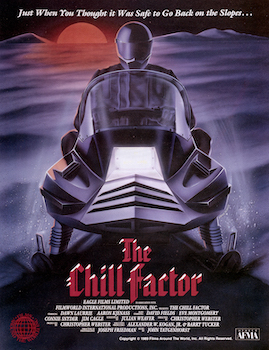
The 1993 film, The Chill Factor, is a bit of an oddity.

The film opens with a shot of young, attractive people racing their snowmobiles across a snowy landscape.  One of them, Jeannie (Dawn Laurrie), narrates.  She tells us that she can still remember everything that happened as if it was yesterday.  She and her friends were visiting the ski slopes of Wisconsin.  She was engaged to be married to Tom (Aaron Kjenaas), who she secretly knew didn’t really love her that way that she loved him.  She mentions that they were traveling with their friends and none of them had any worries because they were young and the year 2000 was right around the corner.  She mentions that one of her friends was “dating a black girl.”  It’s an odd line, especially when heard in 2023, when interracial couples in movies and television are so common that it’s almost become a bit of a cliché.  One thing that makes the line feel all the stranger is the rather flat tone of the narrator’s voice.  The narration almost sounds as if it’s being delivered by someone who is under hypnosis.

Jeannie, Tom, and their friends stop off at a rustic lodge.  Karen (Connie Snyder) is Tom’s little sister and Chris (David Fields) is her boyfriend, as well as being a medical student.  Ron (Jim Cagle) is a friendly football player who has just been drafted by a pro team.  Ron’s girlfriend, Lissa (Eve Montgomery), is the black girl mentioned in Jeannie’s opening narration.  When two local racists confront Ron and Lissa and spit out a racial slur, friendly waitress Bessie (Bekki Vallin) makes it up to the group by telling them about a great place to race their snowmobiles.  It’s called Black Friar Lake and Bessie promises to tell them why it’s named that if they come back.  Even though Tom has been drinking all day long, he insists on going out to Black Friar Lake.

At Black Friar Lake, Tom pulls a Kennedy and crashes his snowmobile into a tree.  His friends drag the unconscious and blood-covered Tom to an abandoned Dominican summer camp.  They bandage his wounds and try to keep him warm.  Chris says that Tom probably has internal injuries.  However, Tom suddenly opens his eyes and, other than having a headache, he acts as if nothing serious has happened.  While Ron heads back to town to try to get help, Karen searches the camp and comes across a makeshift Ouija board.  Even though Jeannie believes that Ouija boards can actually summon evil spirits, she still joins the others in fooling around with it.  (As Jeannie explains in her narration, “It was my nature.”)  Soon, Tom is waking up more often and speaking much more aggressively than usual.  (When Karen — HIS SISTER — tells him that he’s a pain in the ass, Tom tells her, “I’ll give you a pain in the ass,” and then suggests that she and Chris should go have sex.)  Soon, people are dying, blood is being spilled, and the Ouija board keeps trying to send out messages.

The Chill Factor is an odd film.  On the surface, it seems like a typical mash-up of slasher mayhem and Evil Dead-style supernatural activity.  But there’s an intriguingly off-center quality to the film.  The film moves at its own dream-like pace, with certain scenes going on longer than one might expect while other scenes end rather abruptly.  When the group first arrives at the summer camp, their conversations are a bizarre mix of the mundane and the philosophical.  Random shadows can be spied moving along the walls and the main characters never seem to notice that fresh blood is flowing from the eyes of a statue of Jesus.  Towards the end of the film, there’s a Rosemary’s Baby-style sex scene between Tom and Jeannie, except occasionally it’s not Jeannie that Tom is making lover to but instead Karen.  The falling snow gives the entire film a chilly and rather bleak atmosphere.  (This may be the only film to feature a demon chasing his prey on a snowmobile.)  The cast was obviously made up of amateurs and the majority of the performances are extremely stiff.  However, even that contributes to the film’s otherworldly atmosphere.  Indeed, watching the performers, I was reminded of Werner Herzog’s Heart of Glass, in which Herzog had his actors perform under the influence of hypnosis.

Finally, there’s an interesting subtext to this film.  Jeannie, who fears that Tom will never love her the way that she loves him, has a night of passionate sex with him, just to wake up the next morning and discover that he had suddenly changed.  He’s not the man who she thought he was.  Now, in Tom’s case, this is because he’s been possessed by a demon.  However, this scene captures a fear that every woman has felt.  Will your lover still be the same man when you wake up in the morning?  Or, having gotten what he wanted, will he then reveal his true self?  As much as Jeannie feared the Ouija board, she still used it because, deep down, she wanted to know who Tom really was.  And the board revealed the truth.  In her final piece of narration, Jeannie speaks of still dreaming about that night with Tom and her flat tone leaves it up to the audience to decide if she dreams of who Tom become or who she thought Tom was before.

I suspect that The Chill Factor may have been a happy accident, a case of a low budget and an amateur cast actually coming together something that turned out to be far better than anyone was expecting.  Accidentally or not, The Chill Factor is an intriguing work of existential horror.

6 Trailers For October 13th, 2023


Happy Friday the 13th!  Since today is a special day, here’s a special edition of Lisa Marie’s Favorite Grindhouse and Exploitation Film trailers!  The theme today is …. DON’T GO IN THE WOODS!

  1. Friday the 13th (1980)

Obviously, I had to start things off with the trailer for the original Friday the 13th!  This trailer puts a lot of emphasis on Marcie’s dream about the rain turning into blood.  I have to say that is a pretty intense dream.

2. The Burning (1981)

After Friday the 13th, there were many movies about the dangers of going to camp.  The Burning is one of the best-remembered.  Seriously, I’m so glad that I never did the camp thing.

3. Madman (1982)

I reviewed Madman earlier this month but I’m going to share the trailer again.  Seriously, camping is bad but yelling, “Madman Marz!” is apparently even worse.

4. Sleepaway Camp (1983)

As bad as those camps are, they’re a picnic compared to Sleepaway Camp!

5. Without Warning (1980)

Of course, it’s not just camps that are dangerous.  As the trailer for Without Warning shows, you never know what you might run into in the woods.

6. The Guardian (1990)

Not even the trees are safe!

The TSL Horror Grindhouse: Creature From Black Lake (dir by Joy N. Houck, Jr.)


It’s Bigfoot time!

1976’s Creature From Black Lake tells the story of two students at the University of Chicago.  Pahoo (Dennis Fimple) and Rives (John David Carson) decide that they want to spend their Spring Break on the Arkansas/Louisiana border, researching the legend that a Bigfoot-like creature that lives in the bayous.  (The creature is obviously based on the legendary Fouke Monster, who was also the subject of the 1972 documentary, The Legend of Boggy Creek.)

Pahoo and Rives head down South, looking to interview anyone who has seen the Creature From Black Lake.  Some people are willing to talk to them and they tell stories involving the Creature causing cars to crash, killing dogs, and attacking fisherman.  The Creature does not sound nice at all.  Still, the majority of the people in town don’t really feel like opening up to two Yankee monster hunters.  They’re worried that Pahoo and Rives are only in town because they want to portray everyone as being a bunch of ignorant rednecks who are scared of things that go bump in the night.

And really, they have every right to be concerned.  I grew up all over the South and the Southwest.  My family briefly lived in Fouke, the home of the Fouke Monster.  (No, I never saw or heard the monster, mostly because the monster doesn’t exist.)  When I was a kid, I lived in both Louisiana and Arkansas, among other states.  From my own personal experience, I can tell you that there is no one more condescending than a Northerner who is visiting the South for the very first time.   “Why is it so hot?”  “Why is everyone down here so polite?”  “Why can’t I find a Wawa!?”  Seriously, it gets old really quickly.  Now, to their credit, Pahoo and Rives are actually pretty polite and considerate when talking to the people who think that they have seen the Creature From Black Lake.  But still, one can understand why the town isn’t exactly thrilled to have them asking about monsters.

Anyway, after interviewing both Jack Elam and Dub Taylor about their experiences with the monster and getting yelled at by the local sheriff (played by Bill Thurman), Pahoo and Rives head out to the local swamp, hoping to find the creature themselves.  That, of course, turns out to be a huge mistake on their part.

Creature From Black Lake is a deliberately-paced film, which is a polite way of saying that it’s a bit slow.  Obviously inspired by The Legend of Boggy Creek, a good deal of the film is taken up with scenes of Pahoo and Rives interviewing people about their encounters with the monster.  That said, the film definitely picks up when Pahoo and Rives head into the swamp themselves and their eventual meeting with the monster is well-directed.  I have to admit that I spent this entire film dreading the moment when it would be revealed that the Monster was actually misunderstood and peaceful and I appreciated that the film did not go that route.  The creature turns out to be no one’s friend and is genuinely menacing.

The cast is full of familiar county character actors, all of whom do a good job bringing their characters to life.  Dennis Fimple and John David Carson are likable as the two students.  This film was also an early credit for cinematographer Dean Cudney and, just as he would later do for John Carpenter, Cudney creates a perfectly ominous atmosphere of isolation.  Creature From Black Lake may start out slow but, ultimately, it’s an effective creature feature.


The TSL Horror Grindhouse: Things (dir by Andrew Jordan)


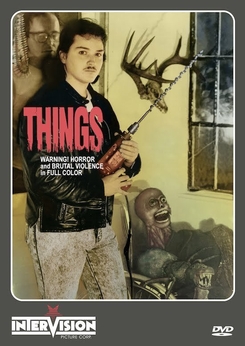
Things is a low-budget, independently-made horror film from 1989.

Things tells the story of Don (Barry J. Gillis) and Fred (Bruce Roach), two gentlemen with mullets who decide to drop by the house of Don’s brother, Doug (Doug Bunston).  When they arrives at the house, they’re surprised to find that Doug is nowhere to be seen.

“Doug, are you here?” Don asks, “Doug, are you alive?”

Don and Fred decide to raid the refrigerator in search of beer.  Inside the refrigerator, they find a book by Aleister Crowley and a tape recorder.  They decide to listen to the tape, which was a huge mistake because, when you’re starring in a crappy horror film, the last thing you want to do is remind the viewer of a different, better horror film.  As they played the tape, I thought to myself, “Don’t mention Evil Dead, don’t mention Evil Dead….”

“Hey,” Don said, “this is like that movie where those weird things happened….”

Anyway, Doug finally makes an appearance and orders them to stop making so much noise.  His wife is trying to sleep.  She’s been exhausted because she and Doug have been working with the mad Doctor Lucas (Jan W. Pachul) in an attempt to conceive a child.  Unfortunately, Lucas’s experiments have led to Susan giving birth to several insect-like monsters, which promptly attempt to eat Doug, Don, and Fred.

Things is such a Canadian film that I actually had to pause the movie after about ten minutes so that I could put on one of Jeff’s hockey jerseys and watch the film in proper style.  Don and Fred are just two regular guys who want to show off their guts and drink some beer.  Indeed, it’s debatable whether or not Don and Fred are as upset about the killer monsters as they are about the fact that Doug doesn’t have much beer left in the refrigerator.  For his part, Don sports both a formidable mullet and truck driver mustache.  He looks like he can’t wait to head back to Toronto as soon as the problem with all of the killer monsters are taken care of.

Things has a reputation for being one of the worst horror films ever made and …. well, it’s certainly not a good film.  The film takes a few stabs at Robocop-style social commentary by casting porn star Amber Lynn as a news reader who appears at random moments and announces that there’s been a power failure in New York and that George Romero is heading to the Supreme Court in his attempt to establish his ownership of Night of the Living Dead.  We’re also promised a story about the presidency of George H.W. Bush and the growing possibility of nuclear war.  Unfortunately, these scenes don’t add much to the film but they do provide a diversion from listening to Don and Fred attempt to have an articulate conversation.  Even if one can accept the bad acting (and sometimes, when it comes to indie horror films, you have to be ready to accept a few awkwardly delivered lines), the film itself is so poorly lit that it’s often difficult to tell what’s actually happening on screen.  Perhaps Things’s biggest problem is that, unless you really enjoy listening to two grown men argue about whether or not there’s any beer left, Things is just a boring movie.  It’s developed a cult reputation, largely due to being riffed on by the Rifftraxx crew, but I would be shocked to find anyone who has actually watched the film more than once.  Things is not The Room.  It’s not even Birdemic.

That said, the film did end with the suggestion that the whole thing might have just been a dream and I appreciated that.  It was a solution that made about as much sense as anything else in the film.

The TSL Horror Grindhouse: Sweet Kill (dir by Curtis Hanson)


As the saying goes, everyone has to start somewhere and, for Curtis Hanson, that somewhere was with 1973’s Sweet Kill.

Curtis Hanson, of course, would go on to become one of Hollywood’s top genre directors, directing films like The River Wild, Bad Influence, Wonder Boys, The Hand That Rocks The Cradle, 8 Mile, and the Oscar-nominated L.A. Confidential.  But, in the early 70s, he was just one of the many recent film school grads who approached Roger Corman for a job.

Having previously worked on the script for the Corman-produced Dunwich Horror, Hanson approached Roger and told him that he had an idea for a Psycho-inspired movie about a female serial killer.  Corman replied that he would help finance the film if Hanson made the killer into a man.  Hanson did so but Corman still ended up only putting up a third of the film’s budget as opposed to the two/thirds that he had originally offered.  Hanson ended up convincing his parents to take out a mortgage on their home to help finance the movie.

Hanson shot the film in 1971.  Corman said that the film showed promise but that it needed more nudity and a better title if it was going to be successful.  Corman re-edited the film and additional nude scenes were shot and inserted into the film.  Despite this, Sweet Kill was a box office disappointment when it was originally released.  Corman re-titled the film Kisses For Eddie but it didn’t help at the box office.  Finally, the film was released under a third title, The Arousers.  Despite a lurid ad campaign built around “the arousers,” the film once again failed at the box office.  It wouldn’t be until years later, when Hanson started to achieve some mainstream success, that Sweet Kill would be rediscovered.

After all of the drama that went into post-production, it would be nice to be able to report that Sweet Kill was some sort of overlooked masterpiece but, to be honest, it’s pretty bad.  The film stars Tab Hunter as Eddie Collins.  When Eddie was a kid, he used to hide in the closet and watch as his mother lounged around her bedroom in lingerie.  Now that Eddie is a grown-up and working as a high school gym coach, he is still so haunted by his mother that he’s impotent.  As a result, Eddie spends his time breaking into apartments, stealing underwear, and having a prostitute dress up like his mother so that he can undress her while sobbing.  After a chance meeting with a hippie girl leads to Eddie once again failing to get it up, he shoves the girl hard enough to kill her.  The film implies that this act of violence leads to Eddie getting aroused for the first time and soon, Eddie is killing people and …. well, that’s pretty much the whole movie.  There’s not really a plot, beyond Eddie looking confused and trying to keep his sympathetic neighbor from finding out that he’s a serial killer.

Sweet Kill has gotten some attention because of the casting of former teen idol Tab Hunter in the role of psycho Eddie.  Tab Hunter has the right blonde look for Eddie, who is basically a homicidal beach bum, but otherwise, Hunter’s performance is fairly dull.  Watching the film, it’s obvious that he wasn’t particularly comfortable with the role of Eddie and, as such, he sleepwalks through the performance.  (Ironically, Eddie was based on Norman Bates, who was played by Hunter’s former partner, Anthony Perkins.)  There are a few creepy moments where Hunter stares off into the distance with a blank look on his face but otherwise, this isn’t a particularly memorable performance nor is Sweet Kill a particularly interesting film.

That said, Curtis Hanson went on to have quite a career so, on that level, Sweet Kill‘s bland badness is inspiring.  If the director of Sweet Kill could still go on to direct and produce some of the best films of the past 50 years, there’s hope for everyone looking to achieve their dreams.  Don’t let one failure get you down.

The TSL Horror Grindhouse: Night of the Cobra Woman (dir by Andrew Meyer)


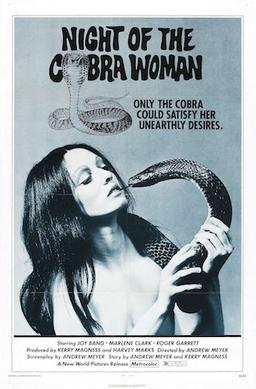
The 1972 film, Night of the Cobra Woman, tells the story of Lena (Marlene Clark).

During World War II, Lena was a nurse assigned to the Philippines.  When she and a friend were attacked in the jungle by a Japanese soldier, Lena’s friend was raped while Lena was bitten by a cobra named Movini.  As the result of being raised by a snake cult, Movini’s super-powered venom conferred eternal youth, beauty, and sexual energy.  It also gave Lena the power to turn into a snake.  After subduing the Japanese soldier and turning him into her slave, Lena made a life for herself in the jungle.  Worshipped by the locals, Lena became known for never aging.

Years later, a young UNICEF worker named Joanna (Joy Bang) is working at a laboratory in the Philippines.  Having heard about Lena’s special snake venom, Joanna heads out to Lena’s compound to ask her how the venom works.  However, Joanna is chased off by Lena’s mute man-servant (Vic Diaz).  Later, Joanna’s boyfriend, Duff (Roger Garrett), decides to head out to the compound himself and see what’s going on.

When Duff doesn’t return, Joanna heads out to the compound a second time.  This time, she brings along Duff’s pet eagle.  Joanna is confronted by Lena, who claims that Duff has been bitten by a cobra and has been recovering at the compound.  After Movini hisses at Joanna, Joanna released the eagle.  The eagle promptly kills Movini.

Now, this sets up a bit of a problem.  Lena needed Movini because it was Movini’s venom that was keeping her young and preventing her from turning into a snake and then not being able to change back.  Now that Movini is dead, Lena has to head into Manila and find men to seduce so that she can live off of their life force.  Helping her out is Duff, who has apparently been brainwashed by Lena and will now do anything to help her, including setting her up with an American serviceman (who is played by an actor named, I kid you not, Slash Marks.)  Duff himself starts to rapidly age and turn into a snake.  Can Joanna save him and, more importantly, why would she want to?  Seriously, Duff left her for another woman.  Joanna doesn’t owe him anything!

Night of the Cobra Woman is a thoroughly incoherent movie, one that feels as if it was made up on the spot while filming was taking place.  Duff’s decision to go to Lena’s compound on his own never makes sense, nor does it really make much sense that Joanna doesn’t seem to be that upset by the fact that he basically just abandoned her to live with the Cobra Woman.  That said, Night of the Cobra Woman does have a cult following because it’s one of the eight films that Joy Bang made during her career.  Bang (and that was her real name, as her husband was named Paul Bang) specialized in playing flighty hippies and, as a result, she’s not exactly believable as an expert in snake venom.  But the fact that she is so miscast adds to the film’s charm.  She has pretty much the same freaked-out reaction to seeing a cobra that I would have, making her a character to whom I could at least relate.

Anyway, Night of the Cobra Woman is not that good but Joy Bang completists will definitely want to check it out.

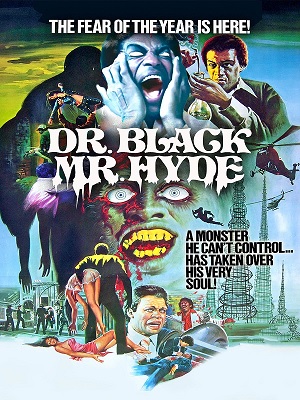
The TSL Horror Grindhouse: Dr. Black, Mr. Hyde (dir by William Crain)


1976’s Dr. Black, My Hyde tells the story of Dr. Henry Pride (Bernie Casey).

Dr. Pride is a respected doctor, the head of a free clinic in the Watts district of Los Angeles.  He has a big house.  He has a fancy car.  With Dr. Billie Worth (Rosalind Cash), he is researching a serum that will help people with cirrhosis to regenerate the tissue of their liver.  Of course, Dr. Pride wasn’t always rich.  In his own words, he and his mother grew up in the guest house of a brothel.  But now that he is rich and successful, some people claim that he’s lost touch with his community.  As a prostitute named Linda (Marie O’Henry) tells him, “You talk white, you think white, you probably drive a white car.”

In a scene that is designed to bring to mind the horrors of the Tuskegee syphilis experiments, Dr. Pride considers the ethics of injecting his serum into his patients without warning them that there might be consequences.  Billie warns him that what he’s thinking about doing would be not only unethical but illegal.  Dr. Pride questions whether ethics matter when dealing with something that could potentially save lives in the future.  After Dr. Pride injects an elderly black woman with the serum, she turns into a white-skinned monster who attempts to strangle a nurse before promptly dying.  Despite this, Dr. Pride continues to develop the serum and eventually, he tries it on himself.

Under the effects of the serum, Dr. Pride becomes a white-skinned madman.  (Bernie Casey wears a white makeup whenever he plays this film’s version of Mr. Hyde.)  Under the influence of the serum, Pride rampages through Watts, killing prostitutes and pimps before transforming back into the Dr. Pride.  The police are investigating the murders but they’re searching for a white man.  Meanwhile, Dr. Pride continues to obsess on trying to work out the kinks of her serum.  He wants Linda to be his latest test subject.

Dr. Black, Mr. Hyde is a blaxploitation take on Dr. Jekyll and Mr. Hyde and, as with many blaxploitation films, the subtext is frequently more interesting than what actually happens on screen.  Dr. Pride, after continually being accused of acting white, takes his serum and soon literally becomes white and sets out to kill the prostitutes and the pimps who remind him of his life before he became a doctor.  And while it’s easy to see this as an example of the serum turning a good man into an evil monster (the classic Jekyll and Hyde formula), it’s also true that, even before his transformation, Dr. Pride views his patients as being potential test subjects.  For all of his talk about helping people, Dr. Pride maintains his distance from the members of his own community.  Is the serum turning Dr. Pride into a monster or is it just revealing who Dr. Pride truly wishes to be?  Given the film was directed by William Crain, who also did Blacula and who, unlike a lot of Blaxploitation directors, actually was black, it’s easy to believe that the subtext was intentional.

Of course, subtext aside, Dr. Black, Mr. Hyde is a cheap-looking and haphazardly edited film.  Much of the acting is amateurish but Bernie Casey gives a strong performance as both the repressed black doctor and his violent, white alter ego.  Cheapness aside, Dr. Black, Mr. Hyde is a frequently intriguing film.

6 Trailers For The End Of The First Week of Horrorthon


As week 1 of the 2023 Horrorthon comes to a close, it’s time for me to admit that I am absolutely, 100% exhausted.  Hopefully, this latest edition of Lisa Marie’s Favorite Grindhouse Trailers will help to keep me awake!

  1. Nightmare on Elm Street (1984)

Here’s a trailer that’s as good as any when it comes to giving you a reason to try to stay awake!

2. Bad Dreams (1988)

Freddy isn’t the only person haunting the dream world.

3. Dreammaniac (1986)

Actually, there’s a lot of dangerous things out there in Dream Land.

4. The Cell (2000)

Even Jennifer Lopez and Vince Vaughn know better than to get lost in someone else’s dream.

5. Phantasm (1979)

And, of course, we can’t talk about sleep and dreams and nightmares without including the classic trailer for Phantasm.

6. Dreamscape (1984)

Fear not, though!  If things get too intense in the dreamworld, we can always call Dennis Quaid.

Sweet dreams!

The TSL Horror Grindhouse: Chopper Chicks in Zombietown (dir by Dan Hoskins)


An all-women motorcycle gang called the Cycle Sluts roars through the desert. Why are they called the Cycle Sluts? As their leader puts it, they know what people are going to call them so they’re reclaiming the term for themselves. Nobody tells the Cycle Sluts what to do and nobody but the Cycle Sluts decides or defines who the Cycle Sluts are. They’re rebels and they’re singers, making music and fighting the patriarchy as they make their way through the dusty corners of America.  Go, Cycle Sluts, go!

When the Cycle Sluts drive into the small desert town of Zariah, the residents are not happy to see them. Zariah is a peaceful and boring town and the citizens would like to keep it that way.  The citizens are happy having a town where there’s only a few buildings, next to no businesses, and only a few residents.  It’s a town where not much happens and everyone can live in peace, far away from all the evil temptations of the big city and corrupt civilization.  However, the town becomes a lot less peaceful when the local mortician starts to bring the dead back to life. Soon, zombies are wandering through the desert on their way back to their former home and only the Cycle Sluts and a bus full of stranded blind kids can save the town!

That slight plot description probably tells you all you really need to know to get a feel for what type of film 1989’s Chopper Chicks in Zombietown is. It was released by Troma, which means that the humor is crude, the zombie attacks are bloody, and the film’s aesthetic is undeniably cheap. That said, the film itself is enjoyable when taken on its own dumb terms. The action moves quickly, the members of the cast perform their silly roles with an admirable amount of dedication, and the whole thing ends with a message of peace and equality. The townspeople learn how to be tolerant and the Cycle Sluts learn how to trust other people. It’s about as dumb as a movie about about bikers fighting zombies can be but it’s a surprisingly fun movie.  It’s hard not to cheer a little when the Cycle Sluts and the towns people and the blind kids finally set aside their differences and do what has to be done.  They even manage to save the life of a baby and anyone who has seen any other Troma films knows how rare that can be.  In its way, Chopper Chicks in Zombietown serves as a reminded that not every Troma film is as bleak as Combat Shock or Beware!  Children at Play. The Cycle Sluts do a good job and so does the film.

Speaking of doing a good job, keep an eye out for Billy Bob Thornton, making an early appearance as the unfortunate boyfriend of one of the residents of Zariah. Billy Bob seems to be having fun with this early job and his appearance here serves as a reminder that everyone started somewhere.

The TSL Horror Grindhouse: Snuff (dir by Michael Findlay, Horacio Frederiksson, and Simon Nuchtern)


For a film that has a reputation for being one of the most controversial ever to be released, Snuff is incredibly boring.

Filmed in Argentina in 1971 as Slaughter, the majority of this film deals with a cult leader whose name is Satan (Enrique Larratelli).  Satan pronounces his name with the emphasis on the second syllable, so that it sounds less like the name of the Lord of the Darkness and more like, “Sah-TAN.”  I guess even he understood that the importance of not being too obvious when it comes to naming yourself.  That said, everything about Satan indicates that he worships the Devil so I’m not really sure why he felt the need to get all fancy with the pronunciation of his name.  Interestingly enough, Satan does not have a last name.  I imagine that if he did have a last name, he would be one of those pretentious people who would try to spruce up his last name with a “von” or “de,” like Satan von Smith or Satan de Jones.

Anyway, Satan has a group of followers.  They’re all young women who ride motorcycles and who look like hippies but they’re actually knife-wielding murder groupies.  Over the course of the film, they seduce several men and then kill them.  One of them carries a knife in the waistband of her panties, which is not something that I would ever have the courage to do because, seriously, if you sit down at the wrong angle or trip and fall, you’re probably going to have blood everywhere.

An actress named Terry London (Mirta Massa) comes to Argentina with her boyfriend and producer, Max Marsh (Aldo Mayo).  They’re going to be making a movie but mostly, Terry just wants to sleep and hang out around their mansion.  Some of Terry’s decadent Hollywood friends show up for the carnival.  Someone dies and I assume he was a friend of Terry’s.  Satan and his followers start plotting to attack and kill all of the Hollywood phonies and their rich friends.  Satan is especially offended that one of them is the son of an arms dealer.  Satan is about world peace, don’t you know.

Anyway, if you’re dumb enough to actually get caught up in the story of Satan and his followers, prepare to be disappointed because that story ends abruptly and without resolution.  Instead, some woman that we’ve never seen before suddenly declares that the movie is turning her on and an actor who is supposed to be the director of the movie proceeds to dismember her while the cameras roll.  The idea is that the crew of the movie actually murdered a woman, filmed it, and then decided to release the move into theaters because it’s not like people get prosecuted for murder or anything….

Of course, the murder footage was faked.  It’s painfully obvious that it was faked, just as its obvious that the footage was shot long after filming was completed on Slaughter.  It’s not even the same film stock.  But, in 1976, when Slaughter was released under the name Snuff, there were actual protestors who showed up at the theaters and claimed that the footage was real.  Some of those protestors were hired by the film’s distributor but reportedly, some of them were actual grass roots activists who believed what they had heard.  As a result, this extremely dull film became a box office success.  In New York City, it was the number one film in theaters for three weeks.

Controversy sells and Snuff will always have a place in the history of grindhouse films.  That said, the film itself is pretty much unwatchable.  If you’re going to watch it, hire someone to come march outside of your house with a sign to keep things interesting.  Otherwise, prepare for boredom.