The Eric Roberts Collection: To Heal A Nation (dir by Michael Pressman)


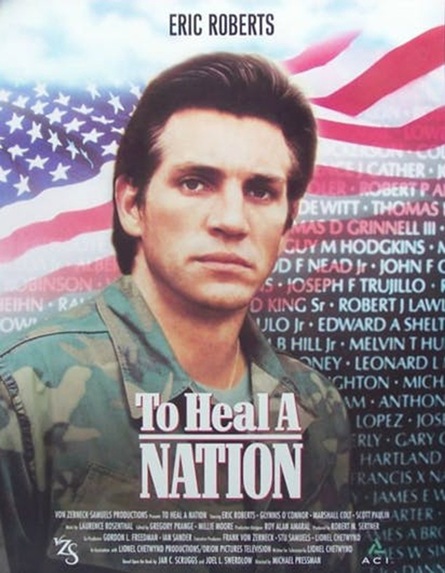
In 1988’s To Heal A Nation, Eric Roberts stars as Jan Scruggs.

When we first meet Scruggs, the year is 1971 and he’s taking his seat on a commercial airliner.  When the blonde woman sitting beside him starts to flirt with him, Scruggs mentions that he’s happy because he’s finished up his tour of duty in Vietnam.  Upon hearing that Scruggs is a Vietnam vet, the woman immediately requests to be moved to a different seat.

Eight years later, things haven’t gotten much better.  Scruggs works for the Department of Labor in Washington D.C.  He’s married to Becky (Glynnis O’Connor) but he’s struggling to deal with the past.  He drinks too much.  He has trouble sleeping.  He doesn’t feel like he can open up about the things that he saw in Vietnam because nobody wants to talk about it.  He was one of the thousands of people who served in Vietnam who now feel as if they’ve been abandoned by their country.  However, after attending a showing of The Deer Hunter, Scruggs has a vision of  a monument that that features the name of every American who was killed in the Vietnam Conflict.

Scruggs devotes the next several years of his life to getting the monument built, appealing to both the government and private citizens for funding.  At first, everyone treats Scruggs and his efforts like a joke.  Even some fellow veterans feel that Scruggs is pushing too hard and that he’s just going to end up embarrassing himself.  But Scruggs refuses to give up and finally, with the support of a senator (Laurence Luckinbill) and a Texas millionaire named H. Ross Perot (Conrad Bachmann), Scruggs is able to make his dream a reality.

Based on the true story of the struggle to build the Vietnam Veterans Memorial in Washington, D.C., To Heal A Nation features a young Eric Roberts giving a nervy but likable performance as Jan Scruggs, a man who becomes so obsessed with building a monument to those who lost their lives in Vietnam that he occasionally seems like he’s close to going over the edge himself.  It’s a good film for Memorial Day and one that still feels relevant today.  The way that Scruggs was treated after returning from Vietnam is the way a lot of our veterans were treated and continue to be treated after returning from Iraq and Afghanistan.  We love our soldiers when they fight in popular wars that result in a definite victory.  When they serve in an unpopular war, they’re often deserted by people who don’t want to be reminded of recent history.  One can certainly see that in the attempts by the national media to gloss over what happened during our final days in Afghanistan.  This film is a reminder that no one should be forgotten.

Previous Eric Roberts Films That We Have Reviewed:

  1. Star 80 (1983)
  2. Runaway Train (1985)
  3. Best of the Best (1989)
  4. Blood Red (1989)
  5. The Ambulance (1990)
  6. The Lost Capone (1990)
  7. Best of the Best II (1993)
  8. Love, Cheat, & Steal (1993)
  9. Voyage (1993)
  10. Love Is A Gun (1994)
  11. Sensation (1994)
  12. Dark Angel (1996)
  13. Doctor Who (1996)
  14. Most Wanted (1997)
  15. Mercy Streets (2000)
  16. Raptor (2001)
  17. Rough Air: Danger on Flight 534 (2001)
  18. Strange Frequency (2001)
  19. Wolves of Wall Street (2002)
  20. Border Blues (2004)
  21. Mr. Brightside (2004)
  22. Six: The Mark Unleased (2004)
  23. We Belong Together (2005)
  24. Hey You (2006)
  25. Depth Charge (2008)
  26. Amazing Racer (2009)
  27. The Chaos Experiment (2009)
  28. In The Blink of an Eye (2009)
  29. Bed & Breakfast (2010)
  30. Enemies Among Us (2010)
  31. The Expendables (2010) 
  32. Sharktopus (2010)
  33. Beyond The Trophy (2012)
  34. The Dead Want Women (2012)
  35. Deadline (2012)
  36. The Mark (2012)
  37. Miss Atomic Bomb (2012)
  38. Assault on Wall Street (2013)
  39. Bonnie And Clyde: Justified (2013)
  40. Lovelace (2013)
  41. The Mark: Redemption (2013)
  42. The Perfect Summer (2013)
  43. Self-Storage (2013)
  44. Sink Hole (2013)
  45. A Talking Cat!?! (2013)
  46. This Is Our Time (2013)
  47. Bigfoot vs DB Cooper (2014)
  48. Doc Holliday’s Revenge (2014)
  49. Inherent Vice (2014)
  50. Road to the Open (2014)
  51. Rumors of War (2014)
  52. Amityville Death House (2015)
  53. Deadly Sanctuary (2015)
  54. A Fatal Obsession (2015)
  55. Las Vegas Story (2015)
  56. Stalked By My Doctor (2015)
  57. Enemy Within (2016)
  58. Hunting Season (2016)
  59. Joker’s Poltergeist (2016)
  60. Prayer Never Fails (2016)
  61. Stalked By My Doctor: The Return (2016)
  62. The Wrong Roommate (2016)
  63. Dark Image (2017)
  64. The Demonic Dead (2017)
  65. Black Wake (2018)
  66. Frank and Ava (2018)
  67. Stalked By My Doctor: Patient’s Revenge (2018)
  68. Clinton Island (2019)
  69. Monster Island (2019)
  70. The Reliant (2019)
  71. The Savant (2019)
  72. Seven Deadly Sins (2019)
  73. Stalked By My Doctor: A Sleepwalker’s Nightmare (2019)
  74. The Wrong Mommy (2019)
  75. Exodus of a Prodigal Son (2020)
  76. Free Lunch Express (2020)
  77. Her Deadly Groom (2020)
  78. Top Gunner (2020)
  79. Deadly Nightshade (2021)
  80. The Elevator (2021)
  81. Just What The Doctor Ordered (2021)
  82. Killer Advice (2021)
  83. Megaboa (2021)
  84. Night Night (2021)
  85. The Poltergeist Diaries (2021)
  86. The Rebels of PT-218 (2021)
  87. Red Prophecies (2021)
  88. A Town Called Parable (2021)
  89. Bleach (2022)
  90. Dawn (2022)
  91. My Dinner With Eric (2022)
  92. 69 Parts (2022)
  93. The Rideshare Killer (2022)
  94. D.C. Down (2023)
  95. Aftermath (2024)
  96. Bad Substitute (2024)
  97. Devil’s Knight (2024)
  98. The Wrong Life Coach (2024)
  99. When It Rains In L.A. (2025

Cleaning out the DVR: The Boy In The Plastic Bubble (dir by Randal Kleiser)


This made-for-television film from 1976 tells the story of Tod Lubitch (played by a pre-Saturday Night Fever John Travolta).  Tod was born without an immune system and, as a result, he’s had to spend his entire life in a germ-free, plastic bubble.  When Tod was a child, it wasn’t such a big deal not being able to leave his house without getting in a plastic ark beforehand.  But now, he’s in his teens and he wants to do teenager stuff.  His parents (Robert Reed and Diana Hyland) are overprotective.  His doctor (Ralph Bellamy) says that there’s little chance that Tod’s condition will ever improve.  But the girl next door, Gina (Glynnis O’Connor), finds herself falling in love with Tod and she wants to help him live a normal life.  Gina loves to ride horses and Tod wants to ride one with her.  As we all know, horses are totally germ-free.

The Boy In The Plastic Bubble is one of those movies that has a reputation.  It’s usually cited as being the epitome of 70s schmaltz and, indeed, it is very 70s and it is very schmaltzy.  It’s one of those films where the big dramatic moments are so overdone that they instead often become kind of comedic.  When Tod finally convinces his parents to allow him to attend school, he does so while wearing a special protective outfit that makes him look like a cross between an old school astronaut and a demented teddy bear.  When it looks like his suit might be malfunctioning, he runs into the plastic cell that’s been set up in the back of the classroom and strips it off while all of his classmates watch.  Everyone’s truly impressed by both Tod’s positivity and the sight of a 22 year-old John Travolta rolling around in gym shorts.

Indeed, while watching the film, it’s impossible not to ask certain questions.  In what world, for instance, could Robert Reed, best known for playing the patriarch on The Brady Bunch, be John Travolta’s father?  Why is there such a weird tension between Tod and his mother?  (It may have had something to do with the fact that Travolta was dating Diana Hyland at the time.)  How does Tod keep his hair so perfect while living in a plastic bubble?  Did anyone think that the scene where Tod is carried onto the beach inside a plastic box would be so odd to watch?  Reportedly, The Boy In The Plastic Bubble was based on the lives of two young men who has the same condition as Tod.  According to Wikipedia, one of them was very amused by the idea the Todd’s protective outfit would keep him safe at school.  And, then of course, there’s the film’s ending, which tries to offer a ray of hope but instead leaves you convinced that Tod is going to die at any minute.

And yet, for all the obvious flaws, The Boy In The Plastic Bubble is slightly redeemed by the sincerity that Travolta and O’Connor bring to their roles.  In particular, Travolta brings a smoldering anger to his role, which may not have been present in the script but which feels appropriate for the character.  As played by Travolta, Tod may understand why he’s in the bubble but he’s still pissed off about it.  O’Connor has an even more difficult role to play because Gina’s actions often don’t make a lot of sense.  But O’Connor makes you believe that she’s sincere in her desire to give the Bubble Boy the high school experience that he deserves.  It’s a schmaltzy film but Travolta and O’Connor bring a few moments of emotional honesty to it.

Director Randal Kleiser later worked with John Travolta on Grease.  I don’t think Danny Zuko would have been a good influence on the Boy in the Plastic Bubble.

The Conquering Hero: Baby Blue Marine (1976, directed by John D. Hancock)


The year is 1943 and America is at war.  All young men are expected to join the Marines and fight for their country but the Corps is not willing to accept just anyone.  Marion (Jan-Michael Vincent) wants to continue a family tradition of service but, as his drill sergeant (Michael Conrad) puts it, Marion just is not pissed off enough to be a Marine.  Marion is kicked out basic training and told to go home.  He is given a blue uniform to wear on his jury so that anyone who sees him will know that he couldn’t cut it.

Ashamed of his failure and in no hurry to confront his family, Marion takes the long route home.   While having a drink in California, he meets a Marine (Richard Gere) who did not get kicked out of basic training.  Though not yet 30, this shell-shocked Marine already has a head of gray hair, which he says he got from the horrors of war.  The Marine is due to return to the fighting in Europe but, upon meeting Marion, he sees a way out. When Marion gets drunk, the Marine knocks him out, switches uniforms with him, and goes AWOL.

When Marion comes to, he discovers that everyone that he meets now judges him by his new uniform.  Strangers buy him drinks.  Other servicemen try to pick fights with him.  When he stops off in a small Colorado town, a local waitress (Glynnis O’Connor) falls in love with him and nearly everyone that he meets assumes that he must be a hero.  Marion doesn’t exactly lie about his past.  Instead, he simply allows people to believe whatever they want to believe about him.  It seems like an idyllic situation until three prisoners from a nearby Japanese internment camp escape and the towns people expect Marion to help capture them.

Loosely plotted and sentimental, Baby Blue Marine is a dramatic version of Preston Sturges’s Hail The Conquering Hero.  Though the film has a gentle anti-war message, it’s actually more about nostalgia for a simpler and more innocent time.  If the film had been made at height of the Vietnam War, it might have been more angrier and more cynical.  But, instead, this is one of the many post-Watergate films that wistfully looked back upon the past.  When Marion settles into the town, he finds what appears to be a perfect and friendly home.  Only the nearby internment camp and the town’s hysteria over the escape prisoners serve as reminders that things are never as ideal as they seem.  Jan-Michael Vincent gives one of his best performances as the well-meaning Marion and actors like Richard Gere, Bert Remsen, Katherine Helmond, Dana Elcar, Michael Conrad, Bruno Kirby, and Art Lund all make strong impressions in small roles.

One of the few films to be produced by television mogul Aaron Spelling, Baby Blue Marine is not easy to find but worth the search.

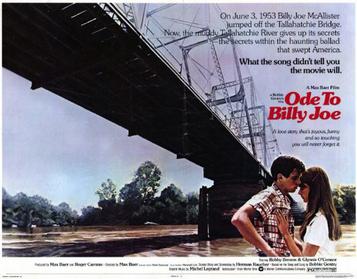
Film Review: Ode to Billy Joe (dir by Max Baer, Jr.)


Why, on June 3rd, did Billie Joe McAllister jump off of the Tallahatchie Bridge in Mississippi?

That was the question that was asked in Ode to Billie Joe, a 1967 country song by Bobbie Gentry.  In the song, the details were deliberately left inconclusive.  Why did Billie Joe commit suicide?  No one knows.  All they know is that he was a good worker at the sawmill and, the weekend before jumping, he was seen standing on the bridge with a teenage girl and apparently, they dropped something down into the river below.  The song suggests that the girl and the narrator are one in the same but even that is left somewhat vague.

Ode to Billie Joe was a hit when it was first released, largely because it’s story could be interpreted in so many different ways.  Why did Billie Joe kill himself?  Maybe it was because he didn’t want to be drafted.  Maybe it was because he and his girlfriend had killed their baby and tossed it off the bridge.  Maybe it was because he was hooked on Dexedrine and his doctor wasn’t available to renew his prescription.  It could be any reason that you wanted it to be.

However, in 1976, when Ode to Billie Joe was turned into a movie, ambiguity would not do.  As opposed to the song, Ode To Billy Joe had to answer the question as to why Billy Joe jumped into that river.  In the movie, 18 year-old Billy Joe (Robby Benson) works at the sawmill and spends his time courting 15 year-old Bobbie Lee Hartley (Glynnis O’Connor).  Bobbie Lee’s father (Sandy McPeak) says that she’s too young to have a “gentleman caller,” even though Bobbie Lee insists that she’s “15 going on 34 … B cup!”  Bobbie Lee warns Billy Joe that her father is liable to shoot his ears off but Billy Joe insists that he doesn’t need ears because he’s in love with her.  That’s kind of a sweet sentiment, even though I don’t think Billy Joe would look that good without ears.

(Whenever I complain about how Southerners in the movies always seem to have two first names, my sister Erin replies, “Yeah, that’s really annoying, Lisa Marie.”  So, I won’t make a big deal about it this time…)

One night, Billy Joe and his friends go out and Billy Joe ends up getting drunk.  He disappears for several days and when he shows up again, something has definitely changed.  After unsuccessfully trying to make love to Bobbie Lee, Billy Joe tells her what happened that night he got drunk.  Billy Joe had sex with a man, something that he has been raised to view as being the ultimate sin.  When Billy Joe is later pulled out of the river, the entire town wonders why he jumped off the bridge and how Bobbie Lee was involved…

Ode to Billy Joe, which aired last Tuesday on TCM, is a better-than-average film, one that I was surprised to have never come across in the past.  That doesn’t mean that it’s a perfect movie. Robby Benson, in the role of Billy Joe, gives an absolutely terrible performance.  You can tell that Benson was trying really hard to do a good job but, often, he goes totally overboard, making scenes that should be poignant feel melodramatic.  Though it probably has more to do with when the film was made than anything else, the film is also vague about Billy Joe’s sexuality.  Is Billy Joe in denial about his identity?  Is he deeply closeted or was he in such a drunken stupor that he was taken advantage of?  Ode to Billy Joe does not seem to be sure.  By committing suicide, Billy Joe joins the ranks of gay movie characters who would rather die than accept their sexuality.  Obviously, he had to jump off that bridge because that’s what the song said he did but there’s a part of me that wishes the movie had featured someone commenting that they never actually found Billy Joe’s body and then the final scene could have taken place 16 years later, with Bobbie Lee living as a hippie in San Francisco and just happening to spot Billy Joe walking down the street, hand-in-hand with his boyfriend.

Here’s what does work about the movie.  Glynnis O’Connor gives a great and empathetic performance as Bobbie Lee.  The scenes with her father and her mother (played by Joan Hotchkis) have a very poignant and wonderful realness to them.  Though I’ll always be a city girl at heart (well, okay — a suburb girl), I spent some time in the country when I was growing up.  And while I was never quite as isolated as Bobbie Lee (who lives in a house with no electricity or plumbing) and the film took place in the past, I could still relate to many of Bobbie Lee’s experiences.  The film may have been made in 1976 and set in 1952 but life in the country hasn’t changed that much.

For instance, there’s this great scene where Bobbie Lee’s father is trying to drive across the bridge.  The only problem is that there’s a bunch of drunk shitkickers on the bridge, sitting in their pickup truck and blocking his way.  It’s a very tense scene, one that I found difficult to watch because, when I was growing up in Arkansas, Oklahoma, Louisiana, and South Texas, I saw the exact same thing happen more times than I care to admit.  In the country, no one backs down.  Scenes like that elevated Ode To Billy Joe to being something more than just another movie based on a song.

Finally, there’s a beautiful scene towards the end of the film, between Bobbie Lee and a character played by an actor named James Best.  I won’t spoil the scene but it’s a master class in great acting.  (Best also played one of the sadistic villains in Rolling Thunder, another good 70s film about life and death in the country.)

Though I wasn’t expecting much from it, Ode to Billy Joe was a pleasant surprise.  It’s not perfect but it’s still worth watching.

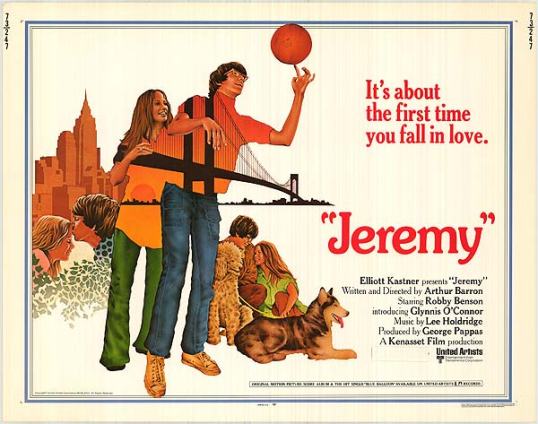
Back to School Part II #6: Jeremy (dir by Arthur Barron)


Jeremy

After I finally finished working out my thoughts concerning A Clockwork Orange, I continued my back to school reviews by watching a 1973 teen romance called Jeremy.  I have to admit that it was kind of a shock going from Stanley Kubrick’s confrontational masterpiece to this rather gentle and sweet-natured film about two nice kids who fall in love.  But that’s one of the things that I love about reviewing movies.  You get to see all sorts of things.

As for Jeremy — it’s a film that tells a familiar story but it doesn’t quite go in the direction that you’re expecting.  15 year-old Jeremy (played by Robby Benson, who was apparently the Justin Bieber of his day) is a 15 year-old student at a private high school in New York City.  He’s a brilliant but painfully shy student.  He’s very serious about learning the cello, even though his teacher (Leonardo Cimino) tells him that he’s good but he’ll probably never be great.  He’s also really into horse racing, though he never bets himself.  Instead, he just likes to pick the winner and is content with the knowledge that he was right.  Jeremy is largely ignored by his parents and has only one friend but he seems to be okay with his largely solitary life.

That is, of course, until he spots Susan (Glynnis O’Connor) practicing ballet in a classroom.  Jeremy is instantly attracted to her and it’s obvious that she likes him as well but, because of his pathological shyness, Jeremy cannot bring himself to ask her out.  (In fact, he even forgets to ask her name the first time that they meet.)  It’s not until Susan compliments him on his cello playing that Jeremy is able to work up the courage to ask her out.  It’s not that Jeremy is arrogant or stand-offish or any of the other stuff that people regularly say about shy people.  It’s just that talking about his cello gives Jeremy the courage to be himself.  It’s rather sweet, actually.

Jeremy and Susan go out for three weeks and, in a tastefully handled scene, even end up making love for the first time.  However, Susan’s father has been transferred to another city and Susan is about to move away.  Even when Susan and Jeremy say that they’re in love, all of the adults ignore them.

At this point, I was expecting Susan and Jeremy to enter into a suicide pact but it didn’t happen.  That’s not the type of film that Jeremy is.  Jeremy is a very sweet but ultimately realistic film about first love and first heartbreak.

As for the two lead performers, they apparently dated for a while after making Jeremy and they both display a very real chemistry in the film.  Admittedly, there’s a few scenes where Benson goes a little bit overboard but, watching him, I could tell why he was a teen idol in the 70s.  There’s not a threatening or dangerous thing about him and when he’s insecure or sad, you just want give him a big hug.  Glynnis O’Connor brings a bit of an edge to Susan (there always seems to be a poignant sadness right under the surface when it comes to Susan) and it contrasts nicely with Benson’s performance.

In the end, it may not add up too much but it’s heartfelt and nicely done and I’m glad that I watched it.

http://www.youtube.com/watch?v=jLi-oAbkEHQ

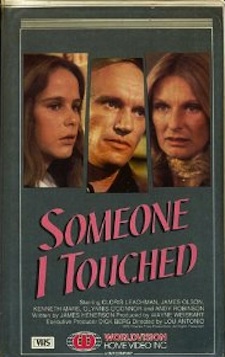
Embracing the Melodrama Part II #53: Someone I Touched (dir by Lou Antonio)


someoneitouch_225In the 1975 made-for-TV venereal disease epic Someone I Touched, there’s a scene of children’s author Cloris Leachman at work.  She’s sitting in her office, typing away on a manual typewriter.  Directly behind her is a crude drawing of a clown.  And to the right of her, there’s a statue of the same creepy clown.  Eventually, her husband (played by James Olson) comes into the office and, after a very long argument, finally forces himself to confess that, as the result of a one-night stand with a grocery store cashier (Glynnis O’Connor), he has syphilis.  And it’s possible that Cloris now has syphilis herself.  And, since Cloris is pregnant, it’s also possible that their baby may be born with syphilis.

And it’s all very serious and very dramatic and certainly, it’s nothing to laugh at.

But, I have to admit, that I could not stop thinking about that creepy clown.  And I have to admit that as Cloris was stumbling back in shock, I started to giggle because I just couldn’t stop thinking about what it must be like to work in an office surrounded by creepy clowns.  It made me think about The Sims and how, if your sims ended up getting depressed, the tragic clown would arrive and just makes things worse.

That’s the thing with Someone I Touched.  It’s a very serious film and yet it’s almost impossible to take that seriously.  Whenever a helpful health worker (Andy Robinson, the Scorpio Killer from Dirty Harry) shows up to dispense statistics or the cashier attempts to track down everyone that she’s ever had sex with or Cloris and Olson start to argue about the sad state of their marriage, you’re very aware that the film is dealing with some serious subject matter.  And yet, you can’t take it seriously because of all the little details.  You find yourself fixated on how ugly 70s interior design truly was.  You watch this tiny vein in Olson’s forehead and you worry if it’s going to explode during some of his more dramatic scenes.  You listen to dialogue like, “It (syphilis) can be a real drag if you don’t take care of it” and “Tramps get Syphilis!”  You realize that Leachman is supposed to be playing someone in her mid-30s, even though she was 49 when the film was made.  You listen as Olson explains his recent one night stand by saying, “I was looking down the barrel of my 40th birthday,” despite the fact that Olson looks like he’s in his mid-50s.  And let’s not forget those creepy clowns…

And you just can’t take the movie seriously.  You know that you should but you just can’t.  How could one well-intentioned film produce so many involuntary giggles?

Now, I know you’re probably thinking to yourself, “I would never watch a movie like that!”  But, if you change your mind, Someone I Touched is currently available on Netflix streaming.