Hot in Argentina: Rita Hayworth in GILDA (Columbia 1946)


gary loggins's avatarcracked rear viewer

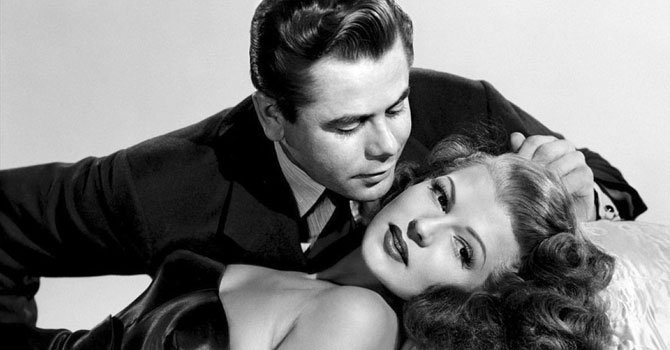
If COVER GIRL made Rita Hayworth a star, then GILDA propelled her into the stratosphere. This 1946 film noir cast Rita at her smoking hot best as the femme fatale to end ’em all. Surrounded by a Grade A cast and sumptuous sets, GILDA gives us the dark side of CASABLANCA , moved to Buenos Aires and featuring star-crossed lovers who are at lot less noble than Rick and Ilsa ever were.

“Every man I knew went to bed with Gilda… and woke up with me”, Hayworth is famously quoted as saying. Who could blame them, as Rita is absolutely stunning in this film. From our first glimpse of her, popping into view with that iconic hair flip…

…to her sultry faux striptease singing “Put the Blame on Mame”, Rita burns up the screen with her smoldering sexuality. Lines like “If I’d been a ranch,  they’d’ve named me the Bar Nothing” leave no doubt…

View original post 565 more words

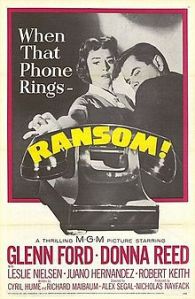
A Movie A Day #128: Ransom! (1956, directed by Alex Segal)


What would you do if your child was kidnapped?

That’s the question asked in this unjustly obscure film from 1956.  Dave Stannard (Glenn Ford) is a wealthy businessman, with a beautiful wife (Donna Reed), a big suburban home, and a butler named Chapman (the great Puerto Rican actor Juano Hernandez).  One day, his son Andy (Bobby Clark) does not come home from school.  The school says that a nurse showed up to pick Andy up for a doctor’s appointment but neither Dave nor his wife know about any appointment and their family doctor says that he would never send a nurse to pick up a patient.

Andy has been kidnapped.  When the kidnappers call, they tell Dave that they want half a million dollars in ransom.  Dave gets the money together but is then told, by reporter Charlie Telfer (Leslie Nielsen), that, once the kidnappers have the money, they will have no incentive to return Andy.  Since Andy is the only person who could identity them to the police, they may very well kill Andy after getting the money.  By paying the ransom, Dave will also be encouraging other kidnappers.

The next morning, Dave goes on television and announces that he will not be paying the ransom.  Instead, he announces that if the kidnappers do not immediately return his son, the money will be given as a reward to anyone who helps to track them down.

If this sounds familiar, it’s because Ransom! was later remade by Ron Howard, with Mel Gibson as the father and Gary Sinise as the kidnapper.  (Ransom! itself was a remake of a live television drama that aired in 1954.)  As opposed to the Howard film, the original Ransom! is a low-key character piece, one that takes place almost entirely in the Stannard home and in which the kidnappers remain largely unseen.  Almost the entire movie focuses on Dave, his decision, and his struggle to come to terms with that decision.  Was Dave right or was he wrong?  Ransom! is stagey but thought-provoking with excellent performances from the entire cast.  Even Leslie Nielsen, making his film debut, does well in the type of dramatic role that defined his career until he reinvented himself as a masterful comedic actor.

They don’t make them like this anyone and that is too bad.


Hittin’ the Dusty Trail with THE DESPERADOES (Columbia 1943)


gary loggins's avatarcracked rear viewer

desp11

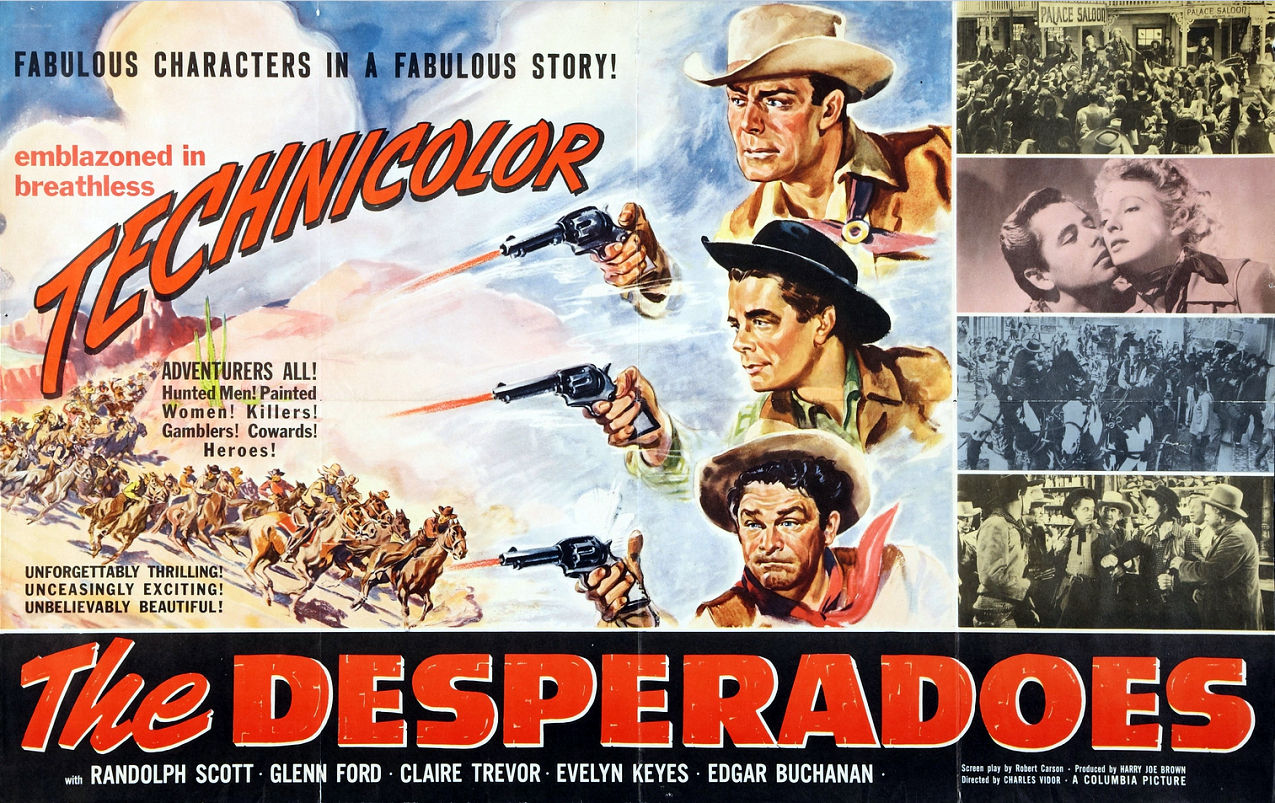
There’s a lot to like about THE DESPERADOES. Not that it’s anything groundbreaking; it’s your standard Western outing with all the standard clichés. you’ve got your two pals, one the sheriff (Randolph Scott ), the other an outlaw (Glenn Ford ). You’ve got your gambling hall dame (Claire Trevor ) and sweet young thing (Evelyn Keyes) vying for the good/bad guy’s attention. You’ve got your goofy comical sidekick (Guinn ‘Big Boy’ Williams). You’ve got your  supposedly respectable heavy (Porter Hall ), a mean heavy (Bernard Nedell), and a heavy who has a change of heart (Edgar Buchanan). What makes this one different is the movie seems to know it’s clichéd, giving a nod and a wink to its audience as it merrily makes its way down that familiar dusty trail.

Based on a novel by pulp writer Max Brand (who also created the Dr. Kildare series), this was one of Columbia’s big releases of the year, and…

View original post 385 more words

Happy 100th Birthday Glenn Ford: 3:10 TO YUMA (Columbia 1957)


gary loggins's avatarcracked rear viewer

3101

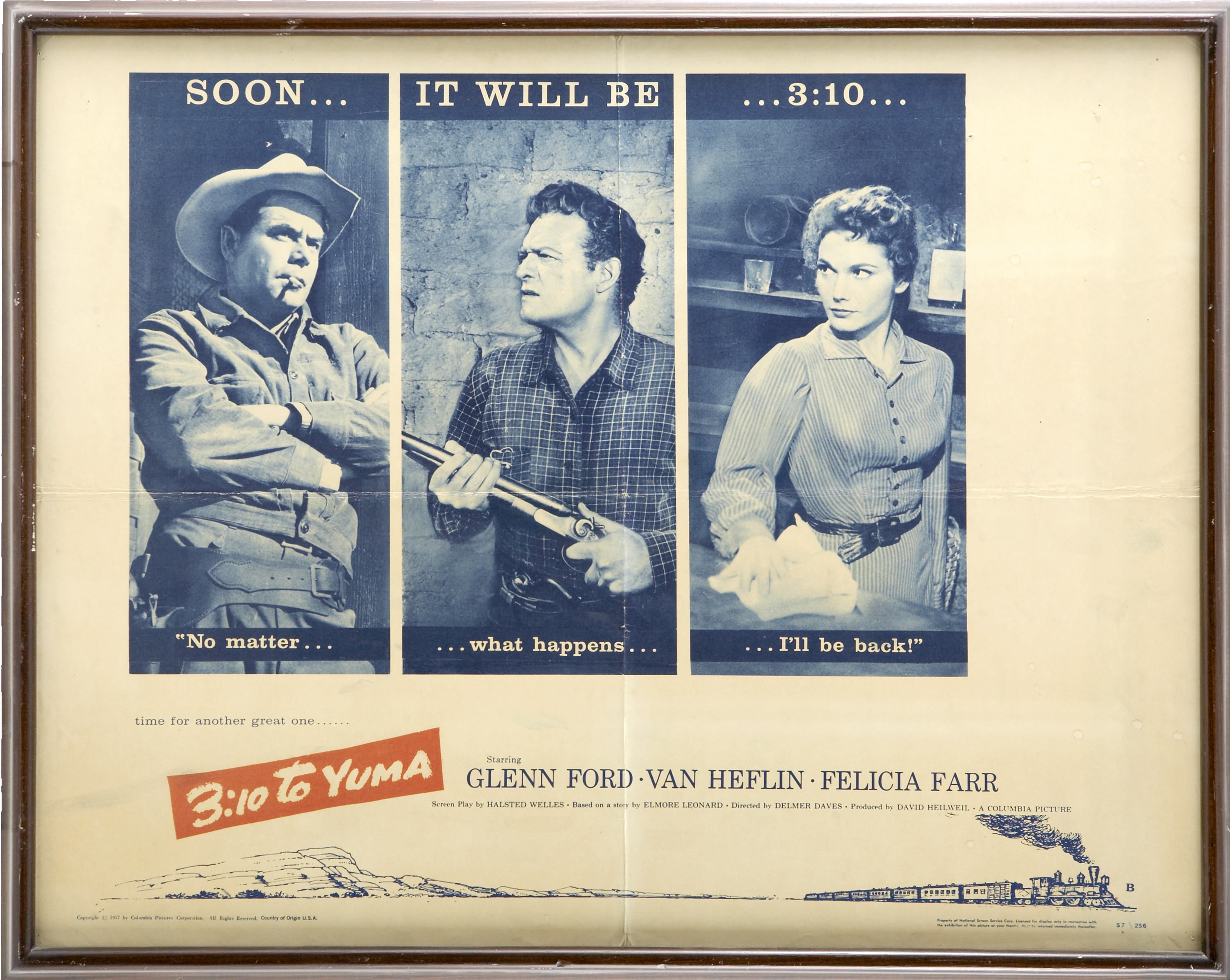
Actor Glenn Ford was born 100 years ago today in Sainte-Christine-d’Auergne, Quebec, Canada. Yes, the All-American star was actually Canadian, becoming a U.S. citizen in 1939. That same year, Ford signed a contract with Columbia Pictures and began a long, prosperous career with the studio. After getting noticed in films like HEAVEN WITH A BARBED WIRE FENCE, SO ENDS OUR NIGHT, and TEXAS (his first Western), Ford took a break from acting and joined the Marine Corps to serve in World War II.

3102

After the war, Glenn Ford was one of Hollywood’s top leading men. He hit it big with 1946’s GILDA, co-starring Rita Hayworth in what may very well be the first true film noir. Soon he found himself the hero in a string of successes: FRAMED, MAN FROM THE ALAMO, THE BIG HEAT , BLACKBOARD JUNGLE, JUBAL, and TEAHOUSE OF THE AUGUST MOON. But my favorite Ford role casts him…

View original post 553 more words

Surely, Leslie Nielsen can’t be the bad guy: The Sheepman (1958, directed by George Marshall)


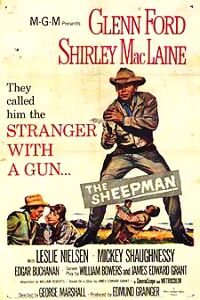
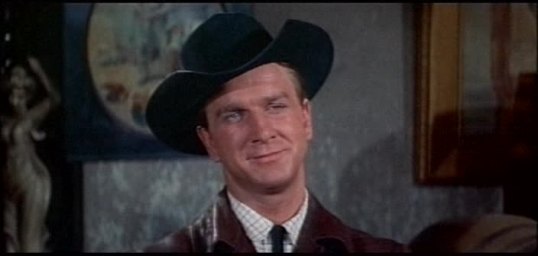
Thesheepman At the start of The Sheepman, reformed gambler and gunslinger Jason Sweet (Glenn Ford) shows up in the middle of cattle country. He has won a herd of sheep in a poker game and he is planning on grazing them on the nearby public land. Knowing that he will face opposition from the local cattle ranchers, Jason asks the local towns people to direct him to the town bully. After Jason beats up Jumbo (Mickey Shaughnessy), Jason is invited to meet Jumbo’s boss, Col. Stephen Bedford (Leslie Nielsen).

As soon as Jason meets Bedford, he realizes that he is not a colonel and his name is not Bedford. Instead, he is an old friend from Texas, a former gambler and outlaw named Johnny Bledsoe. Like Jason, Bledsoe has also gone straight and is now the most powerful man in town. He is also engaged to marry a local girl named Dell Payton (Shirley MacClaine), to whom Jason has taken a liking.  Bledsoe tells Jason to take his sheep somewhere else and when Jason refuses, Bledsoe threatens to have him, Dell, and his sheep killed.

Wait a minute, Leslie Nielsen is playing a bad guy?

Surely, you can’t be serious!

I am serious. And don’t call me Shirley.

(Sorry, had to do it.)

Leslie Nielsen is best remembered for being the deadpan comedian who could deliver the most ridiculous of lines with a totally straight face and who helped to make Airplane one of the funniest movies ever made. But before Nielsen recreated himself as a comedic actor, he was a dependably stiff supporting player and occasional leading man who appeared in nearly 100 dramatic pictures. The Sheepman is one of his “serious” roles.

Today, it is always strange to see one of Nielsen’s dramatic performances. Johnny Bledsoe is a standard western villain and Nielsen does okay with the role but, because his serious performances shared the same style as his comedic performances, it was impossible not to think of Dr. Rumack saying, “I just want to tell you both good luck. We’re all counting on you,” even while Johnny Bledsoe was offering to pay the outlaw Chocktaw (Pernell Roberts) to track down and kill Jason and his sheep.

The Sheepman is an average western and, as always, Glenn Ford is a good hero. But ultimately, the most interesting thing about it and the main reason to see it is to witness Leslie Nielsen doing his thing before he officially became the funniest man in the world.  Leslie Nielsen was not a terrible dramatic actor but watching The Sheepman made me all the happier that he eventually got to show the world his true calling.

Leslie Nielsen in The Sheepman (1958)

Horror Film Review: The Visitor (dir by Giulio Paradisi)


The_Visitor_1979_film_poster

Do you want to see a strange horror film?

Just check out The Visitor, a 1979 Italian film that has recently been re-released by Drafthouse Films and occasionally shows up on TCM.  In many ways, The Visitor is a total and complete mess.  But, as is so often the case with Italian horror films, that very messiness — combined with some genuinely imaginative narrative and directorial choices — serves to make The Visitor into one of the most memorable films that you (possibly) have never heard of.

Like many of the Italian exploitation films released in the 70s and 80s, The Visitor is a rather blatant rip-off of a successful American film.  What makes The Visitor unique is the amount of different movies that it rips off.  The Visitor takes films that you would assume had no connection and mixes them together to create something wonderfully odd.
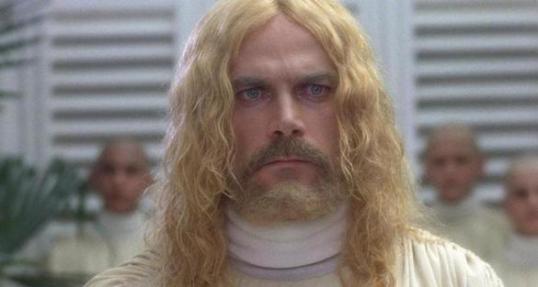
Franco Nero as Jesus in The Visitor

Franco Nero as Jesus in The Visitor

Much like Close Encounters of the Third Kind and 2001: A Space Odyssey, The Visitor opens with the idea that intergalactic beings have been visiting Earth for centuries and are subtly influencing the development of humanity.  The Visitor literally opens with Jesus Christ (played by Franco Nero!) sitting on a satellite and telling a version of the creation story to a bunch of bald children.  He explains that, long ago, he battled an evil intergalactic demon known as Sateen.  Sateen (who, the film implies, is better known on Earth as Satan) was eventually blown up but his genes were spread throughout humanity.  The bald children surrounding him are the descendants of Sateen.  Whenever one of them is born, Jesus sends an old man named Jerzy Colsowicz (played by director John Huston) to Earth so that Jerzy can bring the child to the satellite.  Of course, whenever Jerzy isn’t kidnapping kids for Jesus, he spends his time hanging out in a psychedelic dimension.

Yes, you did read that correctly.
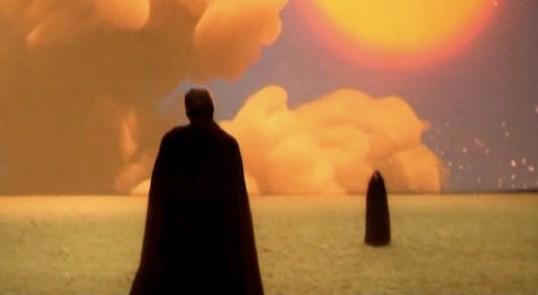
This is where Jerzy lives.

This is where Jerzy lives.

Once you get past the intergalactic part of the story, The Visitor is a pretty obvious rip-off of both The Omen and Damien: Omen II, with the main difference being that the demon child here is not a cherubic little boy but instead is a rather bratty 8 year-old little girl named Katy (Paige Collins).  However, Katy is not the Antichrist.  Instead, her job is to mate with a male child who also has Sateen’s genes and then her baby will be the Antichrist.  In order to get this male child, Katy is pressuring her mother (Joanne Nail) to have sex with businessman Raymond Armstead (Lance Henriksen, who was also in Damien II: The Omen) so that Katy can have a half-brother to mate with.  (Ewwwwwwww!)  Raymond is a follower of Sateen and, adding to the film’s already odd feel, he also happens to own a basketball team.

(So, along with everything else going on, The Visitor also features a lot of basketball footage, which I guess would be exciting if I knew anything about basketball.)

Despite being a pretty powerful figure in the Sateenist hierarchy Raymond is not the head Sateenist.  No, the head Sateenist is played by Mel Ferrer, an actor who was once married to Audrey Hepburn and who will be familiar to anyone who has ever watched an Italian horror film.  (You can spot Ferrer in Zombie Holocaust, for example.)  Ferrer and the other Sateenists are all old, distinguished looking white men who spend all of their time meeting in an ornate corporate boardroom.

So, Jerzy comes down to Earth  to, with the help of a nanny played Shelley Winters, try to kidnap Katy but, for some reason, he doesn’t just do that.  Instead, he spends most of his time just watching Katy do destructive things.

Much as in The Omen, anyone who gets too close to discovering the truth about Katy ends up dying an elaborate and bloody way.  Often times, their death involves black crows, who the film suggests might actually be all of those little bald kids in animal disguise. So is Jesus sending those crows to kill people?  Seriously, this movie is weird.
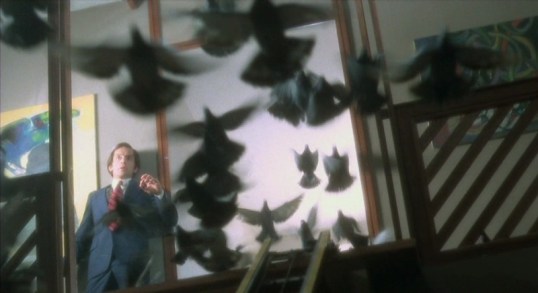
Beware the Crows

Beware the Crows

Meanwhile, Katy’s mom is having doubts about both Raymond and her daughter.  She even goes and talks to her ex-husband, an abortionist who is played by yet another film director, in this case Sam Peckinpah.  Katy gets annoyed with her mom and, after happening to come across a gun hidden away inside of a birthday presents, shoots her in the back and leaves her paralyzed.

And did I mention that Katy is telekinetic, much like Carrie?  That’s right!  During my favorite scene, Katy goes skating at the local mall’s ice rink and, after a group of boys bully her, she uses her powers to send those bullies flying all over the mall.  Oddly enough, nobody seems to notice this chaos.  Except, of course, for Jerzy who just stands off in the corner and watches without doing anything…

Seriously, I love The Visitor.  Along with being surprisingly well-acted and visually inventive, the film is just so weird!  In many ways, it epitomizes everything that I love about the old Italian exploitation films.  While it is rather shameless about ripping off other movies, the film still brings its own unique spin to everything.

Normally, I’d say that The Visitor is a good film for Halloween but you know what?  Anytime is a good time for an Italian horror film!

Welcome

Welcome


Back to School #3: Blackboard Jungle (dir by Richard Brooks)


http://www.youtube.com/watch?v=HA0_NRjx9KQ

You really can’t write about high school films without writing about 1955’s Blackboard Jungle.  While the film is often cited as being the first movie to feature a rock song on its soundtrack (Bill Haley’s Rock Around The Clock is played at the opening and the end of the film), Blackboard Jungle should also be remembered for being one of the first and most influential examples of the dedicated-teacher-in-the-inner-city film genre.

Blackboard Jungle tells the story of Richard Dadier (Glenn Ford), a newly hired teacher at an inner city high school.  As soon as he arrives for his first day at work, he meets his co-workers.  Josh Edwards (Richard Kiley) is another new teacher and is convinced that he can reach the students by talking to them about his valuable collection of jazz records. Mr. Murdock (Louis Calhern) is a burned out old cynic who believes that none of the students at the school have a future.  As Dadier quickly discovers, most of his fellow teachers have more in common with Murdock than with either him or Josh.

At first, Dadier struggles to reach his students, the majority of whom don’t see why they should waste their time in English class.  The head troublemaker, psychotic Artie West (Vic Morrow) sees the new teacher as being a rival and Dadier’s attempts to reach another student, Gregory Miller (Sidney Poitier), are made difficult by the racial animosity that dominates the entire high school.  Soon, Dadier is being targeted by his students and his pregnant wife (Anne Francis) starts to receive anonymous letters that imply that Dadier is having an affair.  It all leads to a violent classroom confrontation in which Dadier’s students are finally forced to pick a side in the battle between the forces of education and the forces of chaos.  (If that sounds melodramatic — well, it is kinda.)

It’s a little bit difficult to judge a film like Blackboard Jungle today.  We have seen so many movies about idealistic young teachers trying to make a difference in the inner city that it’s pretty easy to guess most of what is going to happen here.  In order to appreciate Blackboard Jungle, it’s necessary to understand that the only reason why it occasionally seems predictable is because it’s such an incredibly influential film.  And there are still moments in Blackboard Jungle that can take the viewer by surprise.  The scene in which Ford lists off all of the racial slurs that he doesn’t want to hear is just one example.  It’s hard to imagine that scene appearing in a movie made today.  (If it did, it would probably be played for laughs.)

That said, the performances in the film hold up surprisingly well.  Glenn Ford is a compelling hero and he and Anne Francis make for a likable couple.  Despite being 28 years old and having already played several adult roles, Sidney Poitier is a convincing high school student and, not surprisingly, he makes for a convincing leader.  However, for me, the film was dominated by Vic Morrow.

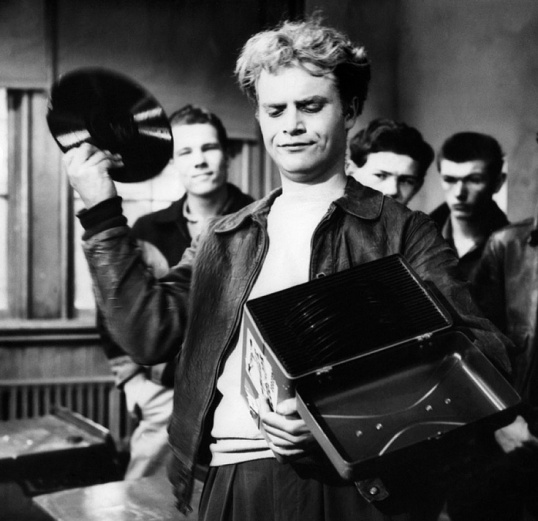
As played by Morrow, Artie Turner is a truly frightening villain.  In previous films about juvenile delinquency, the emphasis was always put on why the delinquent went bad and usually, the blame was put not on the teenager but instead on the environment around him.  He had bad parents or maybe he listened to too much jazz but, ultimately, he was not lost.  He was merely damaged.  However, Artie Turner has no convenient excuses for his behavior.  His parents go unmentioned.  When he’s exposed to jazz, he responds by breaking all of Mr. Edwards’ records.  Among all of Dadier’s students, Artie is unique in that he cannot be reached.  He’s a force of pure destruction and ultimately, Dadier’s success as a teacher depends less on reaching Artie and more on convincing his other students to reject Artie as a role model.

Blackboard Jungle may be a film that feels very familiar but it’s still one worth watching.

Artie Turner Acting Out

Artie Turner Acting Out