Quick Review: The Longest Day (dir. by Ken Annakin, Andrew Marton, and Bernhard Wicki)


Hey hey!! Before you read this, know that this isn’t the only review for The Longest Day. Lisa Marie also wrote about it. Read that first, and then double back here if you like.

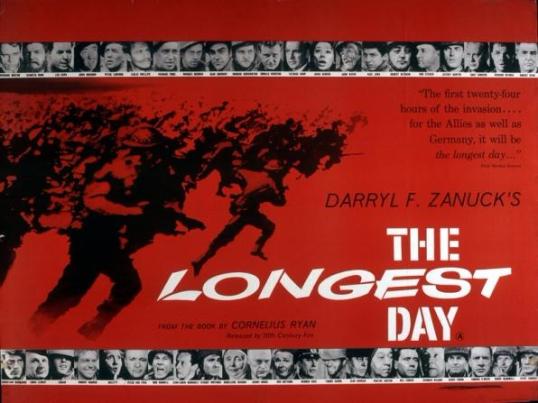
With June 6th being the 81st Anniversary of D-Day, I decided to write about 1962’s The Longest Day, a film often discussed in my family, but surprisingly, I don’t recall ever fully watching it until today. I’ll try to get a hold of a hard copy of this in the future. The film is currently available to watch (with ads) on YouTube. This was a film my Aunt adored, as she liked seeing the Military come to the rescue in any situation (which happened often in most classic sci-fi films). This, They Died With Their Boots On, and All Quiet on the Western Front were films she raved about.

According to the National WWII Museum, “The Allies suffered over 10,300 total casualties (killed, wounded, or missing), of which approximately 2,400 were on Omaha Beach.” it was also an incredible offensive achievement, with nations gathering together to take the fight to a common enemy. 

I don’t have a whole lot to say about this. As this is a film based on actual events (which takes some movie related liberties), I can’t complain or state I loved the “story”. As my boss at my Dayjob sometimes says, “It is what it is.” In terms of presentation, however, I highly recommend it. The film never really falters, nor does it give you too much time to relax. There’s a quiet tension with all of the characters you meet (all of the Allied ones, anyway), wondering if they may make it through by the end. If nothing else, watching it reminds one of the sacrifices made and the courage of anyone deciding to run head first into battle like that. 

The film is epic in scope, with a runtime of 3 hours and an all star cast that includes Robert Mitchum (Cape Fear), Eddie Albert (Dreamscape), John Wayne (The Quiet Man), Henry Fonda (Once Upon a Time in the West) Curt Jurgens (The Spy Who Loved Me), Red Buttons and Roddy McDowall (who would later work together in The Poseidon Adventure), Richard Beymer (West Side Story), Frank Findlay (Lifeforce), Gert Frobe and Sean Connery (both two years shy of working together in Goldfinger), Richard Burton (Cleopatra) and Robert Ryan (The Wild Bunch) among others.

Much like 1970’s Tora!Tora!Tora! (which my Dad often talked about), there were multiple directors for The Longest Day. Bernhard Wiki captured the German scenes, Andrew Marton handled the American ones, and Ken Annakin handled both the English and French sequences. This is all brought together in a seamless and pretty amazing tapestry. Unlike Steven Spielberg’s Saving Private Ryan, The Longest Day only covers the time leading up to and through the Omaha Beach assault, using the bulk of the film’s 3rd hour for the event. The entire film makes wonderful use of the time with all the alternate views, and by the time the first combat starts near the start of the 2nd hour, it continues to flow from interaction to interaction. There are also some wonderful arial shots over the battles, including an classic one shot that’s pretty marvelous given the time period.

The film takes place just before the invasion. American troops are already in the water on boats. Others are ready to parachute in. The French are ready to fight, waiting for the right phrase to hit the radio to put them into action. all are waiting to hear from the Britians on when the Allied Assault should begin. The weather isn’t optimal, but with the operation already delayed once before, President Eisenhower (Henry Grace) decides the 6th is the drop date. The Germans assume nothing will happen assaults are supposedly not done in harsh weather, but this proves to be quite the mistake.

It was wonderful to see everything come together. From the French sabotaging communications, to the strange comedy of soldier toting bagpipes to lead the Scottish into battle, or the Nuns who walked right through battle to save lives, it’s quite a sight to behold. 
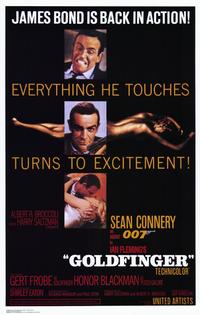
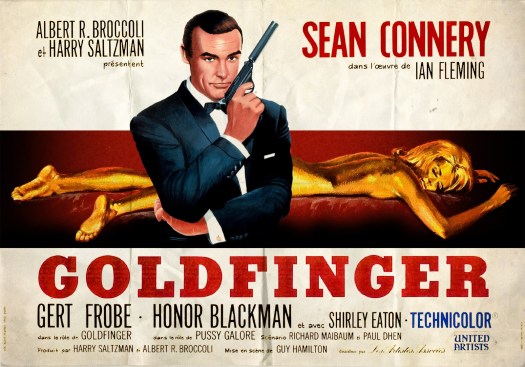
Scenes That I Love: “No, Mr. Bond….” from Goldfinger


Seeing as how today would have been Gert Frobe’s birthday, it seems only appropriate that today’s scene of the day should be one of the best moments from the original Bond franchise.  In 1964’s Goldfinger, Frobe sets the standard by which all other Bond villains would be judged.

My Favorite Spy: Sean Connery as James Bond in GOLDFINGER (United Artists 1964)


gary loggins's avatarcracked rear viewer

For my money, GOLDFINGER is the ultimate James Bond movie, serving as the blueprint for spy sagas to come. The action begins right off the rip as a scuba diving 007 infiltrates an oil refinery in an unnamed Latin American country, plants some plastique explosives, and changes into a tux as the whole shebang blows, then attends to some “unfinished business” with a beautiful Latina who sets him up to be killed by a bad guy, electrocuting his foe in a tub and wittily remarking “shocking, positively shocking” – all before the opening credits roll and Shirley Bassey belts out the immortal title tune by Anthony Newley and Leslie Bricusse!

Our Man Bond is then off to Miami to meet with his CIA pal Felix Leiter. He’s put on the trail of one Auric Goldfinger, a legit gold bullion dealer suspected of illegal activities. The avaricious Goldfinger isn’t above running…

View original post 607 more words

Lisa Reviews An Oscar Nominee: The Longest Day (dir by Ken Annakin, Andrew Marton, Bernhard Wicki, Gerd Oswald, and Darryl F. Zanuck)


As my sister has already pointed out, today is the 73rd anniversary of D-Day.  With that in mind, and as a part of my ongoing mission to see and review every single film ever nominated for best picture, I decided to watch the 1962 film, The Longest Day!

The Longest Day is a pain-staking and meticulous recreation of invasion of Normandy, much of it filmed on location.  It was reportedly something of a dream project for the head of the 20th Century Fox, Darryl F. Zanuck.  Zanuck set out to make both the ultimate tribute to the Allied forces and the greatest war movie ever.  Based on a best seller, The Longest Day has five credited screenwriters and three credited directors.  (Ken Annakin was credited with “British and French exteriors,” Andrew Marton did “American exteriors,” and the German scenes were credited to Bernhard Wicki.  Oddly, Gerd Oswald was not credited for his work on the parachuting scenes, even though those were some of the strongest scenes in the film.)  Even though he was not credited as either a screenwriter or a director, it is generally agreed that the film ultimately reflected the vision of Darryl F. Zanuck.  Zanuck not only rewrote the script but he also directed a few scenes as well.  The film had a budget of 7.75 million dollars, which was a huge amount in 1962.  (Until Steven Spielberg’s Schindler’s List, The Longest Day was the most expensive black-and-white film ever made.)  Not only did the film tell an epic story, but it also had an epic length.  Clocking in at 3 hours, The Longest Day was also one of the longest movies to ever be nominated for best picture.

The Longest Day also had an epic cast.  Zanuck assembled an all-star cast for his recreation of D-Day.  If you’re like me and you love watching old movies on TCM, you’ll see a lot of familiar faces go rushing by during the course of The Longest Day.  American generals were played by actors like Robert Mitchum, Robert Ryan, Henry Fonda, and John Wayne.  Peter Lawford, then the brother-in-law of the President of the United States, had a memorable role as the Scottish Lord Lovat, who marched through D-Day to the sounds of bagpipes.  When the Allied troops storm the beach, everyone from Roddy McDowall to Sal Mineo to Robert Wagner to singer Paul Anka can be seen dodging bullets.  Sean Connery pops up, speaking in his Scottish accent and providing comic relief.  When a group of paratroopers parachute into an occupied village, comedian Red Buttons ends up hanging from the steeple of a church.  When Richard Beymer (who is currently playing Ben Horne on Twin Peaks) gets separated from his squad, he stumbles across Richard Burton.  Among those representing the French are Arletty and Christian Marquand.  (Ironically, after World War II, Arletty was convicted of collaborating with the Germans and spent 18 months under house arrest.  Her crime was having a romantic relationship with a German soldier.  It is said that, in response to the charges, Arletty said, “My heart is French but my ass is international.”)  Meanwhile, among the Germans, one can find three future Bond villains: Gert Frobe, Curt Jurgens, and Walter Gotell.

It’s a big film and, to be honest, it’s too big.  It’s hard to keep track of everyone and, even though the battle scenes are probably about an intense as one could get away with in 1962 (though it’s nowhere near as effective as the famous opening of Saving Private Ryan, I still felt bad when Jeffrey Hunter and Eddie Albert were gunned down), their effectiveness is compromised by the film’s all-star approach.  Often times, the action threatens to come to a halt so that everyone can get their close-up.  Unfortunately, most of those famous faces don’t really get much of a chance to make an impression.  Even as the battle rages, you keep getting distracted by questions like, “Was that guy famous or was he just an extra?”

Among the big stars, most of them play to their personas.  John Wayne, for instance, may have been cast as General Benjamin Vandervoort but there’s never any doubt that he’s playing John Wayne.  When he tells his troops to “send them to Hell,” it’s not Vandervoort giving orders.  It’s John Wayne representing America.  Henry Fonda may be identified as being General Theodore Roosevelt II but, ultimately, you react to him because he’s Henry Fonda, a symbol of middle-American decency.  Neither Wayne nor Fonda gives a bad performance but you never forget that you’re watching Fonda and Wayne.

Throughout this huge film, there are bits and pieces that work so well that you wish the film had just concentrated on them as opposed to trying to tell every single story that occurred during D-Day.  I liked Robert Mitchum as a tough but caring general who, in the midst of battle, gives a speech that inspires his troops to keep fighting.  The scenes of Peter Lawford marching with a bagpiper at his side were nicely surreal.  Finally, there’s Richard Beymer, wandering around the French countryside and going through the entire day without firing his gun once.  Beymer gets the best line of the film when he says, “I wonder if we won.”  It’s such a modest line but it’s probably the most powerful line in the film.  I wish The Longest Day had more scenes like that.

The Longest Day was nominated for best picture of 1962 but it lost to an even longer film, Lawrence of Arabia.

James Bond Review – Goldfinger (dir. by Guy Hamilton)


The Shattered Lens continues the Bond Marathon leading up to the release of Skyfall with 1964’s Goldfinger. Normally, one would figure that the third film in a series is the one with the most danger of ruining everything. You’ve already had two successful stories and you’re asking audiences to come back for yet another round. Yet Goldfinger manages to be considered a favorite by many, and even managed to be the first 007 film to win an Academy Award (for Sound Effects). It does this by expanding on what was already done.

Building on the format that From Russia With Love started, Goldfinger opens with the gun barrel animation and Bond already on a mission. As he reaches what looks like an oil field under the cover of night, he manages to sabotage it (with a little help from C4 or possibly C3, given the time) and arrive back in a neighboring town before it explodes. Heading to his hotel room, he finds a young lady waiting for him who tries to capture his attentions before he catches sight of a thug in the reflection of her eyes. In the fight that ensues, Bond’s quick thinking and a bathtub full of water makes all of the difference. This prologue will become commonplace in all of the EON Production Bond films save for Dr. No (of course) and Quantum of Solace, which gives you the gun barrel at the end of that film.

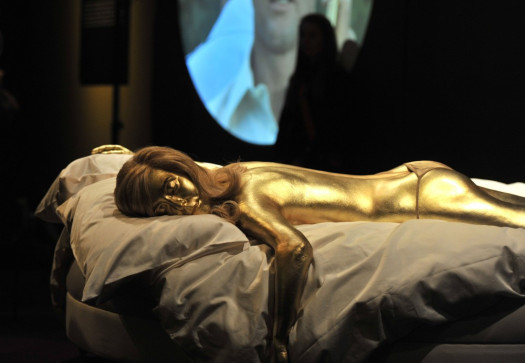
Sean Connery reprises his role as MI6’s best agent, finding himself in Miami, where he interrupts the card game of one Auric Goldfinger (Gert Frobe), cheating with the help of Jill Masterson (Shirley Eaton). When Bond is caught off guard and knocked out, he wakes up to find Jill dead in her bed, covered in gold paint. The scene actually sparked a number of rumors that Eaton had died in the process of filming it, and as it was mentioned in the film, without leaving a free space near the base of the spine, the actress suffered “skin asphyxiation”. This was later tested on the Discovery Channel’s Mythbusters, and while skin doesn’t “breathe” the way Fleming wrote, your sweat can’t get out of clogged pores. You end up dying of heat stroke. Guess my science teachers were right there, to a degree. The image is so popular, it was even referenced by Quantum of Solace, though Oil was the substance of choice used there.

Bond is given the mission to track Goldfinger and figure out what he’s up, but not without a quick visit to Q Branch. It’s here where we find James’ new car, the Aston Martin DB5, and are introduced to one of longest professional relationships between an automotive company and a production one. Aston Martin would go on to cover nearly every Bond film save for a few (Goldeneye quickly comes to mind), but I’ll profile that relationship in a separate article. The car is outfitted with machine guns, oil slicks, smoke screens and even an ejector seat, believe it or not. Among the gadgets he’s given are two trackers (one large and one small). In terms of the overall series, this is the point where 007 seemingly becomes more of a gadget hound than relying on his actual abilities. I always felt that the ones in From Russia With Love supported him just when he needed it. In Goldfinger, they come across as utility belt like items, though functional all the same.

One of the other standouts in the film is Goldfinger’s henchman, OddJob (Harold Sakata). With a bowler hat that served as a razor disc, he’s one of the most iconic villains in the series, perhaps second only to Richard Kiel’s Jaws. Tomorrow Never Dies and even Goldeneye went on to use henchmen (or henchwomen in Famke Jassen’s case) to great effect.

In going after Goldfinger, Bond runs into Tilly Masterson (Tania Mallet), who mistakenly tries to kill him. They’re eventually caught an in classic 007 Fashion, Bond is placed in a situation that causes one to ask why no one has ever tried to kill him outright. The laser scene that has Bond tied to a table features one of the most famous lines in Goldfinger. When Bond asks Auric if he expects him to talk because of the laser that’s due to cut him in two, Goldfinger stops, turns to face him and exclaims, “No, Mister Bond! I expect you to die!” Needless to say, Goldfinger changes his mind after Bond mentions “Operation Grand Slam”, a plot to seemingly rob Fort Knox. It’s only later that we find that Goldfinger isn’t out to rob the reserve, he’s planning on detonating a nuclear weapon in it that would make all of the nation’s gold radioactive (and all of his gold worth billions, as a result). This is all showcased in a grand sequence involving Pussy Galore’s flight team and some knockout gas. As a kid, I loved it.

Finally, what Bond film would be complete without a Bond Girl? For Goldfinger, we have Honor Blackman’s Pussy Galore. In doing some research on this, I found that according to an article in Empire Magazine, in order to get the name by the American censors, the movie producers took them out to dinner. They decided to not interfere with the name, but it was never exactly listed in any of the US marketing promos. I’d always wondered about that, myself.

As a Bond Girl, Pussy was great in that she handled herself well with both weapons and hand to hand combat. Honor Blackman was well versed in Judo, so her action scenes with Sean Connery were easy to make. Cold and to the point, Pussy Galore wasn’t the “crying over a broken nail” type, but this being the 60’s, they still had the character succumb to Bond’s advances. Personally, I’m not exactly cool with that, but understand that given the time period and possibly the audience, it had to be written as such. Future Bond Girls would make up for it. At least it was good to see that there was a Bond Girl who could stand toe to toe with Bond.

Regarding the casting, one thing that’s also interesting to note that Gert Frobe, who played Goldfinger had a heavy German accent, so heavy in fact that his lines had to be dubbed by someone else. All of the Bond regulars from previous films make a return – Desmond Llewelyn as Q, Lois Maxwell as Miss Moneypenny, in particular. Felix Leiter would be played by a different actor (my favorite being David Hedison from License to Kill).

The impact of Goldfinger has been huge over the years. It’s one of the films everyone usually recalls, and even famed Video Game creator Hideo Kojima pays homage to the film by way of the theme song used in it’s game “Metal Gear Solid 3: Snake Eater”, as the game takes place in the same time period as Goldfinger.

Overall, Goldfinger remains one of the strongest parts of the 007 saga. Tomorrow, the Shattered Lens takes on Thunderball, the Fourth Connery film and the controversy surrounding it. I’ll leave you with Shirley Bassey’s iconic theme to the film.