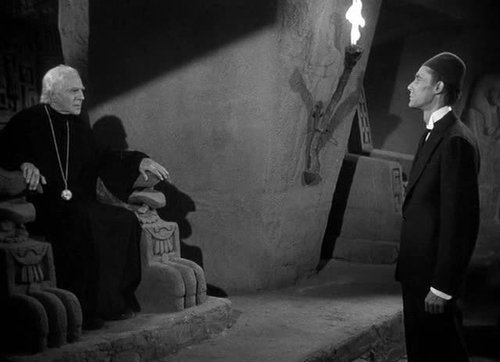
Horror Film Review: Voodoo Man (dir by William Beaudine)


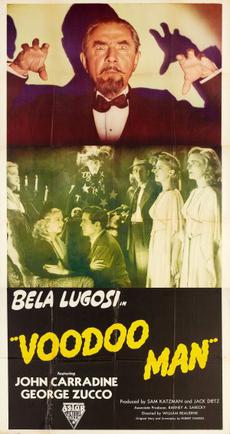
In 1944’s Voodoo Man, Michael Ames stars as Ralph, a screenwriter who has been asked to write a treatment based on the real case of several “girl motorists” who have disappeared in the surrounding area.  Ralph turns down the assignment because he’s busy planning his wedding to Betty (Wanda McKay).  However, when Betty’s maid of honor, Stella (Louise Currie), vanishes, Ralph and Betty set out to investigate.  As Ralph puts it, he’s become a part of the story that he earlier rejected.

What has happened to Stella and all of the other women?  They’ve been abducted by Toby (John Carradine) and Grego (Pat McKee), two lunkheads who work for Dr. Marlowe (Bela Lugosi).  Dr. Marlowe lives in an isolated mansion where he is cared for by his loyal housekeeper (Mici Goty).  Twenty-two years ago, Dr. Marlowe’s wife, Evelyn (Ellen Hall), died but Marlowe has been able to keep her body in a sort of suspended animation ever since.  Marlowe is kidnapping women because, through the use of voodoo and mad science, he hopes to take their “will to live” and transfers it into Evelyn.  Helping Marlowe out is a voodoo priest named Nicholas (George Zucco).

Lugosi, Carradine, and Zucco!  Obviously, the main appeal of Voodoo Man is that it brings together three great names in horror. Even if the story doesn’t really make much sense (and it doesn’t), the film gets a lot of mileage out of the combination of Lugosi, Carradine, and Zucco.  While Lugosi does seem to be a bit bored with his role, Carradine and Zucco really throw themselves into their characters.  John Carradine, in particular, seems to be having the time of his life as he shuffles around the mansion and replies, “Yes, master,” to every command from Dr. Marlowe.  It’s the type of entertaining performance that could only be delivered by a trained Shakespearean slumming in a low-budget, B-grade horror film.  As for Zucco, he plays Nicholas with a certain amount of ruthless erudition.  Zucco is playing the Boris Karloff role here and he definitely seems to understand what that means.

As for the film itself, it has its moments.  Legend has it that director William Beaudine’s nickname was “One Shot” because he was usually only willing to do one take of each scene.  As a result, he filmed quickly and he didn’t spend a lot of money and that was probably a good thing for a production like Voodoo Man.  It also meant that if someone flubbed a line or bumped into a piece of furniture, that take would still be the one that showed up in the film.  My favorite moment of Voodoo Man was when the local sheriff (Henry Hall) referred to Dr. Marlowe as being “Dr. Martin,” and Bela Lugosi, who appeared to be struggling not to laugh, quickly said, “It’s Marlowe.”  The sheriff corrected himself.  That’s the type of fun you don’t get in movies made by people who do more than one take.

Voodoo Man has a quick 61-minute running time.  To enjoy it, it probably helps to already be a fan of low-budget, B-horror films from the 40s.  Lugosi, Carradine, and Zucco are combination that deserves to be seen.
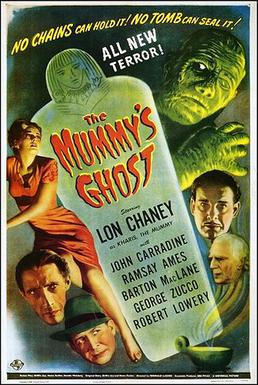
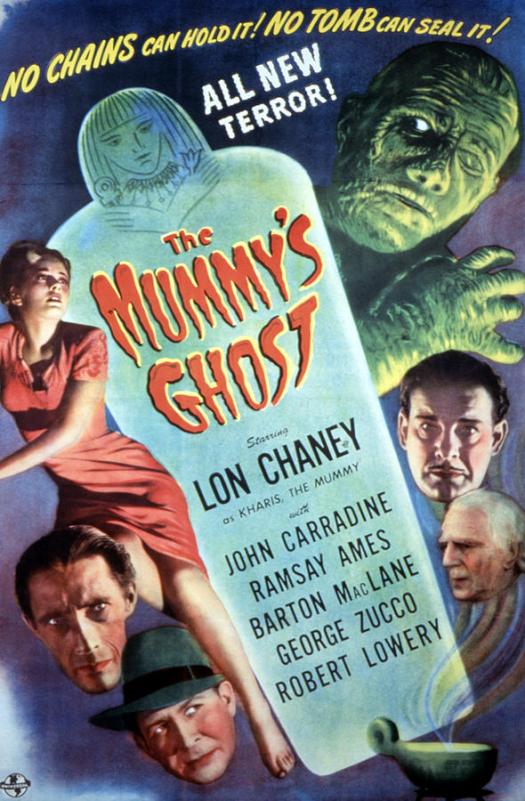
Horror Film Review: The Mummy’s Ghost (dir by Reginald Le Borg)


When we last checked in with Kharis the Mummy, he was trapped in the middle of an inferno in Massachusetts.  Having come to America to kill the members of the expedition that discovered the Tomb of Ananka and who brought Princess Ananka’s body to the United States, Kharis (Lon Chaney, Jr.) was trapped by the citizens of the town of Mapleton who, in the best tradition of Universal horror, cornered Kharis in a house and then set the place on fire.

1944’s The Mummy’s Ghost begins with the revelation that Kharis did not die in that inferno.  Somehow, he managed to escape and, rather improbably, he’s spent the last few years wandering around town without anyone ever noticing him.  The film presents Kharis as being largely a nocturnal creature but, even if he is only coming out at night, it still seems strange that no one would notice a mummy wandering around, especially since the entire town was traumatized by Kharis’s previous reign of terror.  As well, it’s also been established that Kharis owes his eternal life to an ancient Egyptian plant.  One reason why Kharis has always needed a “minder” is because Kharis needed someone who could keep him supplied with the plant.  So, if Kharis has been wandering around Massachusetts for the past few years, from where has he been getting the plant?

The Mummy’s Ghost also established that, in Egypt, High Priest Andoheb (Georg Zucco) is still alive.  This is somewhat surprising, considering that Andoheb died in both The Mummy’s Hand and The Mummy’s Tomb.  But no matter!  Andoheb is apparently still alive.  He’s really old and his hands shake but he’s still alive and he’s still determined to bring both Kharis and Princess Ananka back to Egypt.  This time, he sends Yousef Bey (John Carradine) to Massachusetts.

Yusef Bey takes over managing Kharis and he’s even able to supply Kharis with more of the special plant the keeps him alive.  However, Kharis grows upset when it discovers that Bey has tracked down the reincarnation of Ananka in the person of Amina (Ramsay Ames) and that, rather than return her safely to Egypt, Bey wants to give her eternal life with the help of the plant and then marry her.  This leads to Kharis going on a rampage and carrying Amina into a nearby swamp while Amina’s boyfriend, Tom Hervey (Robert Lowery), chases after them.

Full of plot holes and inconsistencies, The Mummy’s Ghost is about as silly as a mummy film can be.  If the previous films about Kharis managed to create a feeling of tragic inevitability as Kharis tracked down all of the people who had entered Ananka’s tomb, The Mummy’s Ghost presents Kharis as being something more akin to Frankenstein’s Monster, an inarticulate and easily frustrated creature who does things with little rhyme or reason.  That said, the film does make good use of Lon Chaney Jr’s hulking physicality as Kharis.  He’s still an intimidating figure when he goes after someone.  And John Carradine’s pained expression as Yousef Bey is memorable as a reminder of how much Carradine disliked most of the Universal monster films in which he found himself.  Otherwise, The Mummy’s Ghost is fairly forgettable.

Previous Universal Horror Reviews:

  1. Dracula (1931)
  2. Dracula (Spanish Language Version) (1931)
  3. Frankenstein (1931)
  4. Island of Lost Souls (1932)
  5. The Mummy (1932)
  6. The Invisible Man (1933)
  7. The Bride of Frankenstein (1935)
  8. Dracula’s Daughter (1936)
  9. Son of Frankenstein (1939)
  10. Black Friday (1940)
  11. The Invisible Man Returns (1940)
  12. The Mummy’s Hand (1940)
  13. The Wolf Man (1941)
  14. Ghost of Frankenstein (1942)
  15. Invisible Agent (1942)
  16. The Mummy’s Tomb (1942)
  17. Frankenstein Meets The Wolf Man (1943)
  18. Son of Dracula (1943)
  19. House of Frankenstein (1944)
  20. The Invisible Man’s Revenge (1944)
  21. House of Dracula (1945) 
  22. Creature From The Black Lagoon (1954)

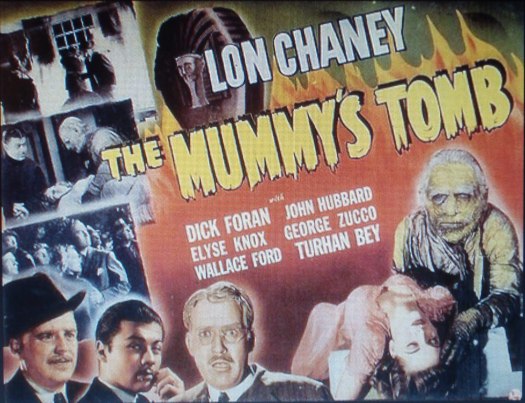
Horror Film Review: The Mummy’s Tomb (dir by Harold Young)


1942’s The Mummy’s Tomb picks up 30 years after the end of The Mummy’s Hand.

Archeologist Steve Banning (Dick Foran) is now living a peaceful life in the small town of Mapleton, Massachusetts.  As the film opens, he is telling his guests about the time that he and his friend, Babe Hanson (Wallace Ford), went to Egypt and discovered the tomb of an Egyptian princess.  He tells them how Andoheb (George Zucco) tried to use the ancient mummy, Kharis, to protect the tomb.  Steve assures everyone that Andoheb is now dead and Kharis is no longer a threat to anyone.

The film then travels to Egypt where we discover that Steve was not quite correct.  Adoheb survived being shot at the end of The Mummy’s Hand.  He’s now an old man, dying but still obsessed with getting revenge.  He instructs his disciple, Mehemet Bey (Turhan Bey), to travel to America with Kharis (now played, under a bunch of bandages, by Lon Chaney, Jr.) and to get revenge on the remaining members of the Banning expedition.

Bey and Kharis travel to Massachusetts and soon, the entire town of Mapleton is gripped in fear as Kharis starts to murder people.  Steve Banning is the first victim.  Then Steve’s sister, Jane (Mary Gordon). Kharis even kills Babe Hanson, whose role in the previous film was largely comic relief.  Seriously, not even Frankenstein’s Monster killed the comic relief.  Kharis is a ruthless and unstoppable killer and, in a performance that is totally focused on his hulking physicality, Lon Chaney, Jr. makes for a frightening mummy.  Kharis moves slowly, dragging one foot behind him.  But when he does attack, he’s relentless.  This movie reminded me of why the mummy has, to me, always been the scariest of the old Universal monsters.

Despite the fact that Kharis is leaving bandages and ancient mold all over the place, the authorities are not quite convinced that an ancient mummy has come to their small town.  However, the townspeople have no doubt what’s happening and, since this is a Universal film, they are soon running around with torches and pitchforks.  Meanwhile, Steve’s son, John (John Hubbard), tries to figure out how to destroy the mummy and how to protect his fiancée, Isobel (Elyse Knox).  Bey has decided that he’s in love with Isobel and he orders Kharis to bring her to him.  Even under all the bandages, Kharis’s facial expression still suggests that he knows this isn’t a good idea.

The Mummy’s Tomb suffers from the same problem that afflicted The Mummy’s Hand.  It feels like it takes forever to actually get to the good stuff.  This is only a 60-minute film and ten of those minutes is taken up with a flashback to The Mummy’s Hand.  But no matter!  Once Kharis arrives in America, the pace of the film picks up and it becomes an effective little horror film.  Lon Chaney, Jr. is frightening Kharis.  I wouldn’t want him following me down a dark alley!

Previous Universal Horror Reviews:

  1. Dracula (1931)
  2. Dracula (Spanish Language Version) (1931)
  3. Frankenstein (1931)
  4. Island of Lost Souls (1932)
  5. The Mummy (1932)
  6. The Invisible Man (1933)
  7. The Bride of Frankenstein (1935)
  8. Dracula’s Daughter (1936)
  9. Son of Frankenstein (1939)
  10. Black Friday (1940)
  11. The Invisible Man Returns (1940)
  12. The Mummy’s Hand (1940)
  13. The Wolf Man (1941)
  14. Ghost of Frankenstein (1942)
  15. Invisible Agent (1942)
  16. Frankenstein Meets The Wolf Man (1943)
  17. Son of Dracula (1943)
  18. House of Frankenstein (1944)
  19. The Invisible Man’s Revenge (1944)
  20. House of Dracula (1945) 
  21. Creature From The Black Lagoon (1954)

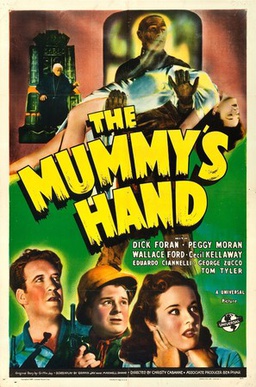
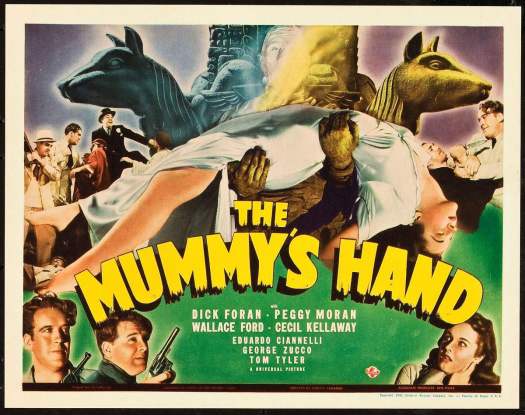
Horror Film Review: The Mummy’s Hand (dir by Christy Cabanne)


In 1940, having brought back The Invisible Man and Frankenstein’s Monster, Universal Pictures decided that it was also a good time to bring back The Mummy!

The Mummy’s Hand takes place in what we’re told is Egypt, though it’s obvious just a Universal backlot.  Two archeologists — Steve Banning (Dick Foran) and Babe Jenson (Wallace Ford) — are penniless and stuck in Egypt.  Babe wants to find a way to return to Brooklyn and his ex-girlfriend.  Steve is a bit more serious about archeology, though it must be said that he’s no Indiana Jones when it comes to discovering relics and taking them to museums.  If Indiana is the type who will risk his life to search a hidden cave in the Amazon Rain Forest, Steve is far more likely to just wander around an Egyptian market until he comes across someone selling an ancient vase.

Which is exactly what happens!  Steve finds someone selling a vase and, after he learns where it came from, he buys the vase.  He takes the vase to Prof. Andoheb (George Zucco), not knowing that Andoheb is an Egyptian high priest who has been sworn to protect the tomb of Princess Ananka.  When Andoheb realizes that the vase could lead to the discovery of the tomb, he lies and claims that it’s a forgery.  He then “accidentally” breaks it in order to keep Steve from showing the vase to anyone else.  Steve, however, is not deterred and a chance meeting with an American magician named Tim Sullivan (Cecil Kellaway) leads to Sullivan agreeing to finance Steve’s expedition to discover where the vase came from.  Sullivan’s daughter, Marta (Peggy Moran), worries that Steve and Babe are just trying to steal her father’s money so she insists on coming on the expedition with Steve.  Also following the expedition is Andoheb, who is himself starting to fall for Marta and who is hoping that he can use a secret serum hidden in the tomb to make both himself and Marta immortal.

Of course, the tomb itself is protected by Kharis (Tom Tyler, under a ton of bandages), a mummy who is immortal due to the serum and who has sworn to protect the tomb from any outsiders.  Kharis moves slowly but efficiently.  He’s a ruthless and silent killer, one whose eyes appears to just be two black holes, the better to reflect his own lack of a soul.

The main problem with The Mummy’s Hand is that it takes forever for the Mummy to actually show up.  This is only a 67-minute film and the Mummy mayhem doesn’t really start until around the 50 minute mark.  As a result, the viewer spends a lot of time watching Steve and Babe wander around Egypt and essentially act like stereotypical American tourists.  Even when the expedition finally gets started, the audience still has to sit through endless scenes of Marta accusing Steve of being some sort of con artist.  This is a movie that will truly leave you saying, “When is the mummy going to show up!?”

That said, The Mummy itself is a frightening creature, especially with his empty eyes.  Mummy’s are naturally frightening, especially when they’re walking towards you and dragging their decaying bandages  behind them.  The Mummy is effective, I just wish he had been featured in more of the movie.

Previous Universal Horror Reviews:

  1. Dracula (1931)
  2. Dracula (Spanish Language Version) (1931)
  3. Frankenstein (1931)
  4. Island of Lost Souls (1932)
  5. The Mummy (1932)
  6. The Invisible Man (1933)
  7. The Bride of Frankenstein (1935)
  8. Dracula’s Daughter (1936)
  9. Son of Frankenstein (1939)
  10. Black Friday (1940)
  11. The Invisible Man Returns (1940)
  12. The Wolf Man (1941)
  13. Ghost of Frankenstein (1942)
  14. Invisible Agent (1942)
  15. Frankenstein Meets The Wolf Man (1943)
  16. Son of Dracula (1943)
  17. House of Frankenstein (1944)
  18. The Invisible Man’s Revenge (1944)
  19. House of Dracula (1945) 
  20. Creature From The Black Lagoon (1954)

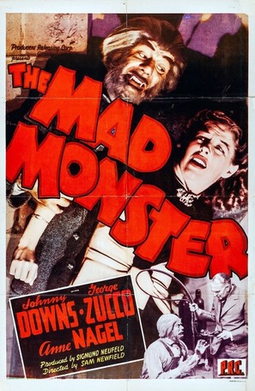
Horror On The Lens: The Mad Monster (dir by Sam Newfield)


In the 1942 film, The Mad Monster, the great George Zucco plays Dr. Cameron.  Dr. Cameron is a mad scientist who has a few issues with his colleagues and who makes the decision to deal with those issues by transforming his simple-minded handyman (Glenn Strange, who played Frankenstein’s Monster in a number of Universal films) into a wolfman.

The Mad Monster is one of the many horror films that were produced by Producers Releasing Corporation, which was one of the most poverty-stricken of the poverty row production companies.  To me, the interesting thing about the film is that Cameron initially wants to use his werewolf formula to help in the war effort.  He wants to help the United States win the war by turning soldiers into wolfmen.  It’s only after his plans are dismissed as being ludicrous that he starts using his wolfman to get revenge.  Unfortunately, the wolfman itself turns more savage and bloodthirsty with each act of revenge so I guess it’s a good thing that it wasn’t deployed on the battlefield because who knows what type of state the soldiers would have been in when they finally came home.

Here is 1942’s The Mad Monster!

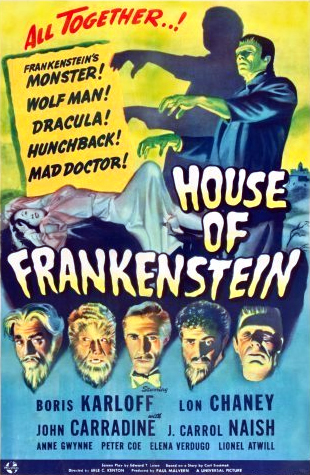
Horror Film Review: House of Frankenstein (dir by Erle C. Kenton)


House of Frankenstein opens in a prison.  Dr. Gustav Neimann (Boris Karloff), the bother of one of Baron Frankenstein’s assistants, has been convicted of robbing graves and attempting to carry on the Baron’s work.  Dr. Neimann’s faithful assistant is the hunchback, Daniel (J. Carroll Naish).  Daniel is loyal to Neimann because Neimann has promised to someday place Daniel’s brain in a stronger body.

When a sudden earthquake allows Neimann and Daniel to escape, they waste no time in getting revenge on Neimann’s enemies.  First, they murder a traveling showman named Prof. Lampini (George Zucco) and steal both his identity and his mobile horror exhibit.  Included in the exhibit is a coffin that Lampini claimed held the skeleton of Dracula.  (There’s even a stake sticking out of the skeleton’s chest.)  When Neimann returns to his original hometown, he removes the stake from the skeleton so that he might use it on the Burgomaster, Hussman (Sig Ruman).  The skeleton transforms into Dracula (John Carradine).  Because he is relieved to have been brought back to life, Dracula does not attack Neimann but instead agrees to help Neimann get revenge on Hussman in return for Neimann looking after his coffin.  Dracula soon learns that he should have thought twice before trusting either Neimann or Daniel.

Neimann moves on, stopping off at Frankenstein’s village and recovering the bodies of both Frankenstein’s Monster (Glenn Strange) and Larry Talbot (Lon Chaney, Jr.) from the frozen chamber in which they were trapped at the end of Frankenstein Meets The Wolf Man.  Revived from suspended animation, Larry immediately starts whining about how much his life sucks.  (I love The Wolf Man but subsequent films turned Larry into the whiniest of the Universal monsters.)  Neimann promises to put Larry’s brain in a new body if he helps to revive the Monster.  Larry agrees.  Meanwhile, Daniel falls in love with a gypsy girl named Ilonka (Elena Verdugo) while Ilonka falls in love with Larry.  Daniel wants Neimann to put his brain in Larry’s body, Larry won’t stop whining about the approaching full moon, and the villagers are getting suspicious!

House of Frankenstein has never been a favorite of critics or horror historians and the film does have its share of flaws.  For instance, though it would have been fun to see Bela Lugosi return to his signature role, John Carradine seems like ideal casting for Dracula.  Unfortunately, Dracula is only in the film for about ten minutes and he comes to an end that really doesn’t feel worthy of a character of his stature.  The film reduces Larry Talbot to just being a dumb lug who won’t stop feeling sorry for himself.  Finally, Glenn Strange has the right physique for the Monster but, much as with John Carradine, he is underused.

That said, I still enjoyed House of Frankenstein.  A lot of that is because of Boris Karloff, who brings a lot of sly humor to his performance as the mad scientist.  (That said, Karloff himself later said that he did the role solely for the money and was bored with the whole thing.)  J. Carroll Naish turns Daniel into a rather sympathetic henchman, one who is so desperate to be “normal” that he’s willfully blinded himself to the fact that Neiman really doesn’t care about anyone other than himself.  (In many ways, he’s the equivalent of the hapless characters that Michael Ripper later played for Hammer Films.)  Finally, Elena Verdugo brings a lot of life to the stock role of the dancing gypsy girl who falls in love with Larry Talbot despite the fact that Larry is kind of a dumb lug.

For a modern viewer, the main appeal of House of Frankenstein is that it is one of the original Universal horror films, even if it came out long after the first Dracula and Frankenstein films.  As such, it has all the things that we associate with and love about those films.  There’s a ruined castle.  There’s angry villagers.  The cast is full of Universal horror mainstays, including Lionel Atwell and Anne Gwynne.  And, yes, the film features a mob descending on the castle with torches.  Flaws and all, House of Frankenstein is an enjoyable time capsule.  It’s a horror film from a far more innocent age and it’s one that remains a fun watch.

Previous Universal Horror Reviews:

  1. Dracula (1931)
  2. Dracula (Spanish Language Version) (1931)
  3. Frankenstein (1931)
  4. Island of Lost Souls (1932)
  5. The Mummy (1932)
  6. The Invisible Man (1933)
  7. The Bride of Frankenstein (1935)
  8. Dracula’s Daughter (1936)
  9. Son of Frankenstein (1939)
  10. The Wolf Man (1941)
  11. Ghost of Frankenstein (1942)
  12. Frankenstein Meets The Wolf Man (1943)
  13. Son of Dracula (1943)
  14. Creature From The Black Lagoon (1954)

Halloween Havoc!: THE MUMMY’S GHOST (Universal 1944)


gary loggins's avatarcracked rear viewer

THE MUMMY’S GHOST, Kharis the killer mummy’s third time around, finds the plot wearing a bit thin in this rehash, as once again the High Priests of Arkham… wait, what? Arkham? What happened to Karnak? Did the High Priests suddenly change religions? Just another example of continuity shot to hell in this series, though we do get an upgrade in the High Priest department with John Carradine boiling the tanna leaves instead of Turhan Bey .

At least George Zucco as Andoheb is still around to brief Yousef Bey (Carradine) on the plot up til now, dispatching him to Mapleton to fetch back Princess Ananka and Kharis to the temple, though the usual tanna leave spiel is upped from three to nine. There are no more Bannings in Mapleton, but still plenty of victims for Kharis to kill. Frank Reicher is back too, as Professor Norman, giving a lecture on…

View original post 435 more words

Halloween Havoc!: THE MUMMY’S TOMB (Universal 1942)


gary loggins's avatarcracked rear viewer

Universal followed up THE MUMMY’S HAND with 1942’s THE MUMMY’S TOMB, casting their new horror sensation Lon Chaney Jr. in the role of the undead Kharis. But it didn’t really matter who was under all those bandages, Karloff , Chaney, Tom Tyler, or Lou Costello (okay, maybe not Costello), the part is just a non-entity used to further the plot along, and the new film was almost completely scuttled by a bad performance from Turhan Bey as the latest High Priest of Karnak, Mehemet Bey.

THE MUMMY’S TOMB kicks off with Dick Foran under Jack Pierce’s old age makeup relating the tale of finding Princess Ananka’s tomb thirty years ago to his son John (John Hubbard), John’s fiancé Isobel (Elyse Knox, mother of NCIS star Mark Harmon), and sister Aunt Jane (Mary Gordon ). Or rather, stock footage from the previous film tells the tale, which takes up about 15…

View original post 534 more words

Halloween Havoc!: THE MUMMY’S HAND (Universal 1940)


gary loggins's avatarcracked rear viewer

Universal revived The Mummy in 1940’s THE MUMMY’S HAND, but except for the backstory (and judicious use of stock footage), there’s no relation to the 1932 Karloff classic . Instead of Imhotep we’re introduced to Kharis, the undead killing machine, as the High Priest of Karnak (Eduardo Cianelli in old age makeup) relates the tale of Princess Ananka, whose tomb is broken into by Kharis, who steals the sacred tanna leaves to try and bring her back to life. Kharis gets busted, and is condemned to be buried alive! For he “who shall defile the temple of the gods, a cruel and violent death shall be his fate, and never shall his soul find rest for all eternity. Such is the curse of Amon-Ra, king of all the gods”. So there!

The High Priest croaks, making Andoheb (George Zucco ) the new High Priest. Meanwhile in Cairo, Americans Steve…

View original post 591 more words

Cleaning Out the DVR #19: Things To Watch When You Have Flumonia!


gary loggins's avatarcracked rear viewer

So I’ve been laid up with the flu/early stage pneumonia/whateverthehellitis for the past few days, which seemed like a  good excuse to clean out the DVR by watching a bunch of random movies:

Bette Davis & Jimmy Cagney in “Jimmy the Gent”

JIMMY THE GENT (Warner Brothers 1934; D: Michael Curtiz ) –  Fast paced James Cagney vehicle has Jimmy as the head of a shady “missing heir” racket, with Bette Davis as his ex-girl, now working for his classy (but grabby!) rival Alan Dinehart. Allen Jenkins returns once again as Cagney’s sidekick, and Alice White is a riot as Jenkins’s ditzy dame. Some funny dialog by Bertram Milhauser in this one, coming in at the tail-end of the Pre-Code era. Cagney’s always worth watching, even in minor fare like this one. Fun Fact: Cagney’s battles with boss Jack Warner over better roles were legendary, and the actor went out…

View original post 786 more words