Film Review: Any Which Way You Can (dir by Buddy Van Horn)


In this 1980 sequel to Every Which Way But Loose, Philo and his orangutan Clyde are still living next door to Orville (Geoffrey Lewis) and his mother (Ruth Gordon).  Philo is still working as a truck driver but he’s becoming far better known as a bare-knuckles brawler.  In fact, when another famous fighter named Jack Wilson (William Smith), moves to the area, everyone assumes that Jack wants to challenge Philo.  It turns out that Jack’s actually a pretty nice guy.  He and Philo become jogging buddies.

Remember Lynn Halsey-Taylor (Sondra Locke), the extremely self-centered singer who broke Philo’s heart in the first film?  Well, she’s back and she’s changed her ways.  When she and Philo meet in a bar, Lynn apologizes to him for her past behavior and soon, she and Philo are a couple again.  Booo!  Seriously, Eastwood and Locke somehow have even less chemistry here than they did in the first film.  (Again, Locke and Eastwood were in a relationship at the time, which makes their total lack of chemistry even more interesting to consider.)  Everyone in the film is surprisingly forgiving of Lynn, considering that she was portrayed as being nearly sociopathic in the previous film.  Even Clyde seems to be happy to have her back.  Of course, Clyde gets to have a romance of his own, with another orangutan.  Clyde has sex with his partner while Philo and Lynne fool around in the room next door.  It’s …. kind of weird.

Anyway, the Mafia really wants Philo and Jack to fight so they decide to kidnap Lynn in order to force the fight to happen.  Instead, Jack and Philo team up to rescue Lynn and to put those gangsters in their place.  That might sound dramatic but this film is very much a redneck comedy so these are probably the least intimidating mafia soldier that I’ve ever seen.  Just as the previous film’s outlaw bikers (and they also make a return appearance in this film) were too buffoonish to be truly menacing, the same is true of the Mafia in this film.

In the end, Philo and Jack do have a fight but it’s under their own terms and, afterwards, they accompany each other to the hospital.  It’s kind of a nice moment, really.  Even after beating the hell out of each other and causing more than a few broken bones, Philo and Jack are still friends.  It’s a nice touch that Jack was played by William Smith, who was a bit of a low-budget version of Clint Eastwood.

Indeed, with Geoffrey Lewis relegated to a supporting role and Sondra Locke abducted by the mafia, the friendship between Philo and Jack becomes the heart of the film and if there is really anything that makes this film memorable, it’s the scenes that Eastwood shares with William Smith.  These two tough guys actors seem to have a natural understanding of each other and their friendship and mutual respect feels real.  They may fight but it’s only out respect for each other.  It’s a shame that Eastwood and Smith didn’t team up for more films.

Any Which Way You Can is an amiable comedy.  It’s not as much fun as Every Which Way But Loose.  Beverly D’Angelo’s Echo is missed but she was presumably busy filming Coal Miner’s Daughter at the time.  The film works best as a buddy movie.  Clint Eastwood, William Smith, Geoffrey Lewis, and an orangutan.  What a team!

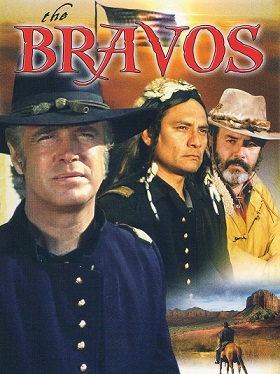
The Bravos (1972, directed by Ted Post)


Major John David Harkness (George Peppard) is the commander of Fort Bravo, a small and ill-equipped frontier fort.  Despite having only 77 soldiers and not many supplies, Harkness has managed to keep an uneasy peace between the local Indian tribes and the settlers who move through the area.  The peace, however, is disturbed when an arrogant wagon master (Pernell Roberts) kills the son of the tribal chief.

That’s not all that Harkness has to worry about.  A German outlaw (Bo Svenson) is hiding out at the camp.  His head scout (L.Q. Jones) suspects that something is forcing the local tribes out of the area.  Two settlers from Missouri (played by Barry Brown and Belinda Montgomery) are at the fort and trying to decide whether they should continue westward or return to Missouri.  Finally, Harkness’s 12 year-old son, Peter (Vincent Van Patten), has been expelled from his New England boarding school and is being sent to Fort Bravo to live with his father.  When Major Harkness refuses to turn the wagon master over to the Indians, they kidnap his son instead.

The Bravos was made for television and originally aired on ABC in 1972.  It was apparently meant to serve as the pilot for a television series, one that would have followed the daily adventures of the Major, his son, and all of the men at Fort Bravo (who were played by television mainstays like Dana Elcar, Randolph Mantooth, and George Murdock.)  For all intents and purposes, Pernell Roberts, Bo Svenson, Belinda Montgomery, and Barry Brown are all “special guest stars” and are meant to serve as examples of the type of television-friendly actors who would visit Fort Bravo on a weekly basis.  That the pilot didn’t lead to a series isn’t surprising.  TV westerns may have dominated the ratings in the 50s and the 60s but they quickly went out of fashion in the 70s as networks realized that they could make more money selling ad space for Norman Lear sitcoms and cop shows.  In the 70s, the people that advertisers were wanting to reach were watching Archie Bunker and Starsky and Hutch, not George Peppard.

Because of its TV origins, The Bravos is a fairly bland western.  It would be a few years before George Peppard would reinvent himself as a grizzled character actor and he’s sincere but fairly dull here.  Pernell Roberts is more effective as the headstrong wagon master and perhaps The Bravos would have worked better if Roberts and Peppard had switched roles.  In the end, the main reason to see the film is for the chance to see L.Q. Jones play a heroic role for once.  A member of Sam Peckinpah’s stock company, Jones brings some authentic grit to his role as the fort’s only scout.  Jones played a lot of villains but I always preferred him as one of the good guys.

The Bravos ends with a few major subplots unresolved.  Maybe they would have been resolved during the show’s first season but it was not to be.

Film Review: Night Gallery (dir by Boris Sagal, Barry Shear, and Steven Spielberg)


Night Gallery was a horror anthology series that aired on NBC in the early 70s.  Each episode featured Rod Serling, of Twilight Zone fame, serving as the curator of a museum where all of the paintings have a somewhat macabre theme.  (One could even say that the museum was a …. wait for it …. night gallery!)  Serling would give each painting a properly pithy introduction and then the audience would see the story behind the artwork.  It was a bit like the Twilight Zone, except the Night Gallery episodes were in color, they were all horror-themed, and, for the most part, they steered away from social commentary.  The series ran from 1970 and 1973 and it still airs in syndication and on some of the retro stations.  (I believe it currently airs on Comet TV.)  Even if it wasn’t as consistently good as Twilight Zone, it’s still a pretty fun little series.

Two Christmases ago, I was gifted  Night Gallery: The Complete Series on DVD.  Though I’ve watched several episodes from the DVD, I recently realized that I have never actually sat down and watched every episode in order.  With the world currently shut down due to the pandemic (a development that, if we’re going to be honest, sounds like something Rod Serling would have used on the Twilight Zone), I figured what better time to watch the entire series then now?

I started out by watching the Night Gallery pilot film.  This originally aired on November 8th, 1969, a full year before Night Gallery became a weekly series.  It features three different stories (all written by Rod Serling) of the macabre.  As with every episode of the subsequent series, each story is introduced by Serling standing in front of a painting.  In the pilot, though, the museum is rather bare and the painting’s are a bit minimalist.  I have to admit that, as a lover of the baroque, I was a bit disappointed in that aspect of the pilot.

But what about the stories themselves?  Read on!
The Cemetery (dir by Boris Sagal)

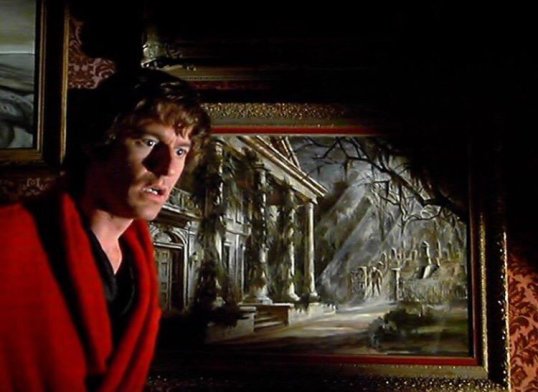
The first story was The Cemetery, a cheerfully gruesome little tale that featured Roddy McDowall and Ossie Davis.  McDowall plays Jeremy, a spoiled young man who murders his uncle so that he might inherit the dead man’s estate.  At first, it looks like McDowall’s plot is a complete success but then McDowall notices a painting of the family graveyard hanging above a staircase.  (To be honest, it seems odd to hang a painting of a graveyard in the foyer but I guess that’s something old rich people do.)  The painting keeps changing.  One minute, the painting looks normal.  The next minute, it features a newly dug grave.  And then something emerging grave.  And then something heading towards the house….

Is Jeremy losing his mind or is the painting warning him that his uncle has risen from the dead and is seeking revenge!?  You’ll probably be able to guess the answer long before poor Jeremy but no matter.  This is a fun little horror story and it benefits from two enjoyably arch performances, from McDowall and, in the role of a butler who may have an agenda of his own, Ossie Davis.

Eyes (dir by Steven Spielberg)

Of the three stories presented in the pilot, Eyes probably gets the most attention from critics because it not only stars Joan Crawford in one of her final performances but it was the professional directorial debut (if you don’t count Amblin’) of 22 year-old Steven Spielberg.  Spielberg apparently had some issues dealing with the veteran crew members, many of whom didn’t like the idea of taking orders from a 22 year-old.  (It probably didn’t help that pictures from that era suggest that Spielberg looked several years younger than his age.  Let’s just say that it’s easy to understand why he eventually grew that beard.)  I’d like to think that Joan Crawford yelled at everyone and defended Spielberg and maybe even Rod Serling came down with Luca Brasi and said, “You’re going to the give this kid the respect he deserves or your brains are going to be all over that union contract.”  I don’t know if that’s true but it’s a nice thought.

That said, Eyes is pretty good.  Even if the crew doubted him, Spielberg proved himself as a director with this story.  It’s about a hateful and selfish woman (Joan Crawford) who happens to be both rich and blind.  She has manipulated a doctor into performing an experimental operation that will allow her to see.  The only catch is that the operation will only be good for 22 hours and a donor (Tom Bosley, as a bookie who is in trouble with the mob) will be required to give up his eyes so that Crawford can have those 22 hours.

On the one hand, this is very-much a Rod Serling-type tale.  It’s easy to imagine Eyes, with its belief in karma and its final macabre twist, as a Twilight Zone episode.  At the same time, Spielberg very much brings his own signature style to the film, livening up dialogue-heavy scenes with interesting camera angles and getting good performances from Crawford, Barry Sullivan, and Tom Bosley.  Eyes is a clever story but, for modern viewers, the most interesting thing about it will be discovering that, even at the age of 22, Spielberg already had a clear directorial style.
The Escape Route (dir by Barry Shear)

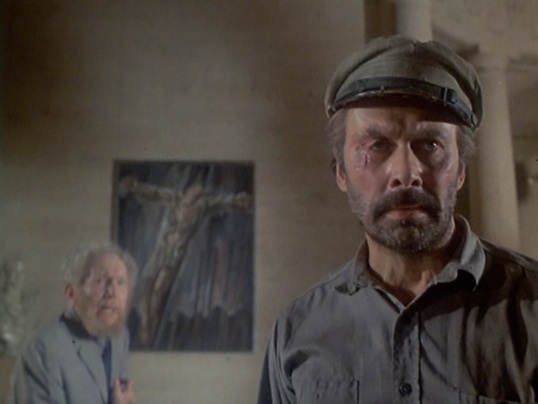
The Escape Route is about an Nazi war criminal named Joseph Strobe (played by Richard Kiley) who is hiding out in South America and spending all of his time nervously looking over his shoulder.  One day, he enters a museum where he finds himself drawn to two paintings.  One painting features a man who has been crucified in a concentration camp, which we learn was Strobe’s trademark back when he, himself, was a camp commandant.  The other painting features a fisherman in a peaceful setting.  Even though Strobe imagines himself as the peaceful fisherman, his attention keeps getting redirected to the painting of the concentration camp.  Soon, Strobe realizes that a survivor of the camp (played by Sam Jaffe) is also in the museum and that he is studying the painting as well.

Compared to Eyes and especially The Cemetery, The Escape Route may seem like a rather low-key story but it has a power that sneaks up on you.  Hiding out (as many real-life Nazi war criminals did) in South America, Strobe is full of excuses for his past and he may indeed be sincere in his wish that he had just become a fisherman as opposed to a brutal Nazi.  But, in the end, Strobe can neither escape his past nor his final punishment.  Justice cannot be escaped, no matter how hard Strobe tries to outrun it.  In the end, there is no escape for the wicked.  Richard Kiley and Sam Jaffe both give excellent performances.  The Escape Route will stick with you.

As a series, Night Gallery was a bit uneven but the pilot stands as a classic of its type, featuring three short films that all deserve to be remembered.

As for me, I’m going to try to watch an episode or two a day.  I may review a few more Night Gallery episodes here on the Shattered Lens.  As I said, the series itself was a bit uneven and not every episode is as good as the pilot.  Still, there’s definitely some gems to be found in the Night Gallery and I’ll share them as I come across them.

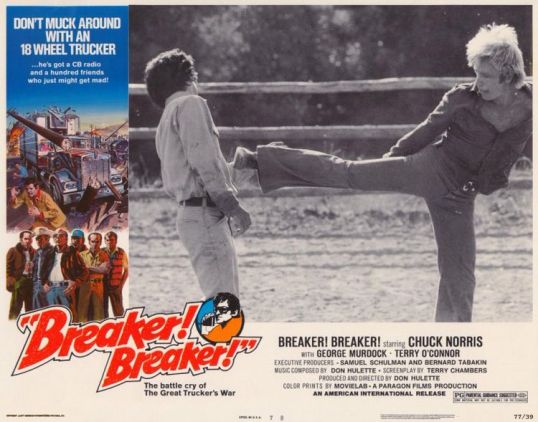
A Movie A Day #18: Breaker! Breaker! (1977, directed by Don Hulette)


breaker-breaker-lobby-card-2

Somewhere, in Southern California, there’s a small town called Texas City.  Texas City is run by a corrupt judge (George Murdock) and a sadistic cop (Don Gentry).  The residents of Texas City make their money by arresting truckers, forcing them to pay huge fines, and selling their rigs to the savage yard.  But they made a mistake when they arrested a trucker named Billy Dawes (Michael Augensten).  Billy has an older brother who is also a trucker.  His name is J.D. and he’s Chuck Norris!

After appearing as an “honorable” villain in Bruce Lee’s The Way of the Dragon and providing martial arts training to the Hollywood elite, Chuck Norris made his starring debut in Breaker!  Breaker!  This is one of those weird only in the 70s hybrid movies.  Mix in a little Deliverance, add a little Smokey and the Bandit, and then toss in Chuck Norris doing a roundhouse kick.  Shake it up and you get Breaker!  Breaker!

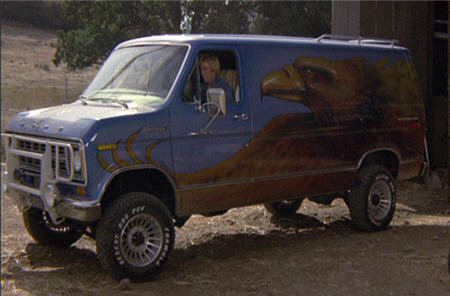
The main problem with Breaker!  Breaker! is that it does not really know what to do with Chuck Norris.  While he’s stil a step above someone like Steven Seagal, Chuck has never exactly been a great actor but, in Breaker!  Breaker!, his inexperience in front of the camera is especially noticeable.  Chuck is at his best when he’s fighting but he spends too much of Breaker!  Breaker! sitting behind the wheel of either his truck or his super groovy 70s van (check out the eagle painted on the side) and doing CB radio patter.  When he does fight, his opponents are all rednecks who, unlike Bruce Lee in Way of the Dragon, don’t stand a chance against him.

norris-van

I did like the movie’s ending, in which an army of big rigs descend on Texas City.  Don’t mess with truckers!

Two final notes: Breaker! Breaker! was edited by Steven Zaillian, who 16 years later, would win an Oscar for writing Schindler’s List.  Also, keep an eye out for Eraserhead himself, Jack Nance, as one of J.D.’s friends.

jack-nance

Horror On TV: Twilight Zone 3.33 — “The Dummy”


TheTwilightZoneLogo

In this episode of The Twilight Zone (which was originally aired on May 4th, 1962), a neurotic ventriloquist named Jerry (Cliff Robertson) has a bizarre relationship with his dummy. Not only does Jerry seem to hate his inanimate partner but the dummy doesn’t seem to be too fond of Jerry either.

You’ll probably already figured out The Dummy‘s twist but it’s still extremely well-done, featuring a great performance from Cliff Robertson and expressionistic direction from Abner Biberman.