Horror On The Lens: The Invasion of Carol Enders (dir by Dan Curtis)


In 1973’s The Invasion of Carol Enders (Meredith Baxter) is attacked while walking in the park with her boyfriend (Christopher Connelly) and strikes her head.  At the same time, Diana Bernard (Sally Kemp) crashes her car while driving home in the rain.  Both women end up at the hospital at the same time.  Both die but Carol is brought back to life.  Except now, there’s someone else in Carol’s head….

This is a bit of an odd made-for-TV movie, even by the standards of the 70s.  It’s only 69 minutes long and it was shot on video tape, giving the whole thing the look of an old daytime drama.  It’s easy to watch this movie and imagine that it’s just a supernaturally-tinged episode of General Hospital or Days Of Our Lives.  Both the acting and the plot add to the daytime drama feel of the production.  This is a movie that fully embraces the melodrama.

I think the most interesting thing about this film is that everyone is very quick to accept that Diana has somehow willed her spirit into Carol’s body.  There’s very little hesitation about accepting Diana/Carol at her word and no one even thinks to suggest that maybe Carol is having some sort of mental episode as a result of the attack.  Adam hears that his girlfriend has been possessed and he immediately gets to work helping out the woman who has possessed her.  I mean, good for Adam.  I like a man who is willing to do whatever has to be done.  Still, everyone acts as if possession happens every day.

This is kind of a silly movie, which is probably why I enjoyed it.  It’s short, it’s simple, and it embraces the melodrama.  What’s not to enjoy?

Horror Film Review: The Norliss Tapes (dir by Dan Curtis)


1973’s The Norliss Tapes begins with a disappearance.

David Norliss (Roy Thinnes), a California-based journalist, has vanished.  Before he disappeared, he had started work on a book that would have detailed his own adventures investigating the paranormal.  Though Norliss vanishes, he leaves behind several audiotapes in which he discusses some of the frightening things that he has seen.  Searching for clue about Norliss’s disappearance, his editor, Sanford T. Evans (Don Porter), sits down and listens to the tapes.

(Incidentally, Sanford T. Evans is a wonderful name for an editor.  It’s a name that just says, “My father knew Hemingway and I went to the University of Pennsylvania as a legacy.’)

As Evans listens to each tape, we watch the story unfold from Norliss’s point of view.  In this film, we watch as Norliss investigates an incident in which Ellen Sterns Cort (Angie Dickinson) claims that she was recently attacked by her dead husband, James Cort (Nicki Dimitri).  James was an artist who, in his final days, became obsessed with the occult and fell under the influence of the Mademoiselle Jeckiel (Vonetta McGee), a mysterious woman who claimed to appreciate James’s art and who gave him a scarab ring that he insisted on being buried with.

Norliss interviews Ellen and investigates her story.  He’s far more sympathetic to the idea of James having returned from the dead than the local sheriff (Claude Akins) is.  Of course, the sheriff has problems of his own.  Dead bodies keep turning up in his county, their skin gray and their bodies drained of blood.  Hmmm …. I wonder if that could have anything to do with James Cort and his scarab ring….

The Norliss Tapes is a pretty simple film.  Norliss shows up and then basically waits around until James Cort makes an appearance.  The film only runs 72 minutes and it’s very much a pilot for a television series that never went into production,  Apparently, each episode would have featured Stanford listening to a different tape and hearing about David Norliss and a weekly guest star dealing with some sort of supernatural occurrence.  Director Dan Curtis was also responsible for the cult television series, Kolchak: The Night Stalker, and The Norliss Tapes feels very much like a dry run for that show.  The main difference is that Roy Thinnes’s David Norliss is nowhere near as nervous as Darren McGavin’s Carl Kolchak.

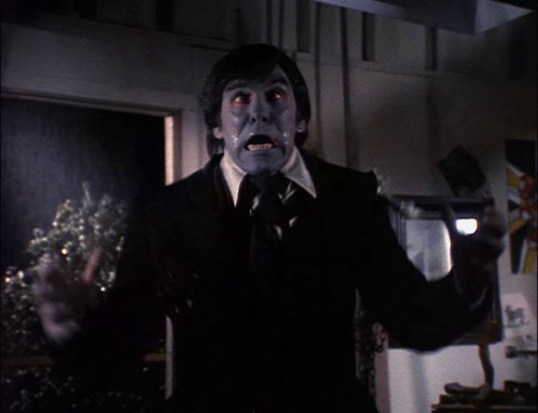
That said, the exact details for what’s going on with James Cort are almost ludicrously complicated.  It turns out that James Cort is not only trying to cheat death but he’s also helping an ancient Egyptian deity invade our world.  It’s best to ignore the nonsense about the Egyptian Gods and instead just focus on how creepy the undead James Cort is.  With his hulking frame, his gray skin, and his nearly glowing eyes, Cort is a truly frightening monster and he’s certainly the most impressive thing about this movie.  What makes Cort such an effective villain is how angry he seems to be.  Whenever he’s on screen, he’s either bursting through a door or chasing someone.  He’s pure nightmare fuel.

The Norliss Tapes never became a series but it did do well in Europe, where it was released in theaters.  The Norliss Tapes still has a cult following, not bad for a failed pilot.  Who knows what other adventures David Norliss could have had?

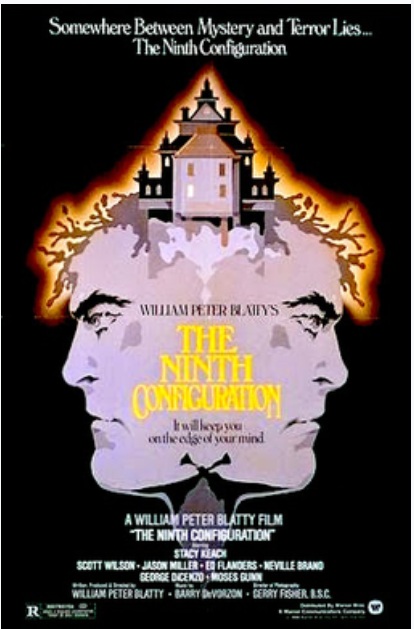
The Unnominated #20: The Ninth Configuration (dir by William Peter Blatty)


Though the Academy of Motion Picture Arts and Sciences claim that the Oscars honor the best of the year, we all know that there are always worthy films and performances that end up getting overlooked.  Sometimes, it’s because the competition too fierce.  Sometimes, it’s because the film itself was too controversial.  Often, it’s just a case of a film’s quality not being fully recognized until years after its initial released.  This series of reviews takes a look at the films and performances that should have been nominated but were, for whatever reason, overlooked.  These are the Unnominated.

Some films defy easy description and that’s certainly the case with 1980’s The Ninth Configuration.

The film opens with a shot of a castle sitting atop of a fog-shrouded mountain.  A voice over tells us that, in the early 70s, the castle was used by the U.S. government to house military personnel who were suffering from mental illness.  Inside the castle, the patients appear to be left to their own devices.  Lt. Reno (Jason Miller) is trying to teach dog how to perform Shakespeare.  Astronaut Billy Cutshaw (Scott Wilson) is haunted by the thought of being alone in space and refuses to reveal why he, at the last minute, refused to go to the moon.  The men are watched over by weary and somewhat sinister-look guards, who are played by actors like Joe Spinell and Neville Brand.

Colonel Kane (Stacy Keach) shows up as the new commandant of the the castle.  From the first minute that we see Kane, we get the feeling that there might be something off about him.  Though he says that his main concern is to help the patients, the man himself seems to be holding back secrets of his own.  With the help of Colonel Fell (Ed Flanders, giving an excellent performance), Kane gets to know the patients and the guards.  (Despite the objections of the guards, Kane says that his office must always be unlocked and open to anyone who want to see him.)  He takes a special interest in Cutsaw and the two frequently debate the existence of God.  The formerly religious Cutshaw believes the universe is empty and that leaving Earth means being alone.  Kane disagrees and promises that, should he die, he will send proof of the afterlife.  At night, though, Kane is haunted by dreams of a soldier who went on a murderous rampage in Vietnam.

The film start out as a broad comedy, with Keach’s smoldering intensity being matched with things like Jason Miller trying to get the dogs to perform Hamlet.  As things progress, the film becomes a seriously and thoughtful meditation on belief and faith, with characters like Kane, Billy, and Colonel Fell revealing themselves to be quite different from who the viewer originally assumed them to be.  By the time Kane and Cutshaw meet a group of villainous bikers (including Richard Lynch), the film becomes a horror film as we learn what one character is truly capable of doing.  The film then ends with a simple and emotional scene, one that is so well-done that it’ll bring tears to the eyes of those who are willing to stick with the entire movie.

Considering all of the tonal shifts, it’s not surprising that the Hollywood studios didn’t know what to make of The Ninth Configuration.  The film was written and directed by William Peter Blatty, the man who wrote the novel and the script for The Exorcist.  (The Ninth Configuration was itself based on a novel that Blatty wrote before The Exorcist.)  By most reports, the studio execs to whom Blatty pitched the project were hoping for another work of shocking horror.  Instead, what they got was an enigmatic meditation on belief and redemption.  The Ninth Configuration had the same themes as The Exorcist but it dealt with them far differently.  (Because he wrote genre fiction, it’s often overlooked that Blatty was one of the best Catholic writers of his time.)  In the end, Blatty ended up funding and producing the film himself.  That allowed him complete creative control and it also allowed him to make a truly unique and thought-provoking film.

The Ninth Configuration was probably too weird for the Academy.  Though it received some Golden Globe nomination, The Ninth Configuration was ignored by the Oscars.  Admittedly, 1980 was a strong year and it’s hard to really look at the films that were nominated for Best Picture and say, “That one should be dropped.”  Still, one can very much argue that both Blatty’s script and the atmospheric cinematography were unfairly snubbed.  As well, it’s a shame that there was no room for either Stacy Keach or Scott Wilson amongst the acting nominee.  Keach, to date, has never received an Oscar nomination.  Scott Wilson died in 2018, beloved from film lovers but never nominated by the Academy.  Both of them give career-best performances in The Ninth Configuration and it’s a shame that there apparently wasn’t any room to honor either one of them.

The Ninth Configuration is not a film for everyone but, if you have the patience, it’s an unforgettable viewing experience.

Previous Entries In The Unnominated:

  1. Auto Focus 
  2. Star 80
  3. Monty Python and The Holy Grail
  4. Johnny Got His Gun
  5. Saint Jack
  6. Office Space
  7. Play Misty For Me
  8. The Long Riders
  9. Mean Streets
  10. The Long Goodbye
  11. The General
  12. Tombstone
  13. Heat
  14. Kansas City Bomber
  15. Touch of Evil
  16. The Mortal Storm
  17. Honky Tonk Man
  18. Two-Lane Blacktop
  19. The Terminator

Horror Film Review: The Invasion of Carol Enders (dir by Dan Curtis)


The Invasion of Carol Enders….

AGCK!  That’s a scary title that just brings to mind all sorts of disturbing images.  And this 1973 made-for-television film does get off to a rather disturbing start, with Carol Enders (Meredith Baxter) and her boyfriend, Adam Reston (Christopher Connelly), getting attacked in the park by a random criminal.  Carol falls and strikes her head.  She is rushed to the hospital in a coma and is not expected to survive.

Meanwhile, Diana Bernard (Sally Kemp) has an argument with her former lover (John Karlen) and then goes for a drive in the rain.  When the car crashes, Diana is rushed to the same hospital as Carol.  Ironically, it’s the same hospital where her husband, Peter (Charles Aidman), works.  Like Carol, Diana is not expected to survive.

Diana and Carol both appear to die at the same time.  Except Carol doesn’t actually die.  Instead, she has a miraculous recovery.  She comes out of her coma and she is remarkably articulate for someone who has just suffered serious brain damage.  However, there is one problem.  Carol swears that she’s never seen Adam before, that she’s married to Peter, and that her name is Diana!

That’s the invasion of Carol Enders.  When Diana died, her spirit moved into Carol’s body and took control.  Diana is convinced that her car accident was not actually an accident.  She thinks that she was set up by her ex and she sets out to try to prove that the accident was actually attempted murder.  (Actually, it’s only attempted from Diana’s point of view.  As far as the rest of the world is concerned, Diana is dead.)  While Adam tries to help Diana solve her murder out of a hope that she’ll go away and allow Carol to once again be in control of her own body, Diana runs off to her husband.  However, it turns out that there’s a lot more going on than even Diana realizes.

This is a bit of an odd made-for-TV movie, even by the standards of the 70s.  It’s only 69 minutes long and it was shot on video tape, giving the whole thing the look of an old daytime drama.  It’s easy to watch this movie and imagine that it’s just a supernaturally-tinged episode of General Hospital or Days Of Our Lives.  Both the acting and the plot add to the daytime drama feel of the production.  This is a movie that fully embraces the melodrama.

I think the most interesting thing about this film is that everyone is very quick to accept that Diana has somehow willed her spirit into Carol’s body.  There’s very little hesitation about accepting Diana/Carol at her word and no one even thinks to suggest that maybe Carol is having some sort of mental episode as a result of the attack.  Adam hears that his girlfriend has been possessed and he immediately gets to work helping out the woman who has possessed her.  I mean, good for Adam.  I like a man who is willing to do whatever has to be done.  Still, everyone acts as if possession happens every day.

This is kind of a silly movie, which is probably why I enjoyed it.  It’s short, it’s simple, and it embraces the melodrama.  What’s not to enjoy?

Horror on the Lens: The Norliss Tapes (dir by Dan Curtis)


The Norliss Tapes (1973, dir by Dan Curtis)

Today’s Horror on the Lens is The Norliss Tapes, a 1973 made-for-TV movie that was also a pilot for a television series that, unfortunately, was never put into production.

Reporter David Norliss (Roy Thinnes) has disappeared.  His friend and publisher, Stanford Evans (Don Porter), listens to the tapes that Norliss recorded before vanishing. (Stanford Evans, it must be said, is a great name for an editor.)  Each tape details yet another paranormal investigation.  (Presumably, had the series been picked up, each tape would have been a different episode.)  The first tape tells how Norliss investigated the mysterious death of an artist who apparently returned from the grave.

For a made-for-TV movie, The Norliss Tapes is pretty good.  It’s full of atmosphere and features a genuinely menaching yellow-eyed zombie monster. The film was directed by Dan Curtis, who was responsible for several made-for-TV horror films and who also created the deathless TV show, Dark Shadows. Curtis also directed a few feature films. Burnt Offerings, for instance, will be forever beloved for its scene of annoying little Lee Montgomery getting crushed by a chimney. If you ever get a chance to listen to the director’s commentary that Dan Curtis recorded for the Burnt Offerings DVD release, you must do so. Curtis comes across as the crankiest man on the planet and it’s actually kind of fascinating to listen to. His irritation when Karen Black keeps asking him if he knows the name of the actor who played the ghostly chauffeur is truly an amazing thing to here. (For the record, the actor’s name was Anthony James, he also had important supporting roles in two best picture winners — In The Heat of the Night and Unforgiven — and yes, he was one of the best things about Burnt Offerings. Karen Black knew what she was talking about.)

But back to The Norliss Tapes!

Admittedly, this is not the first Halloween in which I’ve shared The Norliss Tapes with our readers. Back in both 2015 and 2021, The Norliss Tapes was one of our “horrors on the lens.” Unfortunately, there’s only so many good quality, public domain horror films available on YouTube so, occasionally, a movie is going to show up more than once over the years. But, as long as it’s good film, who cares?

Enjoy The Norliss Tapes!

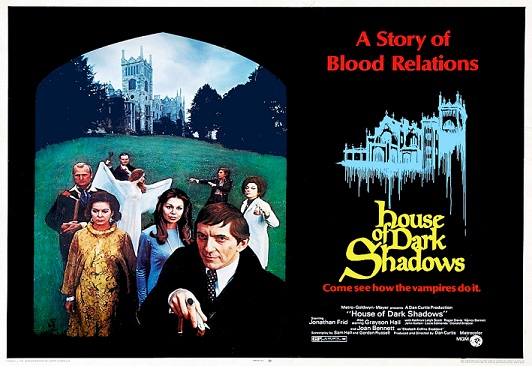
Horror Film Review: House of Dark Shadows (dir by Dan Curtis)


There’s a lot that you can say about this vampire film from 1970 but I think it can all be summed up with one word: relentless.

A lot of this is because House of Dark Shadows is a film adaptation of a daytime drama.  Over the course of six sesons, Dark Shadows ran for a total of 1,220 episodes.  That’s a lot of story to cram into a 97-minute film but director Dan Curtis does just that.  The end result is an incredibly busy film and I mean that in the best way possible.

Seriously, there are so many twists and turns in this film’s plot that it’s difficult to even know where to begin.  This is one of the most incident-filled horror films that I’ve ever seen.  No sooner does one plotline resolve itself than another begins.  Meanwhile, a surprisingly large cast wanders through the shadows and tries not to get transformed into a vampire.  Most of them do not succeed.

See if you can keep all of this straight:

In Maine, a lowlife handyman named Willie (John Karlen, giving the film’s best performance) breaks into a mausoleum and approaches a coffin that’s covered with chains.  Willie thinks that there’s a treasure hidden in the coffin but, after he removes the chains, he instead discovers that he’s stumbled across the home of a vampire!  Barnabas Collin (Jonathan Frid, who perfectly combines old world manners with thinly veiled menace) has spent 175 years trapped in that coffin and now that he’s been released, he’s not in a very good mood.

Soon, Barnabas has introduced himself to his descendants (including Joan Bennett, as Elizabeth, the family matriarch) as a cousin from England.  Everyone is impressed with Barnabas’s charm and courtly style.  Of course, some people are a little bit skeptical.  Prof. Stokes (Thayer David) notices that Barnabas doesn’t seem to know much about London while Dr. Hoffman (Grayson Hall) flat out accuses Barnabas of being a vampire.  Barnabas admits that this is true but fear not!  Dr. Hoffman’s fallen in love with him and wants to help cure him.

Meanwhile, everyone in town is growing concerned about all of the bloodless bodies that are showing up.  They especially get worried after Elizabeth’s daughter, Carolyn (Nancy Barrett), dies and then promptly comes back to life, complete with her own set of fangs….

While the town concerns itself with what to do about Carolyn, Barnabas has fallen in love with a nanny named Maggie (Kathryn Leigh Scott), who he thinks is the reincarnation of his former lover.  Unfortunately, Maggie already has a boyfriend named Jeff (Roger Davis) but when has the ever been a problem for a vampire?  Far more of a problem than Jeff is the fact that Willie is also in love with Maggie and Dr. Hoffman is so jealous of Barnabas’s love for Maggie that she’s willing to inject him with a formula that causes him to transform into an elderly man….

And all that’s just in the first hour!

Needless to say, it all leads to one final, gore-filled confrontation.  When I say that this film is gory, I mean just that.  Blood isn’t just spilled in House of Dark Shadows.  Instead, it flows like water busting out of a cracked dam.  When Barnabas bites a victim, he doesn’t just leave two neat little puncture marks.  Instead, he literally rips their neck to shreds.  Just how savage Barnabas and Carolyn get in this film is one of the things that sets House of Dark Shadows apart from other vampire films.  As opposed to the type of tragic figure who shows up in so many vampire films, Barnabas is ruthless, cruel, and unforgiving.  He’s a genuinely frightening creation.

House of Dark Shadows is a chaotic movie but it’s also a lot of fun.  This is one of those films that you watch in amazement as it just keeps going and going, piling on one incident after another.  Does the film always make sense?  No, but it doesn’t have to.  Quickly paced and featuring nonstop gore and fog, the film has a dream-like feel to it.  Curtis and the cast attack the material with such unbridled enthusiasm that it doesn’t matter if the plot occasionally doesn’t always add up or if the dialogue is occasionally a bit clumsy.  It’s impossible not to get swept along with the film’s insanity.

Probably because of its television roots, House of Dark Shadows is often dismissed by critics.  (I’ve never seen any old episodes of the show so I can’t say how the movie compares to it.)  Well, those dismissive critics are wrong.  House of Dark Shadows is one of my favorite vampire films and it’s definitely one that deserves to be rediscovered.

(And yes, it’s a helluva lot better than that movie that Tim Burton made with Johnny Depp….)

Horror on the Lens: The Norliss Tapes (dir by Dan Curtis)


The Norliss Tapes (1973, dir by Dan Curtis)

Today’s Horror on the Lens is The Norliss Tapes, a 1973 made-for-TV movie that was also a pilot for a television series that, unfortunately, was never put into production.

Reporter David Norliss (Roy Thinnes) has disappeared.  His friend and publisher, Stanford Evans (Don Porter), listens to the tapes that Norliss recorded before vanishing. (Stanford Evans, it must be said, is a great name for an editor.)  Each tape details yet another paranormal investigation.  (Presumably, had the series been picked up, each tape would have been a different episode.)  The first tape tells how Norliss investigated the mysterious death of an artist who apparently returned from the grave.

For a made-for-TV movie, The Norliss Tapes is pretty good.  It’s full of atmosphere and features a genuinely menaching yellow-eyed zombie monster. The film was directed by Dan Curtis, who was responsible for several made-for-TV horror films and who also created the deathless TV show, Dark Shadows. Curtis also directed a few feature films. Burnt Offerings, for instance, will be forever beloved for its scene of annoying little Lee Montgomery getting crushed by a chimney. If you ever get a chance to listen to the director’s commentary that Dan Curtis recorded for the Burnt Offerings DVD release, you must do so. Curtis comes across as the crankiest man on the planet and it’s actually kind of fascinating to listen to. His irritation when Karen Black keeps asking him if he knows the name of the actor who played the ghostly chauffeur is truly an amazing thing to here. (For the record, the actor’s name was Anthony James, he also had important supporting roles in two best picture winners — In The Heat of the Night and Unforgiven — and yes, he was one of the best things about Burnt Offerings. Karen Black knew what she was talking about.)

But back to The Norliss Tapes!

Admittedly, this is not the first Halloween in which I’ve shared The Norliss Tapes with our readers. Back in 2015, The Norliss Tapes was one of our “horrors on the lens.” Unfortunately, there’s only so many good quality, public domain horror films available on YouTube so, occasionally, a movie is going to show up more than once over the years. But, as long as it’s good film, who cares?

Enjoy The Norliss Tapes!

Playing Catch Up: First Daughter, Ice Girls, Raising The Bar, Walk Like A Man


So, this year I am making a sincere effort to review every film that I see.  I know I say that every year but this time, I really mean it.  Unfortunately, over the past two weeks, real life has interfered with my movie reviewing, if not my move watching.

So, in an effort to catch up, here are four quick reviews of some of the movies that I watched over the past two weeks!

  • First Daughter
  • Released: 2004
  • Directed by Forest Whitaker
  • Starring Katie Holmes, Marc Blucas, Amerie, Michael Keaton, Margaret Colin, Lela Rochon

Michael Keaton as the President of the United States!?  Now, that’s a great idea.  Michael Keaton plays President Mackenzie.  First Daughter was made long before Birdman so Michael Keaton doesn’t really have a huge part but, whenever he does appear, he is totally believable as a world leader.  You buy the idea that this guy could win an election and that he’d probably be a good (if not necessarily a great) President.  Someone really needs to make another movie where Michael Keaton plays the President.  Maybe President Birdman.  Just don’t give it to Inarritu to direct because he’ll make it too political…

Anyway, the majority of the film is about Katie Holmes as the President’s daughter, Samantha.  Samantha has been accepted to a college in California.  She’s excited because it means that she’ll finally be able to have a life outside of the White House.  The President is concerned because he loves his daughter and he knows that, if she makes any mistakes in California, his political opponents will try to use her against him.  Samantha goes off to college and tries to have a good (but rather chaste) time.  Making that somewhat difficult is her secret service entourage.  Fortunately, Samantha meets a guy (Marc Blucas) who loves her for who she is and not because her father is the President.

It’s all pretty silly and shallow but I have to admit that I get nostalgic whenever I see this movie.  Much like From Justin To Kelly, it’s definitely a film from a more innocent and less angry time.  To date, it’s also the last film to be directed by actor Forest Whitaker.
  • Ice Girls
  • Released in 2016
  • Directed by Damian Lee
  • Starring Michaela du Toit, Lara Daans, Arcadia Kendal, Sheila McCarthy, Taylor Hunsley, Shane Harte, Elvis Stojko

Struggling financially, Kelly (Lara Daans) is forced to move back to her hometown and move in with her sister (Sheila McCarthy).  Until she got married and gave up that part of her life, Kelly was once an up-and-coming figure skater.  Fortunately, her daughter, Mattie (Michaela du Toit), has inherited her mother’s talent.  However, a serious injury shook Mattie’s confidence.  Now, she says she doesn’t want to skate anymore.  Still, she’s willing to accept a job from Mercury (Elvis Stojko) at the local rink and it’s not too long before, under Mercury’s guidance, Mattie is skating once again.  Mattie also befriends another skater, Heather (Taylor Hunsley).  Heather happens to be the daughter of Rose (Natasha Henstridge), who was once in love with Kelly’s father…

It sounds like the set-up of a melodramatic Lifetime movie but actually, Ice Girls is a sweet-natured film about two ice skaters, one who has a mother who is too protective and the other who has a mother who is too driven.  In the end, both of them end up skating for themselves and not their mothers and that’s a good message for the film’s target audience of young skate fans.  The majority of the cast is made up of actual ice skaters, so the skating footage is pretty impressive.  It’s a predictable movie but I enjoyed it when I watched it on Netflix.

  • Raising the Bar
  • Released in 2016
  • Directed by Clay Glen
  • Starring Kelli Berglund, Lili Karamalikis, Tess Fowler, Emily Morris, Peta Shannon

I also watched this one on Netflix, a day after I watched Ice Girls.  (I was in an Olympics sort of mood, even though neither film took place at the Olympics.)  Raising the Bar feels a lot like Ice Girls, except that the ice skaters were now gymnasts and instead of relocating to Toronto, the family in Raising the Bar relocates all the way to Australia.  Once in Australia, Kelly (Kelly Johnson) finds the courage to re-enter gymnastics and ends up competing against her former teammates.

Kelly Johnson gives a good performance in the lead role.  Though it may be predictable, Raising the Bar is an effective and sweet-natured family film.  Perhaps the most interesting thing about watching the film was that I quickly found myself rooting against the American team.  Australia all the way!

  • Walk Like A Man
  • Released 1987
  • Directed by Melvin Frank
  • Starring Howie Mandel, Amy Steel, Cloris Leachman, Christopher Lloyd, Colleen Camp, Stephen Elliott, George DiCenzo, John McLiam, Earl Boen

Oh, what sweet Hell is this?

Okay, I’m going to try to explain what happens in this movie.  You’re not going to believe me.  You’re going to think that I’m just making all of this up.  But I swear to a God … this is an actual movie.

When he was a baby, Boba Shand (Howie Mandel) got separated from his family.  His mother and his father assumed that he was gone forever but what they didn’t know was that Bobo was found and raised by a pack of wild dogs.  For twenty years, Bobo lives as a dog.  Then he’s discovered by Penny (Amy Steel), an animal researcher who tries to teach Bobo how to be a human.  However, as time passes, Penny comes to realize that maybe she’s making a mistake trying to change Bobo.  Bobo is innocent and child-like and obsessed with chasing fire engines.  When he has too much to drink, he runs around on all fours.  And … PENNY’S IN LOVE WITH HIM!

Seriously, she’s in love with a man who thinks he’s a dog.

However, Bobo stands to inherit a fortune and his evil brother (Christopher Lloyd) is planning on having him committed.  Penny has to prove that Bobo is human enough to manage his own affairs while also respecting his desire to continue living like a dog.

I’m serious.  This is a real movie.

Anyway, making things even worse is the performance as Howie Mandel.  Mandel has always been a rather needy performer and the role of a man who thinks he’s a dog only serves to bring out his worst instincts.  Remember when Ben Stiller played Simple Jack in Tropical Thunder?  Well, Mandel’s performance is kinda like that only worse.  At one point, Bobo walks up to a mannequin in a mall and says, “I have to go pee pee.  Come with me,” and I nearly threw a shoe at the TV.  Oh my God, it was so bad.

The main problem with Walk Like A Man is that it wants to have it both ways.  It wants to be a wild comedy about Howie Mandel chasing fire engines but it also makes us want to tear up when Penny explains why Bobo should be allowed to live as a dog.

All in all, it’s a really bad movie.  And yes, it does actually exist.
Horror on the Lens: The Norliss Tapes (dir by Dan Curtis)


Today’s Horror on the Lens is The Norliss Tapes, a 1973 made-for-TV movie that was also a pilot for a television series that, unfortunately, was never put into productions.

Reporter David Norliss (Roy Thinnes) has disappeared.  His friend and publisher, Stanford Evans (Don Porter), listens to the tapes that Norliss recorded before vanishing.  Each tape details yet another paranormal investigation.  (Presumably, had the series been picked up, each tape would have been a different episode.)  The first tape tells how Norliss investigated the mysterious death of an artist who apparently returned from the grave.

For a made-for-TV movie, The Norliss Tapes is pretty good.  It’s full of atmosphere and features a genuinely menaching yellow-eyed zombie monster.

Enjoy!

http://www.youtube.com/watch?v=bmET4ypSzFA