Halloween is less than a week away and for the next few days there’ll be more song of the day choices and this time around it will all be centered on horror. To start things off I chose the theme from George A. Romero’s Dawn of the Dead which was composed by the Italian prog-rock band Goblin.
The theme’s titled “L’alba Dei Morti Viventi” and it definitely creates a dissonant tone which just creeps along and makes one feel more than just a bit uncomfortable. Goblin used a lot of their electronic music background to make this such a signature and iconic horror theme. Anyone who has seen the original Dawn of the Dead will automatically recognize this theme and the feeling it brings up. A feeling of dread and of creeping horror which perfectly describes the zombies from Romero’s grand opus.
Horror fans everywhere have Italian horror maestro Dario Argento for having gotten Goblin to create the score for Romero’s film (Argento was one of the key producers for the film and even re-cut it for the European market). Goblin had already worked with Argento on previous films with their best early work with the filmmaker being the score for ProfondoRosso (known as Deep Red in the US and English market). But no matter how many other Italian horror scores the band has made since Dawn of the Dead (and the ones after have been great in their own right) it will be their score for that film which will indelibly link the band in film music history.
PS: as an added bonus below is the band’s theme for Argento’s Profondo Rosso.
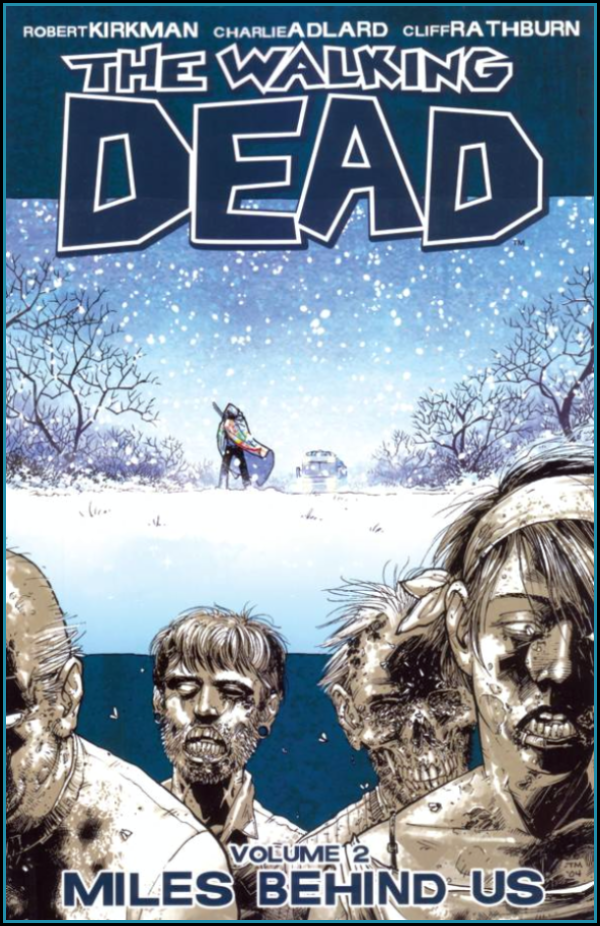
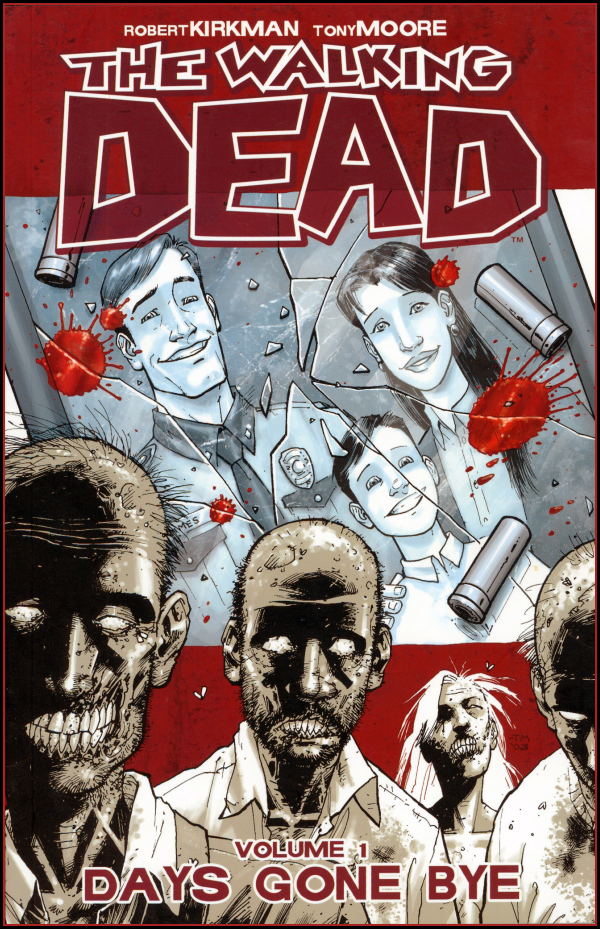
Robert Kirkman’s The Walking Dead Vol.2 – Miles Behind Us puts together issues 7 through 12 into one collection. The first six issues introduce the reader to the main character of Rick Grimes and his discovery of a world turned upside-down and inside-out as the legions of undead walk and prowl the streets, fields and by-ways. The rest of that first volume reunites Rick with his wife and son and a ragtag bunch of other survivors just looking for a safe place to stay. I loved how Kirkman used the backdrop on a world of the undead to tell a story of survival and how extreme situations can have surprising and lasting effects on those left behind.
In Miles Behind Us, Robert Kirkman’s story has a new artist in Charlie Adlard. Adlard’s style has a different look to that of previous artist Tony Moore. Where Moore’s pages and panels had a smoother and more cinematic feel to them, Adlard’s rougher, sketchy style actually fits the mood and feel of the story Kirkman is writing. I love Moore’s work and the gory detail he put in the first issues, but Adlard’s just seems to resonate a bit more with the subject matter of survival and doing what it takes to survive. There’s certain scenes in Miles Behind Us where its hard to tell the difference between the survivors and the zombies. I like this technique in how it shows that the zombies and the survivors may have alot more in common after all in relation to the title of the story.
Kirkman introduces in this volume quite a bit of new characters to the group Rick is leading as they leave the campground at the outskirts of Atlanta. They’ve lost three of their numbers in the previous volume. Two of them to the predations of the undead who stumbled into their campground and another to the stress and jealousy that weighed on the mind of one of their own.
Miles Behind Us brings in two groups of survivors. One is a father, his daughter and the girl’s boyfriend. Tyrese is an interesting character right from the get-go and hints of problems with the daughter and boyfriend are gradually doled out to help bring in new conflicts to the group dynamic. The other group is a farmer and his children and some neighbors from down the road. The introduction of Herschel and his family helps in showing how not everyone reacted the same way to the undead crisis. To say that Herschel’s reaction and temporary solution to how to handle the undead crisis was a bad idea all-around was an understatement. Hershel’s actions helps lead to the biggest sequence event in this volume and how far-reaching its ramifications are. While new characters are introduced some of the people in Rick’s group fall by the wayside as their search for a safe place to stay in becomes more and more dangerous and people are lost and/or nearly lost along the way.
I agree with the assertion that The Walking Dead is really not all about the zombies and the gore (it helps that it has them in abundance), but that its about the effects of extreme events and situations on the personality, psyche and behavior of those left behind trying to survive. From the Dale (the oldest) all the way down to Carl (one of the youngest), the survivors are affected right down to their bones with all that has happened to them. Sometimes the result makes each individual stronger and at times it just leads to conflicts and brings out the baser nature of man as an individual.
Miles Behind Us continued to impress me in how well Kirkman has taken the zombie apocalypse theme and ran with it. It’s a testament to his storytelling and imagination that I consider The Walking Dead series as equal to anything Romero has done. I think from fans of zombie and apocalyptic stories that’s high praise indeed.
One of the geek properties that had been building a major hype and buzz at this year’s San Diego Comic-Con was Image Comics and Robert Kirkman’s long-running and critically-acclaimed zombie series, The Walking Dead. It’s time at the Con didn’t just push the title to a new batch of fans, but also made a major showing at it’s very own panel with the cast and crew of AMC’s tv series adaptation of the comic book. It would be an understatement to say that by the time The Con was over the series (both comic book and the upcoming tv series) walked away a clear winner and put the property into hype/buzz overdrive.
With the series set to premiere on AMC this coming October 2010 I thought it was high-time that I went back to my reviews of the collected trade paperbacks of the series. Each trade paperback collection were 6-issues long and usually started a current story-arc or finished an on-going one. This comic book series is one of the few in the market currently running which could was able to keep releasing its trades in 6-issue collected formats and not lose any impact that particular arc had when read as single-issues. It was by finding the first trade that I was initially introduced to Kirkman’s zombie opus.
It was 2005 and I was what one might call a lapsed comic book fan. I had burned myself out on the neverending flood of superhero titles even as independent ones quickly got cancelled, died out or just outright didn’t end but left its readers hanging. But it took a passing glance of The Walking Dead‘s first trade volume to get my interest in comic books rekindled. Kirkman’s foray into creating the zombie film that never ends made comic books fun for me again. The fact that Kirkman didn’t jump onto the fast-zombie bandwagon that became the rage of the mid-2000’s was a major plus in my eyes.
Using the same slow, shambling zombies that George A. Romero first made popular with Night of the Living Dead and its subsequent sequels, Kirkman continued the zombie story where Romero usually ended his films. All those times people have wondered what happened to those who survived in zombie films need not imagine anymore. Kirkman has created a believable world where the dead have risen to feast on the living, but has concentrated more on the human dynamic of survival in the face of approaching extinction.
I won’t say that the story-arc collected in this first volume has little or no zombies seen, but they’ve taken on more as an apocalyptic prop. One can almost substitute some other type of doom in place of zombies and still get a similar effect (as was done in Brian K Vaughn’s equally great series, Y: The Last Man). What Kirkman has done was show how humanity’s last survivors were now constantly, desperately trying to adapt to a familiar world through unfamiliar circumstances. Characters from the start make the sort of mistakes regular people would make when they don’t know exactly everything that was happening around them. Instead of chiding these people as one reads their story, we sympathize and hope for their continued survival.
The artwork by Tony Moore is another reason why people should check out this first volume. While it is only in this volume (the first 6-issues of the series which is now deep into the 70’s) Tony Moore’s art puts the horrific in the story Kirkman has written. His zombies and their look were quite detailed and for fans of the series his departure after issue 6 and staying to just make the covers to each single-issue has rubbed them the wrong way. While I subscribe to the opposite viewpoint that Moore’s work was a nice bonus to bring in the readers in the end his artwork was gravy to what was already a fulfilling story that would’ve been as effective if the artwork was mediocre at best. It’s a good thing that follow-up and series regular artist Charlie Adlard more than holds his own in drawing the rest of the series.
This first volume was a great beginning which should automatically pull in the hardcore zombie fans (pretty much any of those types should’ve been reading the books for years now) while giving newbie fans to the zombie genre a reason not to dismiss it as just another gorefest lacking in drama and great storytelling. Already Kirkman has done more to realizing the universe Romero created than a lot of the hack filmmakers who have taken Romero’s idea and cannibalized it for their own profit. I consider The Walking Dead as a must-read for anyone looking to find something different from all the costumed superhero titles. It is also a great starting point for those awaiting the start of the tv series, but have never read the original comic book source.
Masters of Horror has been good but very uneven in its execution during it’s two season run on Showtime. Haeckel’s Tale is the last episode for Season One (Takashi Miike’s episode never got an official airing) and it sure ends the season on a disturbingly kinky compilation of twisted grotesqueries. The story is from a Clive Barker short story that’s been adapted by Mick Garris (fellow Masters of Horror director and also its brainchild) and produced by George A. Romero to be directed by John McNaughton.
One wonders why Romero would be producing instead of directing the piece. Scheduling conflicts prohibited Romero from taking the director’s chair and he instead recommended John McNaughton (his one film which earned him Master of Horror status is one of the best horror films of the last quarter century: Henry – Portrait of a Serial Killer). The fact that Romero was originally chosen to direct Barker’s Garris adapted short story means there’s got to be zombies or some form of undead within. I, for one, was glad that Romero decided that he wouldn’t be able to direct and chose another in his stead. Barker’s short story does indeed include zombies but it also has a heavy sense of the old classic technicolor Hammer Films vibe to it. Haeckel’s Tale under the capable hands of McNaughton takes those Hammer Films conventions and ramps it up into overdrive.
Even though John McNaughton really has only one true horror film under his belt (he also directed a little-known cult scifi-horror called The Borrowers which had fledgling effects shop KNB EFX still doing things guerilla-style), but his work in Henry: Portrait of a Serial Killer more than earned him his horror creds. In Haeckel’s Tale, John McNaughton clearly has a bit of fun making the only true period piece in the whole Masters of Horror series. McNaughton goes for the classic Hammer Films look for this episode and it shows in the gothic, fog-shrouded atmosphere in the outdoor scenes. The look of the costumes and even the dialogue harkens back to those Christopher Lee and Peter Cushing Hammer Films.
The story is a mixture of the Frankenstein tale with a some Cemetary Man (aka Dellamorte Dellamore) mixed in. Haeckel’s Tale begins somewhere around the 1800’s and I’m assuming close to the end of it from the costume worn by Steve Bacic who played Mr. Ralston who arrives to seek the help of Miz Carnation who is purported to be a necromancer who can grant him his wish to have his dead wife brought back to life for him. Miz Carnation rebuffs Ralston, but after some begging she makes a deal with him to hear Haeckel’s Tale. If he still wants his wife brought back to life after hearing it then she would do so.
Ernst Haeckel (played by Derek Cecil)is a young medical professor whose obsession to conquer death mirrors that of a certain eccentric European scientist he so admires. Unlike his idol, Haeckel’s attempt to use electricity to put the spark of life back into a corpse fails dramatically. He’s soon investigating the rumor of a certain traveling necromancer who goes by the name of Montesquino (played by Joe Polito) who he thinks to be a fraud, but he soon finds out that Montesquino is all he says he is when Haeckel stumbles upon Wolfram (played by Stargate SG-1‘s own Maybourne, Tom McBeath) and his stunning young wife Elise (the drop-dead gorgeous Leela Savasta).
Haeckel quickly lusts after the young Elise, but as Wolfram will later tell him as the story nears it’s climax (in more ways than one), Elise cannot be satisfied by him or Haeckel. Her obsession with a dead husband she loves and cannot let go brings Haeckel to a scene that he cannot comprehend nor accept as something she truly wants. I must say that Leela Savasta’s performance as the dead-obsessed Elise is only surpassed by Anna Falchi’s own work as “She” in Dellamorte Dellamore. Leela’s pretty much spending most of her screentime fully naked and writhing around in an orgy not typical of most horror movies. It’s also in this orgy scene where we get the biggest Clive Barker feel to the story. Anyone how has read Barker earlier work knows the man can mix horror and sex like no other.
The ending of the episode brings to it a slight twist with Miz Carnation being more than she says she is. This Masters of Horror episode is not the best of the lot, but it is one of the better looking ones in terms of cinematography and it’s leads. It also doesn’t have much in terms of genuine scares. The story gradually builds up the dreads and disturbing images but never anything that will put a genuine heart-stopping scare on the viewer. Like McNaughton’s own foray into horror with Henry, Haeckel’s Tale lets the story’s own disturbing themes on obsession and the darker side of love put the horror in the story. It does have a nice gore-laden sequence courtesy of Howard Berger and Greg Nicotero and their KNB FX team.
In the end, Haeckel’s Tale is a very good episode which has its flaws like the rest of the Masters of Horror episodes. What sets it apart from the rest of the series entries is its unique Hammer Films look and the return of McNaughton back in the director’s chair as a horror filmmaker. It’s no Henry: Portrait of a Serial Killer, but Haeckel’s Tale will have enough disturbing images to burn itself to its audiences’ minds.
I’ve always found the zombie debate amongst horror fans quite interesting as it offers a glimpse at people’s personalities. The debate I’m talking about is which zombies are better and scarier.
There are those who will always choose the zombies that were born out of George A. Romero’s imagination. I’m talking about the recently dead who have been revived to feed on fresh human flesh. These zombies also could be distinguished by their slow-moving nature with speed only a consequence of stumbling forward when prey is near. These are the zombies which made the genre itself so popular and so widely imitated since Romero first introduced them in the 1968 horror classic, Night of the Living Dead. While slow and easily avoided their numbers alone is the danger. The fact that not just those bitten turn into zombies, but anyone who dies whether by natural or unnatural cause makes them scary. This literally means that death itself has died and anyone who dies and not found immediately returns as a threat to the group.
The second type of zombies which have made a major renaissance in the last decade are the running zombies. Running zombies are not really new since Italian horror filmmakers during the 80’s used them frequently and were really made popular by the horror-comedy franchise of Return of the Living Dead their ability to scare lies more towards the fact that they’re fast. They’re not slow-moving and not easily avoided. It’s their very lively movements which puts the scare into people. The one consequence of the running zombies have been those using them to create a cause for the zombie. Whether it’s a biological/viral weapon gone amok or something supernatural (Brian Keene’s zombie novels uses this).
The third type is a combination of the two where the zombies are not slow moving, but can get up to speed when really motivated. These types also have a tendency to have intelligence beyond mere primal. They’ve retained either a modicum of their former brainpower or all of it. Enough so that they can talk, create plans to trap and/or even organize beyond the hive-mentality of the Romero-type. These kind of zombies have been relegated to novels and short stories. While still not prevalent in films they do provide genuine scares due to the fact that intelligence of the surviving humans stop being an advantage when fighting against zombies.
My choice has always been the Romero-type since they remain the most frightening in the most existential way possible. There’s no reason why people should lose to them yet in every film and story using the type these zombies always end up prevailing in the end. The other two I like as well, but bring up too many reasons of why losing to them is a possibility even with the advantages resting mostly on the survivors.
I’m sure this debate will continue to rage amongst horror fans and I’m sure it will get heated at times.
I wasn’t born yet when George A. Romero’s Night of the Living Dead was first released in theaters, but I’ve wished many a night that I was old enough to have seen this classic horror film on the big screen. Night of the Living Dead simply changed the film industry forever and showed that horror was taking an uncharted road toward realism, brutality, and true terror. Before Romero’s film, horror often echoed the classic 1940s Universal style or the technicolor Hammer Films. Night of the Living Dead became the torchbearer of what would soon evolve into the splatter and exploitation films of the following decades. The influence this film has had on horror filmmakers is still ongoing.
Zombie films existed long before Night of the Living Dead, but they mostly depicted the traditional Haitian voodoo variety—with zombies as heavily drugged victims forced into slave labor for merciless masters. Romero changed all that in 1968. Made on a shoestring budget even by the standards of the time, Romero and his friends decided to make their own horror movie. The premise was simple: radiation from a returning Venus probe (though later films in the series abandoned that explanation for something more vague) somehow reanimated the recently deceased—though these zombies only had the most basic motor skills. That alone was terrifying enough. But Romero took it further by giving the zombies a new motivation: an unending hunger for the flesh of the living. With this, Night of the Living Dead marked the birth of horror at its most extreme.
The story was heavily influenced by Richard Matheson’s apocalyptic vampire novel I Am Legend, and Herschel Gordon Lewis’ Blood Freaks and Two Thousand Maniacs. Matheson’s novel contributed the idea of an encroaching horror besieging the survivors, while Lewis’ films provided an unflinching portrayal of exploitative violence and gore. Lewis didn’t shy away from gore, but Romero was the first to put a solid story behind the carnage.
The film opens simply enough, with a brother and sister heading to a rural cemetery to visit their dead mother. Right away, it takes on a disturbing tone, as both siblings come under attack from what seems to be a transient. Barbara, played by Judith O’Dea, flees for her life, with her brother Johnny already down. The tension of the opening sequence still makes my pulse pound every time I watch it. Soon, the story introduces the strongest character: Ben, played by Duane Jones in what became his signature performance. But even as strong-willed and level-headed as Ben is, he shares flaws that lead to critical mistakes later. The rest of the cast follows: Harry Cooper (Karl Hardman), his wife Helen (Marilyn Eastman), their injured daughter Karen (Kyra Schon), and the local couple Tom (Keith Wayne) and Judy (Judith Ridley). As the farmhouse becomes surrounded by a growing horde of undead, attracted by their noise, you’d expect the group to band together to survive the night until help arrives. But instead, misunderstandings and bitterness divide them, escalating into open conflict and self-preservation without concern for others.
The infighting and inability to cooperate is Night of the Living Dead’s strongest message—a bleak reflection of human nature in times of upheaval. The characters are fully realized, complex, and rare for horror films of that era. Their realistic portrayal makes their conflicts hit harder. After watching them fall apart, it’s easy to judge them as foolish, but realistically, many others faced with the same pressure might behave just as destructively. Romero’s harsh commentary on humanity’s failure to unite has led to conflict throughout history, and the film points this out in the bluntest, most brutal way possible.
The horror of Romero’s film is intensified by an economic choice. Color film was available in the 1960s but still expensive; only major studios or wealthy independents could afford it. Romero instead used black and white, helped by his background in documentary filmmaking, which made film stock easier to procure. This gave Night of the Living Dead its signature cinéma vérité look—grainy, raw, and immediate, like 8mm home movies of the era. Combined with Romero’s economical editing and minimalist, bass-heavy soundtrack, the film gains a life of its own. Its creeping dread was so tangible, I’m surprised more viewers didn’t walk out when it first played. The horror lingered long after watching.
There really isn’t much to complain about this film. Horror fans were given a movie that went well beyond exploitation. It also opened the door for a new generation of filmmakers who saw that movies could be more than entertainment—they could express social, political, and economic truths of their era. Night of the Living Dead had it all. It told audiences young and old that the era of silly, fantastical horror was over, and a new wave of realistic horror was about to descend. It didn’t shy away from violence. Flesh was ripped from limbs; intestines and organs were shown being handled and devoured. This “Vietnamization” of film violence launched a new era in what filmmakers could depict. But in 1968, this was the kind of violence usually reserved for drive-in exploitation fare—and initial audiences were unprepared. Not just adults, but 11- and 12-year-olds saw this as part of Saturday morning double features. One moment they were watching Flash Gordon or Buck Rogers, the next they faced flesh-eating ghouls and damning social themes bombarding their minds.
1968 is now seen as a turning point in filmmaking history. Night of the Living Dead influenced not just horror directors but filmmakers in all genres. It’s no surprise the film lives in the Smithsonian National Film Registry as a work that reshaped filmmaking art. Decades later, it still shocks first-time viewers and delights devoted fans. Night of the Living Dead didn’t just usher in a new era of horror and cinema; it announced the arrival of a genuine guerrilla auteur, a master of his craft.
1979 saw the release of a film titled Zombi 2. It was suppose to be an unofficial sequel to Romero’s own Dawn of the Dead which was released in Italy under the title of Zombi. many thought this pseudo-sequel was a way to cash-in on the success of Romero’s film in Italy. This wasn’t true for the fact that it’s director and producers had already been working on their own zombie film as Romero started on Dawn of the Dead. It was by coincidence that both were released within the same year and in order to try and tie the two films together their titles reflected it.
Lucio Fulci’s Zombi 2 (or just plain Zombie in the US) has no connection whatsoever with Romero’s own Dawn of the Dead except for the zombies and the rules governing their destruction. This is not to say that Fulci’s Zombi 2 wasn’t good. In fact, I would say that Zombi 2 was, and still a great horror movie that’s been unfairly compared with Romero’s ultimate zombie classic. The two films tell different type of stories even when sharing similar plot devices and rules. Where Romero used the backdrop of the zombie epidemic as a damning visual commentary on the growing consumerism culture in the United States, Fulci’s film eschews any such social observations and goes for pure horror instead.
Zombi 2 helped begin the Italian cinema’s love of zombie movies and Fulci’s film still stands as the best of the lot. Starring Tisa Farrow as Ann, the daughter of a missing doctor working in the Carribean, and Ian McCulloch as reporter Peter West who helps Ann try to solve the mystery of her father’s disappearance in one of the Carribean Islands. The only clue they have being the mysterious reappearance of a boat belong to Ann’s father. A drifting yacht which, when inspected by NY Harbor Patrol, a disfigured, obese man violently attacks one of the patrolmen before falling overboard into the city harbor. From that moment on, Ann and Peter head off to her father’s last location on the Carribean island of Matool. Once on Matool, Ann and Peter discover that one of her father’s colleagues, a Dr. Manard, has been trying to solve the mysterious disease, or curse as the native islanders call it, which her father became afflicted with. A disease which seem to kill those it infects and then return them to life to attack the living.
These two are soon joined by a vacationing couple who seem to have arrived on Matool at the worst time. Ann and Peter soon enlist the aid of Brian and Susan, but before they could solve the island’s deadly mystery the island’s dead, both past and recent, rise up from their resting place and doom the remaining inhabitants. One sequence involving these zombies has gone down in horror history as one of the most cringe-inducing scenes on film. It involves the torturously slow sequence where a woman’s head is dragged forward toward a door splinter aimed directly at the woman’s eye. This gore-sequence in addition to the scenes of the zombies attacking and feeding on the visiting Westerners and the remaining living islanders were very well done and all due to make-up FX master Giannetto de Rossi. There’s even a spectacular sequence where a zombie tries to attack and feed on a live shark. Even to this day I still marvel at whichever stuntman volunteered for that action shot.
Zombi 2 has been called a dumbed down attempt to capitalize on Dawn of the Dead. I wholeheartedly disagree with this obeservation. Zombi 2 was never meant to be socially relevant, but one whose only goal was the scare, disgust and disturb its audience with scenes of extreme violence and gore. In this respect Fulci succeeded with the final cut of Zombi 2. The acting itself was very well done considering that half the cast spoke in English as their natural language while the other half were saying their lines in Italian. The dubbing of the Italian-spoken lines were done particularly well. A rarity when it comes to dubbed films.
The final few minutes of Zombi 2 where the Matool survivors make it back to New York through its harbor makes for a great ending. With a city radio station recounting the growing zombie crisis which seemed to have begun while Ann and Peter were on Matool, the final shot of zombies walking on the pedestrian level of the Brooklyn Bridge with cars below them seeming to be rushing out of the city to escape the crisis still makes for a haunting scene. Lucio Fulci’s Zombi 2 might not have been the iconic, cultural and societal masterpiece that was Romero’s Dawn of the Dead, but it more than holds its own when seen as a pure horror film.
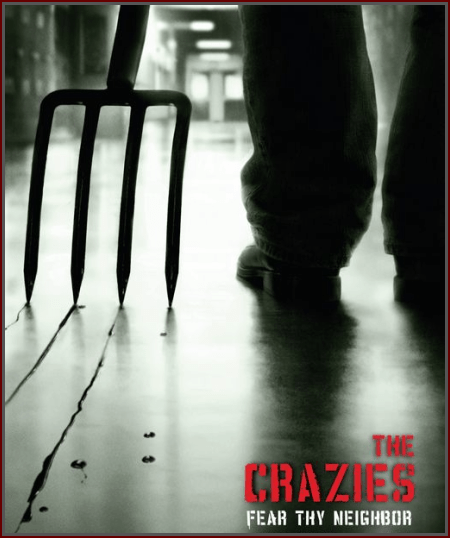
While remakes of older films have a tendency to fail in terms of storytelling and just overall quality, for some reason most remakes of George A. Romero’s films seem to do quite well. The Tom Savini-directed remake of the original Night of the Living Dead wasn’t better than the first but was very entertaining and stood on its own merits. The next Romero film to be remade was another of his horror classics, Dawn of the Dead. Another first time director in Zack Snyder handled this remake (despite howls of protests about the attempt to remake a film many consider one of the greats) and what he ended up making didn’t disappoint and has become of the the last decade’s best horror entries. While the remake of Day of the Dead ended up becoming a huge pile of crap I am happy to say that the remake of Romero’s bio-terror flick, The Crazies, under the directing work of Breck Eisner ended up better than I expected and, in my opinion, surpassed the original.
The film adheres pretty close to the original with just the setting having changed from Evans City, PA to Ogden Marsh, Iowa. Using this Midwest backdrop the film quickly establishes that Ogden Marsh is the prototypical Middle America town with everyone in the town of 1260 knowing everyone. They town even celebrates itself as the friendliest town in America. This all changes when a seemingly random and tragic event at a high school baseball game shatters the thin edifice of the town’s neighborly facade. The town’s sheriff (played by Deadwood’s Timothy Olyphant) knows that something is not right when another inexplicable murder happens the following day. The final clue which reinforces this hunch of his is when a trio of local hunters stumble upon the decomposing body of a pilot who died attempting to parachute and landing in a creek marsh close to town. The plane of the said dead pilot is later found. Not knowing what exactly was being ferried (later discovered to be a bio-weapon code-named “trixie”) on this plane the sheriff and his deputy (played by Joe Anderson) soon find the town’s phone lines, cellphone signal and network connection down.
The middle section of the film happens occur with the arrival of “help” in the form of biohazard-suited soldiers forcibly taking all accounted for townspeople from their homes and herding them in the local high school. It is in this section of the film where the remake deviates somewhat from the original. The story never truly establishes just exactly why the soldiers were using extreme tactics and protocols to contain the town and the surrounding area. The film seem to set the military as a faceless machine doing things by-the-book to the detriment of the town and it’s population. The original had the infected and uninfected civilians trapped between the military apparatus trying to contain the outbreak by any means necessary and the scientists flown in to try and find a cure. Writers Kosar and Wright keeps the film centered on the Sheriff Dutton, his pregnant wife (played by Radha Mitchell), his deputy and the his wife’s assistant.
By keeping the film focused on these four individuals the film loses the epic, grand-scale Romero was trying to do with the original and instead we get a more intimate, personal film about survival in a world that suddenly has gotten apocalyptic overnight for these four. It helped the film and Eisner that his two leads in Olyphant and Mitchell were up to the task of giving their husband and wife characters some gravitas in what could’ve easily been just a paycheck performance for them. Olyphant as Sheriff Dutton was especially good in his performance. He kept his character grounded throughout most of the film. Never did he play his character false in that one-minute we get a confused, desperate husband searching for his wife and then next minute we get a badass action hero who can’t get hurt and always coming up aces. Joe Anderson as Deputy Russell Clank who added just a tad bit of levity to an otherwise very tense film from beginning to end.
The infected townsfolk were not zombies as others might like to say. They have a certain similarity to Danny Boyle’s “Rage-infected” but while those seem to get a boost in strenght and speed in The Crazies those who become infected seem to just go all nutfuck crazy. While physical changes occur the longer a person was infected (veins beame inflamed and show up visibly) the “trixie” bioweapon does to those infected what the title says: crazy. Some behave in a crazy non-violent manner with uncontrollable giggling. Some would start rambling for no apparent reason while others become homicidal. It’s the last example which becomes the film’s second danger to the film’s leads in their attempt to survive the night and find safe haven.
It’s from the viewpoint of these four individuals that the audience experiences the night when Ogden Marsh must survive not just the “crazies” but also the government sent in to “help” contain the situation. As stated earlier this time around we do not know the motivations of those sent in to help. The government and the military force sent in are not just faceless, but mechanical in their handling of the situation. People were gathered en masse from their homes and paraded through a series of checkpoints to be checked, prodded and separated from those infected. We hear random bits and pieces of radio communication amongst the soldiers and the scientists controlling the situation, but not enough to know what their true agendas.
As the film progresses the danger posed by the “crazies” themselves seem to pale in comparison when we finally see the final solution the military and the government has come to in dealing with the outbreak. An outbreak caused by an accident and one which happens to occur near this small Iowa town. Just like in Boyle’s own 28 Days Later the solution which the military has come up with to deal with both infected and uninfected ends up being the craziest and horrific action by any and all in the film. There’s a sense of detached horror in how the government decided to truly contain the trixie outbreak.
The film was by no means a great one, but director Breck Eisner does a good job of keeping the film moving forward at a brisk pace right from the start then turning things up the farther in the film we get. By the time The Crazies hit the midway point the film the pacing has gone from brisk to unrelenting. There’s barely a chance for the audience to take a breather from the tension and terror before another one comes along. The decision by the filmmakers to just show the film from the point of view of the sheriff, his wife, the deputy and the assistant keeps some of the moral questions brought up by Romero in the original. Just like with Snyder’s remake of Dawn of the Dead, Eisner goes for the easier route and concentrates on making a thriller instead of trying to push complex social and moral commentaries. While this might disappoint some fans of the original in the end it makes the film more accessible for the wider audience.
In the hands of a more capable filmmaker and writers would this compromise to simplify the film have been avoided. Sure it could’ve but for what Eisner and company ended up creating was still quite engaging and entertaining. In the end, The Crazies was a remake of a horror master’s earlier film that more than hold it’s own against the original and actually surpasses it despite a storyline which had been simplified. It’s not one of the best films in the early part of 2010, but it definitely wasn’t the trainwreck may think horror remakes always end up being.
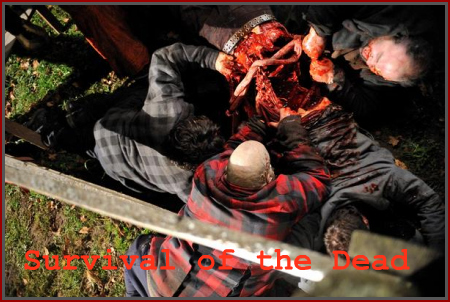
The sixth living dead film from George A. Romero, Survival of the Dead, has finally been giving it’s release dates from it’s distributor Magnet Releasing (a genre-specific arm of Magnolia Pictures). This will come as great news for all manner of Romero fans who are always looking forward to one of his zombie films. While not all of them have been great as in the past they’re still widely-anticipated by his long-time fans who see him as the creator of the zombie subgenre as we know of it today.
First reported by Fangoria through it’s new blog, Romero’s latest zombie offering will have an initial release this April on VOD (Video On Demand) before getting released in the theaters the following month of May. While these release dates seem a tad peculiar it’s really the beginning of a trend for indepedently-financed and produced horror and genre films. The initial VOD release date would help gauge the audience’s reaction to the film. IF the buy in numbers for VOD are high enough then the theatrical release will get more screens. This way films can better make their money back without the distributor having to cut the film at the knees just because of bad reviews from the theatrical run. Either way I’m just glad the master is back and this spring I get to see another of his zombie films either on my HDTV or a theater nearby.





 Through the Shattered Lens