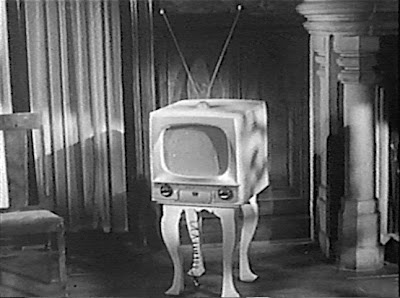
On tonight’s episode of Hammer House of Horror, a family picks up a hitchhiker. A subsequent tragedy leaves a wife wondering if her husband is actually her husband. This is a creepy and twisty episode that is guaranteed to inspire just a little paranoia.
This episode originally aired on November 29th, 1980.
The 1965 biblical epic, The Greatest Story Ever Told, tells the story of the life of Jesus, from the Nativity to the Ascension. It’s probably the most complete telling of the story that you’ll ever find. It’s hard to think of a single details that’s left out and, as a result, the film has a four hour running time. Whether you’re a believer or not, that’s a really long time to watch a reverent film that doesn’t even feature the campy excesses of something like The Ten Commandments.
(There’s actually several different version of The Greatest Story Ever Told floating around. There’s a version that’s a little over two hours. There’s a version that’s close to four hours. Reportedly, the uncut version of the film ran for four hour and 20 minutes.)
Max von Sydow plays Jesus. On the one hand, that seems like that should work because Max von Sydow was a great actor who gave off an otherworldly air. On the other hand, it totally doesn’t work because von Sydow gives an oddly detached performance. The Greatest Story Ever Told was von Sydow’s first American film and, at no point, does he seem particularly happy about being involved with it. von Sydow is a very cerebral and rather reserved Jesus, one who makes his points without a hint of passion or charisma. When he’s being friendly, he offers up a half-smile. When he has to rebuke his disciples for their doubt, he sounds more annoyed than anything else. He’s Jesus if Jesus was a community college philosophy professor.
The rest of the huge cast is populated with familiar faces. The Greatest Story Ever Told takes the all-star approach to heart and, as a result, even the minor roles are played by actors who will be familiar to anyone who has spent more than a few hours watching TCM. Many of them are on screen for only a few seconds, which makes their presence all the more distracting. Sidney Poitier shows up as Simon of Cyrene. Pat Boone is an angel. Roddy McDowall is Matthew and Sal Mineo is Uriah and John Wayne shows up as a centurion and delivers his one line in his trademark drawl.
A few of the actors do manage to stand out and make a good impression. Telly Savalas is a credible Pilate, playing him as being neither smug nor overly sympathetic but instead as a bureaucrat who can’t understand why he’s being forced to deal with all of this. Charlton Heston has just the right intensity for the role of John the Baptist while Jose Ferrer is properly sleazy as Herod. In the role Judas, David McCallum looks at the world through suspicious eyes and does little to disguise his irritation with the rest of the world. The Greatest Story Ever Told does not sentimentalize Judas or his role in Jesus’s arrest. For the most part, he’s just a jerk. Finally, it’s not exactly surprising when Donald Pleasence shows up as Satan but Pleasence still gives a properly evil performance, giving all of his lines a mocking and often sarcastic bite.
The Greatest Story Ever Told was directed by George Stevens, a legitimately great director who struggles to maintain any sort of narrative momentum in this film. Watching The Greatest Story Ever Told, it occurred to me that the best biblical films are the ones like Ben-Hur and The Robe, which both largely keep Jesus off-screen and instead focus on how his life and teachings and the reports of his resurrection effected other people. Stevens approaches the film’s subject with such reverence that the film becomes boring and that’s something that should never happen when you’re making a film set in Judea during the Roman era.
I do have to admit that, despite all of my criticism of the film, I do actually kind of like The Greatest Story Ever Told. It’s just such a big production that it’s hard not to be a little awed by it all. That huge cast may be distracting but it’s still a little bit fun to sit there and go, “There’s Shelley Winters! There’s John Wayne! There’s Robert Blake and Martin Landau!” That said, as far as biblical films are concerned, you’re still better off sticking with Jesus Christ Superstar.
While I have been buying and collecting dvds for some ten years now (collection around 2500-3000 titles) I have seen those purchases dwindle and wane to almost just a few a year now. I blame the convenience of Netflix and my resurgence in gaming with my Xbox 360 as the main cause for my slacking off in the dvd collecting. While I still see myself collecting dvds and, most likely, moving onto blue-rays, I have seen why people love their Netflix accounts so much. Last night I was able to combine my love for my Netflix and my Xbox 360 and feed my need to always be watching a film. Using Netflix Instant I was able to watch streaming over my Xbox 360 one of the classic fantasy films ever made.
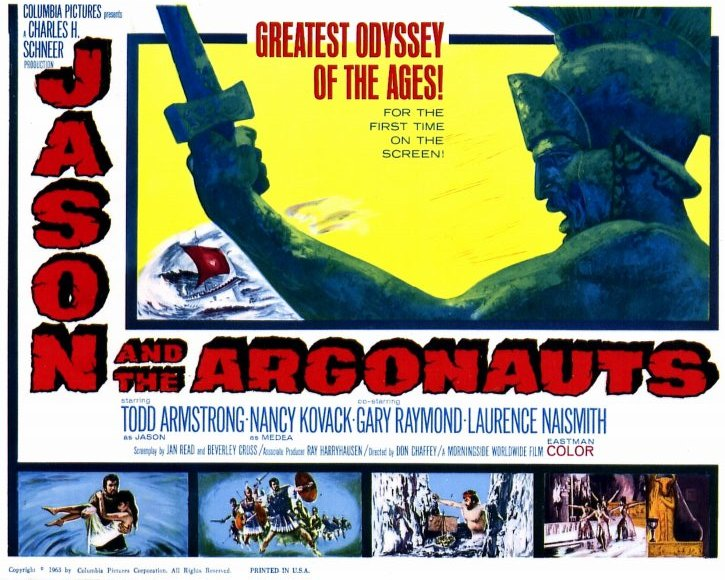
The film I speak of is the 1963 classic fantasy meets Greek mythology simply called Jason and the Argonauts. It is one of those films which has stood the test of time. I know of no film lover who hasn’t seen this at least once. It’s beloved and admired by millions of people of different generations for its simplicity and for the work of one man whose name overshadows everyone on the film from the director to the actors. This was the film which established for eternity the genius and imaginative creative of special effects guru Ray Harryhausen.
Jason and the Argonauts takes one of the more popular Greek myths about a son looking to re-take his father’s kingdom from a usurper but in the process goes through a journey that pits him against monsters, betrayers and the Gods themselves. The titular character and his crew must travel to the fabled island of Colchis at the edge of the world to find the legendary Golden Fleece purported to have magical properties of healing and even to grant peace throughout the land. I say that’s a piece of item worth fighting off a giant bronze warrior statue, screeching harpies, tempermental seaside cliffs and up to a many-headed hydra and skeleton warriors spawned from it’s teeth.
The acting is typical of most fantasy films of the 60’s and that’s they’re all bombastic, full of vigor and turns even the most simple dialogue into pronouncements of epic deeds to be done. Todd Armstrong leads a cast of British actors including such luminaries of their era like Nigel Green, Nancy Kovack, Honor Blackman and Douglas Wilmer. While the acting may seem quaint by today’s standards I still believe it’s what gives the film it’s timeless energy and quality. It makes the film flow like an epic poem that gave birth to it’s source material to begin with.
But what really makes this film stand out years after years and decade after decade since it’s release is the stop-motion animation effects created by the king of stop-motion effects himself, Ray Harryhausen. To say that the quieter moments where characters interact with each other almost feel like fillers to move the story along until it reaches one of several action sequences featuring Harryhausen’s work. It doesn’t diminish the work done by the actors or the efficient direction by filmmaker Don Chaffey. It just means that Harryhausen’s stop-motion work were so impressive that the audience just wants to see what new magic he has up next.
The climactic fight between Jason and his men versus skeleton warriors born from the teeth of a slain hydra (a stop-motion sequence which was in itself quite impressive) still goes down as one of the most impressive feats of filmmaking married with special effects today. There’s something to be admired about a four and a half minute action sequence where Harryhausen spent 4 months of meticulous frame-by-frame work to make the skeletal opponents come to life. There’s a reason why so many special effects magicians since then have pointed to this scene as one of their favorites and one reason why they got into the FX work to begin with.
Jason and the Argonauts may not have the technical wizardry of today’s fantasy epics and films with their million-dollar budgets spent on CGI-effects. It may not have the seriousness that today’s fantasy films have taken to heart (losing some of the fun, innocence of what makes fantasy films so great). What it does have is great storytelling which harkens back to a more innocent, hopeful and simple time. It also has the finest work of one of film history’s master magicians in Ray Harryhausen and that, in the end, is what makes this film of the the greatest of its kind and one every kid should be introduced to.

 Through the Shattered Lens