Video Game Review: Borderlands 2 (by Gearbox Software / 2K Games)


2K Games and Gearbox Software have finally unleashed the sequel to it’s successful IP, Borderlands on game consoles, and wow, it’s wonderful to return to this universe. Some of my friends on Xbox Live introduced me to the original game and we had quite a bit of fun making our way through it. It was easy to have the sequel on our must play lists.

Here’s what you need to know about Borderlands. The game exists within a barren wasteland known as Pandora. In this place, we have The Vault. If found and opened, it will yield an unimaginable treasure, and as a result, Vault Hunters come from far and wide to seek it out. Along the way, you end meeting some strange characters and fighting against weirder ones. What set Borderlands apart was that it was something of a shooter / Role Playing Game and that it also contained a massive amount of weaponry. Working off of an XP system, you can upgrade your character by killing any enemies you find on the landscape, which is normal for any RPG, but the amount of different weapons in the game was massive.

It was rare to run into the same gun twice.

Borderlands 2 basically picks up where the last game left off in terms of development. Gearbox has introduced four new types of characters to work with, new landscapes and guns. Since the graphics engine is more akin to games like XIII and maybe even The Legend of Zelda: The Wind Waker, the game moves very fast and there’s little lag online when playing with 3 other players in a Co-Op battle.

The guns in the game all have attributes of their own, such a reload factors, damage strength and scope strength (if they have them). Some guns can be used as grenades when they use up a clip. Others have Elemental qualities (which I love), in that they can set enemies on fire, shock them with lightning or shoot corrosive acid. As you level up in the game, so the available weapons, so you’ll find yourself selling or discarding the ones you’ve carried along for more powerful upgrades – unless of course you happen to own one revolver or two that you just can’t part with. Trust me, that happens.

The four characters in Borderlands 2 are the Siren (my personal favorite), who has a focus on Elemental Ability and healing factors on the battlefield. The Gunzerker is pure brute force, can duel wield weapons and can beat an animal senseless with his melee tactics. The Commando can send out a sentry turret as a backup in battle. The Assassin, new to Borderlands, has tactics similar to Ghost Recon: Future Soldier, where he can blend in with the background and send out a decoy to confuse the enemy. His sword allows for massive melee damage when he’s out of ammo.

The skill tree system in Borderlands 2 has been upgraded from the first game as well. There are upgrade paths for every character with a limited amount of points to use, which help ensure that once you fully fill a skill tree – say one that allows you to cause elemental damage to everyone in the environment when using a Siren’s Phaselock ability – you’ll want to play the game over again to work on another path. It helps to shape just how you want your character to go, and is really fun when working in a team environment. One character can focus on healing the team, while another can be pure attack. If you have communication between your players, there’s no limit to how well you can do in a battle.

If Borderlands has any limitations, it’s that you can’t benefit from having your Single Player character work in a Co-Op environment. For example, if you have a level 20 Gunzerker, he can jump into a friend’s game who is only at the start and be a major effect on the battlefield, but it gives that high level character next to nothing in XP as they’re only fighting characters that are far weaker than them. Additionally, the high level character won’t benefit from any of the missions in the game (after all, they’ve already gone through them in their own game) In a way, it’s very smart, because it helps newer players level up, but the best way to go through a Co-Op game is to start from the very beginning together. This way, you all can level up around the same time and move forward as a group.

Overall, Borderlands 2 is a fantastic game to play if you have a team to work with, moves very quick and has no shortage of ammo or enemies to blast away to your heart’s content.

Faster Than Light


Entirely by accident, I discovered a game called Faster Than Light (FTL) while I was making my weekly perusal through the library over at Great Old Games. Because I like spaceships and bright shiny stars, I was instantly intrigued. Without really taking the time to learn a whole lot about the game, I went ahead and made the purchase. At $9, I didn’t feel like I had to get much return on my investment. After having sunk roughly a billion hours into FTL since that purchase, I’ve subsequently learned that FTL was funded by Kickstarter (another rousing success story! Go Kickstarter!), is actually new, despite having been on Great Old Games, and there was some buzz before it came out that I literally can’t believe that I didn’t hear even a single whisper about. I guess I haven’t been reading enough blogs after all.

My embarrassment over this game being news to me is a side issue, however. I have played Faster Than Light. Extensively. Allow me to tell you how it is, so you can decide whether that daunting $9 price point is worth it for you.

It’s great! Go buy it!

Well, alright. Let’s start with the premise. FTL is a Roguelike that stars you as the commander of a lone Federation starship with vital intelligence on the Rebel armada which you need to hustle across seemingly the entire galaxy to return to the last Federation fleet before they’re stomped by the aforementioned Rebels. Going against space type, we’re not rooting for the Rebels this time, as they are brutal, corrupt, jerks. On your journey, your ship will pick up space scrap which is used as currency. You need as much of this currency as possible in order to upgrade your single cruiser’s capabilities (the possibilities for this are extensive, including eight main ship systems, three subsystems, up to four weapon slots and three drone slots, three ‘augmentation’ slots for special systems, and your crew itself which starts small but can be expanded and include powerful alien species. So yeah.) You will need to upgrade your systems if you want to survive the long trek to the Federation fleet, and even more so if you intend to successfully defeat the final boss located there.

Your advance across the galaxy is star by star across multiple ‘sectors’ of space, with the Rebel armada in pursuit all the while, seeking to bring you down before you can bring your vital information to the Federation. Each star contains a random event, which can range from absolutely nothing, to running laser gun battles in asteroid fields, nebulae, or near stars that are experiencing solar flares. Suffice to say, given the random generation and the large range of customization options, no trek across the stars is ever exactly the same. Add in the fact that the game ultimately features about twenty unique ships each with its own unique interior layout and a unique starting loadout (some of which are much stronger than others) and you have a game that you can sink a great deal of time into.

The primary things that you, as a player, will need to do include managing your crew (crew members can be assigned to ‘man’ your ship systems. They can also be moved around to repair damaged systems, fight shipboard fires, repair hull breaches, board enemy craft, or repel boarders against your own), battling enemy ships with your craft’s weapons, drones, and boarding parties, and purchasing new upgrades and equipment to create a load-out that you feel like can go the distance. Finding combinations of weapons and special systems that work well for you is a big part of the game, and the only way that you will ultimately be able to experience any success against the final boss – an extremely difficult encounter, particularly if you are not prepared for it.

The downside for some players will be the difficulty. Faster Than Light is not an easy game. Not by a long shot. For those unfamiliar with Roguelikes, runs of horrific luck leading to catastrophe and death are incorporated by design. It is not a “problem” with the game that you might encounter a series of random events with no way out that lead to your ship exploding in the very first sector, or right before your confrontation with the boss. Death is deadly. There aren’t save points, folks, you’re back to the start if you go down in flames. This is, again, by design. It is not a “problem”, but it could be a reason why you would prefer not to play the game. So if the difficulty thing doesn’t appeal to you – and I didn’t even mention a learning curve that’s somewhat difficult to quantify – Faster Than Light may not be entirely to your liking. Of course, you may end up addicted anyway, and end up on a spiral of increasing frustration. I don’t personally recommend that path, but it’s your mouse to break, as they say.

The graphics “look like a flash game” as I’ve been told, which I suppose is true enough, but the game has spot-on sound effects and an excellent environmental music score that provides exactly the right touch of ambiance while you play. I found the graphics adequate, if nothing to rave about, and there’s something charming about the presentation, which is reminiscent of older video games and tugs at my nostalgia strings in a way that I find appealing. I definitely find myself recommending the game, even freely acknowledging that it may not be for everyone. After all, what game is?

For those who are interested, you can acquire FTL off of its official website or on Steam. You can also purchase the DRM-free version on GOG, but this version is only available for Windows platforms. Regardless, of where you get it, the game will be $9 until the sale price ends, after which it will price out at a whopping $10. So, act now, or whatever.

What I Played Today: Mass Effect 3: Leviathan!


Technically, I played it yesterday.

So, remember how everyone hated the ending to that highly anticipated, trilogy-culminating, pre-order bonanza of a FPS RPG called Mass Effect 3? I do. Later, when Bioware got around to releasing an expanded and updated ending, it seems like only about half of the original ME3 crowd came back to see it. Part of it might have just been exhaustion over the whole ME3 ending saga – it was mostly fatigue that kept me from running to my XBox to plunge into the depths of the new ending. I suspect others are sticking to their guns; they heard that the “new” ending isn’t really new at all, just an expansion on existing events and themes. So they’re not interested. The Indoctrination crowd didn’t find much to love in the new ending, so diehards of that theory or whatever… probably didn’t need to rush back to see things unfold.

Others I suspect are in a third camp. They want an excuse to play the game again, but they don’t really feel like doing Chronos Station and Earth. At least, not as a standalone. It’s not like those missions were some glowing paragon of what ME3 could be. All of the heavy stuff happens earlier, and Earth doesn’t have the fun factor that the final assault on the Collector Base did. It’s kind of a long slog, when you get right down to it. In fact, the whole game is pretty heavy, and I’m not sure it bears back-to-back play-throughs with as much grace as the previous installments did. I, at least, noted Mass Effect lover and apologist, have completed Mass Effect and Mass Effect 2 probably a dozen times each. I have completed Mass Effect 3 once. Just once. I continued to play the multiplayer occasionally, keep that readiness nice and blue, and waited patiently for a time when I would feel the urge to play the game once again.

It turns out that the urge returned when BioWare finally dropped their first single player content DLC: Leviathan.

Leviathan starts with the story of a man named Dr. Bryson, a scientist on the Citadel who is investigating celestial phenomenae. Specifically, he is rooting around through old monster legends and other such seeming nonsense for any kind of clues that might have survived from a previous cycle about the Reapers. In the course of this research he discovered something that is – potentially – even more interesting… an artifact that is linked to a space monster they’ve dubbed ‘Leviathan’. A creature so powerful that it was capable of downing a Reaper in single combat. Something that seems impossible. But, Bryson does have this weird glowy artifact, and he seems pretty sure… and, since we’re completely desperate for even the tiniest possible edges at this point in our seemingly unwinnable battle against extermination… I eventually acceded that it was probably worth tracking down Bryson’s assistant, who went to an asteroid mining facility in order to follow up on a possible second artifact. Needless to say, hilarity ensues, and Shepard embarks on several missions, broken up by return visits to the lab for analysis, before the climactic scene on an eerie ocean planet about which the less I say, the better.

In terms of DLC, Leviathan is no Lair of the Shadow Broker. While it does appreciably expand on some story elements of Mass Effect 3 (specifically, you gain some fun information about the Reapers. This DLC answered one of my most irritatingly nagging questions about the background of the Reapers. Fun!) and it provides a handful of fun missions – the ocean planet, it’s worth stating, is a gorgeous backdrop for the mission that takes place there – it lacks the character driven tension of Lair. I would put it more on par with the “Arrival” DLC for ME2. You don’t have much reason to get invested in the new characters you meet, and so they feel disposable in a way the core cast never would have. That having been said, I don’t know how many of you returned to ME2 to complete Arrival, but I felt it was a well-spent $10, and I feel the same way about Leviathan. It has a good atmosphere, a couple of cool weapons and new modifications for your gun toting pleasure, and a very impactful revelation at the end.

Incidentally, if you have any interest in ME3 single player DLC at all, there’s extra incentive to acquire Leviathan. Fan interest has seemed much less driven for ME3 DLC than in previous titles… presumably because the ending to the game is as final as it is. Shepard’s story can’t continue, it can only expand.

On the Rain-Slick Precipice of Gaming!


Unfortunately, this particular editorial can’t pass without some background information being passed around first. The story is a sad one at times, but I think you’ll find the resolution as satisfying as I have! Do let me know!

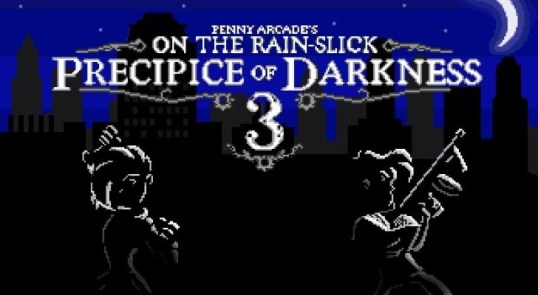
Some of you may have heard of the popular webcomic Penny Arcade. A much smaller chunk of you are probably familiar with the two games that Penny Arcade released in the year 2008, parts one and two of On the Rain-Slick Precipice of Darkness… a story which blended Penny Arcade’s unique style of humour and its unique visual style with a modern RPG engine to create a new gaming experience. Most of you who bought the first two games are further familiar with the catastrophic announcement in 2010 that Hothead Games was going to proceed with the Deathspank franchise over producing the third title in the Penny Arcade series… and that… the Penny Arcade series was cancelled.

Ouch.

Double ouch to people who really enjoyed the first two titles, and were looking forward to the conclusion of the story of Tycho Brahe and Jonathan Gabriel.

But then in 2011, a ray of hope emerged. Zeboyd Games, producers of such titles as Breath of Death VII: The Beginning and Cthulu Saves the World, had signed on to the project. In development? Rain-Slick 3. Only now, instead of using Penny Arcade’s comic book visual style and a more modern RPG engine, we were going to experience a fully pixelated 16-bit treatment of the story and the world, and it was to be released in a more Indie fashion.

Fine by me!

Now, in mid-2012… the new game is here. I have played it. And I would like to tell you all about it.

Rain-Slick 3 continues the story immediately after it left off at the end of Rain-Slick 2. Our heroes Tycho Brahe and Jonathan Gabriel, of the Startling Developments Detective Agency, have slain two Gods, and by a prophecy spoken by Tycho’s own father, this has brought the world to the brink of oblivion. Unfortunately, it seems, we must balance that against the fact that the ongoing presence of these ancient Gods has infused a great amount of evil into the world, from wicked hobos and rampaging mimes to the occurrence of ghosts, ghouls, and other supernatural critters. Railing against this destiny, Tycho and Gabe enlist the help of a head in a jar and a mysterious woman detective who shares a past connection with Tycho, in an effort to halt the ongoing conflict before it spirals out of control.

The gameplay is pure 16-bit RPG. Characters use a job system which is not unlike a pared-down version of that used in any Final Fantasy game, with jobs having certain special abilities gained as they level up. However, Rain-Slick wants to be fun for the player, and actually doesn’t allow you to grind (enemy groups disappear when defeated, and do not return!), so un-used jobs level up concurrently with those currently equipped, albeit at a slower rate, and your characters can equip multiple jobs with no penalty. Combining a useful suite of skills can create truly devastating fighters, so there is definitely a strategic aspect to how you equip your jobs, and how you choose equipment which can either cover weaknesses or heavily accent strengths. It gives a decent feel of customisation to the player, which is otherwise somewhat lacking as the player’s own avatar is absent from the game’s cast of characters (although referenced several times as having participated in previous events) and the game plays like a traditional RPG – there are no Mass Effect style conversation wheels to be found here.

The game’s charm is in its simplicity, and its storytelling. Although the story is predictably broken up by long chunks of combat-heavy dungeon, it remains infused with the humour and ability of the guys from Penny Arcade – not insubstantial! – and hints of that artwork style, used for character portraits and enemy models. Of particular amusement value are the names of enemies, always accompanied by a short description, which really rekindle the feel of the first two games. Zeboyd has done a marvelous job in continuing the saga, even though the game plays absolutely differently from the original two titles.

If you still have any interest in this series, I highly encourage a purchase! Rain-Slick 3 is available on Xbox Live Marketplace or Steam, or through the Penny Arcade store. The official site also notes that it should become available for iOS and Android in the future, and Penny Arcade notes the possibility of free updates to expand upon the core game. For a pittance of $5, this game is likely to do nothing but impress you from start to finish.

The Magic of Duels of the Planeswalkers


A couple of years back I was bored one afternoon and browsing the XBox Live Marketplace. I didn’t have any real expectation of finding a game that would get me through the afternoon, let alone something that would have real staying power for me, and I would revisit time and again. When I saw that there was a Magic the Gathering game, it was suspicions that became aroused, not interest. Out of a kind of morbid curiosity I selected the game and read a little more into it, saw that a couple of my friends had played it, and that it seemed to be a self-contained engine of a game, and not simply another attempt to sell me Magic the Gathering Online in a repackaged form (don’t get me wrong, I don’t have anything against MTG:O. In fact, it’s a clever idea to reach people who either don’t have an active local Magic scene, or hate their local Magic scene, but if I had money to waste on Magic, I personally would do it at my local comic store).

But, oddly, the complaint that I keep hearing from people about Duels of the Planeswalkers (aside from some more quantitative complaints, which I’ll get into) is that it’s a self-contained thing, not a beautifully rendered amalgamation of all Magic ever.

…Well, duh.

You may bring whatever expectations you wish into your gaming experiences, but I find it’s better to try and keep things a little bit in perspective. For a $10 XBox Live Arcade title – a game that by definition is not a full retail game – you are expecting a full pool of Type II cards, a fully operational deck builder, and carte blanche to build as many decks as you like and play them against other humans? How much money does that privilege cost in real life? If some quickly-researched netdecking can be believed, a couple hundred bucks will buy you a top end deck in the current meta (and someone bought those cards at $4 for each randomized pack or whatever at retail, let’s not forget). Let’s say each ranked DCI event costs another $7 as an entry fee. So for one singular deck, you must expend hundreds of dollars, and much of that income reaches Wizards of the Coast. Then, if you wish to change decks, you’re likely to need more cards. Wizards will release new expansions, and you will need still more cards. All of this generates revenue for the company that is printing the game (and all of the creative people behind its design, etc.) and you honestly approach Duels of the Planeswalkers with the expectation that it’s going to just replace the CCG model forever?

Come on.

So now that that soap box moment is out of the way, let’s talk about the game. 2013 is the latest upgrade to the now-yearly franchise. Much like regular Magic’s Type II environment, DotP can be seen as a sealed ‘block’ of decks of cards, and it evolves year by year. The game-play improvements in 2013, then, are very slight, since the game of Magic hasn’t changed much. The most meaningful one is the long-awaited ability to manually select your own lands to tap for Mana instead of letting the CPU select them for you (the CPU attempts to do this intelligently, but unfortunately, the CPU has no idea what it’s doing). The main difference is, therefore, the entirely new pool of decks that players can customize and compete with. The game launched with 10 available decks which come with a basic pool of 35 cards (plus the necessary land to make the deck function of course) and an additional 30 unlockable cards. The cards are unlocked – unfortunately – one by one, by winning duels, or if you’re lucky enough to be playing the console versions, by the purchase of Deck Keys (those cost about $1 of your real money each) which completely unlock the deck in question. This represents a large increase in possible customization over the selection offered by 2012.

The decks themselves are primarily monochrome, which is a shame. I understand that Wizards probably sees DotP as a tool to draw people into the world of Magic: The Gathering either on or off line, hoping to gain more lifetime players who are eager to experience the full game. However, many players do want to enjoy DotP as a game in its own right, and while monochrome decks are easier to play and make a decent introduction, the truth is that the Magic decks you’re going to see even at a local Friday Night Magic tournament are going to include a lot of paired colours for a simple reason – each colour is deliberately designed with shortcomings. Black has access to many easy fire-and-forget creature destruction spells and no enchantment removal at all. White has only a tiny splash of creature removal (and each of their ‘removal’ cards has a drawback printed on the card!) but many good cards for destroying enchantments or artifacts. If you combine the two, you can have both of those strengths, and cover for the weaknesses, at the expense of a deck that can be less reliable (since you must now possess two different colour resources) and harder to play. The trade-off is almost always worth it.

Hopefully DLC (it’s already in the works, of course!) will expand a little bit on this, and throw in some more two-colour decks (and a few fewer absolutely atrocious 3-colour decks. Please?).

As for the Planechase mode, I haven’t got much to say. I’ve never liked Planechase because it can really take a long time to play a single game of it, so I’ve avoided testing it extensively. I can say that it works just like I remember it working in real life, and it can definitely be fun if you have the patience to stick with it. The unpredictable and powerful effects of the different twisting Planes can really throw a traditional match-up on its head. Combined with the inevitable chaos of FFA multiplayer, and you definitely have a format with legs – no two games of Planechase will ever be exactly the same.

I suggest that you think of Duels as a Magic format much like Captains or, frankly, Type II… and enjoy it for what it is; a closed Magic experience that doesn’t cost you a lot of cash out of pocket to play. The added levels of customization (regrettably, still not the ability to pick how many lands your deck has in it. Grrr!) make the environment more varied than ever (mind you, I did not suggest the environment was balanced. It’s much too early to speak on that) so it’s definitely a game that’s got some depth if you’re willing to take the time to learn the format and delve into its own quirks and strategies.

The game reportedly suffers from numerous bugs. I have not encountered any that are more severe than the ‘mild annoyance’ variety, but I suspect there are uglier ones to be found in those innumerable lines of code somewhere. I wish I could say this was uncommon for releases in 2012, but I try to remain honest when I write these columns.

So there it is. I find Duels to be a fantastic addition to my summer, and I’m more excited than ever to waste countless hours trying to determine the best combination of 60 cards in the fixed pool that makes up my blue deck that will best let me control the decks I’ve seen people playing this week. Oh, and if you pick it up, do try it out with a friend in Two-Headed Giant at least once. It’s riotously fun.

Mass Effect 3


I finished Mass Effect 3! The first video game I’ve ever finished! … Or, at least, for a long time.

Shall we talk about it?

Mass Effect 3 is (ostensibly, we know how sequels work these days) the conclusion to the story of one Commander Shepard, a human of exceptional skill, whose whole history is determined by the player. Shepard has journeyed long and hard to make people aware of the threat posed by the Reapers, synthetics bent on annihilating all organic life. From what I’ve seen, Mass Effect 3 is receiving decidedly mixed reviews. I think most of the negativity is oriented toward the ending, and we’ll talk about that later, but I’m going to start with a list of things that are ‘to like’ about this game. Even though if you have even the slightest interest in the franchise, you’ve already bought it.

Mass Effect 3 improves on the gameplay of Mass Effect 2.

Let that statement hang in the air for a moment. Why? Because I already thought Mass Effect 2’s gameplay was incredible; the game’s best feature, aside from its variety of characters and character interactions.

It still pads its play time by giving you lots of relatively minor quests, and forcing you to scan systems for ‘War Assets’ which involve running from Reaper forces and wasting a bunch of time. This is nothing new. After all, we drove the Mako around identically featureless planets in ME1, and we scanned for resources in ME2. The difference to me is that while we’re running around the Citadel recovering missions in ME3, we’re also subjected to background conversations between the inhabitants of that great space station. Their lives are affected by the war, and overhearing snippets of conversation lets us understand how so. It drew me into the setting of a (seemingly) hopeless war more than any activity aboard the Normandy. After all, Commander Shepard runs a stealth vessel with the most deadly folks around aboard. We don’t have any reason to fear the Reaper forces for the most part, because we’re better than they are. But on the Citadel, the Everyman is on the run. The Everyman fears that they will never see loved ones again.

In a holding area for Refugees, there’s a teenage girl waiting for her parents who has a variety of conversations with a C-Sec officer about her parents, and their transport, and when it’s going to arrive. It’s kind of heartwrenching. But also extremely appropriate.

In the field I suspect players will find much to like. The variety of enemy types is vastly improved over Mass Effect 2, as you combat the forces of the Reapers (now with more than just Husks and minibosses!), the forces of Cerberus (who are varied and deadly, very appropriate) and the traditional Geth opponents as well. I often felt that ME2’s opposition was pretty vanilla, but the unique properties of the enemies in ME3 make them feel much more varied even if (as I suspect) the actual number of “different” enemy types is not much different. The variety of powers IS improved, and now re-implements the use of grenades (an odd omission from ME2!) while keeping the basic gameplay mechanics of the second game intact. The most tangible difference is that you can now see Shepard’s hit points reflected in a bar with five segments. Once a segment is totally depleted, it only replenishes with the use of Medi-Gel. This is a significant feature of the game, especially on the harder difficulties.

Weapon upgrades are back with a vengeance. They operate like they did in the original Mass Effect, only +1. Now, you can acquire more advanced versions of weapons, and install increasingly powerful upgrades, to customize weapons to fit your playstyle. All classes now wield any weapon you like, with the newly devised penalty of heavier weapons slowing the recharge time of your special powers. So, a Biotic Adept is fully free to carry a sniper rifle and assault rifle, but it may mean that their Singularity cools down three times slower. Is that trade-off worth it? The answer is no, but it’s still definitively up to the player.

I was favourably impressed with the character moments and interactions in this game. Your own mileage will vary based on choices in previous games (and yes, while I have heard complaints that your choices don’t have a significant enough impact on the ending, they certainly have a significant impact on the game at large) but I was treated to a number of unexpectedly poignant and emotional character moments from both new and old faces. To me, this is the best work BioWare has done yet in terms of the characters involved… perhaps even exceeding Dragon Age II (although that entire game is so character-based, it’s a tough comparison). Some may be disappointed that many of the discussions no longer involve choosing options on the conversation wheel, but rather just talking it out after the fashion of conversations with companions Zaeed Massani and Kasumi Goto in Mass Effect 2.

I hesitate to say more, because it’s a story game, and I won’t be the one to spoil things for those who haven’t completed it.

Multiplayer!

Yes, there is now a multiplayer mode. It feeds the single player in that you can use any multiplayer character of level 20 as a War Asset, and in that it improves your Galactic Readiness score. For anyone who is wondering why your Galactic Readiness sits at a mediocre 50%, this is why! The multiplayer mode is a horde-styled mode where you fight against any of the three enemy forces (Geth, Cerberus, or Reaper) on one of several small maps, over the course of 10 waves, and then a “bonus” wave in which your squad waits for extraction. Three difficulty levels are available, which mirror normal, hardcore, and insanity level enemies, and thereby force different tactics to be used by the players.

I’d heard rumours that the single player was also supposed to support the multiplyer, but I’ve seen no evidence of that.

If you’re into Horde modes, you’ll almost certainly enjoy the multi-player here. Just be aware that you’ll have to work your way through a lot of matches to earn weapons and characters if you want the full experience, and getting a character to level 20, while not hard per se, can be time consuming. If you’re only looking to supplement your single player experience, your mileage will vary with the multiplayer mode.

And that’s where I’ll stop. I’d be happy to answer any specific questions, but I certainly don’t want to spoil the game for you. Just know that it’s a good game, and I hope you like it.

Trailer: Mass Effect 3 “Take Earth Back”


During one of the many commercial breaks for February 19th’s episode of The Walking Dead audiences were treated to the premiere of a trailer for one of 2012’s most-anticipated video games.

Mass Effect 3 is the final title in the series trilogy that first began five years ago with the Mass Effect title. The series has just gotten bigger since then with the second title selling even more and improving on the first game. This third title looks to tie-up all the storylines begun with the first two games and finish them off in the only way possible: EPIC.

This trailer is simply called “Take Earth Back” and we see just why it’s called just that. The Reapers (extragalactic robotic beings of extreme intelligence who scour the galaxy of all living life every 50,000 years or so and this time they’re returning with their sights set on taking on the homeworld of the person who has tried to stop them from returning: Earth. We see much in this trailer from major cities being destroyed by giant Reaper ships then to the arrival of Cmdr. Shepard and his allies to take on the possessed “Husks” of aliens the Reaper has turned against everyone.

The game has been hyped since the second game ended and this trailer just adds to that as we get nearer to the title’s March 6, 2012 release date. This trailer preaches to the loyal and should go a long way to helping convince those still on the fence to pick it up.

2011 in Review: Video Games!


    The Games of 2011!

Yes, a year-end wrap-up column in lieu of an actual review of an actual game! Why, you ask? Because I can’t stop playing Star Wars ToR, of course! I haven’t played anything new that I can talk about, aside from a little daliance with Dynasty Warriors 7 – actually, more than a little daliance. It’s getting talked about in this very column!

Now, after I went through everything I played this year, I realized I didn’t have enough material to make a list of good games or bad games. I just didn’t play enough different games this year. That’s the tragedy of writing about a medium where I either have to wait a while for availability (still plodding along with Gamefly. I haven’t mastered the magic of RedBox yet) or spend $60 in order to play the game. The other problem is that it takes me ages to finish things off; even RedBox might not be able to save me.

So in lieu of some kind of ferentic rankings column where I attempt to explain which game I liked best, I’m instead going to count down 10 games I liked from this year in a numerically ranked order, then give some honourable mentions.

10. Bulletstorm
A game which received seemingly almost universally positive reviews, but only Arleigh and I seem to have ever played. Granted, it has its obsession with peurile humour – it stirred up some heated controversy with morons. However, the game has a rich environment (with refreshingly brilliant backgrounds, colour is everywhere!) and its storyline is full of dark humour which I very much appreciated. The gameplay is exactly like a Gears of War title that doesn’t take itself seriously. This was a solid title.

9. Madden NFL 12 / NCAA Football 12
Neither of these games merits full consideration. If you don’t like paying the Madden Tax, you probably buy these games only when your current copy begins to feel dated. It’s worth mentioning that the dynasty modes in NCAA Football 12 have expanded considerably in scope, and Madden NFL 12 has a (relatively) credible electronic opponent. The online franchise mode in Madden is worth owning one of the newer titles (I believe it was introduced in Madden 10) if you have other folks you want to break on the interwebs.

8. L.A. Noire
The motion-capture technology used to produce this game remains one of the most stunning achievements I’ve ever come across in video games. I also think it’s an inspired choice by Rockstar to make a game that breaks away from the style of both GTA and Red Dead. Although many of the controls are the same, L.A. Noire is a very distinct experience from Rockstar’s other offerings. Note that it does not have a number after its name. That’s kind of exciting! I will say, the game seems to demand to be played in small doses… there are only so many faces I can analyze for tiny lies in one feverish night before they start to blend together, and it’s not always ‘traditionally’ fun to play. My other main complaint? The game doesn’t do nearly enough to tell the player what level of accusation we should be leveling at the suspect.

7. Call of Duty: Modern Warfare 3
I don’t have too much to add about this one. I think it’s an improvement on the previous installments of the game. I find it more accessible, I like the weapon selections, and I greatly prefer shotguns being a primary weapon. That having been said, the map selection in this title doesn’t offer enough variety of ranges. It’s missing a big, sniper-friendly map. That really encourages people to quickscope more, and nothing frustrates me more (well, when I’m not the one doing it) than a lot of quickscopers running around. Bah.

6. Marvel vs. Capcom 3: Fate of Two Worlds
This game’s stock took a huge hit when they abandoned trying to support it and decided to put out a re-issue instead. At least the re-issue isn’t going to cost me $60 when I get around to picking it up. I did like the title enough to pay for a bunch of new characters…. I guess. But this was still mishandled. Disappointing!

5. Bastion
This game would have made my top ten list (not that I’m doing a rankings column) if there was a bit more meat to it. I actually thought the game experience was roughly of perfect length, but I have a thought process issue where I associate longer games giving me more pleasure for the same amount of money with… oh, wait, Bastion was just an Arcade title? That’s why I loved it! There’s so much to this little title. The narration is a standout – the game’s best feature, and the storytelling style makes it quite unique in feel, even if the gameplay itself is something we’ve seen before.

4. Star Wars: The Old Republic
Yeah, it’s pretty good. I had huge reservations about this one going in, but it’s so much better than I had ever expected. Congratulations BioWare, you might have managed to climb your way back to the top of my video game developer power rankings.

3. Deus Ex: Human Revolution
This is a great game. I never did get around to reviewing it, because it took me ages to beat… but I loved the fact that the game encouraged and rewarded me for handling things stealthily. I haven’t played a game that truly, really, madly, deeply, embraced stealth from start to finish in… I don’t know, when did Thief II come out? Yikes!

2. Might and Magic Heroes VI
I’m a lifelong fan of this series, which is the same as Heroes of Might and Magic, despite the inexplicable re-arrangement of the words in the title. I was grievously disappointed with Heroes V (apparently in the minority on this, although I seem to remember hearing a lot of negative comments. Maybe people just hated that PC-crippling DRM it came with?) and found Heroes IV, while enjoyable, to be too much of a departure from the classical gameplay style. This franchise hit its pinnacle in Heroes of Might and Magic III, but this new installment… well, it took me back. I don’t necessarily approve of the degree to which it has simplified the resource management and strategy aspect of the original games, but it has plenty of improvements to make up for that, and the total control over your hero’s skill progression is a change I very much appreciate.
I should probably just review this game. Let’s move on.

1. Dragon Age 2
Well, I certainly played it the most. I was unbelievably impressed with the characters and conversations and interactions in this game. I fully understand the issues people had with it; I had some of the same issues, but every time someone asks me about this game I find that I just don’t care about its flaws. I love it so much that I totally overlook its imperfections. I can’t even be objective. I don’t know why I’m still talking.

    Other Titles


And, just as importantly, why are these other titles not on this list?

Gasp! Dragon Age 2 at number 1? Where, you ask, is Gears of War 3? You’re violently shaking me, wondering how I could have liked Bulletstorm better. The truth is? Gears of War 3 is still in its wrapping. I haven’t even played the damn game.

Well what about Arkham City? I haven’t played that one either. The market is saturated with games!

Assassin’s Creed? Looking at borrowing this one soon. What I heard about it kind of killed the series’ momentum for me, even though I’m certain this is still a fine title and enjoyable to play.

As I mentioned in the column intro, I’ve played a lot of Dynasty Warriors 7 lately. It’s exactly the same game as ever. I’m not sure what I can tell you about it that you don’t already know. I’d try anyway if I was going to do a full review; we’ll see about that.

I think I’ll do a full review on Forza Motorsport 4 when I have time to play it more thoroughly. I didn’t know I liked racing games until I got a free copy of Forza 3 with my 360 Arcade console (I had never cared much for racing games earlier in my life). Anyway, it’s an excellent title so far, but I wouldn’t feel good about slotting it anywhere at the moment. Maybe it’s like

    Final Thoughts

So, that’s it. That’s the list. Those are the games I played this year that I liked the most. I know I ranked them from 10 to 1 like some kind of rankings column (which is a kind of column I don’t do) but I’ll be honest; aside from Dragon Age at the top of the list, the rest of the order is probably arguable. And here’s the part where you argue with me! Use that handy-dandy leave a comment button below, and set your synapses firing. I want to hear why I’m wrong, and I want to hear impassioned pleas for games I either haven’t played or hated.

Star Wars: The Old Republic


As BioWare’s ad campaign boldly proclaims… the wait is over.

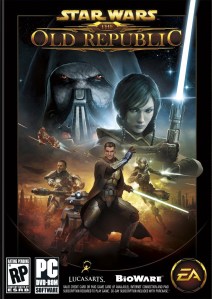
I don’t know how many Star Wars fans are still willing to embrace new products that come out without some measure of hesitation. I’m certain that many people still love Star Wars, and refuse to let their love be tainted by any of the more questionable decisions that the brand has made over the years. As a boy, I would certainly have counted myself amongst that group; as an adult, I simply feel free to make the choice not to give money to things that I don’t enjoy. It was definitely with a significant measure of hesitation that I placed a pre-order for BioWare’s brand-spankin’-new MMO, Star Wars: The Old Republic.

As the name implies, this game takes place during that lengthy and largely unexplored time of the Old Republic. Since the Republic persisted for thousands and thousands of years, it makes for a seemingly endless breeding ground for unique and individual stories without the need to be concerned with the absolute canon of the six Star Wars films. In other words, the further removed we are from characters like Luke Skywalker and Darth Vader, the easier it is to make a game that still feels like Star Wars… but doesn’t even attempt to infringe upon the films or their core events. The setting for The Old Republic is set some time after the events of the two “Knights of the Old Republic” games. Darth Revan, at least, is considered to be an almost-mythical figure in this time period. It still follows the progress of ongoing hostilities (if not outright war) between the Sith Empire and the Republic. Beyond that, the game’s story depends heavily (at least insofar as I’ve progressed myself) on which character class you’ve selected. Unlike other MMORPGs that you might have played in the past, the Old Republic is designed to provide a story and interaction-rich single player leveling experience. It uses a dialogue wheel with a variety of options and relies heavily on interactive conversations with NPCs to determine which quests your character obtains, what rewards you get from them, your alignment toward the Light or Dark sides of the Force, and how much your companions (more on this in a moment) like you. There are definitely still periods in your leveling experience which feel like a traditional grind; you will find yourself completing circuits of non-individual quests to shore up your XP total and bring in much-needed credits.

Based on your character class, you have a main personal story that you’re progressing through. My character, a bounty hunter, is attempting to be the overall winner in a massive competition of bounty hunters staged by the Mandalorians that requires me to go around the galaxy hunting the most difficult of targets – and the other hunters who have been assigned to the same targets. The missions specific to this bounty hunter storyline are accessed through single-character “phases” – areas only accessible to you – and serve to give the player the impression that they are advancing their character’s story along with their skills. Because these events are personal to the player and follow a linear progression, the NPCs involved become increasingly impressed with you, your reputation, and your abilities. Compared to other MMO-style games where your personal contribution to the world is rarely felt in any meaningful way, this game goes out of its way to try and make the player feel involved and important. This is particularly important, I think, in the context of the Star Wars setting. While of course the game involves fighting through seemingly endless hordes of creatures, rebels, insurgents, bandits, etc. in the wilds and in quest areas, the pacing of the game and the structure of the quests all seem bent toward keeping the feel of a Star Wars adventure. The game is not encouraging a long grind against increasingly formidable types of bats; your character has important business to be about, and just has to scythe through bad guys of various competency levels in order to complete that business.

Further adding to the immersion of the game is the aforementioned companion system. As you progress through your story, your character will acquire access to different companions. As you’d expect, these companions (one of them, anyway) joins you in battle and helps by fighting your enemies. In addition, your companions deal with the responsibility of gathering and crafting for the game’s profession system, which boasts an impressive variety of skills, from which your character may select three. Since your companions take care of most of this nonsense, it might sound like the professions are fairly hands-off. Fortunately or unfortunately, this is not really the case; you still must micromanage your crew of companions, dispatch them on missions, and set them to crafting. You cannot simply queue up a list of things for them to make or do, and it can quickly become tiresome to constantly refer to your crew management window and dispatch your minions. Unlike most of the game’s other features, this one does feel like it breaks the rhythm of your individual Star Wars story.

Incidentally, your friends still can have plenty to do with your experience in the game; situations called Flash Points call for parties to group up and take on significant challenges together (much like a dungeon in Everquest’s Lost Dungeons of Norrath, or in World of WarCraft). End game content is also available, but even with my early access, I certainly haven’t achieved such a high level as to be involved in any of that yet. Still, given the composition of the game so far, there is reason for me to remain optimistic about continuing game content.

The last thing rolling off my tongue is a little discussion of the space combat system. Yes! There is space combat! You can take your starship into space combat missions which are worth XP and credits for your character. They use a Starfox-style system of controls; your ship moves toward your mouse cursor, you have both lasers and missiles, and you can perform a barrel roll (the default key is the space bar!) You’ll have to deal with both enemy starfighters and capital class starships, and complete different objectives like escorting a friendly starship to safety, or destroying certain elite enemy targets, etc. It’s very much in the background (most of the action takes place ‘on the ground’ for your character) of the game, but it’s certainly a lot of fun, and the XP rewards are more than worth delving into it if you find the space combat minigame at all playable. My recommendation is to try it and have fun.

Halo: CE Anniversary


Some of you may remember, back to a day just over 10 years back, when a little console called the XBox launched. It was, at the time, a seemingly suicidal attempt to challenge the dominance that Sony held over the home console market – albeit without much relevant interference from previous juggernaut Nintendo – and to establish a new console master. The XBox had such innovative features as an onboard hard drive (only standard on PCs since they were conceived) and a more interactive BIOS that let the owner of the console do things that had never really been possible with a home entertainment console before. At its launch, the XBox boasted such titles as Dead or Alive 3… Project Gotham Racing… Jet Set Radio Future (and I don’t think this launched in the US!) annnnnnnnd a very tiny game called Halo: Combat Evolved.

Most game fans, at least those who dabble in first person shooters, have played Halo: CE. Even in 2011, ten years after CE’s launch, with a whole new generation of gamers. At the very least, contemporary gamers are familiar with the Halo franchise, which has now spawned seven games (counting the offshoot Halo Wars), as well as novels, comics, and even an animated feature which tried to delve deeper into the mythology of the Halo universe. All of that – a billion dollar franchise – was spawned by this one little, innovative title.

Before I begin my review of the new game, launched a mere week ago, I think it’s important that we take a peek at the significance of Halo: Combat Evolved, as a franchise. Until CE launched, the gold standard for console FPS games was 007: Goldeneye, on the Nintendo 64. Now, Goldeneye is a fine game, and it actually incorporates many of the same elements that Halo would later exploit to their fullest potential, but there was never any danger of Goldeneye challenging PC titles like Counterstrike. At the time, the keyboard and mouse were irrefutably better for the world of the first person shooter. Goldeneye was really the pioneer that taught us how much fun it could be to play locally with a few friends split screen and try to kill one another. But Halo perfected this art; we learned to love the 16 player LAN, with a game that had faster pacing and a shallower learning curve than any PC-based shooter title, and was dramatically more advanced than Goldeneye.

You can look back and criticize the game now. It had poor multiplayer balance (well, really, the balance was excellent, so long as everyone had only a human pistol or sniper rifle), the single player re-used a lot of set pieces and enemy models, and the lack of true multiplayer – to be fair, XBox Live did not exist at this point! – made it impossible for Halo to truly outshine fully multiplayer active PC titles. But there is simply no denying that Combat Evolved launched a franchise which is now viewed as the flagship title of the XBox and Xbox 360, and one of the most successful shooter games of all time. Even Call of Duty, the chief rival in the field, has adapted a number of features from Combat Evolved over time.

Flash-forward to November, 2011.

I belatedly remembered that Microsoft Studios, in a shameless attempt to milk more revenue out of the franchise, was releasing the 10th Anniversary edition of Combat Evolved. Bungie has released the Halo franchise, and stated over and over that they’ll release no new Halo titles. Microsoft Studios, on the other hand, spun off 343 Studios (343 Guilty Spark, anyone?) specifically to create more Halo games. This remake of the original is just the beginning, as Halo 4 is already slated to be released sometime during 2012. Many fans may be turned off by Bungie’s dissociation with the brand, and I assume most every fan is going to look with some skepticism at this Anniversary Edition release of Halo: CE. To be honest; if I’d had to pay $60 US for a copy of this 10th Anniversary Edition, there’s simply no chance that I would have. Instead, I was able to rent the game, and so guilt-free I offer the following review:

The graphics are good. They are not cutting edge, and certainly do not test the limits of the XBox 360’s hardware. In a very real sense, the graphics of this updated remake were obsolete even before the launch. They don’t compare to the visual spectacle that we see in the level and model design of, say, Modern Warfare 3. So, those expecting some kind of visual masterpiece had best look elsewhere. However, the updated graphics are so far beyond the capabilities of the original XBox (the original graphics, like many XBox Arcade titles, are available with one button press). A couple of swaps between the original graphics and the updated ones should be more than enough to demonstrate how far graphical processors have come in such a short time.

If you’ve ever waxed nostalgic for the single player mode of Halo: CE, the Anniversary edition is for you. It adds nothing. Literally; nothing. But it does take us back to a game that many of us now lack the means to play; a classic title, but with beautiful new set pieces. The control setup feels very ‘classic Halo’, right down to the speed the Master Chief moves, and the way that he jumps. This will be unsettling for players of contemporary titles like Halo: Reach at first, but you’ll settle back in without too much trouble.

As for multiplayer, the Anniversary Edition builds on Halo: Reach. It features a number of remakes of original Halo maps, including Battle Creek, Damnation, Prisoner, Hang ’em High, and the Halo 2 map Headlong. All of these maps are set in the Halo: Reach multiplayer engine, so Halo multiplayer diehards will find nothing new here beyond the maps.

Of course, the Anniversary Edition also includes Online Co-Op, so you can play the story mode with friends across the world. Don’t sell that short; Halo’s storyline has always been more involved than people give it credit for.