Welcome to Late Night Retro Television Reviews, a feature where we review some of our favorite and least favorite shows of the past! On Thursdays, we will be reviewing Highway to Heaven, which aired on NBC from 1984 to 1989. The entire show is currently streaming on Amazon Prime, Tubi and other services!
Episode 4.10 “A Dream of Wild Horses”
(Dir. by Michael Landon, originally aired on December 2nd, 1987)
In this episode, traveling angel Jonathan Smith (Michael Landon), and his companion Mark Gordon (Victor French) arrive at a struggling ranch where the widow Billie Harwood (Gail Strickland) is trying to keep her late husband’s legacy alive while caring for her young son Richie (Jason Horst) and aging father Jet Sanders (Richard Farnsworth). It seems that Jet, the patriarch of the family, sort of lost his will to live when he lost his wife and then his son in law, a man he truly thought of as a son. As Jonathan and Mark arrive on the scene, the family members are all at a breaking point. Jet wishes he would just die and quit being a burden. Billie is completely overwhelmed with the ranch, and you get the feeling she’s never truly mourned the loss of her husband. And Richie, who needs someone to love him and pay attention to him, instead is mostly ignored by his family. Jonathan, Mark, a pack of wild horses, and some divine compassion turn out to be just what the family needs to find the inspiration to start putting the pieces of their lives back together.
Directed by Michael Landon, “A Dream of Wild Horses” is everything I would expect from this series. Considering this episode was in season 4, it’s possible the formula was starting to wear thin with viewers back in 1987, but I thoroughly enjoyed it. For a man like me who loves a good western, I especially enjoyed the ranch setting, the wild horses, and the presence of veteran, Oscar nominated actor Richard Farnsworth as Grandpa Jet Sanders. He’s believable as the man who’s lost his purpose in life, but he’s even better when he turns things around at the end. One of the things I like about this series is the way Jonathan always knows exactly what buttons to push to get the characters going in the right direction. From bluntly telling Grandpa that he needs to quit feeling sorry for himself, to offering the widow a shoulder to cry on, and helping both of them see how much Richie needs their love and guidance, Jonathan’s genuine compassion is something this world really does need. Skeptical viewers may even roll their eyes, but I choose to accept the episode’s inspiring messages at face value. There have been times in my own life when I just needed someone else to care, and this series leans into those types of interactions. This family was broken, and Jonathan and Mark helped turn things around for them by simply caring. Things may be more complex and nuanced in the real world, but the simple act of caring will always be powerful.
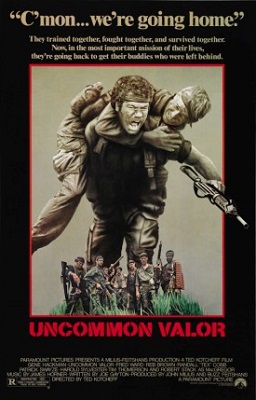
Retired Marine Colonel Jason Rhodes (Gene Hackman) and oilman Harry MacGregor (Robert Stack) share a tragic bonf. Both of them have sons that served in Vietnam and are listed as being MIA. Believing that their sons are still being secretly held in a POW camp in Loas, Rhodes and MacGregor put together a team to sneak into Southeast Asia and rescue them.
With MacGregor supplying the money and Rhodes leading the mission, the team includes Blaster (Red Brown), Wilkes (Fred Ward), Sailor (Randall “Tex” Cobb), and Charts (Tim Thomerson), all of whom served with Rhodes’s son. Also joining in his helicopter pilot Curtis Johnson (Harold Sylvester) and former Marine Kevin Scott (Patrick Swayze), whose father was also listed as being MIA in Vietnam. After a rough start, the group comes together and head into Laos to bring the prisoners home!
UncommonValor is one of the many movies released in the 80s in which Vietnam vets returned to Asia and rescued those who were left behind. In the 80s, there was a very strong belief amongst many Americans that soldiers were still being held prisoner in Vietnam, Cambodia, and Laos and Hollywood was quick to take advantage of it. The box office success of UncommonValor set the stage for films like Rambo and Missing In Action, film in which America got the victory that it had been denied in real life.
What set UncommonValor apart from the films that followed was the cast. Not surprisingly, Gene Hackman brings a lot more feeling and nuance to his performance as the obsesses Col. Rhodes than Sylvester Stallone and Chuck Norris brought to their trips to Vietnam. The film surrounds Hackman with a quirky supporting cast, all of whom represent different feelings about and reactions to the war in Vietnam. Fred Ward’s character suffers from PTSD. Randall “Tex” Cobb, not surprisingly, is a wild man. Patrick Swayze’s character is trying to make the father he’ll never know proud. Robert Stack and Gene Hackman represent the older generation, still trying to come to terms with everything that was lost in Vietnam and still mourning their sons. The raid on the POW camp is exciting but it doesn’t feature the type of superhuman action that’s present in other POW-rescue films. Col. Rhodes and his soldiers are ordinary men. Not all of them survive and not all of them get what they want.
UncommonValor started out as a screenplay from Wings Hauser, though he’s not present in the cast of the final film and he was only given a “story” credit. John Milius served as producer. Director Ted Kotcheff is best-known for FirstBlood, another action film about America’s struggle to come to terms with the Vietnam War.
Sometimes, I come across things on my DVR that I not only have no memory of recording but which I also cannot, for the life of me, figure out why I decided to record it in the first place. I recorded the 1977 film One On One off of TCM on January 17th and I’m not really sure why.
It’s not that One On One is a terrible movie or anything like that. It’s an extremely predictable film and it’s got one of those soundtracks that is extremely 70s but not cool disco-style 70s. No, instead this film is full of the type of soft rock music that your grandmother listens to while driving to the local CVS Pharmacy. (The majority of the songs are performed by a group called Seals and Croft and are painfully undanceable.) But, even with that in mind, it’s not really a bad movie. If I’m confused about why I recorded it, it’s because One on One is a movie about basketball, which is a sport that holds absolutely zero interest for me.
(My main issue with basketball has to do with the sound of all of those squeaky shoes on the court.)
But, before going any further, let’s watch a commercial:
One on One tells the story of Henry Steele (Robby Benson), a high school basketball star. Henry is from Colorado, which this film seems to suggest is the equivalent of coming from Siberia. When Moreland Smith (G.D. Spradlin). the renowned coach of Western University’s basketball team, offers Henry a full athletic scholarship, Henry negotiates a pretty good deal for himself. Not only is his education going to be paid for but he also wins a guarantee that he’ll never be cut from the team and that his father will get a car. All Henry has to do is keep his grades up but that shouldn’t be a problem. Sure, Henry appears to be an idiot but the athletic department will set him up with a tutor and, as long as the coach is happy with him, it’s not like Henry’s actually going to have to go to class.
Upon arriving in Los Angeles, Henry picks up a hitchhiker (a very young Melanie Griffith) who promptly robs him of all of his money. Once he arrives at the university, he discovers that Coach Smith is not going to be the surrogate father figure that he was expecting. Instead, Coach Smith is a rather cold and ruthless taskmaster, whose main concern is winning. When Henry, who is by far the shortest player on the team, struggles, Smith tells Henry that he needs to renounce his scholarship and return home. When Henry refuses to do so, Smith becomes obsessed with trying to break him.
As Henry’s roommate, Tom (Cory Faucher), points out, Henry’s head is not in the game. Instead, Henry can’t stop thinking about his tutor, Janet (Annette O’Toole). At first, Janet assumes that Henry is just a dumb jock, largely because Henry’s a jock and he spends the first half of the movie acting really, really dumb. Then, out of nowhere, Henry reveals that he’s not only read Moby Dick but he can quote passages from memory. In fact, Henry even understands that Ahab was — wait for it — obsessed! Oh my God, Janet realizes, Henry’s literate! In fact, Janet exclaims that Henry is the first person she’s met who has actually read Moby Dick! (Really?) Janet and Henry fall in love but, unfortunately, Janet is already dating her psychology professor.
(The professor has got a beard that looks like it reeks of stale weed and he says stuff like, “Have you seen my sandals?,” so we know better than to take him seriously when he compares the popularity of college athletics to the rise of fascism. When Henry accuses him of being a hippie, the professor just smirks and says something condescending. Stupid hippie.)
Will Janet and Henry fall in love? Will Janet dump her unattractive and unappealing boyfriend so she can date Henry? Will Henry manage to pass his classes? Will Henry ever get a chance to prove himself on the court? Will … oh, why even ask these questions? You already know what’s going to happen in this movie. There’s really not a single unexpected moment to be found in One on One. Everything about the film, from the coach’s ruthlessness to Henry’s transformation from idiot to savvy player, feels pre-ordained. It’s a predictable movie but, at the same time, it’s a likable movie. At the start of the film, Benson overplays Henry’s stupidity and O’Toole overplays Janet’s brittleness but, at the film progresses, both performers seem to relax and, by the time the end credits role, they’re actually a fairly likable couple. Benson even gets a killer final line, one that I imagine made audiences in 1977 applaud.
That said, the film is pretty much stolen by G.D. Spradlin. Spradlin was a former Oklahoma oilman who reinvented himself as a politician and then as a character actor. Best known for playing Senator Pat Geary in The Godfather, Part II, Spradlin had a flair for bringing casually corrupt authority figures to life. In One on One, Spradlin turns Coach Smith into a Mephistophelean figure, offering Henry success at the cost of his soul. Coach Smith is arrogant, oily, casually racist, and an all-around jerk but, at the same time, it is also obvious that he knows how to lead a team to victory. The great thing about Spradlin’s performance is to be found in not just how menacing he is but in how charismatic he is. You never doubt that Coach Smith is both a lousy human being and an absolutely brilliant coach. If nothing else, he’s good at his job.
As I said at the start of this review, I am not really sure why I recorded One on One but it turned out to be better than I was expecting. It is a flawed and uneven film but worth watching for Spradlin’s intriguingly villainous turn.
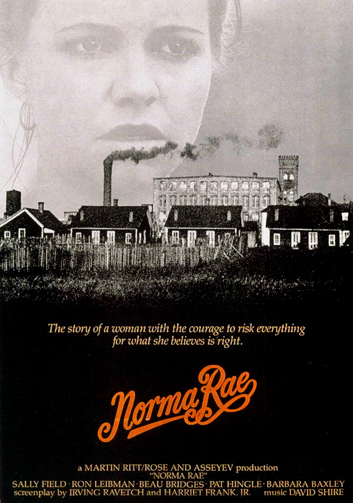
Earlier, in honor of Labor Day, I reviewed one of the most anti-labor union films ever made, the 1954 Oscar winner On The Waterfront. In the interest of fairness, it only seems right to now take a look at one of the most pro-union films ever made, the 1979 best picture nominee Norma Rae.
Norma Rae takes place in one of those small Southern towns that is defined by just one industry. In this case, almost everyone in town works for minimum wage at the local textile mill. Conditions are terrible, with the employees working long and brutal shifts in a hot and poorly ventilated factory. The overwhelming roar of the machines have left the majority of the workers deaf to reality, both figuratively and literally. The mill is run by the usual collection of slow-talking, tie-wearing rednecks who always seem to show up in movies like this.
One day, a union organizer from New York shows up in town. Brash and cocky, Ruben Warshowsky (Ron Leibman) is determined to unionize the mill but, at first, he struggles. Nobody wants to risk their job by being seen with him and his Yankee manners rub many of the townspeople the wrong way.
Eventually, Ruben does find one ally. Norma Rae (Sally Field) has worked at the mill her entire life. She’s tough and determined but she’s also regularly shunned because of her past. A widow who has three children (“She’s had a child out of wedlock!” a judgmental union organizer tells Ruben in a near panic), Norma channels her frustration into drinking too much and having an affair with a married (and abusive) salesman.
Two things happen that give Norma Rae a new purpose in life. First off, she meets and marries the well-meaning but chauvinistic Sonny (Beau Bridges). Secondly, she helps Ruben in his efforts to unionize the plant, even at the risk of going to jail and losing her job. With the mill’s management spreading untrue rumors about Norma’s relationship with Ruben, her dedication to the union soon starts to threaten her marriage to Sonny.
I have to admit that I have mixed feelings about Norma Rae. In many ways, Ruben is an annoying character. He’s so brash and so smugly out-of-place that I actually found it difficult to consider any of the points that he was making. I suppose that was partly intentional. Ruben can’t accomplish anything until he gets Norma Rae on his side. But, at the same time, there was something very condescending about Ruben as a character. Much like the villainous rednecks in charge of the mill, Ruben felt like a stock character. He was Super Yankee, bravely venturing below the Mason-Dixon Line to bring the truth to all of us stupid Southerners. Whenever Ruben smirked and started to complain about how dumb everyone else was, I was reminded of why I never wanted much to do with the whole Occupy Movement.
As well, Norma Rae is one of those films that technically takes place in the South but it’s the South of the Northern imagination. The accents were inconsistent and the dialogue often tried way too hard to sound “authentic.” Ultimately, Norma Rae lacked the artistry necessary to disguise its more heavy-handed moments.
And yet, I still liked Norma Rae. It had nothing to do with the film’s political message and everything to do with the character of Norma Rae. Sally Field gives such a good performance as Norma, making her both strong and vulnerable. The film’s best moments are the ones where Norma stands up for herself and does what she feels is right, despite the opposition from the mill’s management, Sonny, and her father (Pat Hingle). Towards the end of the film, there’s a simply incredible scene where Norma finally tells her children about her past and, at that moment, Norma Rae reveals itself to be a great and heartfelt tribute to the strength and resilience of women everywhere. At that moment, Norma’s strength reminded me of the greatest woman that I’ve ever known, my mom. It made me appreciate the struggles that my mom went through as she raised four strong-willed daughters on her own, while working crappy jobs and dealing with a society that is always threatened by and cruelly judges a woman who refuses to settle. Personally, I think Norma could have done better than Sonny and that Ruben should have been called out for constantly talking to down to her but what’s important, in the end, is that Norma never stopped standing up for what she believed. By the end of the film, Norma is standing in for every woman who has ever been underestimated or judged or told that her opinions didn’t matter. Norma is standing up for all of us.
Sally Field won an Oscar for her role in Norma Rae. Off the top of my head, I have no idea who she defeated for the award. (Yes, I know that I could just look it up on wikipedia but that’s not the point.) But, regardless of her competition, it’s an honor that she definitely deserved.
One of my favorite online film reviewers is Mitch Lovell of the Video Vacuum. The thing I like about Mitch is that he doesn’t worry about how many Oscars a film has been nominated for or whether or not a film’s politics are currently in fashion. Unlike a lot of online reviewers, he doesn’t worry about whether or not he’s going against the “accepted” views of the critical establishment. Instead, he’ll watch a film and tell you exactly how he felt about it.
For example, Mitch Lovell’s review of the otherwise critically acclaimed 1976 best picture nominee Bound for Glory can be summed up in three words: “boring as fuck.” Every other online review that I’ve found for Bound for Glory offers up polite but rarely inspiring praise for this rather lengthy film about the folk singer Woody Guthrie. Most of those reviews do acknowledge that the film moves at its own pace but we are told that we will be rewarded for being patient. If the review was written after 2010, you can be sure that the reviewer will be sure to say that Bound for Glory reminds us of why labor unions are still important and need to be protected from the Tea Party. (The idea apparently being that, if a film has the right politics, it doesn’t have to actually be all that interesting.) It’s all rather predictable and that’s why we’re lucky to have reviewers like Mitch Lovell around. Whether you agree with him or not, it’s good to have a reviewer who will go against the conventional wisdom.
I recently watched Bound for Glory as a part of TCM’s 31 Days of Oscars and, to a large extent, I have to agree with Mitch Lovell’s review. This is a movie that is not only long but which moves slowly as well. It’s not that the film has a deliberate pace. It’s just slow! (If you want to see a film that makes good use of a deliberate pace, check out Barry Lyndon.) David Carradine plays Woody Guthrie, a sign painter who, during the Great Depression, abandons his family in Texas and, by hopping trains, makes his way to California. He works with fruit pickers. He tries to convince his fellow workers to form a union. He gets beat up a lot.
And he plays his guitar.
If there’s anything that remains consistent about Bound for Glory, it’s that Woody is always playing his guitar and that every time he starts to play, something terrible either has happened or does happen. There’s a huge dust storm. Woody plays his guitar. A fight breaks out at a union meeting. Woody plays his guitar. A bunch of hoboes on a train get beat up. Woody plays his guitar. Woody shows up at a textile mill and starts to play his guitar. He gets beaten up by a bunch of thugs. Woody impresses Pauline (Gail Strickland) by playing his guitar and soon, he’s cheating on his wife. Woody partners up with another folk singer, Ozark Blue (Ronny Cox), and they get their own radio show where Woody plays guitar. Woody promptly gets fired.
It quickly became apparent to me that Woody Guthrie’s guitar was cursed. Whenever he played it, poor people ended up getting oppressed.
In many ways, Bound for Glory is a prototypical example of what it means to be an acclaimed-at-its-time-but-subsequently-forgotten best picture nominee. It’s a big epic film that tells a fictionalized account of a real person’s life story. Woody Guthrie is best known for writing This Land Is Your Land, which is a song that I mostly associate with pretentious super bowl commercials. As Bound for Glory details, Woody was also a union organizer and political activist but what’s odd is that the film keeps the exact details of what he believed rather vague. We’re given the general idea of what Woody believed but we’re not given any specifics. As a result, Woody just comes across like another part-time social protestor as opposed to being a true political thinker (much less a revolutionary).
On a positive note, Bound for Glory is impressive to look at. The film’s cinematographer was the famous Haskell Wexler (who also directed Medium Cool, a film that was as upfront about its politics as Bound for Glory is vague) and Wexler captures some hauntingly beautiful images of the American wilderness. The scene where a gigantic wall of dust crashes down onto a small Texas town is especially memorable.
Otherwise, though, Bound for Glory is pretty much a snoozefest. It was nominated for best picture of 1976 and, when you compare it to fellow nominees like All The President’s Men, Network, Taxi Driver, and even Rocky — Bound for Glory does feel a bit out of place.
Then when you consider some of the other films that came out in ’76 — Carrie, Face to Face, The Front, God Told Me To, Logan’s Run, The Man Who Fell To Earth, Marathon Man, The Omen, The Outlaw Josey Wales, Lipstick, Robin and Marian, The Sailor Who Fell From Grace With The Sea, and The Town That Dreaded Sundown — the nomination of Bound for Glory feels like even more of a mistake.
Way back in October, around the same time that I first decided that I would do a series of reviews of political films and that I would call it Lisa Gets Preachy (subsequently changed to Shattered Politics), I noticed that the 1995 film The American President was scheduled to be shown on TVLand.
“Hey,” I said, “I’ve definitely got to watch and review that!”
So, I set the DVR and I recorded The American President.
And then, I just left it there.
You have to understand that it’s rare that I ever leave anything unwatched on my DVR. Usually, within an hour of recording a program, I’ll be watching it. I have even been known to go so far as to make out very long lists of everything that I have on the DVR, just so I can make check them off after I’ve watched. As a general rule, I am way too obsessive compulsive to just leave anything sitting around.
But, for whatever reason, I could never work up any enthusiasm for the prospect of actually watching The American President. I knew that, eventually, I would have to watch it so that I could review it. Unlike those folks criticizing American Sniper on the basis of the film’s trailer, I never criticize or praise a film unless I’ve actually watched it. But I just couldn’t get excited about The American President.
Can you guess why? I’ll give you a hint. It’s two words. The first starts with A. The second starts with S.
If you guessed Aaron Sorkin, then you are correct! Yes, I do know that Sorkin has a lot of admirers. And, even more importantly, I know that it’s dangerous to cross some of those admirers. (I can still remember Ryan Adams and Sasha Stone insanely blocking anyone who dared to criticize the underwritten female characters in Sorkin’s script for The Social Network.)
But what can I say? As a writer, Aaron Sorkin bothers me. And since Sorkin is such an overpraised and powerful voice, he’s that rare scriptwriter who can actually claim auteur status. The Social Network, for instance, was not a David Fincher film. It was an Aaron Sorkin film, through and through.
And, after having to deal with three seasons of the Newroom and countless Aaron Sorkin-penned op-eds about why nobody should be allowed to criticize Aaron Sorkin, I’ve reached the point where dealing with all of Aaron Sorkin’s signature quirks is a bit like listening to the drill while strapped into a dentist’s chair. I am weary of pompous and egotistical male heroes who answer every question with a sermon. I am tired to endless scenes of male bonding. I have had enough with the quippy, quickly-delivered dialogue, all recited as characters walk down an endless hallways. I have no more sympathy for Sorkin’s nostalgic idealism or his condescending, rich, white dude version of liberalism.
Most of all, I’m sick of people making excuses for an acclaimed, award-winning, highly-paid screenwriter who is apparently incapable of writing strong female characters. I’m tired of pretending that it doesn’t matter that Aaron Sorkin is apparently incapable of viewing female characters as being anything other than potential love interests or silly distractions who need to be told to go stand in a corner while the menfolk solve all the problems of the world.
Fortunately, as a result of The Newsroom, quite a few critics are finally starting to admit what they always knew to be the truth. Aaron Sorkin is not the messiah. Instead, he’s a somewhat talented writer who doesn’t understand (or, in my opinion, particularly like) women. At his best, he’s occasionally entertaining. At his worst, he’s pompous, didactic, and preachy.
And, of course, Aaron Sorkin is the man who wrote The American President.
So, The American President just sat there until a few days ago when I sighed to myself and said, “Okay, let’s watch this thing.” As I watched it, I promised myself that I would try to see past the fact that it was an Aaron Sorkin-penned film and just try to judge the film on its merits.
But here’s the thing. It’s nearly impossible to separate one’s opinion of Sorkin from The American President. If you didn’t know that Sorkin had written The American President, you’d guess it after hearing the first few lines of dialogue. The film, itself, was directed by Rob Reiner but it’s not as if Reiner is the most interesting of directors. (What’s odd is that Reiner’s first films — This Is Spinal Tap, The Princess Bride, Stand By Me — are all so quirky and interesting and are still so watchable decades after first being released that you have to wonder how Reiner eventually became the man who directed The Bucket List.) In short, The American President is totally an Aaron Sorkin film.
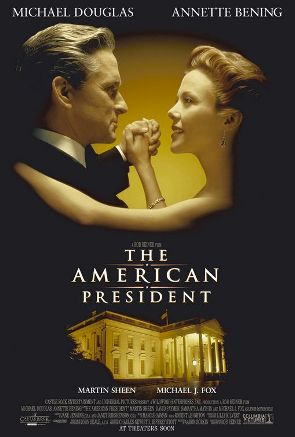
President Andrew Shepherd (Michael Douglas) is a liberal Democrat who, as he prepares to run for a second term, has a 63% approval rating. However, when Shepherd decides to push through a gun control bill, he finds that approval rating threatened. And then, when he listens to environmental lobbyist Sydney Wade (Annette Bening) and tries to push through legislation to reduce carbon emissions, his approval rating is again threatened. And then, to top it all off, he starts dating Sydney. It turns out that Sydney has protested American policy in the past. And, since this is an Aaron Sorkin film, everyone outside of the Northeast is scandalized that President Shepherd is having premarital sex in the White House.
And, to top it all off, there’s an evil Republican named Bob Rumson (Richard Dreyfuss) who wants to be President and is willing to use the President’s relationship with Sydney to further his own evil Republican ambitions.
But, ultimately, it’s not just those evil Republicans who make it difficult for Sydney and the President to have a relationship. It’s also the fact that the President agrees to a watered down crime bill and that he does not hold up his end of the bargain when it comes to reducing carbon emissions.
“You’ve lost my vote!” Sydney tells him.
But — fear not! There’s still time for President Shepherd to give a speech that will be so good and so brilliant that it will, within a matter of minutes, totally change every aspect of American culture and save the day. How do we know it’s a great speech? Because it was written by Aaron Sorkin!
Actually, I’m being too hard on the film and I’ll be the first admit that it’s because I’m personally not a huge fan of Aaron Sorkin’s. But, to be honest, The American President is Aaron Sorkin-lite. This film was written before the West Wing, before the Social Network, before that Studio Whatever show, and before The Newsroom. In short, it was written before he became THE Aaron Sorkin and, as such, it’s actually a lot less preachy than some of his other work. It’s true that, much like The Newsroom, The American President is definitely Sorkin’s fantasy of how things should work but at least you don’t have to deal with Jeff Daniels throwing stuff or Emily Mortimer not knowing how to properly forward an email.
Instead, it’s a film that will probably be enjoyed by those who share its politics. (And, make no mistake, The American President is more interested in politics than it is in the love story between Andrew and Sydney.) Michael Douglas does well in the role of the President. Meanwhile, Annette Bening is so likable and natural as Sydney that it almost make up for the fact that she’s yet another Sorkin woman whose existence is largely defined by looking up to her man while inspiring him to do the right thing and forgiving him when he doesn’t. Personally, I would have been happy if the film had ended with Sydney telling the President, “Thanks for finally doing the right thing but I have a life of my own to lead.”



 Through the Shattered Lens