Lisa Marie Reviews An Oscar Nominee: Alice Adams (dir by George Stevens)


Katharine Hepburn was famous for both her relationship with Spencer Tracy and the films that she made with him.  They were such frequent co-stars and so associated with each other that “Hepburn-Tracy” became a film genre in and of itself, one that promised a bit of comedy, a bit of drama, and some sharp-witted romance.  That said, I have to admit that one of my favorite of Katharine Hepburn’s film is one that she made not with Spencer Tracy but instead with Fred MacMurray.  Alice Adams is a Tracy-Hepburn film without Tracy.

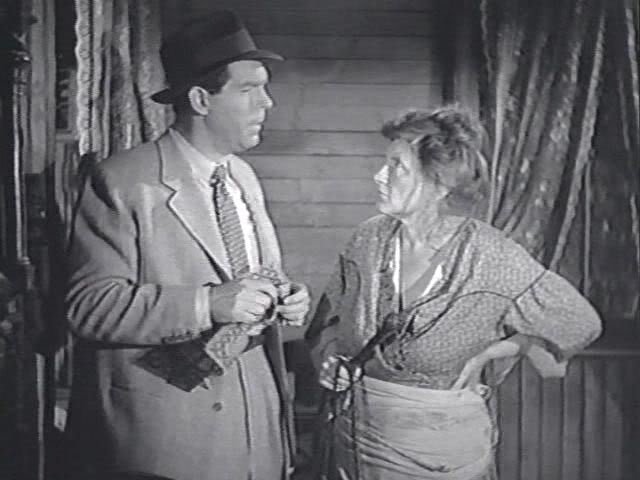
First released in 1935 and based on a novel by Booth Tarkington (who was quite a big deal back in the day even if, like Arrowsmith‘s Sinclair Lewis, he’s somewhat forgotten today), Alice Adams stars Hepburn as the title character.  Alice is the daughter of Virgil Adams (Fred Stone) and his wife, who is only referred to as being Mrs. Adams (Anne Shoemaker).  Virgil is a sickly man who has worked as a clerk at a glue factory for several years.  Despite living in a rather large house and having a maid named Malena (Hatti McDaniel), the Adams family is not wealthy.  However, Mrs. Adams desperately wants the family to be rich and Alice carries herself with the airs of a wealthy woman, despite the fact that everyone in town knows that she’s not.  Alice love her family and is loyal to them, even if her younger brother (Frank Albertson, who later played Sam “Hee Haw” Wainwright in It’s A Wonderful Life) appears to be addicted to gambling and her mother is constantly browbeating her father for not being more ambitious.  Her family may embarrass her but we know she wouldn’t trade them for all the money in the world.  That’s why we like Alice, even if she does sometimes act like a snob.

However, when Alice meets and falls for the wealthy Arthur Russell (Fred MacMurray), she lies about her social background and tries to present herself as being just as rich as him.  When she invites Arthur and his parents to her house for a dinner party, she frantically tries to keep up the charade of being wealthy.  Meanwhile, Virgil finds himself wrongly accused of stealing from his boss (Charley Grapewin) and, as a result, the family’s financial future is put in jeopardy.

Alice Adams is a mix of screwball comedy and social drama.  On the one hand, Alice’s desperate attempts to throw the perfect party are frequently very funny.  Katharine Hepburn was always at her best when she played a flighty character and the contrast between Alice’s sophisticated airs and Alice’s actual personality makes me laugh every time that I watch the film.  At the same time, there’s a definite undercurrent of melancholy to the film.  Alice and her mother are both so desperate to be rich that they’ve both been blinded to just how wonderful their lives really are.  Alice may like Arthur and Arthur definitely likes Alice but one never forgets that a part of Alice’s attraction to Arthur is that Arthur can give her the life to which she aspires.

Alice Adams features one of Hepburn’s best performances and it’s a rare Hepburn performance to which anyone watching should be able to relate.  At some point in our lives, we’ve all felt like Alice.  We’ve all been Alice, even if we don’t want to admit it.  Fred MacMurray’s natural likability serves him well as Arthur.  He comes across like a genuinely nice guy and we definitely want him and Alice to end up together.

Alice Adams was nominated for Best Picture but it lost to a much bigger production, Mutiny on the Bounty.  Bette Davis beat Katharine Hepburn for Best Actress.  Davis later said that she felt Hepburn should have won.
Retro Television Review: The Chadwick Family (dir by David Lowell Rich)


Welcome to Retro Television Reviews, a feature where we review some of our favorite and least favorite shows of the past!  On Sundays, I will be reviewing the made-for-television movies that used to be a primetime mainstay.  Today’s film is 1974’s The Chadwick Family!  It  can be viewed on YouTube.

Who are the Chadwicks?

They’re a family living in San Francisco.  They claim to be an average middle class family but, as has apparently been typical of television since its very first broadcast day, they live in a way that can only be explained by having a good deal of wealth.

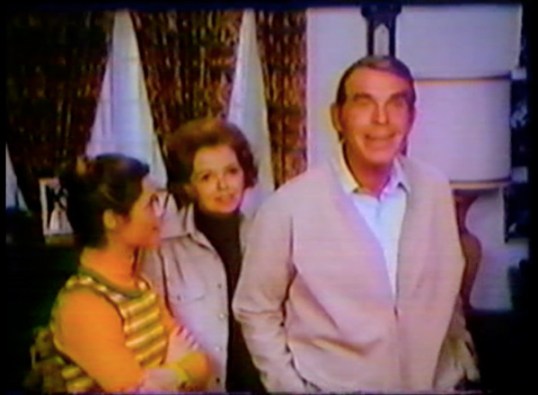
Consider this: Patriarch Ned Chadwick (Fred MacMurray) is a prominent newspaper columnist who writes so well that a mere column from him can settle a potential labor strike.  A national magazine has noticed the power of Ned’s words and they’ve offered him a job.  They want to turn him into a national figure.  The only catch is that he and his wife (Kathleen Maguire) would have to leave their beloved San Francisco and move to Chicago.  There’s no ocean in Chicago, as Ned puts it.  Sure, it would mean more money but who needs money when you’re a fabulously wealthy couple pretending to be middle class?

Moving would also mean leaving behind their children, all of whom have dramas of their own to deal with.  Tim (Stephen Nathan) is a college student, struggling to make the grade.  Lisa (Jane Actman) is engaged to Lee (Frank Michael Liu) and, for some reason, decides that it would be a good idea to tell her future mother-in-law that her desire for a long engagement is “bad chop suey.”  (Lee’s family is Chinese.)  Eileen (Lara Parker) is pregnant and her husband worries this will sabotage their support for “zero population growth.”  And Joan (Darleen Carr) is having to deal with the fact that her charismatic and fun-loving husband, Duffy (a young Barry Bostwick), is seriously ill and might even die before he can finish teaching Ned how to play the bagpipes.  Like all middle class people, Duffy owns his own airplane.

This is one of those movies that was obviously meant to serve as a pilot for a weekly television series and it’s easy to imagine Ned handing out wisdom to his kids on a weekly basis as they tried to navigate their way through the 70s.  Fred MacMurray gives off a nice grandfatherly vibe as Ned, so much so that it’s hard to believe that he’s the same actor who brought to life memorable heels in Double Indemnity, The Caine Mutiny, and The Apartment.  Unfortunately, the rest of the cast is not as memorable as MacMurray, largely because their roles are underwritten and their characters never feel like more than caricatures.  Barry Bostwick acts up a storm as Duffy but the fact that he’s listed as being a “special guest star” in the opening credits pretty much gives away his fate from the start.  As for Lisa, I usually like any character who shares my name but how much sympathy can you have for someone dumb enough to use a phrase like “bad chop suey” while speaking to her Chinese future in-laws.  Indeed, it was kind of weird how everyone in the family seemed to be totally comfortable with making jokes about Lee being Chinese and speaking with an accent.  One has to wonder how Lee felt about that.

Anyway, as far as I know, The Chadwick Family has no further adventures but their sole outing will live forever thanks to YouTube.

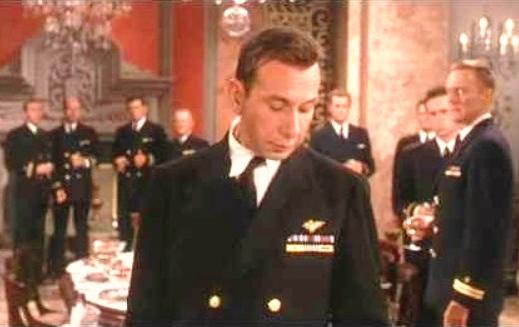
Scene That I Love: Greenwald Confronts Keefer in The Caine Mutiny


Today’s scene that I love comes from 1954’s The Caine Mutiny.

In this scene, directed by Edward Dmytryk, the Caine mutineers celebrate their acquittal when they’re confronted by their own defense attorney.  Having previously exposed Captain Queeg’s paranoia on the stand, Barney Greenwald (Jose Ferrer) has dealt with his guilty conscience by having a bit too much to drink.  He interrupts the celebration and calls out the man who he claims is the real “author of the Caine Mutiny,” the arrogant Keefer (Fred MacMurray).

This scene features Ferrer at his most vitriolic and MacMurray at his sleaziest.  Fred MacMurray was typically cast as a nice, All-American guy so it’s always interesting to see him cast as a bad guy in films like this one, The Apartment, and Double Indemnity.  MacMurray always tended to underplay his villains, playing them as self-centered cads who hid their true motives behind a façade of bland affability.  The Caine Mutiny features one of MacMurray’s best performances.

From The Caine Mutiny:

10 Oscar Snubs From the 1940s


Ah, the 40s! For most of the decade, the world was at war and the Academy’s nominations reflected that fact. The best picture lineups alternated between patriotic films that encouraged the battle against evil and darker films that contemplated both the mistakes of the past and what threats might be waiting in the future.  With the Academy being even more aware than usual that films and awards could be used to send a message, the snubs continued.

1940: John Carradine Is Not Nominated For The Grapes of Wrath

John Carradine’s first credited film appearance was in 1930 but Carradine himself claimed that he had appeared as an uncredited extra in over 70 films before getting that first credit.  Carradine would continue to work until his death 58 years later.  John Carradine did so many films that he was still appearing in new releases in the 90s, years after his death.  He appeared in over 234 films and in countless television shows.  He was a favorite of not only Fred Olen Ray’s but also John Ford’s.

Unfortunately, Carradine was never nominated for an Oscar, despite the fact that he did appear in some classic films.  (He also appeared in a lot of B-movies, which is perhaps one reason why the Academy was hesitant to honor him.)  Personally, I think Carradine most deserved a nomination for playing “Pastor” Jim Casy in John Ford’s The Grapes of Wrath.  Carradine is ideally cast as the former preacher turned labor activist.  When he’s alive, he gives the Joads hope.  When he dies, both the Joads and the audience start to realize how difficult things are truly going to be.

1942: Ronald Reagan Is Not Nominated For Best Supporting Actor For Kings Row

Kings Row is an enjoyably over-the-top small town melodrama and future President Ronald Reagan is fantastic in the film, with his natural optimism providing a nice contrast to the truly terrible things that happen to him and his loved ones over the course of the film.  Reagan was not nominated for this performance, the one that both he and the most of the critics agreed was his best, but he should have been.

1943: Hangmen Also Die Is Not Nominated For Best Picture

Fritz Lang’s anti-Nazi classic was not nominated for Best Picture and only received two nominations (for Sound and Score).  That year, the Best Picture winner was another anti-Nazi classic, Casablanca.

1943: Shadow Of A Doubt Is Ignored

Today, it is recognized as one of Hitchcock’s best but, in 1943, Shadow of a Doubt couldn’t even score a nomination for Joseph Cotten’s wonderfully diabolical turn as Uncle Charlie.  One gets the feeling that the film’s satirical jibes at small town America and its theme of evil hiding behind a normal façade were not what the Academy was looking for at the height of World War II.  It’s a shame because, in many ways, Cotten’s Uncle Charlie was the perfect symbol of the enemy that the Allies were fighting.

1944: Tallulah Bankhead In Not Nominated For Best Actress For Lifeboat

Unlike Shadow of a Doubt, Hitchcock’s Lifeboat received several Oscar nominations.  However, Tallulah Bankhead was not nominated for Best Actress.  Perhaps the Academy was scared of what she might say if she won.

1944: Fred MacMurray and Edward G. Robinson Are Not Nominated For Double Indemnity

For all the nominations that this classic noir received, somehow neither Fred MacMurray nor Edward G. Robinson were nominated for their roles.  Both actors are brilliantly cast against type in this film.  MacMurray uses his trademark casual glibness to portray Walter Neff as being an arrogant man who is hardly as clever as he thinks that he is.  Meanwhile, Robinson’s more introspective performance leaves you with little doubt that, if anyone can solve this case, it’s him.  While Barbara Stanwyck was (rightfully) nominated, it’s had to believe that both MacMurray and Robinson were snubbed.

1946: Thomas Mitchell and Lionel Barrymore Are Not Nominated For Best Supporting Actor For It’s A Wonderful Life

As wonderful as James Stewart and Donna Reed are, it just wouldn’t be Bedford Falls without Uncle Billy and Mr. Potter!  Thomas Mitchell breaks your heart in the scene where he tries to remember what he did with the lost money.  And, for audiences who had just lived through the Great Depression, Lionel Barrymore represented every businessman who cared more about money than people.  It’s impossible to imagine the film without them …. or without Henry Travers, for that matter!  Seriously, very few films have received three best supporting actor nominations but It’s A Wonderful Life deserved to be one of them.

1948: Humphrey Bogart Is Not Nominated For Best Actor For The Treasure of the Sierra Madre

The Treasure of the Sierra Madre received four Oscar nominations.  Somehow, not one of those nominations was not for Humphrey Bogart.

1948 and 1949: Red River, Fort Apache, and She Wore A Yellow Ribbon Are Not Nominated For Best Picture

The public may have loved Westerns but the Academy largely shied away from them, with a few notable exceptions.  Howard Hawks’s Red River and John Ford’s Fort Apache and She Wore A Yellow Ribbon are today all recognized as being classic Hollywood films.  However, the Academy, then at the height of its bias towards “genre” films, didn’t honor any of them.

1949: James Cagney Is Not Nominated For Best Actor For White Heat

“Top of the world, ma!”  Maybe so, but not top of the Oscars.  The Academy was always more interested in honoring Cagney for being a song-and-dance man than for honoring him for his iconic gangster roles.

Agree?  Disagree?  Do you have an Oscar snub that you think is even worse than the 10 listed here?  Let us know in the comments!

Up next: Get ready to hate the commies and to love Ike because the 50s are coming!

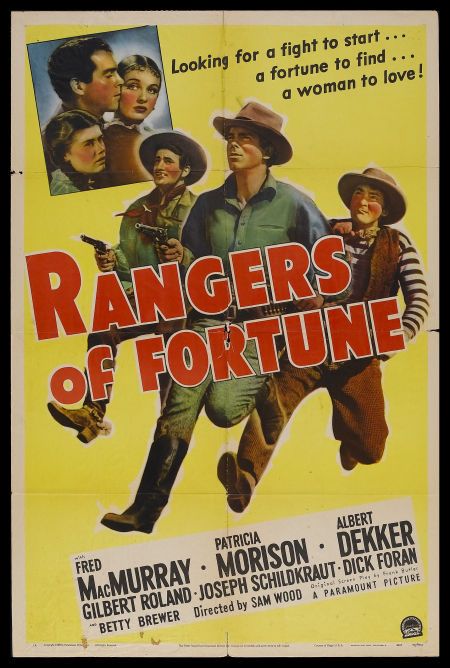
Rangers of Fortune (1940, directed by Sam Wood)


After narrowly avoiding execution by a firing squad in Mexico, three good natured outlaws head back to Texas.  Gil (Fred MacMurray) is their leader, a former army officer.  Antonio (GIlbert Roland) is the charming caballero.  George (Albert Dekker!) is the punch-drunk former prizefighter who provides comedic relief.  When they reach Texas, they meet and become involved in the efforts of a newspaper publisher (Brandon Tynan) and his daughter (Betty Brewer) to free their hometown from the control of an aristocratic landowner named Col. Rebstock (Joseph Schildkraut), who rules the town with the help of a sadistic group of cowboys.  It turns out that the three outlaws aren’t so bad while the respectable and wealthy Col. Rebstock is as bad as they come.

Rangers of Fortune is a standard 1940’s western programmer, though it’s distinguished by a better than usual cast and the quick-paced direction of Sam Wood.  It starts out almost as a comedy, with MacMurray, Roland, and Dekker cracking jokes and getting the better of almost anyone that they come across.  The screenwriter of Rangers of Fortune, Frank Butler, also wrote some of Bing Crosby and Bob Hope’s road films and he’s just as good as coming up with comedic dialogue for the team of MacMurray, Roland, and Dekker as he was for Hope and Crosby.

But the movie takes a serious turn once MacMurray, Roland, and Dekker cross the Texas border and they discover that Col. Rebstock will do almost anything and kill just about anyone to keep his hold on the town.  Even a successful scheme to install Gil as sheriff just leads to more innocent people dying.  When Rangers of Fortune turns dark, it turns very dark, with characters, who we usually don’t expect to die in a film like this, meeting a violent end.  Though it won’t convert any skeptics, it’s an interesting film for those who are already fans of old Hollywood westerns.

Rangers of Fortune has never gotten a proper video release but it is on YouTube.  Unfortunately, the copy uploaded to YouTube was in terrible condition so it’s difficult to fairly judge the film’s production values.  However, even on a damaged print, the natural authority of Fred MacMurray’s lead performance comes through and Joseph Schildkraut is as good a villain as always.  Patricia Morrison plays the prettiest girl in town and, even on YouTube, it’s easy to see why every man in town is competing for her attentions.  Seeing Albert Dekker, usually cast as intelligent and often conniving character, playing dumb is also an interesting experience, even on a bad print.  Hopefully, someday, Rangers of Fortune will get a decent restoration.

At Gunpoint (1955, directed by Alfred L. Werker)


When a gang of outlaws attempt to rob a bank in the small frontier town of Plainview, the local sheriff is one of the first people to get gunned down.  It falls upon two local men, George Henderson (Frank Ferguson) and storeowner Jack Wright (Fred MacMurray), to run the outlaws out of town.  While most of the gang escapes, Jack and Henderson manage to kill the gang’s leader, Alvin Dennis.

At first, Jack and Henderson are declared to be heroes and Henderson is appointed sheriff.  However, when Henderson is found murdered, the town realizes that Alvin’s brother, Bob (Skip Homeier), has returned to get revenge.  The inevitable confrontation is delayed by the arrival of a U.S. marshal who stays in town for two weeks to maintain the peace but everyone knows that, once he leaves, Bob is going to be coming after the mild-manned Jack.  The townspeople go from treating Jack like a hero to shunning him.  They even offer Jack and his wife (Dorothy Malone) money to leave town but Jack refuses to give up his store or to surrender to everyone else’s fear.

At Gunpoint is a diverting variation on High Noon, with Fred MacMurray stepping into Gary Cooper’s role as the upstanding man who the town refuses to stand behind.  What sets At Gunpoint apart from High Noon is that, unlike Cooper’s Will Kane, MacMurray’s Jack Wright isn’t even an experienced gunslinger.  Instead, he’s a mild-mannered store owner, the old west’s equivalent of an intellectual, who just managed to get off a lucky shot.  If he can’t find a way to get the cowardly town to back him up, there’s no way that he’s going to be able to defeat Bob and his gang.

At Gunpoint features an excellent cast of Western character actors, including John Qualen, Irving Bacon and Whit Bissell.  Especially good is Walter Brennan, playing one of the only townspeople to have any integrity.  While this western may not have the strong political subtext or the historical significance of High Noon, it’s still a well-made example of the genre.  It’s a western that even people who don’t normally enjoy westerns might like.

A Movie A Day #223: The Texas Rangers (1936, directed by King Vidor)


Sam (Lloyd Nolan), Jim (Fred MacMurray), and Wahoo (Jack Oakie) are three outlaws in the old west.  Wahoo works as a stagecoach driver and always lets Sam and Jim know which coaches will be worth holding up.  It’s a pretty good scam until the authorities get wise to their scheme and set out after the three of them.  Sam abandons his two partners while Jim and Wahoo eventually end up in Texas.  At first, Jim and Wahoo are planning to keep on robbing stagecoaches but then they realize that they can make even more money as Texas Rangers.
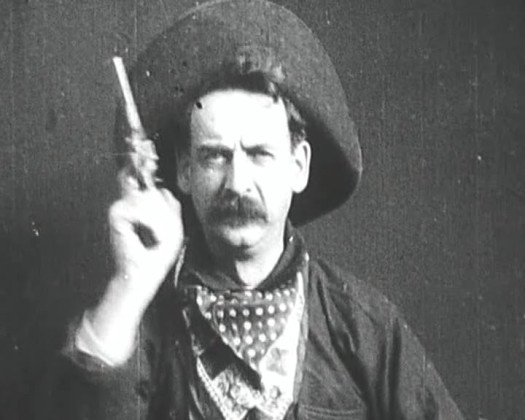
At first, Jim and Wahoo are just planning on sticking around long enough to make some cash and then split.  However, both of them discover that they prefer to be on the right side of the law.  After they save a boy named David from Indians, Jim and Wahoo decide to stay in Texas and protect its settlers.

The only problem is that their old friend Sam has returned and his still on the wrong side of the law.

Made to commemorate the Texas centenary (though it was filmed in New Mexico), The Texas Rangers is a good example of what’s known as an oater, a low-budget but entertaining portrayal of life on the frontier.   King Vidor does a good job with the action scenes and Fred MacMuarry and Jack Oakie are a likable onscreen team.  The best performance comes from Lloyd Nolan, as the ruthless and calculating Sam.  Sam can be funny and even likable but when he’s bad, he’s really bad.

Jack Oakie was better known as a comedian and The Texas Rangers provides him with a rare dramatic role.  Four years after appearing in The Texas Rangers, Oakie would appear in his most famous role, playing a parody of Benito Mussolini in Charlie Chaplin’s The Great Dictator.

Cleaning Out the DVR Pt 13: ALL-STAR WESTERN ROUNDUP!


gary loggins's avatarcracked rear viewer

Major League Baseball’s All-Star Game is tomorrow night, and in honor of that All-American pastime I’ve corralled an All-Star lineup of (mostly) All-American Westerns filled of blazing six-guns, galloping horses, barroom brawls, sexy saloon gals, and wide-open spaces. Hot damn, that DVR sure enough gets filled up mighty fast! Saddle up and enjoy these capsule looks at one of my favorite genres, the Western:

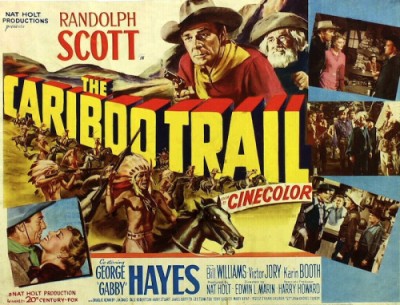
THE CARIBOO TRAIL (20th Century-Fox, 1950; D: Edwin L. Marin) – Randolph Scott   rides tall in the saddle driving his cattle to Vancouver gold rush country in this exciting oater filled with stampedes, Indian attacks, bad hombres, shoot outs, and fisticuffs. There’s a pretty saloon keeper (Karin Booth), a mean town boss (Victor Jory), and Scott’s bitter ex-pardner (Bill Williams), who had to have his arm amputated along the trail. Scenic Colorado stands in for Canada’s Great Northwest, shot in gorgeous Cinecolor by DP Fred Jackman Jr. Look for young…

View original post 944 more words

Cleaning Out the DVR Pt 11: Five from the Fifties


gary loggins's avatarcracked rear viewer

dve1

The 1950’s were a time of change in movies. Television was providing stiff competition, and studios were willing to do anything to fend it off. The bigger budgeted movies tried 3D, Cinerama, wide-screen, and other optical tricks, while smaller films chose to cover unusual subject matter. The following five films represent a cross-section of nifty 50’s cinema:

dve2

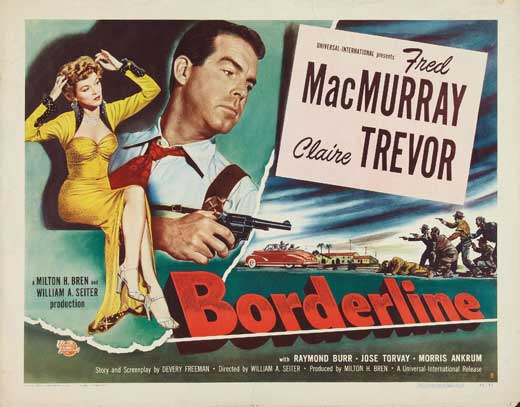
BORDERLINE (Universal-International 1950; D: William A. Seiter)

BORDERLINE is a strange film, straddling the borderline (sorry) between romantic comedy and crime drama, resulting in a rather mediocre movie. Claire Trevor plays an LAPD cop assigned to Customs who’s sent to Mexico to get the goods on drug smuggler Pete Ritchey (Raymond Burr , being his usual malevolent self). She’s tripped up by Ritchey’s rival Johnny Macklin (Fred MacMurray , channeling his inner Walter Neff), and taken along as he tries to get the dope over the border. What she doesn’t know is he’s also…

View original post 628 more words

Hillbilly Deluxe: MURDER, HE SAYS (Paramount 1945)


gary loggins's avatarcracked rear viewer

murderhe1

George Marshall has long been a favorite director of mine. Though he excelled in all genres (particularly Westerns), it’s his comedies that first caught my attention. Marshall guided W.C. Fields through his first for Universal, YOU CAN’T CHEAT AN HONEST MAN (with radio foils Edgar Bergen and Charlie McCarthy), did some of Bob Hope’s best films (THE GHOST BREAKERS, MONSIER BEAUCAIRE, FANCY PANTS), and directed MY FRIEND IRMA, the debut of Dean Martin & Jerry Lewis, later teaming with the pair for SCARED STIFF. He’s also responsible for the classic comic Western DESTRY RIDES AGAIN with James Stewart and Marlene Dietrich, and the remake with Audie Murphy. But his wackiest comedy is undoubtably the off-the-wall MURDER, HE SAYS.

murderhe4

This black comedy gem stars the underrated Fred MacMurray as Pete Marshall, pollster for the Trotter company (“Like the Gallup Poll, but not as fast”), sent to tiny rural Potowanamie to find missing coworker Hector P…

View original post 472 more words