The TSL Grindhouse: The Wild Angels (dir by Roger Corman)


“What is it exactly that you want?” a preacher (Frank Maxwell) asks a congregation of leather-clad bikers.

“We want to get loaded!” Heavenly Blues (Peter Fonda) replies, “And we want to have a good time!”

And have a good time, they proceed to have.  Of course, it’s a good time for them.  Everyone else who meets the bikers at the center of 1966’s The Wild Angels are horrified by this collection of rebellious and violent outsiders.  Sure, Heavenly Blues might actually be a soulful guy who mistakenly believes that he can control the gang’s more excessive tendencies.  His girlfriend, Mike (Nancy Sinatra), actually seems rather reserved and conservative when compared to the rest of the gang.  But make no mistake about it, the majority of the members of the gang are into violence for its own sake.  They are bullies who couldn’t make the football team so, instead, they hopped on a motorcycle and formed their own society.  They’re self-styled rebels  but what are they rebelling against?  What have you got?

I know, I know.  That famous line comes from Marlon Brando and it was uttered in The Wild One.  Peter Fonda, to put it lightly, was no Marlon Brando and, as directed by Roger Corman, The Wild Angels doesn’t have the societal concerns that lay at the hear of The Wild One.  As Corman was often the first to admit, his main concern when it came to making movies was to make money.  Corman wasn’t necessarily against message films.  He often stated that, as a director, 1962’s The Intruder was the film in which he took the most pride.  The Intruder took a firm stand against racism and it let everyone know where Corman stood on when it came to the Civil Rights Movement.  It was also one of his few films to lose money.  The Wild Angels celebrates rebellion but one gets the feeling that celebration is motivated by the fact that younger filmgoers would be happy to pay to see a movie about a bunch of “youngish” people telling the old folks to shut up and get out of the way.  The Wild Angels themselves don’t seem to be motivated by any sort of grand ideology.  Heavenly Blues preaches about getting loaded and having a good time and celebrating freedom but he also allows the members of the gang to drape a Nazi flag over a casket.  What does Heavenly Blues actually believe in?

Heavenly Blues believes in loyalty to his friends.  For all the fights and the orgies and the scenes of motorcycles roaring down country roads, this is ultimately just a film about a guy who wants to give his best friend a decent burial.  The Loser (Bruce Dern) dies about halfway through the film and one gets the feeling that he probably would have lived if the gang hadn’t kidnapped him from the hospital.  Heavenly Blues wants to give The Loser the type of wild funeral that Blues thinks he would have wanted though I think The Loser probably would have been happier not have been killed by the actions of his idiot friends.  Diane Ladd, who was married to Bruce Dern at the time and who has said Laura Dern was conceived during the filming of The Wild Angels, is heart-breaking as The Loser’s girlfriend, Gaysh.  Gaysh wants to mourn her boyfriend while the rest of the gang is more concerned with figuring out who her next boyfriend is going to be.

Does Heavenly Blues ever realize that he’s traveling with a bunch of animals?  He does but one gets the feeling that he’s accepted his fate.  There’s no going back.  The past can’t change and the future cannot be controlled so Heavenly Blues is content to live in the present.  All he can do is try to give his friend a decent burial while the sirens of cops shriek in the distance.

The Wild Angels was a controversial film when it was first released.  It also made a lot of money and led to a whole cycle of outlaw biker films, culminating with Easy Rider.  Seen today, it’s a portrait of a society coming apart, with the establishment and the bikers not even willing to stop fighting long enough to allow for a simple burial.  It’s definitely a time capsule film, one of those productions that epitomizes an era.  There’s not much going on underneath the surface and most of the film’s bikers really are awful people but there is something touching about Blues giving it all up just to try to give his friend a decent burial.

Horror Film Review: The Haunted Palace (dir by Roger Corman)


In the 18th century, the inhabitants of Arkham, Massachusetts yank Joseph Curwen (Vincent Price) out of his mansion and tie him to a tree.  They accuse Curwen of being a warlock who is in league with the devil and who has been bringing young women to his “palace,” and putting them in a trance.  They burn Curwen alive but, before the flames are lit, they also give Curwen a chance to speak and curse both them and their descendants.

You really do have to wonder about the logic behind witch (and warlock) burnings.  They seem counter-productive because they always give the accused just enough time to cast one final curse before being burned to a crisp.  Indeed, you have to wonder why witches and warlock were allowed any final words to begin with.  I mean, at some point, you would think everyone would notice that the final words were always a curse.

Anyway. 110 years later, Joseph Curwen’s descendant, Charles Dexter Ward (Vincent Price, again) rides into town with his wife, Anne (Debra Paget).  He is stunned to see that Arkham has apparently fallen on hard times, with many of the town’s people being horribly disfigured.  It’s explain to him that the disfigurements and the poverty are all a result of his ancestor’s curse.  That’s going to make things a bit awkward, considering that Charles Dexter Ward has not only inherited the Palace but he’s also inherited a copy of Necronomicon and a legacy of messing with Cthulhu.  The townspeople don’t want Ward around but he and Anne decide to spend the night in the Place regardless.

Of course, it doesn’t take long for Curwen’s spirit to possess Charles.  Soon, Charles is trying to resurrect Curwen’s mistress, Hester (Cathie Merchant) and pursuing Curwen’s goals of breeding a race of super humans by forcing the women of the town to mate with the fearsome Yog-Sothoth.  Charles also seeks vengeance on the descendants of those who burned Curwen at the stake, as if all of the poverty and the deformities aren’t punishment enough.  Again, this is why you don’t give warlocks and witches a chance to get out one last curse before being executed.

Though The Haunted Palace is usually considered to be a part of Roger Corman’s Edgar Allan Poe cycle, the story itself is actually based on H.P. Lovecraft’s The Case of Charles Dexter Ward.  (In Lovecraft’s novella, Ward seeks out his evil ancestor whereas, in the film, Ward is more or less an innocent victim.)  The film’s title comes from a Poe poem, which is recited at both the beginning and the end of the film.  But the film itself, with its references to the Cthulhu mythos and its hideous New England setting, is definitely a work of Lovecraftian horror.

Fortunately, it’s an effective work of Lovecraftian horror, one that captures the feeling of people unwisely trying to control a force of evil that they cannot begin to comprehend.  Roger Corman keeps the action moving quickly and creates a gothic atmosphere of impending doom.  Vincent Price, toning down his usual theatrics, is chillingly evil as Curwen and sympathetic as Charles.  The film’s strongest performance, however, comes from Debra Paget, who desperately tries to free her husband from Curwen’s control.  Any woman who has suddenly felt as if she can no longer recognize the man who she once loved will be able to relate to Paget’s performance.

The Haunted Palace is a strong entry in the films of Roger Corman and Vincent Price and one of the better adaptations of the work of H.P. Lovecraft.

A Movie A Day #154: The Day They Hanged Kid Curry (1971, directed by Barry Shear)


Welcome to the Old West.  Hannibal Heyes (Pete Duel) and Kid Curry (Ben Murphy) are two of the most wanted outlaws in the country, two cousins who may have robbed trains but who also never shot anyone.  After being promised a pardon if they can stay out of trouble for a year, Heyes and Curry have been living under the names Joshua Smith and Thaddeus Jones.
During a trip to San Francisco to visit his old friend, a con artist named Silky O’Sullivan (Walter Brennan), Heyes is told that Kid Curry is currently on trial in Colorado.  When Heyes goes to the trial, he discovers that the accused (Robert Morse) is an imposter and that the real Kid Curry is watching the trial from the back of the courtroom.  It turns out that the man of trial is just an attention seeker , someone who is so desperate for fame that he is willing to be hanged to get it.  At first, Curry thinks this is a great thing.  After the imposter hangs, everyone will believe that Curry is dead and they’ll stop searching for him.  Heyes, however, disagrees, especially after the imposter starts to implicated Heyes in crimes that he didn’t commit.

Obviously inspired by Butch Cassidy and the Sundance Kid, Alias Smith and Jones was one of the last of the classic TV westerns.  Though I originally assumed that it was the show’s pilot, The Day They Hanged Kid Curry was actually the first episode of the second season.  With commercials, it ran 90 minutes.  Because of its extended running time, The Day They Hanged Kid Curry was not included in Alias Smith and Jones‘s standard rerun package.  Instead, it was edited to remove the show’s usual opening credits and it was then sold as a motion picture, despite the fact that it is very obviously a television show.

As long as no one is expecting anything more than an extended television episode, The Day They Hanged Kid Curry is okay.  I have never been a big Alias Smith and Jones fan but this episode’s plotline, with Robert Morse confessing to crimes he didn’t commit just so he can have a taste of fame before he dies, feels prescient of today’s culture.  For classic western fans, the main reason to watch will be the chance to see a parade of familiar faces: Slim Pickens, Henry Jones, Paul Fix, and Vaughn Taylor all have roles.  Most important is familiar Western character actor and four-time Oscar winner, Walter Brennan, as Silky O’Sullivan.  This was one of Brennan’s final performance and the wily old veteran never loses his dignity, even when he’s pretending to be Kid Curry’s grandmother.

As for Alias Smith and Jones, it was a modest success until Pete Duel shot himself halfway through the second season.  Rather than retire the character of Hannibal Heyes, the show’s producers replaced Pete Duel with another actor, Roger Davis.  One day after Duel’s suicide, Davis being fitted for costumes.  This move was not popular with the show’s fanbase and Alias Smith and Jones was canceled a year later, though it lived on for years in reruns.

More Of Bronson’s Best: Mr. Majestyk (1974, directed by Richard Fleischer)


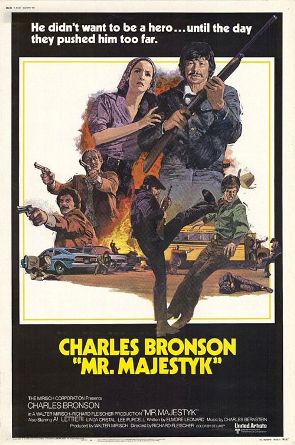
Mr_Majestyk_movie_posterWhat happens when you combine the great tough guy writer Elmore Leonard with the great tough guy actor Charles Bronson?

You get Mr. Majestyk, one of Bronson’s finest films.

Vince Majestyk (Bronson) may be a former U.S. Army Ranger instructor and a decorated Vietnam vet but now that he has returned home to Colorado, all he cares about is running his watermelon farm.  With a lucrative harvest approaching, Majestyk hires a group of unionized Mexican migrant workers, led by the fiery Linda Chavez (Linda Cristal), to pick his crops.  When a local criminal named Bobby Kopas (Paul Koslo) shows up and demands that Majestyk hire his drunken crew instead, Majestyk does what Bronson does best.  He gives Kopas an ass-kickin’ beat down.

After Kopas charges him with assault, the local police arrest Majestyk and, despite his request that he be allowed three days to finish harvesting his crop, Majestyk is thrown in jail.  Also in the jail is a Mafia hitman named Frank Renda (Al Lettieri).  Renda may be a tough guy but nobody’s tougher than Vince Majestyk.  When Renda’s associates attempt to hijack a prison bus, Majestyk ends up hijacking it instead.  Majestyk plans to hold Renda hostage until the police agree to give him his three days of freedom so he can get back to his farm.  Renda even offers to pay him off but Majestyk doesn’t care about his money.  He just cares about melons.

Because he was the only 1970s action star who could be believable as both a decorated combat veteran and a no-nonsense watermelon farmer, Charles Bronson is the only actor who could have brought Mr. Majestyk to life.  Before he became an actor, Bronson worked for a living.  From the age of ten until he enlisted in the Army, Bronson worked in the Pennsylvania coal mines, earning one dollar for each ton of coal that he mined.  Though Bronson was never a great actor, his legitimately working class background allowed him to bring an authenticity to a role like Vince Majestyk that most other actors would have lacked.  When Bronson says that all he cares about is bringing in the harvest on time, you believe him just as much as you believe him when he’s beating up Paul Koslo or hijacking a prison bus.

The rest of the cast is full of good 1970s actors who have never really been given their due.  Al Lettieri may be best known for playing Sollozzo in The Godfather but he also does a good job as Frank Renda.  Paul Koslo plays another one his sleazy villains here and does a great job as Bobby Kopas.

Mr. Majestyk was directed by Richard Fleischer but, with its colorful characters, working class hero, and modernized brand of frontier justice, the film is clearly the work of Elmore Leonard. Though Mr. Majestyk is credited as being based on a novel by Leonard, Leonard actually wrote the screenplay before the novel.

The combination of Elmore Leonard and Charles Bronson makes Mr. Majestyk one of the best action films of the 1970s.

majestyk_rifle


Shattered Politics #16: Ada (dir by Daniel Mann)


Ada_posterSouthern melodrama!

Speaking as a Southerner (well, a Southwesterner), I’ve always found in interesting that the rest of America loves to talk about how much they hate us but, at the same time, they also love books and movies set down here.  From the era of silent cinema to today with films like August: Osage County, people up north are obsessed with Southern melodrama.

It’s interesting because I’ve lived down south for most of my 29 years and there’s really not any more melodrama down here than there is anywhere else.  In fact, one of the main reasons that I enjoy watching Southern melodramas is because I enjoy seeing what the folks up north actually believe to be true.  I watch and I think to myself, “Northerners actually believe this shit.”  And then I laugh and laugh.

Take, for example, the 1961 film Ada.  Ada is pure Southern political melodrama.  (Admittedly, one of the best political films of all time — All The King’s Men — is a Southern melodrama but, to put it politely, Ada is no All The King’s Men.)

Ada tells the story of Bo Gillis (Dean Martin), a guitar-playing, singing sheriff who is running for governor of an unnamed Southern state.  Bo is running as a reform candidate but actually he’s just a figurehead for the wealthy and corrupt Sylvester Marin (Wilfred Hyde-White).  Bo is popular with the crowds, he has a great speech writer named Steve (played by the great character actor, Martin Balsam), and he has ruthless supporters who are willing to do anything to get him elected.  What he doesn’t have is a wife.  But that changes when he meets a prostitute named Ada (Susan Hayward) and marries her three weeks before the election.

At first, Sylvester demands that Bo get the marriage annulled.  Bo, however, refuses.  Fortunately, it turns out that the wife of Bo’s opponent is a drug addict.  Sylvester’s henchman Yancey (Ralph Meeker) leaks the news to the press and Bo is elected governor.

The only problem is that, once Bo is elected, he declares the he wants to run an honest administration and he starts to question Sylvester’s orders.  After the lieutenant governor is forced to resign, Ada lobbies to be appointed to the job.  Soon after Ada is confirmed, Bo is nearly blown up in his car.  While Bo is recovering, Ada serves as acting governor.  Will Ada be able to defeat Sylvester and convince Bo that she wasn’t responsible for trying to get him killed?

Watch and find out!

Or don’t.

Ada truly puts the drama into melodrama.  (It does not, however, bring the mellow.)  This is one of those films that’s full of overheated (yet strangely forgettable) dialogue and vaguely familiar character actors speaking in thick Southern accents.  Susan Hayward is so intense that you worry she might have killed a grip before shooting her scenes while Dean Martin spends most of the movie looking as if he’s waiting for the Rat Pack to show up and take him to a better party.

This is one of those films that you watch and you think to yourself, “Northerners actually believe this shit.”

And then you laugh and laugh.

44 Days of Paranoia #10: The Intruder (dir by Roger Corman)


For today’s entry in the 44 Days of Paranoia, we take a look at one of the most underappreciated films of all time, Roger Corman’s 1962 look at race relations, The Intruder.

Despite the fact that he’s regularly cited as being one of the most important figures in the development of American cinema, Roger Corman remains an underrated director.  Many critics tend to focus more on the filmmakers that got their start working for Corman than on Corman himself.  When they talk about Roger Corman, they praise him for knowing how to exploit trends.  They praise him as a marketer but, at the same time, they tend to dismiss him as a director.

I would suggest that those critics see The Intruder before they presume to say another word about Roger Corman.

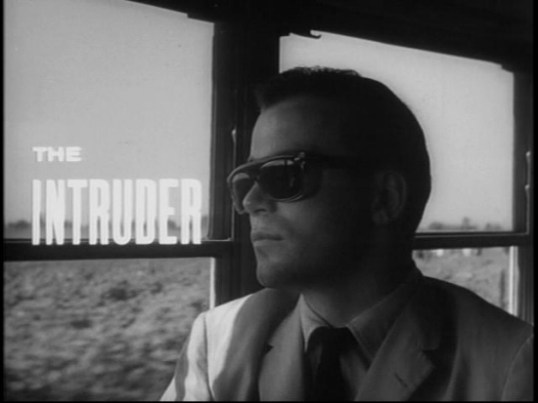
The Intruder opens with a young, handsome man named Adam Cramer sitting on a bus.  The first thing that we notice about Cramer is that he’s wearing an immaculate white suit.  The second thing we notice is that he’s being played by a very young (and, it must be said, rather fit) William Shatner.

I know that many people will probably be inclined to dismiss The Intruder from the minute they hear that it stars William Shatner.  Based simply on Shatner’s presence, they’ll assume that this film must be very campy, very Canadian, or both.  Well, they’re wrong.  Shatner gives an excellent performance in this film, bringing to life one of the most evil characters ever to appear on-screen.

Adam Cramer, you see, is a representative on a Northern organization known as the Patrick Henry Society and he’s riding the bus because he’s heading to a small Southern town.  The high school in that town has just recently been desegregated and Cramer’s goal is to make sure that no black students attend class.  As Cramer explains it, he’s a “social worker” and his goal is to help preserve Southern society.

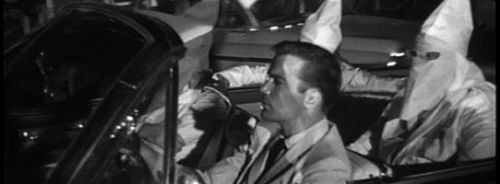
To achieve this goal, Cramer partners up with the richest man in town, Verne Shipman (who is played, rather chillingly, by Robert Emhardt).  With Verne’s sponsorship, Cramer gives an inflammatory speech in the town square and then later returns with a group of Klansmen.  As opposed to recent films like Django Unchained (which scored easy laughs by casting Jonah Hill as a Klansman and playing up the group’s ignorance), The Intruder presents the Klan as figures that have stepped straight out of a nightmare, making them into literal demons who appear at night and disappear during the day.  In a genuinely disturbing scene, the Klansmen set a huge cross on fire.  As the flames burn behind him, Cramer seduces the wife of a local salesman.

intruder-shatner-klan

After Cramer delivers his speech, the local black church is blown up and a clergyman is killed.  The editor of the town newspaper — who, before Cramer showed up, was opposed to desegregation — changes his mind and publishes an editorial strongly condemning Cramer.  Cramer’s mob reacts by nearly beating the editor to death.  Realizing that he’s losing the power to control the mob that he created, Cramer frames a black student for rape which leads the film to its powerful and disturbing conclusion.

Particularly when compared to other films that attempted to deal with race relations in 1962, The Intruder remains a powerful and searing indictment of intolerance and a portrait of how demagogues like Adam Cramer will always use fear, resentment, and ignorance to build their own power.  Corman filmed The Intruder on location in Missouri and used a lot of locals in the cast.  Judging from the disturbing authenticity of some of the performances that Corman got from some of these nonprofessionals, it’s not unreasonable to assume that quite a few of them agreed with everything that Adam Cramer was saying.

As opposed to most films made about the civil rights era in America, The Intruder doesn’t shy away from showing the ugliness of racism.  The Intruder casually tosses around the N word (and yes, it is shocking to not only hear Shatner use it but to see him smile as he does so) but, unlike a lot of contemporary films, it does so not just to shock but to show us just how naturally racism comes to the film’s characters.  The scene in which Verne repeatedly strikes a black teenager who failed to call him sir is also shocking, not just for the violence but because of how nobody seems to be particularly surprised by it.  As a result, The Intruder is not necessarily an easy film to watch but then again, that’s the point.  The hate on display in The Intruder should never be easy to watch.

The Intruder was written by Charles Beaumont, who also wrote several classic episodes of The Twilight Zone.  I think it can be argued that The Intruder represents the best work of Beaumont, Corman, and Shatner.  Unfortunately, but not surprisingly, The Intruder was the only film directed by Roger Corman to not be a box office success.

However, in a world where people are patting themselves on the back for sitting through The Butler, The Intruder is an important film that deserves to be seen now more than ever.

intruder (1962) title capture