VGM Entry 31: RPGs in ’88


VGM Entry 31: RPGs in ’88
(Thanks to Tish at FFShrine for the banner)

Nobuo Uematsu and Koichi Sugiyama were both at work in 1988, recording installments of the Final Fantasy and Dragon Quest series respectively. They both maintained their own standards, remaining at the forefront of RPG and adventure style music on the NES.

Final Fantasy II (Square, 1988) was actually a big improvement over the original. Nobuo Uematsu’s fundamental style hadn’t changed (and I would argue that it still hasn’t), but I feel like on this game he really mastered how to effectively arrange his works for the NES. I mentioned that Final Fantasy‘s arrangement felt like a finished product compared to some other genre-related games released that year, but in Nobuo’s later NES works you can start to get the feeling that the original Final Fantasy was also a sort of work in progress. It incorporated a number of slightly distorted tones which really gave his soft, subtle melodies an air of technological primitivism.

On Final Fantasy II you hear none of that. The overall sound is a lot more smooth. It’s immediately apparent in the “Main Theme” following “Prelude” in this sample. The main melody, here carried by a very soft and pretty tone, is precisely the sort of sound for which he employed a grittier, more mechanical tone in the first game. Since Final Fantasy II was released on the Famicom, not the FDS, I can’t imagine that there was any change in the platform’s capacity. I think, rather, he took some lessons from his earlier shortcomings on the production end of the spectrum.

Final Fantasy II was the first game to feature the famous “Chocobo” theme (1:40), and “Main Theme” (0:53), “Tower of Mages” (not here featured), and “Ancient Castle” (2:42) are all particularly noteworthy, but I think it’s the improved arrangement which really makes the soundtrack shine.

Dragon Quest III (Enix, 1988) is a little harder for me to assess, as I’ve somehow completely failed to acquire full soundtracks for this series. What I’ve heard seems like more of the same old, which is absolutely fine. Koichi Sugiyama seems to have continued to focus on rearranging earlier works rather than composing wholly new ones, and he had a decent amount of success in doing so. I’m not going to talk at length about a score I really know nothing about, but I thought it worth throwing out there again.

As I hope I’ve by now established though, the NES had by no means a monopoly on this style of video game music. Takahito Abe and Yuzo Koshiro’s work on Ys I is a soundtrack I’ve frequently cited, and its follow-up, Ys II: Ancient Ys Vanished – The Final Chapter (Nihon Falcom), was yet another fine 1988 sequel.

But the music here is pretty hard to come by. Takahito Abe was not a part of the sound team this go around, and Mieko Ishikawa took on the bulk of the load, with Yuzo Koshiro providing some of the more up-beat tracks, such as the one here sampled. Ishikawa isn’t a musician I’ve come across too often up to this point, but she was credited alongside Koshiro and Abe on Sorcerian, and I gather she was involved in future Ys titles. I suppose I should have featured one of her songs and not Koshiro’s, but I can’t find enough of it out there to get a good feel for it. There’s a nice sample of the song Tender People up on youtube that might give you an idea. It lacks Takahito Abe’s gentle touch, but it’s quite pretty nevertheless.

A lot of the difficulty in digging out Ys II tracks (at least in the short period of time I can allot it) stems from a remake of the game having been released for PC Engine / TurboGrafx-16 in 1989, a mere one year later. That release, Ys I & II, featured some outstanding new arrangements from Ryo Yonemitsu, but its success denies us easy access to Ishikawa’s original PC-8801 work. As far as Koshiro is concerned, some of his upbeat tracks come off quite well, but I feel like he lacked restraint on this album and ended up with a sound that just didn’t quite suite the type of game he was composing for. It’s a problem which Koshiro would thoroughly overcome over the next three years, adding such stark stylistic distinctions to his name as ActRaiser (Enix, 1990) and Streets of Rage (Sega, 1991).

Above all else in the RPG/adventure world of 1988 though, I’m most impressed by how my new-found hero Kenneth W. Arnold manages to maintain the high standards he set back in 1983.

This guy’s music blows me away every time I hear it, and his work on Ultima V: Warriors of Destiny (Origin Systems, 1988) is no exception. It’s atmospherically perfect. “Engagement and Melee” might be a simple song, but could it have been any more appropriate for a tense medieval battle? It doesn’t deliver with speed and aggression, but rather with a vision of the distant fantasy world it represents. The distortion sounds archaic in the best of ways.

There are a lot of different versions of it floating around out there, as best I understand because Apple II music is nearly impossible to rip and requires some creative liberty. But I did manage to nab a replica of the original Apple II sound as it was meant to be heard through a Mockingboard sound card, and I present these samples to you now. (Thanks again to Apple Vault.)

The aesthetics here never fail to impress me. The sound quality in “Greyson’s Tale” is exploited flawlessly, using every potential adverse limitation to the music’s advantage. The distortion and the fairly minimalistic, distinctly medieval compositions paint every ideal image you’ve ever had a of a fantasy world. There’s something not quite clear and not quite safe about all of it.

In “Dream of Lady Nan” the distorted bass is so forceful you can feel the vibrations, and the melody is crystal clear, creating an unnatural juxtaposition that’s completely haunting. I normally avoid encouraging the free download of potentially copyrighted material, but in consideration of the fact that the owners of this material have nothing to lose and everything to gain from it being distributed, I highly recommend you go download all of Kenneth W. Arnold’s works in Ultima III-V. You can find them in their ideal form at this link.

Ultima V: Warriors of Destiny. It’s not quite on par with Ultima III and Ultima IV in my opinion, and the tracks don’t loop quite as flawlessly as they used to, but it maintains the series’ standing in a complete league of its own, beyond comparison to the contemporary best efforts of Nobuo Uematsu and company. If there were other soundtracks out there like it, well, I would very much like to hear them.

VGM Entry 22: Final Fantasy


VGM Entry 22: Final Fantasy
(Thanks to Tish at FFShrine for the banner)

Final Fantasy also lacks much of a kick. Nobuo’s decision to not use any drums might have seemed surprising, had Koichi Sugiyama not done the same thing. Much like Sugiyama, Uematsu was able to craft songs which were memorable and struck a pleasant balance among the available tones. Both artists successfully mastered the positive aspects of the Nintendo’s cleaner tones.

Final Fantasy doesn’t need much of an introduction. It’s worth noting that it was fairly lengthy for its day, with nineteen full songs. Garudoh did a fine job of capturing all of the best tracks in this collection. The songs which appear here in order are:

(0:00) Prelude
(0:49) Final Fantasy Main Theme
(1:40) Overworld Theme
(2:17) Battle Theme
(3:08) Undersea Shrine
(3:46) Sailing
(4:33) Airship
(5:04) Gurgu Volcano
(5:49) Matoya’s Cave
(6:30) Temple of Chaos
(7:08) Funeral
(7:57) Victory!

I think it would be easy to be a little critical of Nobuo Uematsu’s work, considering how much better his later soundtracks became. One can easily point to later improvements in “Main Theme”, for instance, to say that the original was a little bland. But if you turn to tracks that were not improved upon in future games, “Gurgu Volcano” for example, you can tell that the originals were valuable in their own right. Where Zelda II felt to me like a prototype for a desired sound which the Nintendo was unable to produce, Final Fantasy feels like a finished project.

You will also probably get the distinct impression that Uematsu was inspired by Sugiyama. At least, I did, but this may simply be a consequence of the decision on the part of both musicians to not use a drum track. Uematsu actually had a slightly longer history of writing game music. Koichi Sugiyama started this career late in life, composing his first two game scores, Dragon Quest and Wingman 2, in 1986 at the age of 55. Uematsu’s first soundtrack, a DOS game called Genesis, came out in 1985. The difference is slight, but by the end of ’87 Sugiyama had only one more composition on the books–Dragon Quest II. In that same span of time Uematsu managed to accumulate a staggering repertoire of thirteen.

I couldn’t find samples from either artist’s first soundtrack, but if you listen to King’s Knight, a Square game composed by Uematsu and released for the MSX in 1986, you can tell that Final Fantasy was no epiphany. It might have been his first recognized and highly acclaimed work, but it was not his first good one.

Uematsu and Sugiyama were acquainted at an early stage though. In an interview on nobuouematsu.com, he states that “Koichi Sugiyama is a big boss of game music. I think he was the first person to really pay attention to my works.” Whether this came before or shortly after the release of Final Fantasy, the two were certainly aware of each other’s work.

My best guess is Sugiyama did influence Final Fantasy, but not in regards to song-writing. That talent came naturally to both of them. Rather, I get the feeling Uematsu may have taken some tips from Dragon Quest on how to effectively arrange these types of songs for the NES medium. I suppose if you got an opportunity to interview Uematsu it would be a petty question to ask, but I’m curious all the same.

Perhaps Nobuo Uematsu is still guilty in some capacity of letting the NES sound limitations get the better of him. The sort of stuff he made his career writing worked just fine in King’s Knight, but the NES just didn’t have the capacity to take it all in. Some of the best NES artists dealt with these limitations by allowing the system to dictate the musical style; they approached the NES as an instrument rather than a medium through which to present music existing independently of it. I suppose I’ve said that a lot at this point. Perhaps MSX2 version of Final Fantasy will make it a little more clear. Micro Cabin released the port in 1989, with their sound programmer Tadahiro Nitta handling the new arrangement, not Uematsu himself. Nevertheless, it sounds a lot better than the original in my opinion, and I think it might be a more honest interpritation of the music than Uematsu’s own finished product. If Uematsu had been composing for the MSX in the first place, his music would have made a lot more sense. But the counter argument is fairly obvious; if he hadn’t composed Final Fantasy for the NES the way he did, this MSX version would have never existed.

Review: Suikoden V


Konami’s Suikoden series has been a fixture in the Playstation console systems since the PS1. While not as graphically beautiful as Square-Enix’s Final Fantasy series of role-playing games, Konami’s own Suikoden rpgs more than held its own in complexity of character development and storylines. These two factors have become something the Final Fantasy rpgs have really lacked since Final Fantasy VII. I would even say the Final Fantasy series hit its high-point in Final Fantasy VI and has been downhill since. Not so with the Suikoden series. From the beginning the series has beautifully combined characters and storylines to create a game that still uses the basic stats and experience mechanics of most Japanese RPGs but with a unique brand of npc recruiting and a wholly realized complex world which grows and reveals itself with each successive game in the series.

In 2006, Konami released Suikoden V in North America and there were some trepidations on how well the game would turn out. The previous game in the series, Suikoden IV, was abit underwhelming in its execution. A rarity in the Suikoden series in that the game was just ok; with some fans calling it awful. But even Suikoden IV still played better and its story less cliche than most rpgs coming out of Japan. Suikoden fans needn’t have worried about this latest entry in the series. Suikoden V doesn’t bring anything new or innovating in terms of graphics to the genre (but then these games never has in the past) but what it did was bring back the series to the high-standard of character development and storyline the series was very well-known and critically-acclaimed for.

Set six years before the events which played out in Suikoden I, Suikoden V takes places in the Queendom of Falena whose current Queen has in her possession the Sun Rune. The Sun Rune is one of the 27 True Runes which makes the backbone of what makes the critical events of the Suikoden Universe so unique to the role-playing genre. Queen Arshtat rules Falena with the Sun Rune but events prior to the beginning of the game (told in flashback) has set into motion a dangerous game of political machinations and powergrabbing between two powerful groups in the Houses of Barows and Godwins with the Sun Rune in the middle of it all.

The player is given control of Queen Arshtat’s only son to figure out just what sort of secret plans either Houses has in store for the Royals. Accompanying the player are Arshtat’s sister Sialeeds, his bodyguard and lifelong friend Lyon, and Georg (a familiar face for those who have played the previous games in the series). As the game’s story unfolds the complexity of the power struggle between Barows and Godwins and those of the Falenan Royal Family becomes more than a struggle for the realm of Falena but for its ultimate survival as something powerful and beyond human comprehension has slowly influenced those in close proximity. There’s moments of extreme sadness and ultimate sacrifices and love. Machiavellian plots and counterplots from both the protagonists and antagonists keep the player guessing as to how the story will play out. There’s also betrayals and genocidal actions which gives this entry to the series the dark edge the previous fourth Suikoden lacked.

Unlike most JRPG’s (Japanese RPGs), Suikoden V doesn’t have an end-of-the-world storyline but one which stays regional, but makes the plot no less epic and actually gives the game more freedom in how the story unfolds. The game’s story has to rank up there with Suikoden II‘s as one of the best rpg storylines ever and only lags behind the second game due to that game’s having a brilliant and memorable villain in one Luca Blight. The main characters and most of the 108 Stars of Destiny characters were well-written with their own distinct personalities and motivations for joining the fight. The dialogue during the game is mostly done through text with each character show in anime-style profiles. The cutscenes on the other hand uses voice acting which for a rpg was done pretty well with voice actors who actually gave each character voiced a distinct personality. It would’ve been nice if Konami had included the Japanese voice-acting in addition to the English translation. It’s a minor gripe, but nothing that takes away from making Suikoden V such a great game.

The gameplay mechanics returns back to the 6-party formation from the first three games in the series. There’s still the usual co-operative attacks when certain combinations of characters are put in the battle party. The co-op attacks could involve just two characters all the way up to six characters combining to create devastating non-runic attacks. There’s also co-op attacks between characters using runes. These combined runic attacks are some of the most damaging attacks in the game and allows the player a reason to actually bring a balanced party of 6 characters that’s made up of fighter strong in physical attacks and those adept in runes. The newest change in the battle mechanics occur in the war battles. Gone is the turn-based system that’s worked well in the first four games. Suikoden V‘s war battles now takes place in real-time which makes for much more hectic battles. The player must constantly know where each of his units are and how they’re stacked up against the opposing forces.

Suikoden V is a great game and also brings the Suikoden series back to great form after an interesting but lackluster attempt at innovation with Suikoden IV. This fifth entry did everything right in what made the series great. It had a great and compelling storyline with complex and distinct characters. Suikoden V misses surpassing the great Suikoden II in greatness just due to that game having certain classic and memorable characters. This is an unfair comparison but something that still puts the second game ahead of V, but just barely. That shows just how great this game really is. Already announced by Suikoden’s creators that V will be the last Suikoden game for this current generation of Playstation console system. While the title hasn’t made a return to consoles that’s not handheld if this was the last game in the series then it was a proper send-off.

Song of the Day: Suteki Da Ne (by Uematsu Nobuo)


maxresdefault

The newest Song of the Day is a favorite piece of video game music of mine.

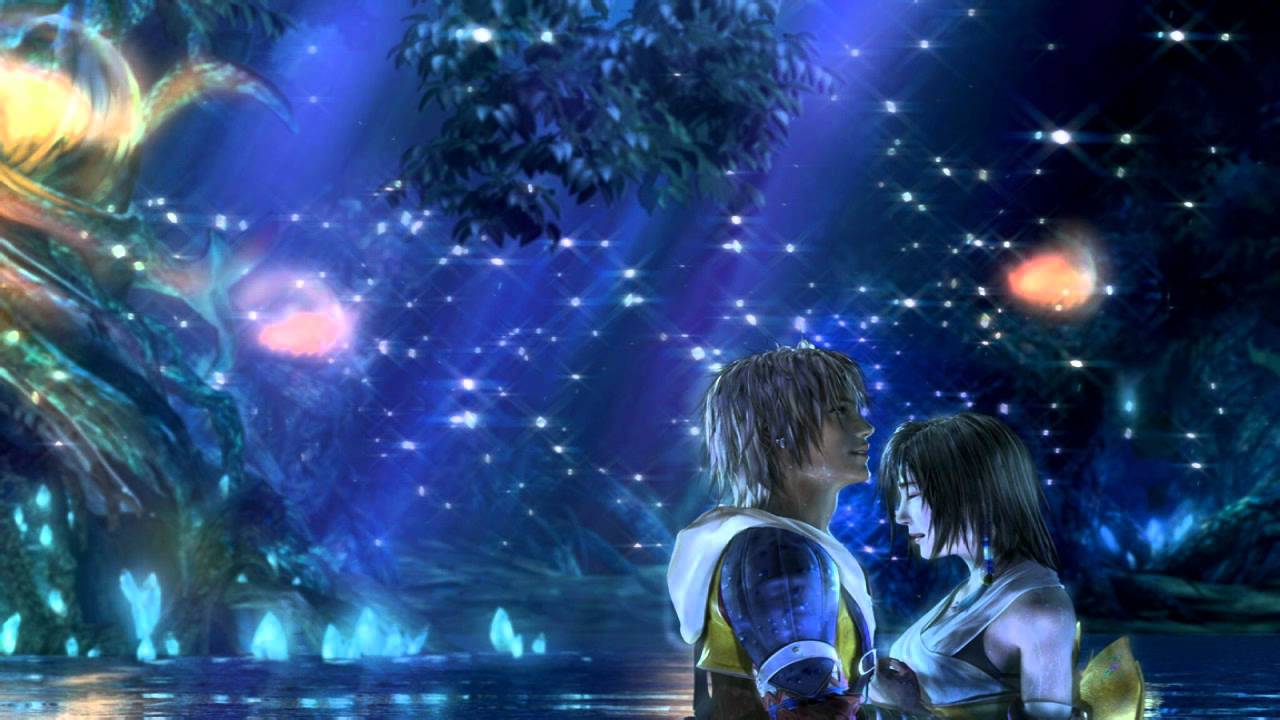
“Suteki Da Ne” is the love theme to Square-Enix’s very popular and long-running rpg series Final Fantasy. The song would mark the point in the game when the lead male and female characters finally realize their love for each other. It’s become a favorite of many game score aficionados and especially those of Japanese game soundtracks. Some consider it one of the best pieces of video game music there is, but that would be going a tad too hyperbolic.

The song is composed by well-renowned game music composer Uematsu Nobuo. He had been instrumental in composing the music for most of the Final Fantasy games until he left Square-Enix in 2004. “Suteki Da Ne” also had other collaborators outside of Uematsu. The lyrics for the song was written by Final Fantasy X scenario writer Nojima Kazushige while the arrangement for the song was done by Hamaguchi Shiro. In the end, most of the credit for the song really belongs to Uematsu-san. He was able to compose a song that worked to not just score a lovely and emotional scene between the two leads in the game but also convey their feelings very clearly through the music.

The lyrics below includes both the original Japanese version as sung by Japanese pop-idol RIKKI and the English translation.

Suteki Da Ne (Isn’t It Wonderful)

Kaze ga yoseta kotoba ni
Oyoida kokoro
Kumo ga hakobu ashita ni
Hazunda koe

(My heart, swimming
In the words the wind has borne
A voice, bouncing
On a tomorrow carried by clouds
)

Tsuki ga yureru kagami ni
Furueta kokoro
Hoshi ga nagare, koboreta
Yawarakai namida

(A heart, trembling
On a mirror where the moon quivers
A star falls, spills
Gentle teardrops)

Suteki da ne
Futari te o tori aruketa nara
Ikitai yo
Kimi no machi, ie, ude no naka

(Isn’t it wonderful
If we could walk, holding hands
I’d want to go
To your town, your house, into your arms
)

Sono mune
Karada azuke
Yoi ni magire
Yume miru

(To your heart
I leave my body
Mixed into the night
I dream)

Kaze wa tomari; kotoba wa
Yasashii maboroshi
Kumo wa yabure; ashita wa
Tooku no koe

(The wind stops; your words
Are a kind illusion
The clouds break apart; tomorrow
Is a distant voice
)

Tsuki ga nijimu kagami o
Nagareta kokoro
Hoshi ga yurete, koboreta
Kakusenai namida

(A heart flowing
In a mirror where the moon has seeped in
A star wavers, spills
Tears you can’t hide)

(kurikaeshi)(repeat)

Sono kao
Sotto furete
Asa ni tokeru
Yume miru

(That face
Touch it, just so
And dream a dream
That melts in the morning)

Warhammer 40K: Dark Millenium Trailer


E3 2010 has made some announcements in regards to several MMORPGs set for release in the near future. One game is Square-Enix’s Final Fantasy XIV which is the sequel to their previous MMORPG in Final Fantasy XI. The second is BioWare’s much-anticipated MMORPG based on George Lucas’ iconic space opera franchise, Star Wars: The Old Republic. Both titles have their fanbase looking forward to play them if just to take a break from the 800 lb. gorilla of the MMO-world: World of Warcraft.

Flying under the radar, but no less anticipated by their own legions of fans is Vigil Studios and THQ’s foray into the MMORPG genre. I am talking about their MMORPG title based on the very popular Games Workshop IP, Warhammer 40,000. Building upon the success and popularity of THQ’s own Dawn of War franchise (also based on the 40k universe), this MMORPG is to be called Warhammer 40K: Dark Millenium Online.

I’m not a huge fan of MMORPG titles since despite how well they play and how much they really look they’re major timesinks that require almost complete dedication from the player to really get into the game. This means almost leaving other games by the wayside and as a gamer that’s a big decision. Either play one game all the time and ignore other great games or only play casually the MMO title and not really get into it.

With this title I may have to rethink about how I feel about MMORPGs since this is one IP that even I am excited over. I have been a huge Warhammer 40K fan since 1990 when I was a senior in high school and my interest has never waned one bit. Now that the franchise has successfully made it’s transition over to video gaming I’m excited for the prospect of enjoying the franchise even more than just reading the lore and playing the tabletop.

The game looks to be like your typical persistent-world MMORPG with two opposing factions having their own unique classes. What I like from looking at the trailer is how heavily it’s based on combat and from the looks of things it might be similar to another scifi-based MMO of the past and that’s Sony’s very own Planetside. I like that vehicles are something that a player can use to fight NPCs and other players of the opposing faction. The only question I and other fans probably have is whether Vigil and THQ will avoid the mistakes Mythic made with Warhammer Online by actually creating a game with an endgame for people to use as their goal.

I’m sure more details will follow as the months pass by. Here’s to hoping that a release date or, at the very least, a beta date for people to participate in, gets announced in the near future. I already know what I shall play and that’s as a Space Marine and hopefully of the Dark Angels Chapter.

AMV of the Week: Bustin’ – Advent Children


The AMV choice for the week won the AMV Best Concept award at 2008 Anime Boston. One I happen to have attended which I must do once again in the near future. While I’m not a huge fan of Square-Enix’s Final Fantasy VII: Advent Children I will say that the theme song from Ghostbusters seemed to have meshed well with scenes from FF7:AC. Again, this is one of the few AMV’s which I actually like. Enjoy!