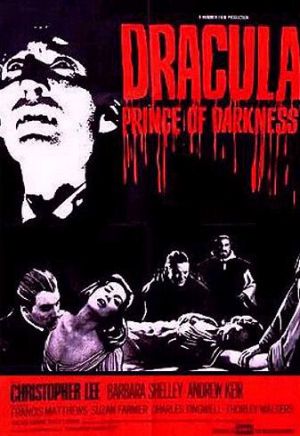
Christopher Lee often went on record about how much he disliked most of the Hammer films in which he played Dracula, feeling that Hammer didn’t really understand the character of Bram Stoker’s famous vampire. In fact, when Lee agreed to appear in 1966’s Dracula: Prince of Darkness, he did so with the requirement that he would not have any dialogue.
While it’s possible that Lee may have been hoping that his demand would force Hammer to release him from his contract, his requirement actually works to the film’s advantage. In the scene below, Lee shows that he didn’t need dialogue to make Dracula into a terrifying and malevolent force. Lee’s otherworldly and dangerous charisma and Dracula’s feral and vicious nature come through without him saying a word.
4 Shots From 4 Films is just what it says it is, 4 shots from 4 of our favorite films. As opposed to the reviews and recaps that we usually post, 4 Shots From 4 Films is all about letting the visuals do the talking.
Today’s director: one of the masters of Hammer horror and the director who brought back to life both Dracula and Baron von Frankenstein, Terence Fisher!
4 Shots From 4 Terrence Fisher Films
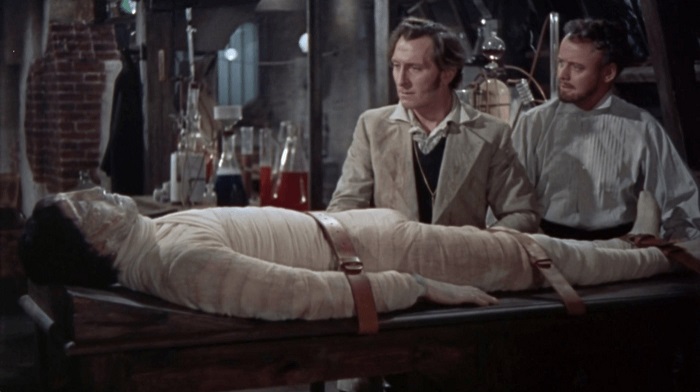
The Curse of Frankenstein (1957, dir by Terence Fisher, DP: Jack Asher)
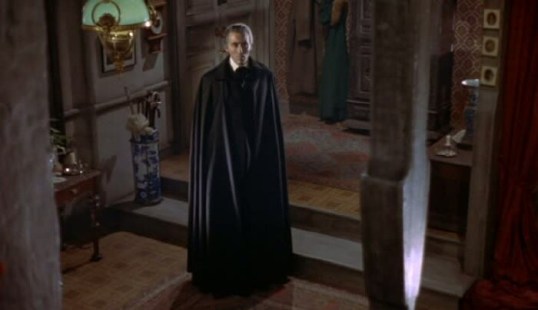
The Horror of Dracula (1958, dir by Terence Fisher, DP: Jack Asher)
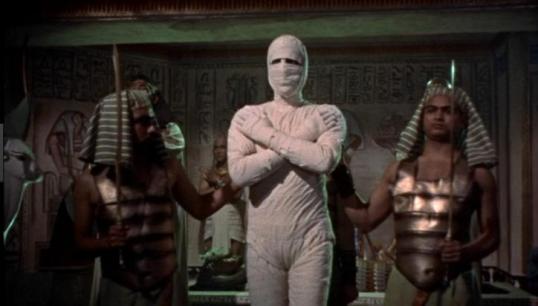
The Mummy (1959, dir by Terence Fisher, DP: Jack Asher)
The new version of Salem’s Lot, which has finally been released on Max after sitting on the shelf for nearly three years, is not very good.
At the same time, it’s definitely not terrible. There are a few effective scenes. The finale, which is a bit different from what happens in the book, is enjoyably berserk. The film made good use of Gordon Lightfoot’s Sundown and, as a history nerd, I appreciated the fact that the movie used the book’s original 70s setting as opposed to trying to update the whole thing. When writer Ben Mears (Lewis Pullman) wants to investigate the history of the old Marsten House, he has to go to the library. People looking up stuff on microfiche is always, from a cinematic point of view, more compelling than them pulling up Wikipedia.
Ultimately, the movie is just kind of forgettable. It’s mediocre in the bland way that so many recent horror films have tended to be. The movie’s style has far more in common with David Gordon Green’s unfortunate forays into horror than to anything done by Mike Flanagan. While it may not have originally been meant for a streaming release, streaming is where it begins because it feels like something that would get dumped on Netflix without much fanfare.
It’s a shame because Salem’s Lot really is one of Stephen King’s better novels, written at a time when King was still embracing his pulpy side and without any of the self-important commentary that’s come to mar some of King’s more recent works. The novel is essentially a small town soap opera, documenting the often sordid lives of the citizens of Jerusalem’s Lot. King introduces a vampire to the mix and most of the town’s problems are solved by folks dying and then coming back from the dead. Ben Mears is a typical King protagonist, a writer from Maine who is trying to deal with a childhood trauma and who discovers that ‘Salem’s Lot has a long and apparently cursed history. In both the book and the movie, Ben teams up with a group of vampire hunters to battle Kurt Barlow (played here by Alexander Ward) and his human servant, Straker (Pilou Asbaek).
The book works because it takes the time to turn Salem’s Lot into a vivid community and, as such, it’s hard not to feel the loss as the town dies off as a result of Barlow’s vampiric invasion. Clocking in at less than two hours, the movie really doesn’t have time to do that. The movie’s version of the town just comes across as being another stereotypical New England town, full of flinty characters and mudrooms. The community never comes to life and, as such, there’s not much emotional resonance as the community dies off. (It’s not a coincidence that the most successful adaptation of Salem’s Lot was a miniseries.) Add to that, the 2024 film features some truly unfortunate acting, which again makes it difficult to accept the town as a community with its own traditions and culture.
There are certain character types and themes that seem to appear in all of Stephen King’s novels and the subsequent adaptations. At its worst, the new Salem’s Lot feels like it’s quickly going through a checklist of all of the expected Stephen King elements. It’s like, “Main setting — check! Writer protagonist — check! Schoolyard bully — check! Child in danger — check!” The end result is a film that feels almost like a parody Stephen King, containing all of his familiar tropes without any of the literary flair that made the original book a classic of vampire literature.
The good thing is that the Tobe Hooper adaptation holds up well and it’s also available on Max. Check it out this weekend.
As some of our regular readers undoubtedly know, I am involved in a few weekly live tweets on twitter. I host #FridayNightFlix every Friday, I co-host #ScarySocial on Saturday, and I am one of the five hosts of #MondayActionMovie! Every week, we get together. We watch a movie. We tweet our way through it.
Tonight, for #ScarySocial, I will be hosting Mario Bava’s Baron Blood!
If you want to join us on Saturday night, just hop onto twitter, start the film at 9 pm et, and use the #ScarySocial hashtag! The film is available on Prime and Tubi! I’ll be there co-hosting and I imagine some other members of the TSL Crew will be there as well. It’s a friendly group and welcoming of newcomers so don’t be shy
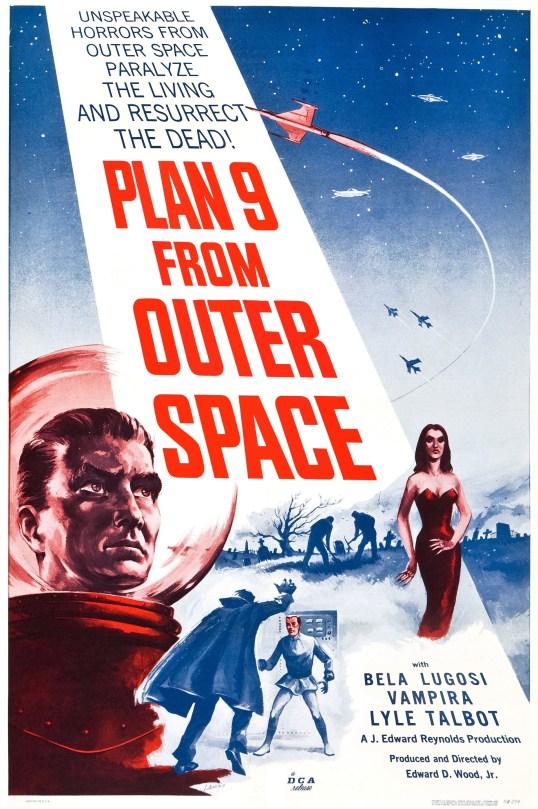
Viewing Plan 9 From Outer Space during October is a bit of a tradition around these parts and here at the Shattered Lens, we’re all about tradition. And since the 100th anniversary of the birth of Ed Wood, Jr. is just a five days away, it just seems appropriate to watch his best-known film.
Speaking of tradition, this 1959 sci-fi/horror flick is traditionally cited as the worst film ever made but I don’t quite agree. For one thing, the film is way too low-budget to be fairly judged against other big budget fiascoes. If I have to watch a bad movie, I’ll always go for the low budget, independent feature as opposed to the big studio production. To attack Ed Wood for making a bad film is to let every other bad filmmaker off the hook. Ed Wood had his problems but he also had a lot of ambition and a lot of determination and, eventually, a lot of addictions. One thing that is often forgotten by those who mock Ed Wood is that he drank himself to death and died living in squalor. The least we can do is cut the tragic figure some slack.
Plan 9 From Outer Space is a ludicrous film but it’s also a surprisingly ambitious one and it’s got an anti-war, anti-military message so all of you folks who have hopped down the progressive rabbit hole over the past few years should have a new appreciation for this film. I mean, do you want the government to blow up a Solarnite bomb? DO YOU!?
Also, Gregory Walcott actually did a pretty good job in the lead role. He was one of the few members of the cast to have a mainstream film career after Plan 9.
Finally, Plan 9 is a tribute to one man’s determination to bring his vision to life. Ed Wood tried and refused to surrender and made a film with a message that he believed in and, for that, he deserves to be remembered.
Now, sit back, and enjoy a little Halloween tradition. Take it away, Criswell!
2017’s Thy Neighbor led me to spend way too much time thinking about neighborhood hot tub etiquette.
Amber Reynolds (Jessica Koloian) is the wife of pastor Zach Reynolds (Nathan Clarkson). Zach used to be fat. Zach used to pick fights and carry a gun. However, Zach lost a ton of weight, wrote a book about how he got thin and conquered his anger issues, and is now something of a celebrity. He’s been invited to be the new pastor at the local megachurch and, upon moving into their new home, Amber makes it a point to bake cookies for all of her new neighbors. One of the neighbors (Dave Payton) — who is simply called The Neighbor for the majority of the film — doesn’t care much for church but he sure does like those cookies. Zach thinks that the Neighbor is creepy and he doesn’t want Amber having anything to do with him. Amber thinks that the Neighbor needs someone to talk to so she invites him to come relax in the hot tub with her.
Seriously….
My neighbors across the street have a hot tub and I’ve pretty much got an open invitation to use it whenever I want. Many a night, we’ve all relaxed in the hot tub and talked about whatever we felt like talking about at the time. But I’m also extremely close to my neighbors. I have a lot in common with my neighbors, as we all graduated from the same college and we tend to have similar cultural and political outlooks. They’re friends, along with being neighbors and it also helps that we all look in our swimsuits. And even so, they still got to know me a little before they said, “Hey, feel free to come use our hot tub whenever you feel like it.” My point is that I have a hard time buying that anyone, regardless of how nice they are or how much they want to help their husband win points around the neighborhood, would invite a total stranger to strip down and join them in the hot tub. That’s especially true when you’re the mother of a young son and your husband is away from the house and when the stranger in question is kind of creepy and bizarrely aggressive in the way that he talks to people.
Zach is not amused to return home and find the Neighbor in the hot tub. After the Neighbor leaves, Amber argues that Zach needs to make an effort to reach out to everyone, even creepy people like The Neighbor. As for The Neighbor, he starts trying to break up Zach and Amber’s marriage by trying to get Zach to lose his temper and trying to convince Amber that Zach is having an affair with a church secretary….
This is not a typical faith-based film. It’s a thriller, one that conveys its message with a minimum amount of preaching and which features a trio of strong performances from Koloian, Clarkson, and Payton. The film argues that everyone should be treated with kindness while, at the same time, acknowledging that some people are very, very annoying. The Neighbor is a total creep but he’s also someone who appears to have spent a good deal of his life being victimized. Unusually for a film of this sort, Thy Neighbor ends on a rather dark and melancholy note, again acknowledging that things are not always as easy as the movies would have us believe. Amber is determined to be kind while Zach cannot let go of his suspicions. In the end, it’s obvious that it’ll take more than a few hours in the hot tub to fix these broken souls.
As we started to watch 1984’s Splatter University, Jeff warned me that, “This is not a great movie.”
I laughed. “Hey,” I said, “I just watched Satan’s Children. How bad can it be?”
I looked at the screen and was immediately confronted by a poorly animated picture of the New York Skyline.
“Oh crap,” I said.
Four words appeared on screen: “A Troma Team Release”
“Oh, no!” I shouted….
Still, I’m not one to stop watching a film once it starts so I watched the entirety of Splatter University. Fortunately, it was only 78 minutes long and, regardless of what else one might say about it, it did not waste much time getting to the murders. Within the opening few minutes, an orderly in a mental hospital got stabbed in the crotch, with the camera zooming in on the blood spurting out from his groin, The patient who stabbed him took the orderly’s clothes (which, quite frankly, should have been covered in blood so I’m not sure that they would actually be the ideal disguise) and makes his escape.
Three years later, a sociology professor is brutally stabbed to death in her classroom at St. Trinian’s College and again, the camera zooms in on the spurting blood, as if to make sure that no one accuses the film of lying about the “splatter” part. Her quickly-hired replacement is Julie Parker (Forbes Riley), who soon notices that someone seems to be murdering her students. Being a good teacher, Julie decides to protect her students by figuring out who the murderer is at St. Trinian’s College. Fortunately, there aren’t that many suspects, for two reasons. Number one, the students and faculty die with such frequency that it’s easy to guess who is responsible by process of elimination. Number two, it appears that the makers of this film could only afford a handful of actors. St. Trinian’s appears to have about twenty students and most of them appear to be in their early forties.
On the one hand, as I mentioned previously, Splatter University does live up to its name. It’s obvious that the production didn’t have a huge budget but it appears that the majority of what the filmmakers did have was spent on fake blood and entrails because a lot of blood is spilled and one particularly gruesome scene even involves intestines spilling out of a body. Agck! (Seriously, the sight of the large intestine always freaks me out.) I really can’t fault the film as a slasher flick, even if the killer’s identity is obvious. That said, this was still a Troma release and, as such, there’s a lot about it that sucks. Apparently, the original film was too short so Troma added some badly acted, “comedic” scenes of the students acting stupid. Those scenes pad out the film’s length but they also screw with the pacing and they distract the viewer from what is otherwise a crudely affective, low-budget American giallo film. But that’s Troma for you!
(And, let’s be honest — how can you not love Lloyd Kaufman?)
The 1974 film, Satan’s Children, tells the story of unfortunate Bobby Douglas (Stephen White).
Bobby is a teenager who lives in a hideous suburban house with his stepfather (Eldon Mecham) and his stepsister (Joyce Molloy), who looks old enough to be Bobby’s mother. Bobby’s a rebellious kid who doesn’t understand why he should always have to cut the grass while his stepsister hangs out by the pool. Bobby is sick of the whole scene, man. When his stepfather yells at Bobby for having a small stash of marijuana in his room, Bobby decides to run away from home. Seriously, that scene was totally melvin so I don’t blame Bobby.
Bobby goes to a bar, where an old man tries to talk to him until Jake (Bob Barcour) tells the old man to get lost. Jake tells Bobby that he has to be careful because there are perverts all over the place. Bobby nods and laughs because Bobby’s not a square. He knows what’s up. Jake invites Bobby to come hang out at his place and Bobby is like, “Cool, way too friendly stranger, I’ll get you in your rape van.” Bobby goes home with Jake and is promptly raped. With Bobby naked and bound, Jake calls all of his friends over and Bobby is then gang raped. The scene where Jake and his friends drive the bound Bobby around is pure nightmare fuel and I can only imagine how audiences in 1974 reacted to it.
The next morning, a group of hippies found Bobby lying in a field and they take him back to their commune. Of course, these folks aren’t just hippies. They’re also Satanists! Sherry (Kathleen Marie Archer) wants to let Bobby stay with them while she nurses him back to health. Joshua (John Edwards), an older member of the group, says that Bobby isn’t welcome because Bobby is probably “queer.” Simon (Robert C. Ray II), the turtleneck-wearing leader of the group, is also hesitant to allow Bobby to stay and again, it’s because Simon assumes Bobby must be gay. Simon also makes it clear that he doesn’t want any lesbians in his Satanic cult either. He just wants people who are prepared to carry out a blood sacrifice….
(I swear, that Satan. Not only is he the ruler of Hell and the tormenter of souls and the fallen angel responsible for getting Adam and Eve kicked out of the Garden and bringing sin into the world, he’s also apparently a massive homophobe!)
While the Satanists torture Sherry for displeasing Simon, Bobby tries to figure out a way to escape. Fair warning: the majority of the film’s finale involves Bobby running around in tighty-whities, which get progressively more and more mud-stained as the movie goes on. Seriously, ew! On the other hand, not one but two people manage to die as a result of accidentally wandering into quicksand. If nothing else, it’s a reminder that Bobby isn’t the only incredibly stupid person in the movie.
This is a weird movie. I imagine it was made to capitalize on the notoriety of the Manson Family but, with its extended opening scenes in the suburbs, it instead becomes an ennui-drenched look at how far people will go to escape conventional society. Despite all the of the truly terrible things that happen to him, Bobby is not a sympathetic or likable character. In fact, he comes across as being just the type of idiot who probably would get sucked into a cult. That said, the film is truly a unique (if rather slow) experience and the brutal ending took me totally by surprise. Like many grindhouse film, Satan’s Children is an oddity that you truly can’t look away from.
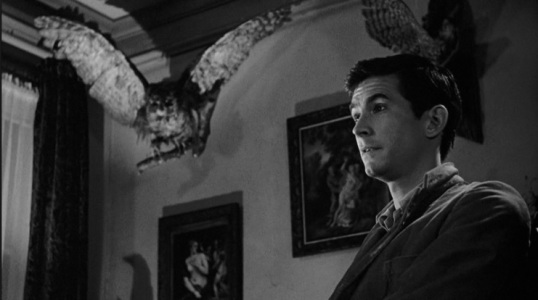
You have to feel a bit bad for Anthony Perkins, who was an Oscar-nominated star of film and Broadway and something of a teen idol before he was cast as Norman Bates in Alfred Hitchcock’s 1960 masterpiece, Psycho. Perkins was so convincing in the role that he pretty much spent the majority of his career either playing variations of the character or appearing in small roles where his macabre screen image would not be too much of a problem. Perkins gave one of the best film performances of all time and his career never really recovered from it.
Unfortunately, there’s a tendency to overlook just how good Anthony Perkins was in this first Psycho. People look at his later, less-compelling performances and they make the mistake of thinking those performance were the best that Perkins was capable of giving. Perkins was a fine actor and never better than when he played Norman. The scene below highlight how Perkins managed to make Norman Bates both poignant and creepy at the same time.
Released this year, Gacy: Serial Killer Next Door tells the story of two neighbors in the 70s.
Bobby (Mason McNulty) is a typical 7os teenager, with long hair and a laid back attitude. He’s what my grandparents used to call a “good kid.” He helps out his neighbors and he only charges 50 cents an hour. When he sees someone new moving in, he immediately offers to help the man unload all of his furniture. He gets along with his parents. He’s popular with his friends. Bobby seems destined to grow up to become the type of guy who you would want living next door to you.
His new neighbor is named John (Mike Korich). John is a small businessman with local political ambitions. He entertains at parties under the name Pogo the Clown. He has a loud and, if we’re going to be honest, somewhat grating laugh. He’s a dorky guy but he seems to be super-friendly. In fact, he’s a bit too friendly. He’s very quick to invite young men like Bobby to come home with him. Bobby can’t help but notice that John’s new friends enter the house but they don’t ever seem to leave.
“I’ve never met anyone named John Wayne before,” Bobby says, when he first meets John.
“My mother named me after a cowboy,” John Wayne Gacy replies.
Soon, Bobby’s curiosity gets the better of him and he starts investigating Gacy on his own. He comes to believe that Gacy is murdering the men that he brings home and then keeping their bodies in the house. Unfortunately, no one wants to believe Bobby. John, a murderer? Friendly, clownish, buffoonish John? “He works for the Democrats!” Bobby’s mother says at one point, a line that genuinely made me laugh.
There’s a lot of laughter to be found in Gacy: Serial Killer Next Door. John Wayne Gacy loves to put on his clown makeup, kill people, and laugh. The laughing gets old pretty quickly, to be honest. The real-life John Wayne Gacy was executed after less than 20 years on Death Row. If his real-life laugh was anything like his laugh in the movie, I’m surprised that they weren’t any quicker about doing away with him.
The real-life John Wayne Gacy was one of the worst serial killers in American history. He killed dozens, so much so that he’s still considered to be a suspect in several unsolved murders. He tortured his victims in the worst ways imaginable. And he never even bothered to fake any sort of remorse for his crimes. Instead, after he was jailed, he sold Gacy merchandise to morbid collectors. His last words, before being put to death, were reportedly, “Kiss my ass.” John Wayne Gacy is the type of murderer who makes people like me, who are against the death penalty in general, seriously reconsider their feelings.
Considering how terrible Gacy and his crimes were, it’s a bit odd that Gacy: Serial Killer Next Door almost plays out like a comedy at time. The film portrays Gacy as being so openly evil that it’s hard not to smile whenever an adult refuses to believe Bobby’s claim that there might be something wrong with the man who enjoys wearing clown makeup and carrying around a set of handcuffs. A scene where Gacy comes over to Bobby’s house and asks if he can use the phone is pure cringe comedy. The problem is that I don’t think that the scene was meant to be comedic.
Gacy: Serial Killer Next Door is a bit of a misfire as a true crime film, as it gets the majority of the facts wrong. (That said, it was correct about John Wayne Gacy being a Democrat.) It works as a comedy but one could argue that a film about John Wayne Gacy should not be a comedy, even if it is largely unintentional on the part of the filmmakers. Mason McNulty gave a good and sympathetic performance as Bobby and Mike Korich was properly creepy as Gacy.
In the end, we should probably just be happy that John Wayne Gacy is dead.
 Through the Shattered Lens