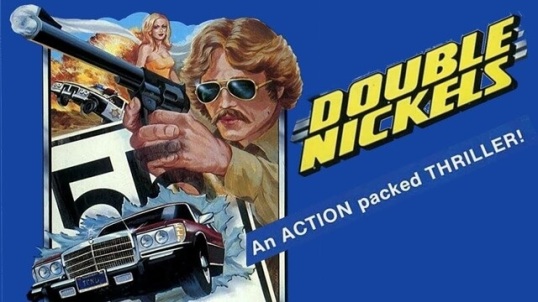
First released in 1977, Double Nickels tells the story of two California highway patrolman. Smokey (Jack Vacek) and Ed (Ed Abrams) have been tasked with enforcing the speed limit but they’re usually too busy chasing each other up and down the highway to worry about doing their job and, in fact, they even have a friendly relationship with the local street racers.
Now, you may think Smokey and Ed are just wasting the tax payer’s money by taking such a casual attitude towards their work and technically, you’re right. But let’s be honest. Nobody likes the speed limit. There’s a reason why it’s usually the rural speed limit signs that end up getting used for target practice. Smokey and Ed are a part of the system for the paycheck but, deep down, they hate the system just as much as the rest of us do. They’re fighting the Man by taking his money and refusing to enforce his rules.
Anyway, one day, Smokey and Ed pull over George (George Cole). George explains that he’s got a pretty good thing going as a repo man. He and his associates drive up and down the California highways, repossessing cars for non-payment. George says that he could always use some help and Smokey and Ed decided to take him up on the offer. The only problem is that, as employees of the Highway Patrol, they’re not allowed to moonlight. So, when they repossess a car, they have to do it without getting caught by either the local police or the car’s former owners.
Double Nickels establishes its pattern early on. Smokey and Ed stake out a house and see the car that they’re repossessing. They repossess the car. They end up getting chased around by either the cops or the car’s owner or both. Smokey and Ed trade a few lame quips and then flirt with their waitress girlfriends. Eventually, George realizes that the people who have hired him are actually car thieves and Smokey and Ed have to break up the car theft ring but, regardless of any individual complications, the pattern pretty much remains the same throughout the film, with mild comedic moments followed by an elaborate car chase.
As long as the film focuses on the cars, it’s fine. The cars are the true star of the film. Jack Vacek and several other members of the cast and crew were previously involved with the production of the original Gone In 60 Seconds. Double Nickels never comes anywhere close to being as entertaining as Gone In 60Seconds but the car chases are still exciting enough to hold the viewer’s attention. Where Double Nickels struggles is whenever the focus shifts to the guys driving the car, as neither Jack Vacek nor Ed Arbams were particularly charismatic actors and neither really had the comedic timing necessary to pull off the film’s humor.
Despite its flaws, Double Nickels does have something of a following. Its popularity actually makes sense. Because the film’s plot is so simple, you can literally start watching the film at any point and automatically know exactly what’s going on. The makers of Double Nickels understood that, above all else, audiences love to watch fast cars do their thing.
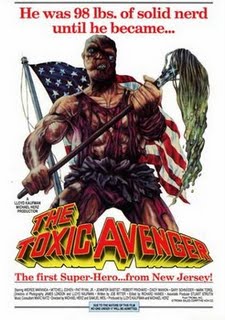
First released in 1984, The Toxic Avenger takes place in Tromaville, New Jersey, which is perhaps the ugliest city in …. well, honestly, it’s probably the ugliest city in the world. The streets are strewn with trash. The walls are covered in graffiti. The majority of the citizens are either bullies or idiots. The mayor is corrupt and totally willing to sell out his city to anyone willing to cut him a big enough check. Is it a surprise that Tromaville is also the “toxic waste capitol of the world?”
(“Forget it, Lisa. It’s New Jersey.” Hey, I hear you, Paulie.)
Tromaville is also the home of Melvin Ferd Junko III (Mark Torgl), who is so nerdy that even I was immediately annoyed by him. Melvin has a job working as a janitor at the local health club. Melvin doesn’t want to bother anyone but four members of the gym still decide to trick him into wearing a pink tutu and nearly having sex with a sheep. In typical Troma fashion, this leads to Melvin falling out of a second story window and into a vat of toxic waste. Melvin bursts into flames and jumps into a bathtub to douse the fire. However, when he emerges from the bathtub, he is no longer Melvin. Now, he is a grotesque and muscular mutant (and he’s now played by Mitch Cohen).
It’s time to get some justice!
Of course, since this is a Troma film, Melvin’s idea of justice may not be everyone’s idea of justice. Yes, Melvin does stop a lot of muggings and he does break up a drug ring. Of course, he does that by killing those criminals and allowing their guts to graphically splatter all over the street. (Cheap as this film is, it’s obvious that some care was put into creating the gore.) However, Melvin also stalks the bullies who were responsible for transforming him into the Toxic Avenger and he murders them with a sadism that is equal to their own. And again, it’s not like the bullies don’t deserve to suffer. I mean, one of the bullies is actually named Slug and he lives up to the name! (That said, you’re kind of dooming your child to a certain fate when you give him a name like Slug.) But still, it’s hard not to notice that The Toxic Avenger is a super hero who is as destructive as the villains he’s taking down. It’s a good thing that Tromaville seems to be exclusively populated by scumbags.
Actually, there are two good people in Tromaville. One is Marisa Tomei, who appears for a split second in one of her earliest roles. I simply can’t imagine that Marisa Tomei would have supported bullying Melvin. The other good person is Sara (Andree Maranda), who is blind. After the Toxic Avenger saves her from a rapist, she falls in love with him. Eventually, Sara even touches his deformed face and declares him to be beautiful. The city may be worshipping their new hero and the corrupt mayor (played by Pat Ryan Jr.) may be desperately trying to take the Avenger down but ultimately, The Toxic Avenger just wants to escape the city and be with Sara. Indeed, the saving grace of The Toxic Avenger is that Sara and the former Melvin really are a sweet couple and you really do hope things work out for them.
The Toxic Avenger, with its mix of comedy, horror, and gore, was one Troma’s first big hits and it remains one of their most popular films. (Macon Blair has directed a remake, which should be opening soon.) Personally, for me, the film is a bit too repetitive and the humor is pretty much hit-and-miss. There’s a lot of scenes, especially in the health club, that were obviously only included to pad out the film’s running time and, as such, the film takes a while to really get going. It may better than the average Troma film but that’s not exactly a hard bar to clear. That said, I did like the relationship between Sara and The Toxic Avenger. For all the crudeness and gore, the movie works best when its sentimental.
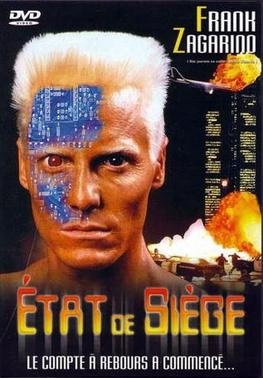
The 1992 film, Project Shadowchaser, takes place in the near future. It’s a time when cyborgs are a common sight and criminals are frozen and sent to a cryogenic prison. At the same time, it’s close enough to the present that the FBI is still America’s main law enforcement agency and the President is still a powerful enough figure that terrorists would want to abduct his daughter. It’s also close enough to the present that terrorists are still learning how to do their job from watching Die Hard.
Romulus (Frank Zagarino) is a cyborg who takes a hospital hostage, all to track down the president’s daughter, Sarah (Meg Foster). The FBI feels that only the hospital’s architect, Mr. Dixon, can figure out the best way for the FBI’s strike force to enter the hospital. Unfortunately, Mr. Dixon broke the law and has been put on deep freeze. When the stoner who runs the cryogenic prison is told to thaw out Mr. Dixon, he screws up and accidentally unfreezes DeSilva (Martin Kove), a former football quarterback.
Knowing a good thing when he sees it, DeSilva pretends to be Dixon but, once he and the strike force enter the building, it become apparent that DeSilva/Dixon has no idea what he’s talking about. All of the members of the strike force are killed when an elevator explodes. Only DeSilva survives and now, whether he wants to or not, he’s going to have to battle the terrorists and save the President’s daughter! It’s a good thing that she’s a football fan.
What a dumb movie this turned out to be! Seriously, you can add all of the sci-fi elements to your Die Hard rip-off that you want to, a Die Hard rip-off is still a Die Hard rip-off and it’s hard to think of any other film (with the possible exception of No Contest) that so slavishly follows the Die Hard formula. There’s nothing particularly surprising to be found in Project Shadowchaser. The minute that Kinderman (Joss Ackland) shows up and declares that he’s taking over the operation from FBI agent Trevanian (Paul Koslo), it’s obvious that he’s going to turn out to be the one behind Romulus’s actions. And from the minute that DeSilva meets Sarah, it’s obvious that they’re destined to fall in love.
I like Martin Kove on Cobra Kai and Kove brings a similar self-awareness to his role as DeSilva. At times, Kove appears to almost be winking at the audience, as if he’s saying, “Hey, I can’t believe I’m in this movie either. What are you going to do?” Unfortunately, Kove often seems to be the only person in the film who is really in on the joke. Needless to say, Project Shadowchaser is no Cobra Kai.
That said, I did appreciate the fact that the film’s entire plot hinged on a government employee accidentally unfreezing the wrong guy. As a portrait of bureaucratic incompetence, Project Shadowchaser works perfectly. I mean, let’s be honest. If there ever was a cryogenic prison, the wrong people would probably be getting unfrozen all the time. No one’s going to keep track of who is in which pod.
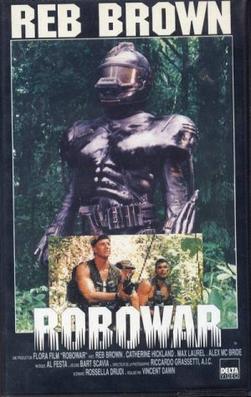
After some men go missing in the jungles of an isolated island, a group of mercenaries is assigned to search the jungle, battle the guerillas who control the island, and rescue the missing. Accompanying the mercenaries is a shifty CIA agent who seems to know more than he’s letting on. What the mercenaries soon discover is that the guerillas aren’t the only threat that they have to worry about. There’s a shadowy figure stalking them. Equipped with state-of-the-art weaponry and encased in impenetrable armor, this figure is following them like some sort of preda–
Wait. Does this sound familiar?
The 1988 film, Robowar, is an unapologetic rip-off of the Predator. Directed by Bruno Mattei and written by Troll 2 director Claudio Fragasso (who also plays this film’s version of the Predator), Robowar is such a rip-off of the Predator that it even ends with an end credits sequence in which we see clips of each actor stalking through the jungle. Reb Brown plays Murphy Black, the head of the mercenaries, and he spends a lot of his time shrilly shouting at them to “Move! Move! Move!” Catherine Hickland plays the head of a local orphanage. She introduces herself as “Virginia” and is called “Virginia” throughout the film but the end credits insist that her character was actually named “Virgin.” The other mercenaries are played by a combination of American and Italian stuntmen and some of them vaguely resemble their better-known counterparts from Predator. Max Laurel, who plays the group’s fearless tracker, looks like he could have been distantly related to Sonny Landham. Massimo Vanni and Romano Puppo play two mercenaries who have a relationship that’s similar to the friendship between Jesse Ventura and Bill Duke. Of course, in anyone really makes an impression, it’s Mel Davidson as the group’s government handler and who spends the whole movie smiling while delivering lines about how the entire group is doomed, himself included. It’s such an odd performance that it becomes rather fascinating.
What type of film is Robowar? It hits all of the same plot points as Predator but it does it with a much lower budget. Indeed, the film’s opening sequence appears to be made up of footage lifted from Mattei’s earlier film, Strike Commando. Whenever we see the action through the killer robot’s eyes, Mattei gives the action an extreme orange tint that makes it impossible to actually tell what’s going on. Reb Brown spends a lot of time yelling but the same thing could be said for the entire cast. This is one of those films where no one fires a machine gun without screaming while doing so. And yet, because it’s a Mattei film, it’s always watchable. Bruno Mattei (who born 92 years ago today in Rome) may have specialized in ripping-off other, most successful films but he was so shameless and unapologetic about it that it’s impossible to judge him too harshly. As always, Mattei keeps the action moving quickly and doesn’t worry to much about things like continuity. Mattei’s films were rarely good but they were almost always fun when taken on their own silly terms.
At times, Robowar almost feels like a parody of an American action film, with Fragasso’s script featuring dialogue that is so extremely aggressive and testosterone-fueled that even Shane Black probably would have told him to tone it down a notch. Much as with Troll 2, the film provides an interesting view into how Fragasso imagined Americans to be. Early on, we are informed that the mercenary group is known as BAM, which stands for “Big Ass Motherfuckers.” Later, one of the members of BAM insults two others by saying, “I bet they have the AIDS.” It’s as if someone programmed a computer to write an action movie and, as such, Robowar might turn out to be a surprisingly prophetic film.
Despite featuring a few Americans in the cast, Robowar was not available in the U.S. until it was released on Blu-ray by Severin Films in 2019. Though Bruno Mattei passed away in 2007, his work continues to be discovered by new audiences.
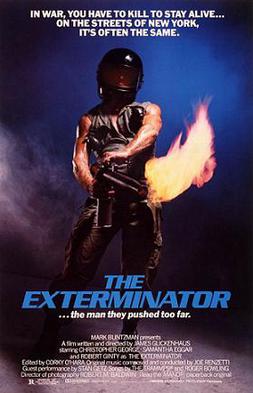
First released in 1980, The Exterminator begins during the Vietnam War.
Two soldiers, John Eastland (Robert Ginty) and Michael Jefferson (future Cannon Film mainstay Steve James) have been captured by the Viet Cong and can only watch as a third soldier is beheaded by his captors. (The graphic beheading, in which the camera lingers on the head slowly sliding off the neck, is an early warning of what this film has in store for its audience.) Jefferson manages to free himself from his bonds and kills most of the enemy soldiers. After Jefferson frees him, Eastland fires a bullet into the still twitching body of the VC commander.
The film jumps forward to 1980. Living in New York City, Jefferson and Eastland are still best friends and co-workers at a warehouse. For a second time, Jefferson saves Eastland’s life when the latter is attacked by a gang calling themselves the Ghetto Ghouls. When the Ghouls get their revenge by tracking down Jefferson and piecing his spine with a meat hook, Eastland gets his revenge by killing …. well, just about everyone that he meets.
Though The Exterminator was obviously inspired by Death Wish, a big difference between the two films is that Eastland doesn’t waste any time before starting his anti-crime crusade. In the original Death Wish, Paul Kersey (played by Charles Bronson) starts out as a self-described “bleeding heart” liberal who was a conscientious objector during the Korean War. Even after his wife and daughter are attacked (and his wife killed) by Jeff Goldblum, Kersey doesn’t immediately pick up a gun and start shooting muggers. Indeed, it’s not until the film is nearly halfway over that Kersey begins his mission and, in one of the film’s more memorable moments, he reacts to his first act of violence by throwing up afterwards. While one could hardly call Death Wish an especially nuanced film, it does at least try to suggest that Kersey’s transformation into a vigiliante was a gradual process.
The Exterminator, on the other hand, goes straight from Eastland informing Jefferson’s wife about the attack to Eastland threatening a tied-up Ghetto Ghoul with a flame thrower. When did Eastland kidnap the Ghetto Ghoul? Why does Eastland have a flame thrower? Where exactly has Eastland tied up the Ghetto Ghoul? None of this is explained and the film’s abruptness gives it an almost dream-like feel. The film plays out like the fantasy of everyone who has ever been mugged or otherwise harassed. Magically, Eastland suddenly has the skills and the resources to outsmart not just the criminals but also the police who have been assigned to stop him. Even the CIA is assigned to take down Eastland because his anti-crime crusade is inspiring people to wonder why the President hasn’t been able to reduce crime. The film plays out like the type of daydreams that Travis Bickle had when he wasn’t driving his taxi.
Eastland is ruthless in his kills but fortunately, everyone he kills is really, really bad. The Ghetto Ghouls clubhouse is decorated with a poster of Che Guevara but Che’s revolutionary rhetoric isn’t worth much when the Exterminator’s after you. A mob boss makes the mistake of not telling Eastland about the Doberman that’s guarding his mansion so into the meat grinder he goes. New Jersey loses a state senator when Eastland discovers him torturing an underage male prostitute. The film was shot on location in New York City and the camera lingers over every grimy corner of the city. A scene where Eastland walks through Times Square takes on a cinéma-vérité feel as people jump out at him and try to entice him to take part in everything the city has to offer. If Death Wish suggested that Paul Kersey’s actions were saving New York, The Exterminator suggests that we should just let John Eastland burn the whole place down.
With his youthful face, Robert Ginty looks more like a mild-mannered seminarian than a hardened veteran of both Vietnam and the mean streets of New York but, ultimately, that works to the film’s advantage. If anything, it explains why everyone who meets him trends to underestimate what he’s capable of doing. B-movie vet Christopher George overacts in his usual amusing way as he plays the detective who has been assigned to catch The Exterminator. Samantha Eggar plays a doctor who starts dating George for no discernible reason. The scenes featuring George and Eggar often seems as if they belong in a different film but they do provide some relief from the rather grim and gruesome scenes of The Exterminator killing almost everyone who he meets.
The Exterminator was controversial when it was originally released and it still retains the power to shock. It’s easy to laugh at some of the film’s more melodramatic moments but there were still more than a few scenes that I watched with my hands over my eyes. The film’s hard edge grabs your attention from the start and the idea of the CIA sending assassins to take out a neighborhood vigilante is so over the top and ridiculous that it’s kind of hard not to appreciate it. That the film totally buys into its paranoid worldview (“Washington will be pleased.”) makes the whole thing far more compelling than it should be.
As ludicrous as it all is, The Exterminator is a film that defies you to look away.
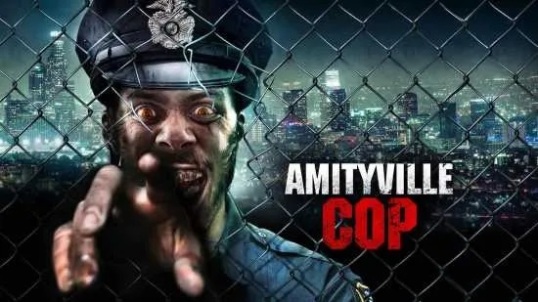
2021’s Amityville Cop does not take place in Amityville.
Actually, as far as I can remember, we never learn the name of the city where this movie is supposed to be taking place. But it definitely is a city and it’s not on Long Island so we can safely assume that it’s not Amityville. It’s not even New York City, which would have at least made the film somewhat Amityville-adjacent.
Amityville Cop also does not feature the infamous house. Nor does it feature a recreation of the DeFeo murders or any conversations about the Lutz hauntings or any of the other nonsense that we typically expect from an Amityville film.
In fact, there’s really no reason for this film to be called Amityville Cop, beyond the fact that Amityville is a recognized brand.
Instead, this is yet another remake of Maniac Cop. This time, the cop in question was a rookie who was either sacrificed by a Satanic cult or who voluntarily chose to be possessed by a demon. It’s a bit hard to follow exactly what happened, to be honest. The head of the cult is played by Laurene Landon, who also appeared in two of Maniac Cop films. Her role is brief but she’s around long enough to ensure that Officer Wilson (Lovie Johnson) will come back to life as a demon who wanders around in the city in his policeman’s uniform and who kills people for the least little infraction. (“No loitering,” he says, before killing one unfortunate homeless man.)
Meanwhile, the non-possessed cops are pretty much useless. Benson (Jason Toler) and his partner, Val (Nicole D’Angelo) are both infamous for roughing up suspects. Tom (Leonard Zhang) is socially awkward and never hangs out with the other cops while off-duty because he’s always too busy taking care of his mother. Cooper (Chris Spenelli) is boring. Lewis (Craijece Danielle) is inexperienced. Detective Clawson (Lisa London) always seems like she’s more interested in going after her fellow cops than the actual criminals. And Chief Benson (Jeffrey Moon) is more concerned with throwing a New Years Party at the station house than actually solving any crimes.
Yes, the entire police force appears to be gathered at the station, partying and dancing as the New Year approaches. It kind of makes you wonder just who exactly is on patrol in the city. Then again, it is New Years Eve. It’s not as if that’s a time of the year that’s associated with people getting drunk and disorderly. Anyway, the important thing that Officer Wilson eventually shows up for the party and soon, the killings start and Tom starts to consider which side he wants to be on.
Where to start with all this? It’s not a very good movie. You probably already guessed that. The awkward dialogue is stiffly delivered, the kills are largely uninspired, and the characters themselves are not particularly interesting. Benson, our nominal hero, literally bullies Tom to the extent that Tom is willing to sacrifice his soul to get revenge but the film never calls him out on it. No one ever says, “Gee, Benson, maybe you went too far when you made fun of his mom.” On the plus side, Officer Wilson is occasionally intimidating. There was one scene where he suddenly comes running down a hallway and, for a few seconds, the film came to life. But it’s hard not to feel that, in our cultural moment, Amityville Cop missed the chance to be something truly subversive. At a time when many people are asking whether we need the police at all, this film asks whether we actually need any more Amityville films.
Filmed in 1988 but apparently not released until 1990, Killing American Style is a low-budget variation on The Desperate Hours.
The film opens with a ruthless criminal named Tony Stone (Robert Z’Dar, of Maniac Cop fame) leading a daring robbery of an ice cream truck depot. All of the ice cream trucks have come back for the day and, when Tony and the boys show up, the money is still being counted. Tony quickly takes control of the situation, intimidating everyone with both his weaponry and his amazing jawline.
Unfortunately, for Tony, the robbery is not as successful as he thought. Yes, he gets away with a lot of money but the police quickly track him down to his home, where he’s in the process of having sex with his stepmother. Tony is arrested and, in record time, sentenced to a maximum security prison. (Seriously, the arrest, conviction, and sentencing all seem to happen on the same day.) Tony is put on a prison bus but then the bus itself stops to help out a stranded motorist. The motorist turns out to be Tony’s brother, Jesse (Bret Johnston). In the resulting shootout, all of the guards are killed but Jesse is wounded. Tony and his associate, Lynch (John Lynch …. hey, I wonder if that’s just coincidence?), take Jesse to a nearby ranch house.
The house belongs to John Morgan (Harold Diamond), who is a long-haired kickboxing champion. When Tony arrives, John is out of the house and beating up the dad of a kid who bulled Morgan’s son, Brandon. John is not happy to come home and discover Tony holding his entire family hostage. For that matter, Morgan’s son isn’t amused by it either.
Because they are being pursued by a grim and determined police detective (played by Jim Brown …. yes, the same Jim Brown who starred in countless blaxploitation films in the 70s), Tony and his men do not want to run the risk of leaving the house to retrieve the loot from the robbery themselves. So, they send Morgan out to pick up the suitcase from Tony’s stepmother. I guess they assume that Morgan will be able to move around inconspicuously despite the fact that Morgan is a 6’1 kick boxer with long hair. I mean, there’s no way that Morgan is going to be able to move around without being noticed by the cops.
Of course, before Morgan can get the money, he also has to get a doctor for Jesse. Dr. Fuji (Joselito Rescober) agrees to help, despite the fact that he never seems to be quite sure what’s actually going on with all the angry men who keep pointing guns at each other. When Dr. Fuji mentions that he wants to kill Tony “Japanese style,” Morgan promises that he’s going to kill Tony “American style.” It’s never really made clear what the difference is between the two styles, though the American version does seem to involve a bit more kickboxing.
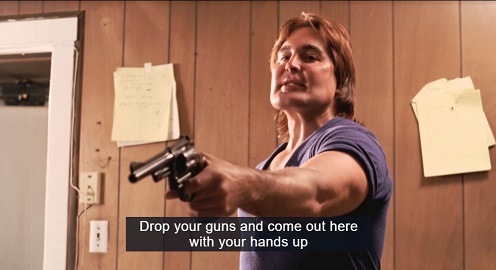
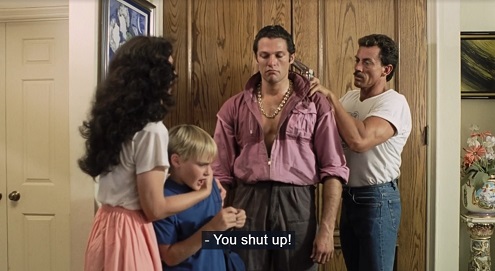
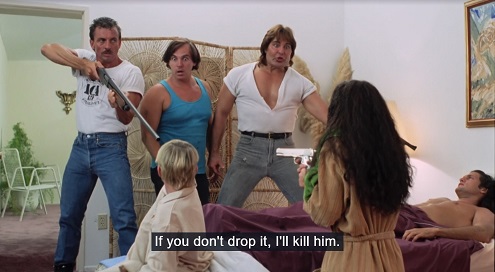
Anyway, this is an incredibly cheap and dumb movie but Robert Z’Dar seems like he’s having fun as Tony and …. well, to be honest, Robert Z’Dar is really the only reason to recommend this film. He gives an enjoyably over-the-top performance, one that certainly contrasts with the more subdued performance of Harold Diamond. (For his part, Diamond often seems to be struggling to stay awake.) Hostage movies usually bore me to tears and this one had a lot of slow spots but it also had shots like the one below:
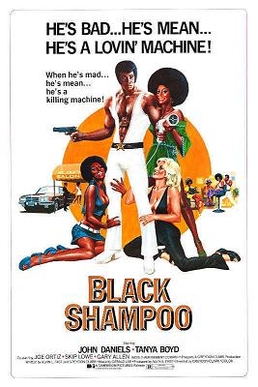
The 1976 film, Black Shampoo, tells the story of Mr, Jonathan (played by an expressionless actor named John Daniels). Mr. Jonathan is the hottest hairstylist on the Sunset Strip. Rich women flock to his salon so that Mr. Jonathan can do their hair and, as the first scene in the film makes clear, do a lot more as well. Black Shampoo begins with a wash and rinse that soon leads to Mr. Jonathan’s client saying, “It is bigger and better!” while the singers on the film’s funk-heavy soundtrack tell us that, “He’s a real man.”
Mr. Jonathan is so popular that the women who come into his salon are visibly upset if they’re told that their hair will be done by Mr. Jonathan’s two associates, Artie and Richard. “Artie doesn’t have the right equipment!” one woman exclaims while another complains, “My hair’s a mess …. I haven’t had my hair done in over a month.” Fortunately, helping to keep the place running is Mr. Jonathan’s new administrative assistant, Brenda St. John (Tanya Boyd). In fact, Mr. Jonathan could even see himself settling down with Brenda.
Unfortunately, Brenda is the ex-girlfriend of a white gangster named Mr. Wilson (Joe Ortiz). And Mr. Wilson is determined to get Brenda back, even if it means sending two of his thugs down to Mr. Jonathan’s and messing the place up. It’s easy for them to vandalize the salon and to harass Artie and Richard because Mr. Jonathan hardly ever seems to be there. He’s always either visiting a client at home or taking part in a falling in love montage with Brenda. When Brenda is kidnapped, Mr. Jonathan falls into a deep depression. Eventually, though, Mr. Jonathan realizes that he has to rescue Brenda and retrieve the black book that proves that Mr. Wilson is a crime lord. Fortunately, Mr. Jonathan is as handy with a chainsaw as he is with a hair blower.
Ugh. This film …. I mean, to be honest, the movie seems like it’s going to be fun when it starts. Yes, the acting is terrible and the dialogue is risible but it’s such a 70s film that I assumed it would be kind of fun. And there are some enjoyably silly moments, like the whole falling in love montage. But, as the film progresses, the violence and the film’s overall tone just gets uglier and uglier. That, in itself, is not a problem. In fact, you could argue that violence should be ugly because it’s violence. But, in the case of Black Shampoo, too much of that ugly violence is played for titillation. When Mr. Wilson threatens to sodomize a character with a curling iron, the film seems to take a certain delight in Mr. Wilson’s sadism. The film is certainly not on the side of the poor guy who is being threatened. Instead, it feels like the film is saying, “Do you think will show this happen or do you think will cut to another scene? Keep watching to find out!” It’s gross.
It would help if Mr. Jonathan were himself an engaging character but John Daniels’s performance in painfully dull. He has a definite physical presence, though he definitely looks a lot better on the film’s poster than he does in the actual movie. But, when he has to deliver dialogue or show emotion, he’s so awkward that it’s like staring at a brick wall and waiting for it to do something. As a character, Mr. Jonathan should be someone who moves with a certain confidence and swagger. John Daniels usually seems like he’s more busy trying not to look straight at the camera.
On the plus side, everyone’s hair looks beautiful.
In the late 1970s, the Rev. Jim Jones was a very powerful man.
The leader of the California-based People’s Temple, Rev. Jones had made a name for himself as a civil right activist. As a minister, he made it a point to reach out to the poor and to communities of color. (It was said, largely by Jones, that he had been forced to leave his home state of Indiana by the Ku Klux Klan.) Local politicians eagerly sought not only Jones’s endorsement but also the donations that he could easily raise from the members of the People’s Temple. Though there were rumors that he was more of a cult leader than a traditional preacher, Jones was appointed chairman of the San Francisco Housing Authority. Everyone from Governor Jerry Brown to San Francisco Mayor George Moscone appeared with Jim Jones at campaign events. Among the national figures who regularly corresponded with Jim Jones were First Lady Rosalyn Carter and Vice President Walter Mondale.
Of course, what actually went on behind the closed doors of the People’s Temple was a bit of secret. Jones was a self-proclaimed communist who claimed to have had visions of an upcoming nuclear war between the U.S. and Russia. In his sermons, he often claimed that it would be necessary for both him and the rest of the People’s Temple to eventually leave the United States. Jones spoke of enemies that were trying to destroy him, like the reporters who investigated Jones’s claim of being a faith healer and who followed up on reports that Jones was sexually exploiting both the women and the men who followed him. Jones secretly started to make plans to leave the United States in 1973 but it would be another four years before he and a thousand of his followers arrived in Guyana. The People’s Temple Agricultural Project sat in the jungle, isolated from oversight. It was informally known as Jonestown.
Over the next year, Jonestown did not exactly thrive. Rev. Jones demanded that his people work hard and he also demanded that they spend several hours a day studying socialism and listening to him preach. Jones ran his commune like a dictator, refusing to allow anyone to leave (for their own safety, of course). Anyone who questioned him was accused of being an agent of the CIA. In the U.S, the families of Jonestown’s citizens became concerned and started to petition the government to do something about what was happening in Guyana. A few people who did manage to escape from Jonestown told stories of forced labor, suicide drills, rape, and torture. The People’s Temple claimed that those people were all lying and, because Jones still had his government connections, he was largely left alone.
Finally, in 1978, Congressman Leo Ryan, a Democrat who had a history of opposing the political establishment, flew down to Guyana so that he could see Jonestown for himself and also bring back anyone who wanted to leave. Despite the efforts of Jones to disguise the truth about life in Jonestown, several people did ask to leave the colony with Rep. Ryan. Jones sent his most loyal men to meet and open fire on Rep. Ryan’s entourage at a nearby airstrip. Rep. Ryan and four others were shot and killed, making Ryan the first Congressman to be assassinated since 1868. Nine others, including future Rep. Jackie Speier, were wounded in the attack.
Back at Jonestown, Jim Jones announced that his prophecy was coming true and that the imperialists would soon descend on Jonestown. Though 85 of Jones’s followers managed to escape into the jungle, the other 909 residents of Jonestown subsequently died. Though some showed signs of having been murdered by Jones’s followers, the majority committed suicide by drinking poisoned Flavor-Aid. Jim Jones shot himself in the head.
The world was horrified and the term “drinking the Kool-Aid” entered the discourse. And, of course, many filmmakers were inspired by the horrific events that happened in Jonestown. Ivan Rassimov, for instance, played a Jim Jones-style cult leader in Umberto Lenzi’s Eaten Alive. Meanwhile, Powers Boothe would win an Emmy for playing Jim Jones in a 1980 television miniseries called Guyana Tragedy.
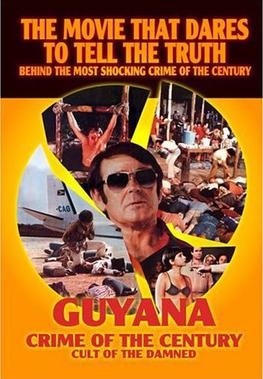
Guyana Tragedy is often described as being the definitive film about Jim Jones. However, a full year before Guyana Tragedy aired, the Mexican director, Rene Cardona Jr., was in theaters with his own version of the Jim Jones story. To anyone who is familiar with Cardona’s style of filmmaking, it’s perhaps not surprising that 1979’s Guyana: Crime of the Century did not win any awards.
Cardona’s film opens with a rather odd title card, explaining that, though the film is based on Jonestown, the names of certain characters “have been changed to protect the innocent.” But if you’re going to start the film by announcing that it’s about the biggest news story of the past year, what’s the point of changing anyone’s name? And for that matter, why is Jim Jones renamed James Johnson and his colony rechristened Johnsontown? Jones was hardly one of the innocents, not to mention that he was dead and in no position to sue when the film came was released. Why is Leo Ryan renamed Lee O’Brien, especially when the film portrays Ryan as being the type of hard-working and honest congressman that anyone would be happy to vote for?
The film opens with Rev. James “Johnson” (played by Stuart Whitman) giving a lengthy sermon about how it’s time for the congregation to move to Guyana, which he describes as being a Socialist paradise. Oddly, in the film, the People’s Temple is portrayed being largely white and upper middle class whereas, in reality, the opposite was true. Indeed, Jones specialized in exploiting communities that were largely marginalized by American society. One reason why Jones’s claim of government persecution was accepted by the members of his church is because the People’s Temple was made up of people who had very legitimate reasons for distrusting the American government.
A few scenes later, Johnson is ruling over “Johnsonville.” Since this is a Cardona film, the viewers are shown several scenes of people being tortured for displeasing Johnson. A child is covered in snakes. Another is shocked with electricity. A teenage boy and girl are forced to kneel naked in front of Johnson as he announce that their punishment for trying to run away is that they will be forced to have sex with someone of Johnson’s choosing. Once the torture and the nudity is out of the way, the film gets around to Congressman O’Brien (Gene Barry) traveling to the Johnsontown. Since the audience already knows what’s going to happen, the film becomes a rather icky game of waiting for O’Brien to announce that he’s ready to go back to the landing strip.
Because the film has been released under several different titles and with several different running times, Guyana: Crime of theCentury has gotten a reputation for being one of those films that was supposedly cut up by the censors. I’ve seen the original, uncut 108-minute version of Guyana and I can tell you that there’s nothing particularly shocking about it. Instead, it’s a painfully slow film that doesn’t really offer much insight into how Jim Jones led over 900 people to their deaths. While Gene Barry make for a convincing congressman, Stuart Whitman gives a stiff performance as the Reverend Johnson. There’s very little of the charisma that one would expect from a successful cult leader. One gets the feeling that Whitman largely made the film for the paycheck.
Of course, Whitman was hardly alone in that regard The film features a host of otherwise respectable actors, including Yvonne DeCarlo, Joseph Cotten, John Ireland, Robert DoQui, and Bradford Dillman. As well, Cardona regular Hugo Stiglitz appears as a photographer. (Stiglitz is perhaps best known for starring in Nightmare Cityand for lending his name to a character in Tarantino’s Inglourious Basterds.) Of the large cast, I appreciated the performances of Cotten and Ireland, who play Johnson’s amoral but well-connected attorneys. (The characters are based on the Temple’s real-life attornes, Charles Garry and Mark Lane. Lane also wrote the first JFK conspiracy book, Rush to Judgment.) I also liked Yvonne DeCarlo’s performance as the most devoted of Johnson’s followers. Even Bradford Dillman’s natural blandness was used to good effect as his character comes to represent the banality of evil when it comes time for him to start administering the Flavor-Aid. But those good performances still can not overcome the film’s slow pace and the fact that the film didn’t bring any new insight to the tragedy.
The film sticks fairly close to what is believed to have actually happened at Jonestown but, in the end, it barely even works as an example of shameless grindhouse filmmaking. It’s not even offensive enough to be enjoyable on a subversive level. Instead, it was just a quick attempt to make some money off of the crime of the century.
So, you think you can just ignore the law, huh? Well, the Super Cops have got something to say about that! This film was based on the “true” adventures of two widely decorated NYPD cops. The cops were so good at their job that they were even nicknamed Batman and Robin. Of course, long after this movie came out, it was discovered that they were both corrupt and were suspected of having committed more crimes than they stopped. Amazingly, this film was directed by the same man who did Shaft. The Super Cops are kind of annoying, to be honest.
2. Super Fuzz (1980)
Far more likable than The Super Cops was Super Fuzz. Terence Hill plays a Florida cop who gets super powers! Ernest Borgnine is his hapless partner. The film was directed by Sergio Corbucci, of Django fame.
3. Miami Supercops (1985)
In 1985, Terence Hill returned as a Florida cop in Miami Supercops. This time, his old partner Bud Spencer accompanied him.
4. Miami Cops (1989)
Apparently, Miami needed a lot of cops because Richard Roundtree decided to join the force in 1989. Unfortunately, I could only find a copy of this trailer in German but I think you’ll still get the idea.
5. The Soldier (1982)
In order to celebrate loyalty, here’s the trailer for 1982’s The Soldier! They’re our government’s most guarded secret …. or, at least, they were. Then someone made a movie about them.
And finally, what better way to celebrate both Loyalty and Law Day than with a film that pays tribute to the Molokai Cops? From Andy Sidaris, it’s….

 Through the Shattered Lens