Today’s horror scene that I love comes from the 1945 film, House of Dracula!
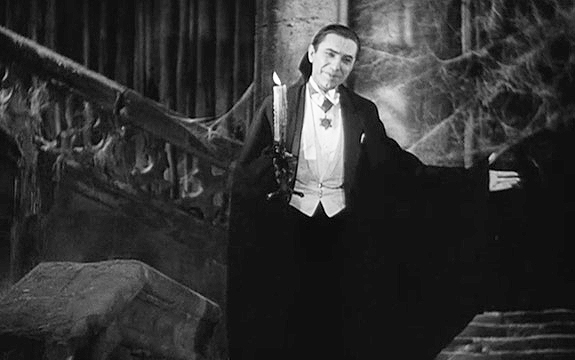
House of Dracula may not be a classic but John Carradine definitely made for an intriguing Dracula. Far more than Bela Lugosi or even Christopher Lee, Carradine matched the physical description that Bram Stoker offered up of Dracula in his famous novel — tall, aristocratic, sophisticated, and disdainful of the world around him. Of course, Carradine’s American accent is all wrong for the role but no matter. He’s Carradine!
This scene features Carradine as Dracula, casting his hypnotic spell.
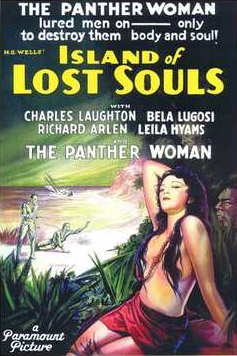
In the 1932 film Island of Lost Souls, Ruth Thomas (Leila Hyams) has reason to be concerned. She’s on the island of Samoa, awaiting the arrival of her fiancée, Edward Parker (Richard Arlen). When Parker’s boat doesn’t show up, it can only mean one thing. He’s been shipwrecked! Did he survive or was he lost at sea?
Well, Ruth need not worry. Parker did survive being shipwrecked. He was picked up by a freighter carrying a wide selection of animals to an isolated island. Unfortunately, when Parker complained about the way that Parker was abusing some of his admittedly odd-looking passengers, the captain responded by dumping Parker on that island as well.
On the island, Parker becomes the guest of Dr. Moreau (Charles Laughton) and his assistant, Montgomery (Arthur Hohl). Parker also meets and finds himself becoming attractive to the seemingly naive Lota (Kathleen Burke). Though Moreau seems to be a good host, Parker grows suspicious of him. It turns out that there’s a room in Moreau’s compound, a room that Lota calls “the house of pain.” At night, Parker can hear horrifying screams coming from the room.
Initially believing the Moreau is torturing the island’s natives, Parker soon discovers an even more disturbing truth. Moreau has been experimenting with trying to transform animals into humans. Lota, it turns out, was once a panther and the woods surrounding the compound are full of other Moreau creations. Though Moreau claims that his intentions are benevolent, he rules his island like a dictator. The animal-men are kept in line by the Sayer of the Law (Bela Lugosi) and any transgressions are punished in the House of Pain…
The Island of Lost Souls was the first cinematic adaptation of H.G. Wells’s The Island of Dr. Moreau. (Perhaps the most famous adaptation came out in 1996 and is the subject of Lost Souls, a fascinating documentary that, I believe, can still be found on Netflix.) I watched it last night on TCM and I have to admit that I had a mixed reaction to it. On the one hand, the film’s atmosphere of mystery and danger is palpable and Charles Laughton’s performance definitely set a standard for all misguided scientists to follow. The human-animals are fantastic creations and the film’s ending still has some power. Bela Lugosi’s performance of the Sayer of the Law was superior to his work as Dracula. (As shown by both this film and Ninotchka, Lugosi was an outstanding character actor.) Kathleen Burke also does a great job as Lota, which makes it all the more interesting that she was apparently cast as a result of winning a contest that was sponsored by Paramount Pictures.
(On a personal note, I always find it amusing that pre-code films always feature at least one scene of an actress removing her stockings, even if the scene itself has next to nothing to do with the rest of the film. In this case, the legs belong to Leila Hyams.)
On the negative side, Richard Arlen is not a particularly interesting hero and, from a contemporary point of view, Island of Lost Souls is a rather slow-moving film. Watching it today requires modern audiences to make a bit of an adjustment to their expectations.
With all that in mind, I still recommend Island of Lost Souls. Watch it for Charles Laughton and Bela Lugosi. Watch it as a valuable piece of cinematic history.
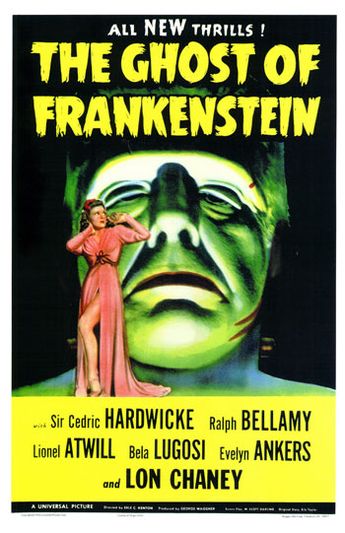
In 1942, three years after Son of Frankenstein, Universal Pictures continued the story of the Frankenstein family with The Ghost of Frankenstein!
However, The Ghost of Frankenstein was a far different film from the three that came before it. The budget was lower. The story was less complicated. The running time was much shorter. Whereas the previous films in the franchise clearly took place in Germany, the setting for The Ghost of Frankenstein is less easily defined. (Considering that the film was made during World War II, this isn’t surprising.) The biggest change is that, in The Ghost of Frankenstein, the monster is not played by Boris Karloff. Instead, the role is taken by Lon Chaney, Jr. Chaney’s hulking frame was perfect for the monster but his face is never as expressive as Karloff’s. Whereas Karloff turned the monster into as much of a victim as a victimizer, Chaney plays the monster like a … well, a monster.
Returning from Son of Frankenstein, Bela Lugosi is back as Ygor. At the start of the film, we learn that Ygor actually wasn’t killed at the end of Son of Frankenstein. Instead, he was just wounded. He’s spent the last few years hiding out in the old castle, trying to once again revive the monster. When the villagers attempts to blow up the castle, he and the monster flee.
It turns out that there’s one other Frankenstein son. His name is Ludwig and he’s played by a very dignified Sir Cedric Hardwicke. Ludwig, who has been hiding his identity and denying the family legacy, has a successful medical practice in another village. Working with his assistants, Dr. Kettering (Barton Yarbrough) and the bitterly jealous Dr. Bohmer (Lionel Atwill, who played a far different role in Son of Frankenstein), Ludwig has developed a procedure in which a damaged brain can be removed from the skull, repaired, and then stuck back inside the skull…
Uhmmm … wow, I have no idea what to say about that. That’s quite a medical breakthrough, though…
When Ygor and the monster show up in the village, searching for Ludwig, the monster ends up getting arrested. The local prosecutor (played by Ralph Bellamy, Cary Grant’s romantic rival in both The Awful Truth and His Girl Friday) asks Ludwig to examine the prisoner. Ludwig is shocked to discover that the prisoner is his father’s creation!
Ygor wants Ludwig to perform a brain transplant on the Monster. At first, Ludwig is hesitant but then he’s visited by Henry Frankenstein’s ghost. (Since Colin Clive died 5 years before Ghost of Frankenstein went into production, Hardwicke plays both Ludwig and Henry.) The ghost asks Ludwig to perfect the monster.
Ludwig finally relents and agrees to give the monster a new brain. Ludwig wants to use the brain of kindly colleague but Ygor has different plans…
The Ghost of Frankenstein is only 67 minutes long but, oddly, it still feels just a little bit draggy. Director Erle C. Kenton does a workmanlike job but, at no point, does Ghost feature the wit that distinguished James Whale’s films or Rowland V. Lee’s work on Son of Frankenstein. Chaney is not a particularly interesting monster but Bela Lugosi is a lot of fun as Ygor. With Chaney showing even less emotion than he usually did and Hardwicke appearing to be occasionally embarrassed by the whole film, it falls to Lugosi to keep the audience awake and he manages to do just that. Lugosi’s performance may be overly theatrical but that’s exactly what The Ghost of Frankenstein needed.
The Ghost of Frankenstein is occasionally entertaining but ultimately forgettable. It’ll best be enjoyed by Universal horror completists.
This October, I’m going to be doing something a little bit different with my contribution to 4 Shots From 4 Films. I’m going to be taking a little chronological tour of the history of horror cinema, moving from decade to decade.
Today, we continue our look at the 1940s.
4 Shots From 4 Films
House of Frankenstein (1944, dir by Erle C. Kenton)
The Uninvited (1944, dir by Lewis Allen)
House of Dracula (1945, dir by Erle C. Kenton)
The Picture of Dorian Gray (1945, dir by Albert Lewin)
4 Shots From 4 Films is just what it says it is, 4 shots from 4 of our favorite films. As opposed to the reviews and recaps that we usually post, 4 Shots From 4 Films is all about letting the visuals do the talking.
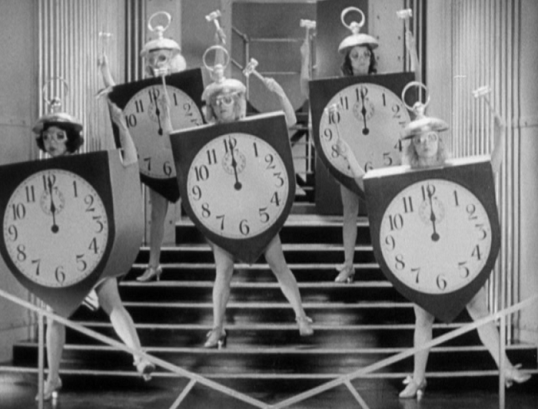
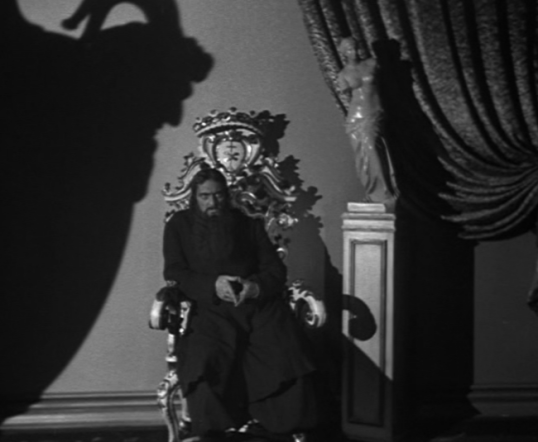
All of the scenes below come from films that were made and released between the introduction of sound in the late 1920s and the adoption of the infamous Hays Production Code in 1934. This was truly an exciting time for film as an art form. Not only were filmmakers intoxicated with discovering what they could accomplish through the medium but they were also unhindered by censorship or regulation. The end result was some of the most visually imaginative and narratively daring films to ever be released by the major American studios.
There’s a reason why film lovers continue to eagerly seek out pre-code films. And if you want to experience what made the pre-Code era so memorable, you could not do any worse than to start with the four films featured in this post.
Madam Satan (1930, dir by Cecil B. DeMille)
Safe in Hell (1931, dir by William Wellman)
Rasputin and the Empress (1932, dir by Richard Boleslawski)






 Through the Shattered Lens