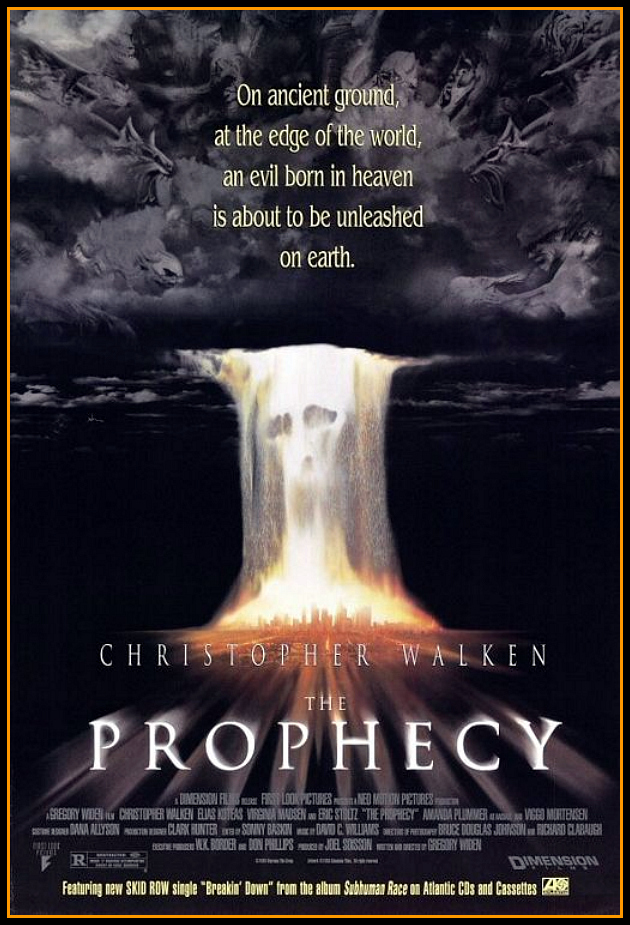
Film Review: The Prophecy (dir. by Gregory Widen)


I first found out about this little cult film starring the very awesome Christopher Walken around 1993 or so when I was at the local Waldenbooks (yes there used to be bookstores not named Barnes & Noble or Borders back in the day) looking at the latest issue of Fangoria. Inside the magazine they were doing a brief feature on an upcoming horror film tentatively called God’s Army. All I saw was that it was to star Christopher Walken and it had gore and angels in it. That alone peaked my interest and I was looking forward to seeing it in the theaters. Almost two years passed and nothing about it was ever heard again until I visited the video rental place near my house and saw a VHS tape (yeah, those big videocassette thingies) with the title of The Prophecy and starring Christopher Walken.

This was the film I was so hyped to seeing in the theaters. The title had changed from it’s earlier (and much cooler) one of God’s Army. It would seem that it’s film distributor had little to no faith in the box-office potential of the film and just delayed it’s release to the point that when it did come out no one knew about it barely anyone saw it. It was a real damn shame since filmmaker Gregory Widen made such a good film that was able to mash-up horror, angels and a detective story all in one without creating a mess of things.

The Prophecy was about the war in heaven we were never taught about in Sunday school. We all know about the war in heaven where Lucifer and the rebel angels who followed him tried to overthrow God. That didn’t go over so well for Lucifer and he and his band of fallen angels were cast out into Hell by God and his right-hand man the Archangel Michael. This film talks about the second war in heaven soon thereafter which no one outside those who wrote little-known apocryphal texts about it (and being apocryphal they never were included in the Bible). This war now had a new group of angels led by the Archangel Gabriel rebelling against God for choosing humans (talking monkeys as these new rebels called them) above all living creatures including the angels themselves for God’s love. This war was now in a state of stalemate after countless millenia, but a prophecy about a soul so dark and evil was to be the tipping point for either side. This particular soul was to be found on Earth and whoever acquires it would break the stalemate and finally bring this second war to an end.

With this in mind we have Walken as the Archangel Gabriel coming down to Earth to look for this soul so he can finally win the war for his side (which also means the end of mankind). It’s the angel Simon (played by Eric Stoltz) who comes down to stop him from getting this soul or, at the very least, hide it from Gabriel. With these two factions of angels vying to acquire this soul we have a Detective Thomas Daggett smack in the middle of the case investigating all the weird happenings and deaths surrounding the battle between these two factions. The dead bodies of angels begin to appear on morgue slabs looking like eyeless, hermaphroditic specimens and angelic script found in crime scenes brings Daggett back to his time studying to be a priest before images of angels warring amongst themselves breaks him down and he quits the seminary to become a cop instead.

It would come down to these three factions racing against time to acquire this dark soul.

The film is not as gory as it’s feature in Fangoria made it out to be, but it is quite violent and bloody that I understand why it got the horror label attached to it. It’s more a dark fantasy thriller more than horror. It’s rare in today’s film that we see angels portrayed as the bloodthirsty beings that the really are. The film even points out this oft-ignored detail of God’s messengers. Angels are always the ones God sends to punish or send a very serious message to his chosen beings that is Man. The Prophecy shows this aspect of angels in full light and how their attitudes about humanity might lead some of them to hate God for raising Man above even them.

Christopher Walker does a great job conveying Gabriel’s hate and contempt for humans. His Gabriel is like one of those pundits always on tv (both liberal and consevative) who are so into their sides’ message that they never see the other side as anything but the enemy. One could almost say that Walken’s Gabriel is like then apocalypse-hungry version of Glenn Beck and Keith Olbermann in one body. This is not to say that Walken goes over-the-top with his performance. In fact, he’s quite subdued in how he uses those many tics and voice mannerisms a whole cottage industry has grown around in.

Walken’s portrayal of Gabriel infuses what could’ve become a one-note villain with lots of layers and complexities that the rest of the cast were able to play off from. His character would be terrifying one moment then smoothly switch over to being funny and charming then back to terror. It’s due to his great performance that the other cast members like Stoltz as the weary, loyal angel Simon and Koteas as the fallen religious cop Daggett were able to bring their own performance to another level. This is quite a feat since the dialogue in the film was a mixed bag of horror cliches and interesting Biblical-speak about secret wars, apocryphal books and prophecies. The film even has a nice appearance of the first fallen angel himself and none other than Viggo Mortensen plays Lucifer.

The Prophecy does have a feeling that it was always one misstep away from becoming an awful film. This had happened with 2010’s Legion and did that film about angels and the apocalypse turn out to be a huge steaming pile of shit-turd. But while Dimension Film saw the film fall over on the side of bad for myself and those who have come to admire and love this cult classic the film stayed balance between good and bad. Widen’s film never went over to the side of becoming a truly great film, but it also never fell on the side that Legion ended up on. What Prophecy ended up becoming was a film that was almost grindhouse in nature, but even then it still looked too good with too many good performances to be given that label. The fact that it contains one of Christopher Walken’s best performances speaks well of a film that many critics during it’s early days had dismissed as just another bad horror film.

In the end, this film became just one of the many little-gems that got lost in film studio money politics. I definitely would recommend this cult film to people who haven’t seen it, but I would tell them to stop at just this film and not even go near the four sequels which came after it.

Review: Let Me In (dir. by Matt Reeves)


In 2008 a little film from Sweden swept through the film festivals and earned a rightful and well-deserved place in many film critics and film circles “best of 2008” and “top ten” lists. This was Swedish filmmaker’s film adaptation of the John Ajvide Lindqvist vampire novel, Let The Right One In. It was a vampire film that appealed not just to horror genre fans hungry for a vampire film that was the polar opposite of the current “Twilight” vampire craze. Horror fans wanted something that wasn’t watered down and emasculated to better appeal to the tween girl set. So, Alfredson’s vampire film was embraced by these horror fans and when news came that the rights to the novel was licensed by British-studio Hammer Film and an American-remake was set for production the reaction was decisively negative.

Fans of the original Swedish film were quite protective of the film and saw any plans to remake it for the North American audience as a cynical cash-grab. Their argument was that the original film was such a great one that there should be no need to remake it. Why fix something that wasn’t broken was another point made. It didn’t help the side of those supporting the remake that Matt Reeves was chosen to direct the remake. Reeves was better known as J. J. Abrams friend (some would say Reeves owes his success to Abrams and that he was coattailing the successful producer-director) and the director of the POV monster film, Cloverfield.

As strident fans of the original continued to vent and complain about the remake already failing (despite not an inch of film being shot) the producers were gradually filling the roles in the remake with some very interesting names. Fresh off her break-out performance in Kick-Ass was Chloe Grace Moretz taking on the role of Abby (the vampire child in the original was named Eli) with Kodi-Smit McPhee (The Road) taking on the role of the young boy Owen who befriends her. One name after the other filled out the cast with some very good veteran actors from Elias Koteas to Richard Jenkins (taking on the role of Abby’s Renfield).

Matt Reeeves’ version of Lindqvist novel from Alfredson comes from using the novel itself as the base for the screenplay Reeves himself wrote for the remake. While Let Me In shares many similarities in characters and situations from the original Swedish film, Reeves film does use more of the themes and details from the novel than Alfredson did for his adaptation. Let Me In definitely has enough about it which will distinguish itself from its Swedish counterpart and stand on its own.

The film switches locales from a suburb of in Sweden to a snowy Los Alamos, New Mexico (yes, it does snow in New Mexico). We learn quickly that Owen has become quite the loner due to the constant bullying by classmates. He spends time alone in the plaza area of the apartment complex he lives in with his mother (played by Carla Buono who we never fully see). He fantasizes of getting back at those who have and still bullying him even to the point that he buys a small pocketknife and practices his retribution on one of the trees in the plaza. It’s during one of his nighttime practices with the pocketknife that he first encounters Abby. There’s a certain wariness during their encounter with Abby proclaiming that Owen will not become a friend. But in time the two do become friends with Abby becoming quite protective of Owen once learning about the bullying he has to endure on a daily basis.

The change in Abby’s relationship with Owen doesn’t sit well with Abby’s Renfield. He asks Abby never to see Owen again as he goes out to procure Abby more fresh blood (a previous attempt goes awry forcing Abby to go out into the night to hunt). It’s in the scenes between Abby and Jenkins character that we see more of the duo’s relationship mirroring the novel’s. The novel explores the theme of pedophilia and while Reeves adaptation wasn’t quite obvious about it there are clues and small character interactions which hint at this pedophilic relationship which the Swedish original never really touched upon.

It’s in these small character interactions that Reeves’ film begins to differentiate itself from Alfredson’s version. The narrative between the two films still remain the same, but Reeves’ version explores the darker themes in the novel source while Alfredson concentrates more on the growing relationship between the two primary characters. These differences could be seen in how Reeves films Abby’s attacks while hunting her prey to be more animalistic (though at times the CGI seems too apparent when Abby attacks) and Abby’s subtle manipulation of Owen. I say manipulation because Abby seems very intent on trying to befriend and put Owen at ease despite the earlier comment that they will never be friends. Not to mention her Renfield admitting to Abby that he has gotten tired of what he has done to keep Abby safe and that maybe he wants to get caught to just end it all.

The film moves along quite leisurely but with a sense of growing dread not just between Owen and his bullies, but between Abby, her Renfield and those suspecting the duo. Owen gets caught in the lives of these two newcomers and soon gets confronted by Abby’s true nature and his own reaction to this. It’s a reaction that at first shows Owen fearing Abby and wanting to escape the growing bond between the two of them, but seeing how Abby’s been nothing but helpful to Owen he chooses to remain at her side. Abby rewards Owen’s protective nature by saving Owen from a near-deadly encounter with the school bullies at the school swimming pool.

This is the one sequence in Reeves’ film which many fans scrutinized to no end. The original film shot the scene with an almost arthouse eye despite the obvious violence involved. It was a scene where Alfredson filmed it as “less is more” and let the audience’s imagination run wild. Reeves’ does the same but adds his own stylistic touches to the sequence. not too much to make it so different from Alfredson’s version, but enough that it’s not a shot-for-shot copy. Again Reeves’ chose to show Abby’s violent predator aspect in this scene, but still keeps the focus of the scene on Owen as he struggles underwater. It’s only once he is out that we see — just as he does — the aftermath of Abby’s promise to protect Owen.

The question remains whether this American-remake stands up to the original. In terms of storytelling it more than holds it own from the original film and at times actually surpasses Alfredson’s version. This Reeves version journeys through the darkside more than the original film. It definitely strips away much of the arthouse sensibilities of Alfredson’s film which made it such a beauty to watch even if at times the narrative became more than too slow to keep one’s attention. Reeves’ adaptation doesn’t ramp up the pacing of the film, but keeps it moving forward even if at a gradual pace. When violence does occur in the remake it happens quickly and with a sense of brutality that the original film fails to deliver. The remake doesn’t linger on the gore and violence, but does show enough of it to remind everyone in the audience that this is a horror film first and foremost.

If there was one quibble to be made about this remake its that Reeves relies too much on CGI to show Abby at her most dangerous. Each attack made by Abby was shot at a wide-angle and we see every move but with each move done using CGI which gives it too much of an artificial look to it. It’s a testament to Moretz’ performance as she switches from a friendly Abby when interacting with Owen during their time together at night to one of a predator older than anyone in the film doing what was necessary to attain the blood needed to survive. Reeves could definitely have used less CGI and went for a more natural approach using sudden edits to show the ferocious nature of Abby’s attacks.

The film’s cast does a great job with the roles given to them. While it was Moretz’s and McPhee’s performances as Abby and Owen that keeps the audience’s attention and keeps it from wavering it’s the supporting cast around them which provides the glue. Koteas as the detective who begins to suspect Abby as having to do more with the attacks than previously mentioned was very good, but in the end it was Richard Jenkins in the Renfield role who would steal every scene he’s in. His character’s fatalistic acceptance of his role when it came to Abby was palpable. We watch him do horrible things to people and to himself, but we also get a sense that he couldn’t stop on his own if he wanted to. He has been doing the role of blood procurer for Abby for so long that he doesn’t know what else to do. I will say that Jenkin’s with the garbage bag mask when out hunting for victims will be the images that will stick to people’s minds long after they’ve left the theater. Some will even unconsciously check the back seat of their cars at night before getting in.

In the end, this remake of Let The Right One In doesn’t feel, look and sound like the cash-grab that cynical fans of the original have proclaimed it to be. Matt Reeves does a great job in adapting more of the novel in his version and using some of the darker themes in that source to allow his film to stand on its own when compared next to Alfredson’s version. The performances by everyone involved was wonderful and keeps the story’s slow pacing from losing the audience. While this remake doesn’t have the arthouse quality of the original film it does have a certain grittiness to its look which lends quite well in pointing out how brutal the narrative really was not just in physical violence but in how one of the two leads manipulates the situation to benefit it’s survival even if there was some genuine affection between Abby and Owen. In the end, Abby gets everything and continues to exist for another boy’s lifetime.

Fans so vocal of their negative attitudes towards this film will not have their minds changed, but those keeping an open-mind will be rewarded with one of the better horror films of the year. If the original Swedish adaptation never existed I’m quite sure that all the accolades heaped on Tomas Alfredson’s film would be given to Matt Reeves instead. A remake should never be discounted because its one of an original that’s already lauded for its quality. There’s been bad remakes but thankfully Let Me In is not one of them.

Let Me In Red Band Trailer and SDCC Exclusive Posters


In 2008 a Swedish film called Let the Right One In stormed through the film festival circuit and became one of the most critically-acclaimed film of that year. The film was an adaptation the a novel by the same name by Swedish author John Ajvide Lindqvist. It took the vampire genre which has started to gain a sort of resurgence in the past 5 years due to the teen-pop vampire-romance franchise Twilight.

Tomas Alfredson’s film was definitely the anti-Twilight of this resurgence. It was a beautifully-shot and framed film with a dark, poignant story to match the visuals. While arthouse film fans and horror fans with discerning taste praised the film the rest of the general public either ignored it or never even heard about it. This is always the case when it comes to foreign films which tries to make a bridgehead onto the U.S. film market.

The film has since been discovered by the general public through home video sales and through Netflix, but not before an American film studio has bought the rights to produce an American remake for the American market. It fell onto the shoulders of Cloverfield director Matt Reeves to film this remake and try to dampen any advance outrage by the original film’s fans. While there will remain a very vocal group denouncing this “Americanized” remake of Let the Right One In (renamed Let Me In for the remake) I think casting decisions and certain stylistic choices by Reeves has me hoping that this remake will not fail but actually stand on it’s own while still letting the original keep it’s status as one of the best horror films of the past decade.

Above is the newly released Red Band Trailer for the film and below are two posters for the remake which were unveiled over at San Diego Comic-Con 2010. Both posters definitely take on a very stylized look. The second one looks too similar to Park Chan-wook’s poster for Thirst. The first one I like better as it combines the film’s innocence with the darker underlying story really well.