Retro Television Review: Fantasy Island 4.13 “The Man From Yesterday/World’s Most Desirable Woman”


Welcome to Retro Television Reviews, a feature where we review some of our favorite and least favorite shows of the past!  On Tuesdays, I will be reviewing the original Fantasy Island, which ran on ABC from 1977 to 1984.  Almost the entire show is currently streaming on Daily Motion.

This week, the Island is full of damn liars.

Episode 4.13 “The Man From Yesterday/World’s Most Desirable Woman”

(Dir by Robert C. Thompson, originally aired on January 31st, 1981)

Bill Keating (Martin Milner) is a photojournalist who has reported from some of the most war-torn areas of the world.  He has spent years searching for a notorious mercenary named Calvin Doyle (Dennis Cole) and he believes that he has finally tracked Doyle down to Fantasy Island.  Bill swears to Mr. Roarke that his fantasy is to only do an interview with Doyle.

Of course, Bill’s lying.  Once Bill tracks down Doyle and discovers that Doyle has not only renounced his previous ways but is also the foster father of three native children, Bill reveals that his true fantasy is to shoot Doyle and get revenge for all the terrible things that Doyle did during his former life.

Marsha (Barbi Benton) is a frumpy, 39 year-old woman who says that she just wants to know what it’s like to be young and beautiful for a weekend.  Maybe she could even enter and win The World’s Most Desirable Woman pageant that’s being held on Fantasy Island.  Mr. Roarke and Tattoo take Marsha to the Island’s fountain of youth.  Marsha enters the fountain as a 39 year-old wearing a modest one-piece bathing suit.  She steps out of the fountain as a 21 year-old wearing a bikini.

Of course, Marsha isn’t being totally honest about her motives.  She is married to Hal Garnett (Bert Convy), the owner of Erotic Magazine and the sponsor of the pageant!  Her fantasy is to get revenge on Hal for all the years in which he’s neglected her for the younger women who appear in his magazine.

Two fantasies, two liars.  Mr. Roarke is fairly busy this week, showing up frequently in both fantasies (and even singing at the Most Desirable Woman pageant).  Mr. Roarke warns Marsha that she is getting too caught up in her newdound beauty.  Mr. Roarke also warns Calvin that Bill Keating wants to kill him.  Roarke allows Keating to take his shot at Calvin but he also arranges for the confrontation to happen on a rickety bridge so that the wounded Calvin can escape into the water below.  It’s interesting to see Roarke getting involved for once and Ricardo Montalban knew exactly how to deliver the character’s occasionally ominous lines.  Still, you have to wonder why he let these two liars on the Island on the first place.  Usually, he has pretty firm rules about stuff like this.  What if the bridge hadn’t broken and Doyle had died?  Mr. Roarke would look pretty dumb.

Fortunately, it all works out.  Having faked his own death, Doyle is able to leave the Island with his children.  And Marsha is informed that she will not go back to being 39 at the end of the weekend but will instead remain 21 and just age naturally.  Hal freaks out, realizing that men are going to be chasing his wife.  Roarke tells him that he better be good to her.

(Of course, Tattoo later takes a picture of Marsha and is shocked to see that picture is of the old Marsha, suggesting that the young Marsha is just an illusion that only Marsha, Hal, and I guess Tattoo can see.  It’s weird.)

Barbi Benton and Dennis Cole were regular guests to Fantasy Island and they both do well with their roles.  All of the lying felt a bit out-of-place for this show but at least Roarke got to be an active force in both fantasies.  All in all, this was a good trip to the Island.

Retro Television Reviews: The Love Boat 2.1 and 2.2 Marooned / The Search / Issac’s Holiday: Parts 1 & 2


Welcome to Retro Television Reviews, a feature where we review some of our favorite and least favorite shows of the past!  On Wednesdays, I will be reviewing the original Love Boat, which aired on ABC from 1977 to 1986!  The series can be streamed on Paramount Plus!

This week, the second season begins with a super-sized episode!

Episodes 2.1 & 2.2 “Marooned / The Search / Issac’s Holiday”

(Dir by Paul Stanley, originally aired on September 16th, 1978)

The second season of The Love Boat started with double-sized episode, promising twice the romance, twice the comedy, and twice the running time!

(Subsequently, this episode was split in two for syndication, hence the double numbering.)

Among the passengers on this cruise is none other than Isaac Washington (Ted Lange)!  The Love Boat’s iconic bartender has decided to spend his vacation where he works and he’s bought a ticket to sail on the Pacific Princess.  It might seem strange to want to spend your vacation at the office but in Isaac’s case, I can see the appeal.  As we saw during the first season, no one works harder than Isaac.  He somehow always manages to be behind every single bar on the ship and it often appears that he’s the only bartender on the boat!  To top it off, he’s always on call.  He’s earned a vacation and he’s earned the right to be served for once.  From the minute Isaac boards the boat, he’s playfully asking the crew to do things for him and none of them mind because he’s their friend Isaac.  One of the key reasons why The Love Boat worked was that the friendships between the members of the crew felt very real.  As such, there’s never any doubt that Isaac would want to spend his vacation with Gopher, Doc, and Julie.

(Interestingly enough, the Captain doesn’t seem to realize that Isaac’s on the boat until Isaac takes his seat at the captain’s table.)

Of course, there are some problems with Isaac’s vacation.  Isaac quickly notices that the substitute bartender, Wally (played by Norm Crosby), is a bit sullen and not very knowledgeable about his drinks.  As well, Isaac has lied to a passenger named Mara (Lola Falana), telling her that he’s a wealthy race car driver.  Bitter old Wally just can’t wait to tell Mara the truth.

Even worse, when Captain Stubing goes to visit a nearby island, Deputy Captain Cunningham (Dick Martin) is left in charge and he quickly proves himself to be thoroughly incompetent.  (The show makes a point of assuring viewers that Cunningham actually works for a different cruise line and is just training on the Pacific Princess.)  Cunningham ignores the news that a hurricane is on the way.  When the hurricane hits, it’s falls on Isaac to take charge and make sure the passengers are safe.  Of course, to do this, he has to admit that he’s not a race car driver.  He’s just a bartender who, in a just world, would probably be a captain.

Meanwhile, Stubing, Doc, Gopher, Julie, and a group of passengers (Avery Schreiber, Barbi Benton, Edie Adams, and Audra Lindley) are all being held captive on that nearby island.  Their captor is an eccentric hermit named David Crothers (played by John Astin, who was often cast as eccentric hermits).  David has a gun, one that later turns out to be full of not bullets but dirt.  Unfortunately, the hurricane that threatens the Pacific Princess also maroons everyone else on the island and they have to wait for someone to rescue them.  Injured by a falling tree, Gopher spends his time deliriously speaking to imaginary women in foreign accents.  Doc, for once, actually gets to do some medical stuff and assures everyone that Gopher will be fine.  Interestingly enough, no one seems to be that worried about being captured by a crazed hermit.  Perhaps that’s because John Astin is just too naturally friendly to be viewed as a threat.

Finally, Jeannie Carter (Donna Mills) is on the boat because she’s been told that one of the passengers is her long-lost mother.  Soap opera actor Mike Adler (David Birney) offers Jeannie the moral and emotional (and romantic) support to confront the woman but the woman (Laraine Day) turns out to be Mike’s mother as well!  Agck!

The 2nd season premiers, with its mix of melodrama, broad comedy, romance, and hurricane-strength winds, is pretty much exactly what most viewers would want out of a show like The Love Boat.  Isaac gets to save the day while John Astin hams it up and David Birney, Donna Milles, and Laraine Day wring every emotion that they can out of their soap opera-style storyline.  It’s a fun and undemanding show, one that gets by on its breezy style and the likable chemistry between the cast.

This episode is also important because it was the second episode (after the first season’s supersized episode) in which the opening credits featured video images of the guest stars as well as their names.  This would continue in every subsequent episode and eventually become of the show’s trademarks.

Next week: Julie’s parents board the boat!

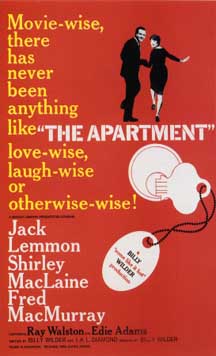
Lisa Watches The Oscar Winners: The Apartment (dir by Billy Wilder)


Apartment_60

After the Nun’s StoryI continued to experience TCM’s 31 Days of Oscar by watching the 1960 best picture winner, The Apartment.  The Apartment is unique among Oscar winners in that it’s one of the few comedies to win best picture.  (Though, in all honesty, it would probably be more appropriate to call The Apartment a dramedy.)  It was also, until the victory of The Artist, the last completely black-and-white film to win best picture.

(And, as long as we’re sharing trivia, it was also the first best picture winner to feature a character watching a previous best picture winner.  At the start of the film, Jack Lemmon deals with insomnia by watching Grand Hotel.)

The Apartment tells the story of C.C. “Bud” Baxter (Jack Lemmon), an anonymous officer worker who is determined to climb the corporate ladder despite not being very good at his job.  However, Baxter does have one advantage over his co-workers.  He’s single and therefore, his apartment has become the place to go for corporate executives who need a place where they can safely cheat on their wives.  Bud spends his day trying to coordinate who is going to be in his apartment and when.  Meanwhile, he spends his nights exiled from his own home and wandering around New York.  In fact, the only beneficial thing about this arrangement is that all of Bud’s supervisors have been giving him good evaluations in return for using his apartment.  (Well, that and Bud’s neighbor, played by Jack Kruschen, is convinced, based on the thinness of the apartment walls, that Bud must be a great lover.)

When Bud finally does get his promotion, it’s only because the personnel director, Jeff D. Sheldrake (an amazingly sleazy Fred MacMurray), wants to use Bud’s apartment.  Bud celebrates his promotion by finally working up the courage to ask out Fran (Shirley MacClaine), an elevator operator who works in the office.  What Bud doesn’t realize is that Fran is also the woman who Sheldrake wants to bring to the apartment….

Fran is convinced that Sheldrake is going to leave his wife for her.  What she doesn’t realize — and what Fred MacMurray’s performance makes disturbingly clear — is that Jeff Sheldrake is basically just a guy having a midlife crisis.  He’s the type of middle-aged guy that every woman has had to deal with at some point, the guy who pulls up next to you in a red convertible and stares at you from behind his sunglasses, attempting his best to entice you into helping him relive the youth that he never had.  When Fran eventually learns the truth about Sheldrake, it leads both to near tragedy and to Bud having to decide whether he wants to be a decent human being or if he wants to keep climbing the corporate ladder.

When one looks over a chronological list of all of the best picture winners, it’s a bit strange to see The Apartment listed in between Ben-Hur and West Side Story.  As opposed to those two grandly produced and vibrantly colorful films, The Apartment is a rather low-key film, one that devotes far more time to characterization than to spectacle.  And while both Ben-Hur and West Side Story are ultimately very idealistic films, The Apartment is about as cynical as a film can get.  The Apartment may be a comedy but the laughs come from a place of profound sadness.

Because it’s more interested in people than in spectacle, The Apartment holds up better than many past best picture winners.  We’ve all known someone like Bud.  We’ve all had to deal with men like Sheldrake.  And, in one way or another, we all know what it’s like to be someone like Fran.  The Apartment remains a truly poignant and relevant film.

http://www.youtube.com/watch?v=B4OXm9-E8OQ

Shattered Politics #20: The Best Man (dir by Franklin J. Schaffner)


Best_man22234

“Does The Best Man Always Get To The White House?” asks the poster for the 1964 film, The Best Man.

Of course, nowadays, that question seems incredibly naive.  Of course the best man doesn’t always get to the White House!  Some of my friends are Republicans and some of my friends are Democrats and a lot of my friends are Libertarians but they all have one thing in common: the belief that at least half of the past 4 elections were won by the wrong man.

But, as anyone who has done their research can tell you, 1964 was a far different time from 2015.  In general, people had greater faith in both government and their elected leaders.  Ineffective leaders and corrupt authority figures were viewed as being the exception as opposed to the rule.  We’re a lot more cynical now and, when we see political movies from the early 60s, all of that optimism and idealism often make them feel very dated.

Another big difference between the middle of the 20th Century and today is that, when it came to presidential nominating conventions, there was actually the potential for some suspense regarding who would win the nomination.  Occasionally, it took more than one ballot for a candidate to be nominated.  Last minute deals often had to be made and convention delegates were actually selecting an ideology along with a candidate.  Political conventions were contests and not coronations.

Again, it’s obvious that times have changed and, as a result, a film like The Best Man, which may have seemed very provocative and shocking in 1964, feels a bit like an antique today.  That doesn’t mean that it’s a bad film.  In fact, The Best Man is an interesting time capsule of the way things used to be.

The Best Man takes place at a presidential nominating convention.  The party is not specified but it feels like a Democratic convention.  There are several candidates competing for the nomination but the two front-runners are former Secretary of State William Russell (Henry Fonda) and Senator Joe Cantwell (Cliff Robertson).

Much like the character that Fonda played in Advise & Consent, Russell is an intellectual, a calm and rational liberal. Much like Spencer Tracy in State of the Union, Russell is separated from his wife (Margaret Leighton) but the two of them are pretending to be a happy couple for the sake of the campaign.

Meanwhile, Joe Cantwell is a paranoid and ruthless opportunist, a former war hero who will do anything to win.  The only person more ruthless than Joe Cantwell is his brother and campaign manager, Don (Gene Raymond).

(For those who enjoy history, it’s interesting to note that John F. Kennedy was a war hero-turned-senator who had a ruthless brother who doubled as his campaign manager.)

Both Cantwell and Russell come to the convention hoping to get the endorsement of former President Art Hockstader (Lee Tracy).  While the pragmatic Hockstader cannot stand Cantwell personally, he also views Russell as being weak and indecisive.

However, both Russell and Cantwell have secrets of their own.  When Cantwell discovers Russell’s secret and threatens to leak it, Russell has to decide whether or not to reveal Cantwell’s secret.

The Best Man was based on a stage play by Gore Vidal and the actual film never quite escapes its theatrical origins.  And, in many ways, it feels undeniably dated.  But it’s still a well-acted film, one that will probably be best enjoyed by political junkies and students of history.  Before watching the movie, be sure to read up on the 1960 presidential election and then see if you can guess who everyone is supposed to be.