by Paul Green
by Paul Green
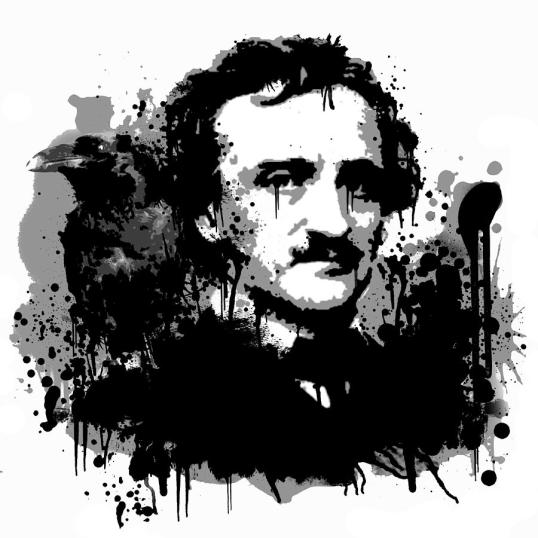
Today is Edgar Allan Poe’s birthday! If he were still alive today, he would be 209 years old. He would probably be the oldest man on the planet. Certainly, I think we would all be rather amazed at his vitality. Unfortunately, Poe is no longer with us. He was only forty years old when he died but his influence lives on.
You would think that there would be a hundred music videos based on the writings of Edgar Allan Poe. Well, you would be wrong. While Poe’s work has inspired countless musicians (and there have been several songs based on his work), there aren’t many “official” music videos of those songs.
(There’s plenty of unofficial and amateur videos, of course. But, for music video of the day, I know that Val preferred to use only official videos and, while I’m filling in for her, I’m going to abide by her rules.)
However, there is a band that was not only influenced by Poe but which proudly displays that influence. Edgar Allan Poets is a Los Angeles band that lists its two greatest influences as being Poe and Hitchcock. Their music has a haunting, rather dream-like feel to it.
This video is for their song Old Black Clown.
Enjoy!
by JK Potter
“Believe nothing you hear, and only one half that you see.”
― Edgar Allan Poe, The System of Doctor Tarr and Professor Fether
In tonight’s episode of Thriller, Boris Karloff not only hosts but also stars!
An adaptation of the Edgar Allan Poe short story, this episode is about a man (Sidney Blackmer) who has very good reason to fear that he might end up being buried alive! Karloff appears as his loyal physician, who might be Blackmer’s only hope to avoid being murdered by his wife and her lover.
Enjoy!
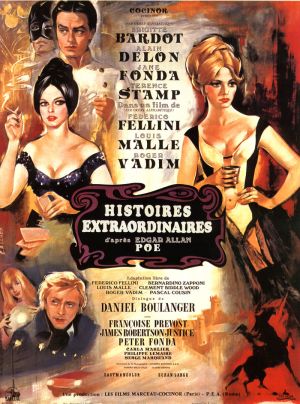
Directed by Federico Fellini, Toby Dammit was the third and final part of the 1968 anthology movie, Spirits of the Dead.
All three parts of Spirits of the Dead were based on a short story by Edgar Allan Poe. Toby Dammit was based on Never Bet The Devil Your Head. It seems appropriate that Fellini was the only director to rename his adaptation. While Toby Dammit may be based on Poe’s story, it’s definitely Fellini’s film.

Terrence Stamp plays Toby Dammit, a former Shakespearean actor turned dissolute film star. As is quickly established, Toby is an alcoholic. As we watch him stumble through this film, alternatively bitter and flamboyant, we’re reminded of the stories of other British thespians who were legendary drinkers: Oliver Reed, Trevor Howard, David Hemmings, Peter O’Toole, and others. With his Shakespearean background, it’s tempting to assume that Toby is meant to be a stand-in for Richard Burton but he actually bears a greater resemblance to Richard Harris.
(If you’re wondering how I came to be an expert on British alcoholics, might I recommend a short but informative book called Hellraisers: The Life and Inebriated Times of Richard Burton, Richard Harris, Peter O’Toole & Oliver Reed. It was written by Robert Sellers and it makes for very interesting reading. Especially the parts about Oliver Reed.)
Toby has come to Rome, to work on a film. He doesn’t seem to be quite sure what the film is about or what role he’ll be playing. (Judging from what the people around him say, it appears to be a biblical epic and Toby will be playing Jesus.) While Toby floats through the city in an alcoholic haze, sycophants and fans surround him. While he sits in the back set of a limo, a fortune teller looks at his palm and gets a worried look on her face. Toby doesn’t care. He just wants to get the Ferrari that the film’s producers promised him.
The only thing that worries Toby is the little girl that he keeps seeing out of the corner of his eye. She bounces a white ball and whenever Toby sees her, a truly evil smile cross her face. Interestingly, Fellini always frames the girl so that, like Toby, we only seem to be seeing her out of the corner of our eye. Is she real or is she a figment of Toby’s alcohol-addled brain? And what are we to make of the fact that Toby’s normally noise-filled world goes silent whenever he sees the girl?
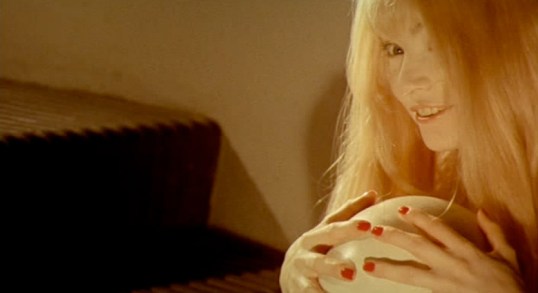
On a talk show, Toby is asked how he visualizes the devil. He says that he doesn’t see the devil as being a demon with horns or an old man. (Interestingly enough, that’s how Poe portrayed the Devil in the original short story.) Instead, he sees the devil as being a little girl with a ball.
However, Toby can’t spend too much time worrying about the little girl. He just got his Ferrari…
Toby Dammit is the only unqualified success among the three short films that make up Spirits of the Dead. I think it helps that, unlike Roger Vadim and Louis Malle, Fellini updated Poe’s story to the 20th Century and set it in the international film world. If Malle and Vadim both seemed detached from their segments, Fellini knew the world that he was depicting. I imagine he certainly was acquainted with plenty of actors who were just like the brilliant but self-destructive Toby Dammit.
The images of frequently dream-like. Everything is filmed slightly off-center, mirroring Toby’s hazy view of existence. When he sits in his limo, the world outside looks like the ruins of some sort of apocalyptic hellscape. When he is on a talk show or at an awards show, Toby still seems to be isolated from all of the adoring people around him. The few times that he does talk to other people, he does so without looking at them. In fact, the only person who seems to truly capture Toby’s attention is that little girl with the ball.
Speaking of which, it seems obvious that Toby Dammit was meant to be a bit of an homage to Fellini’s friend and fellow director, Mario Bava. Not only is the film’s color scheme very Bavaesque but that little girl will look familiar to anyone who has ever seen Kill, Baby, Kill.

Valerio Valeri in Mario Bava’s Kill, Baby, Kill
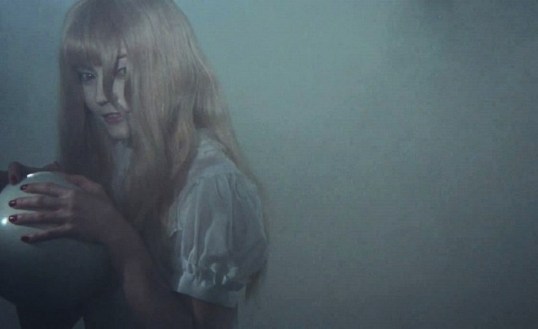
Marina Yaru in Federico Fellini’s Toby Dammit
Toby Dammit is definitely the best part of Spirits of the Dead. It’s a true Italian horror classic.
Directed by Louis Malle, William Wilson is the second part of the 1968 anthology film, Spirits of the Dead. All three of the stories were adapted from the work of Edgar Allan Poe.
William Wilson is one of Poe’s best known and most highly regarded stories. It’s also one that has been adapted into several films, perhaps most famously as the silent German film Student of Prague. So, how did Louis Malle do when it came time to direct his own version?
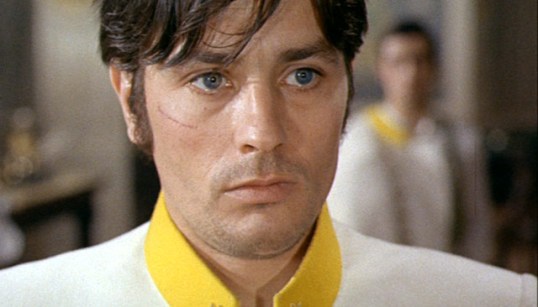
Malle’s William Wilson opens with the title character (played by Alain Delon) running through the cobblestone streets of a gray city. As we shall soon learn, the time is the early 19th century. William Wilson is an officer in the Austrian army, assigned to an occupied Italian village. Wilson, with blood on his head, rushes into a church, ducks into a confessional, and tells the priest that he has just murdered someone.
Wilson goes on to tell the story of not just his life but also the life of his Doppelganger, who is also named William Wilson and who is just as virtuous as the first Wilson is corrupt. All of his life, the first William Wilson has just wanted to be evil in peace and every time, the Doppelganger has shown up and ruined things. The Doppelganger first showed up when Wilson was a young boy and he’s proceeded to always pop up wherever Wilson may happen to go. When the first Wilson was enrolled in medical school and wanted to dissect a village girl, his Doppelganger had to show up and stop things. When the first Wilson beat the famous courtesan, Giuseppina (Brigitte Bardot), at cards and won the right to whip her, the Doppelganger had to show up and let everyone know that Wilson had cheated. Is the Doppelganger real or is he just a figment of Wilson’s imagination? Is Wilson just evil or is he crazy as well? Wilson isn’t sure but he does know that a well-placed dagger is one way to determine the truth…
Reportedly, Malle agreed to direct William Wilson because he was trying to raise the money to direct a far more personal film, Murmer of the Heart. As such, Malle didn’t have a personal stake in William Wilson and made several compromises to keep the film’s producer happy. As a result, William Wilson often doesn’t make much sense. For instance, how does Wilson go from being merely decadent to suddenly trying to dissect a living human being? Though the idea of Wilson cheating at cards is taken straight from Poe’s original story, Brigitte Bardot’s lengthy cameo still feels out of place.
That said, Malle was a good enough director that, even if he was detached from the end result, his segment of Spirits of the Dead is always watchable. The film’s best moments are the ones that simply study Alain Delon’s fascinating face. Delon feels miscast as the virtuous Doppelganger (who, let’s just be honest, is kind of a prig) but he is dangerously compelling at William Wilson. The coldness of his eyes tells us everything that we need to know about who William Wilson is.
William Wilson is technically better than the 1st part of Spirits of the Dead, Roger Vadim’s Metzengerstein, but it’s never as much fun.
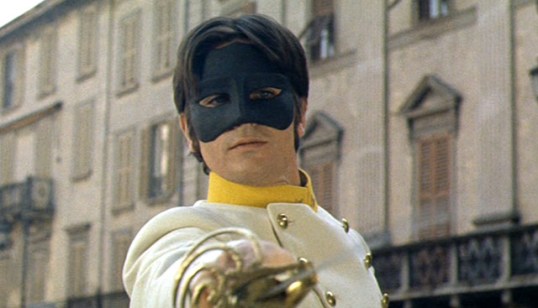
First released in 1968, Spirits of the Dead is an anthology film, one in which three famous international directors (Roger Vadim, Louis Malle, and Federico Fellini) each took a shot at adapting a short story by Edgar Allan Poe. By their very nature, anthology films tend to be uneven and that’s certainly the case with Spirits of the Dead.
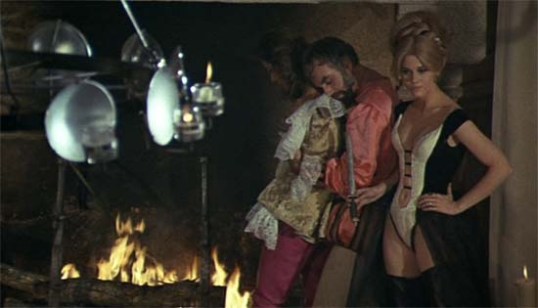
Consider the first story in the film, Roger Vadim’s adaptation of Metzengerstein. Vadim was best known for his visually lavish films, the majority of which starred whoever he happened to be romantically involved with at the time. Vadim’s films were sexually charged and decadent but it was a very specific, late 60s type of decadence. They may have seemed wild when they were first released but, seen today, his films seem rather quaint (not to mention dated).
Anyway, when Vadim was hired to shoot his part of Spirits of the Dead, he was married to Jane Fonda so, of course, she stars as Countess Frederique Metzengerstein (Jane Fonda). That Countess Frederique is evil is obvious from the start. In between having tastefully shot orgies, she torments her servants. She even has one servant boy hung so that she can see if she can shoot an arrow through the rope. (Fortunately, for the servant boy, she can.) It’s an evil, spiritually empty life but, as can be seen in the picture above, her clothes are to die for.
(Though Metzengerstein appears to be taking place in the 19th century, everyone looks like they’ve just flown over from swinging London. There’s a lot of miniskirts, sideburns, and tinted glasses.)
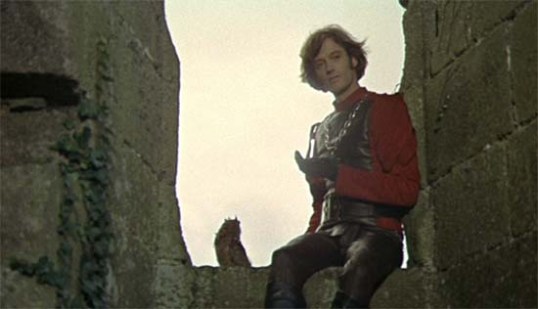
Anyway, things change for Frederique when she meets her virtuous cousin, Wilhelm. She immediately falls into lust with him but he wants nothing to do with her and her evil ways. (Her cousin, I might add, is played by Peter Fonda, brother of Jane.) Upset over being rejected, Frederique sets his stables on fire. Wilhelm dies in the inferno.
After Wilhelm’s death, a new horse suddenly appears outside of Frederique’s castle. Convinced that Wilhelm’s spirit has inhabited it, Frederique grows obsessed with the horse. Soon, Frederique is spending all of her time riding the horse. With no more time to be evil, Frederique becomes less feared.
But, in the distance, there are always flames calling out to her…

So, let’s just start with the obvious. There is a huge ick factor to be found in Metzengerstein. Just as Frederique spends the first half of the movie in love with her cousin, Jane Fonda spends the first half of the movie pretending to be in love with Peter Fonda. Wilhelm, of course, rejects Frederique but still, it just feels undeniably … creepy. What’s odd is that it’s difficult to tell if Vadim was trying to make the audience uncomfortable or if this casting was just a case of Peter having some time to kill while visiting his sister and brother-in-law. For all the attention that he pays to the film’s lush visuals, Vadim is such a detached storyteller that it’s hard to guess what his intention was.
Jane Fonda gives a good performance as the cruel Frederique but otherwise, everyone else in the film is just a part of the scenery. That’s the thing with Metzengerstein. It’s a gorgeous film but, ultimately, it’s all scenery that adds up to nothing.

Today’s horror scene that I love is from the 1961 Roger Corman film, The Pit and The Pendulum!
Not only is that pendulum nightmarish as Hell but check out that set design! One can see that Corman definitely took some inspiration from Hammer’s Dracula and Frankenstein films. Watching this scene, it is easy to see why Corman devoted so much of the early 60s to directing Vincent Price in various Edgar Allan Poe adaptations.
Enjoy!
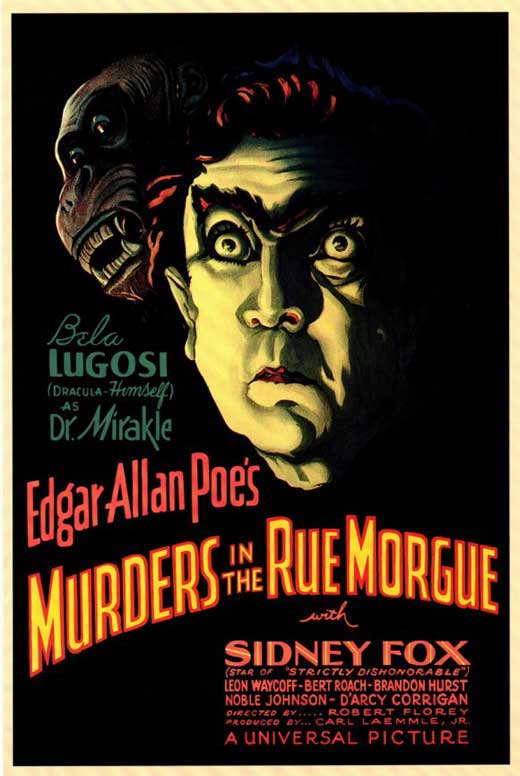
We can’t have a proper ‘Halloween Havoc!’ without inviting Bela Lugosi to the party, now can we? After all, his 1931 hit DRACULA practically invented the horror movie as far as ‘talking pictures’ go. Both Bela and director Robert Florey were slated to work on producer Carl Laemmle’s next horror opus FRANKENSTEIN, but Laemmle wasn’t satisfied with their version, handing it over to James Whale, who hired a bit player named Boris Karloff to portray the monster of science, and the rest is history. Lugosi and Florey were instead given MURDERS IN THE RUE MORGUE, based on Edgar Allan Poe’s classic tale, to bring to screen life. This was the first of Bela’s “mad doctor” role, a part he would essay twelve more times in films of varying quality.
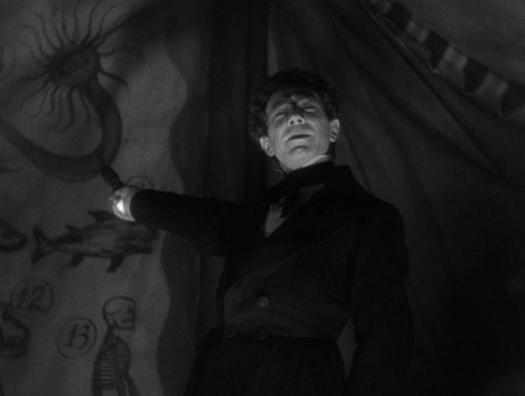
It’s Carnival Night in 1845 Paris, and med student Pierre Dupin takes his girlfriend Camille L’Espanaye to make merry watching exotic belly…
View original post 807 more words
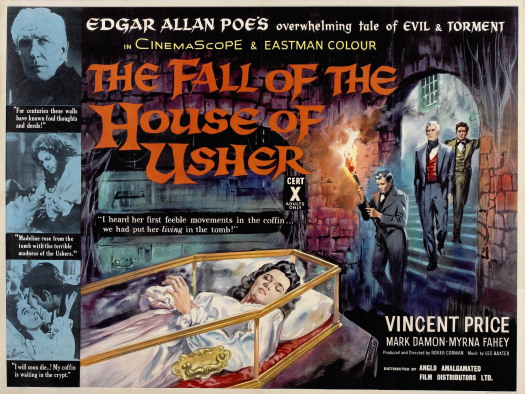
I’ve covered Vincent Price’s film work 17 times here, which must be some kind of record. Can you tell he’s one of my all-time favorite actors? Vincent Leonard Price, Jr. was born May 27, 1911 in St. Louis, Missouri. The elegant, eloquent Price was also an avid art collector and gourmet cook of some note. He’s justifiably famous for his film noir roles, but Price etched his name in cinematic stone as one of filmdom’s Masters of Horror.
Price starred in his first fright film way back in 1940 with THE INVISIBLE MAN RETURNS . But it wasn’t until 1953’s 3-D outry HOUSE OF WAX that he became tagged as a horror star. Later in that decade, he made a pair of gimmicky shockers for director William Castle ( THE HOUSE ON HAUNTED HILL , THE TINGLER), and in 1960 began his collaboration with Roger Corman on movies based (loosely, mind you) on the works of Edgar Allan Poe. The first…
View original post 584 more words

 Through the Shattered Lens