Late Night Retro Television Review: Friday the 13th: The Series 3.6 “Bad Penny”


Welcome to Late Night Retro Television Reviews, a feature where we review some of our favorite and least favorite shows of the past! On Fridays, I will be reviewing Friday the 13th: The Series, a show which ran in syndication from 1987 to 1990. The entire series can be found on YouTube!

This week …. hey, it’s a good episode!

Episode 3.6 “Bad Penny”

(Dir by William Fruet, originally aired October 30th, 1989)

The Coin of Ziocles returns!  Last seen being used by a cult to raise the dead, the Coin is recovered from a construction site at the start of this episode.  This turned out to be the best episode of the third season so far.  Here’s a few reasons why:

  1. First off, with this episode, Friday the 13th finally showed that it still remembered its own history.  The last time Jack, Micki, and Ryan sought the coin, Micki was actually killed and remained dead until Ryan and Jack figured out how to use the coin to bring her back to life.  With this episode, we discover that Micki has some serious PTSD as a result of the experience which actually makes a lot of sense.  In the past, I’ve always felt this show tended to gloss over just how traumatizing it would be to deal with cursed antiques on a daily basis.  With this episode, we see that Micki can’t even look at the site where she was killed without starting to shake.  It was realistic and Robey did a great job portraying Micki’s emotions.
  2. In yet another nod to continuity, Johnny stole the coin and used it to bring back his dead father.  In the past, I’ve felt like Johnny was a bit too quick to accept the idea of the antiques being cursed.  With this episode, we saw that the inexperienced Johnny doesn’t quite understand that danger of the cured antiques.  Ryan, Micki, and Jack would never have made the mistake of using the antique or trusting anything that had once been owned by Uncle Lewis but Johnny is still learning.
  3. Steve Monarque and Sean McCann both did excellent work as Johnny and his father.  Needless to say, Johnny’s father is confused when he’s brought back from the dead.  His struggle to understand what was happening brought tears to my eyes.  It’s been less than a year since I lost my Dad.  I’d probably do the same thing Johnny did.  In the end, Johnny sent his father back into the afterlife.  It was so sad!
  4. Micki writes a letter to Ryan.  It’s probably one that she won’t ever send but it’s good to see that the show at least acknowledged how difficult it would have been for her to say goodbye to Ryan.
  5. By mentioning Ryan so much, this show actually made it easier for me to accept Johnny as his replacement.  Over the past few episodes, I kind of resented how quickly Johnny seemed to be stepping into replace him.  This episode showed me that Ryan is still loved.
  6. The villains — a corrupt cop and his zombified partner — were a bit over-the-top  but still entertaining.  For once, this episode focused on our heroes and I was glad it did.

This was an excellent episode of Friday the 13th!  I hope it’s a sign of things to come for the rest of the third season.
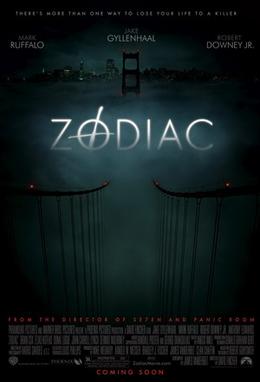
October True Crime: Zodiac (dir by David Fincher)


Who was the Zodiac Killer?

That is a question that has haunted journalists, cops, and true crime fans since the late 60s.  It is known that the Zodiac Killer murdered at least five people in Northern California in 1968 and 1969.  He targeted young couples, though he is also thought to have murdered on taxi driver as well.  What set Zodiac apart from other killers is that he was a prolific letter writer, who sent cards and ciphers to the police and the journalists who were reporting on his crimes.  In one of his ciphers, Zodiac claimed that he had killed 37 people.  Cartoonist Robert Graysmith later wrote two books about his personal obsession with the case.  He estimated that the Zodiac may have been responsible for hundred of murders, up through the 80s.  Of course, reading Graysmith’s first Zodiac book, it’s also easy to suspect that Graysmith reached a point where he saw the Zodiac’s hand in every unsolved murder in the San Francisco area.  Of all the unidentified serial killers in American history, Zodiac is one that most haunts us.  Zodiac was a serial killer who operated in an era when such things were still considered to be uncommon.  Much as Jack the Ripper did during the Victorian Age, Zodiac announced the arrival of a new age of evil.

Zodiac wrote about being a film fan and he was probably happy about the fact that he inspired quite a few films.  1971’s The Zodiac Killer came out while Zodiac was still sending letters to the police and cops actually staked out the theaters showing the film just to see if he  would show up.  Dirty Harry‘s Scorpio Killer was also based on Zodiac, right down to the taunting letters that he sent the mayor and again, one has to wonder if Zodiac ever showed up to watch Clint Eastwood take him down.

And, if Zodiac survived into the 21st Century, one has to wonder if he showed up in the theaters for 2007’s Zodiac.

One of the best true crime films ever made, Zodiac not only recreates the crimes of the Zodiac but it also examines the mental price of obsessing over the one unknown force of evil.  Mark Ruffalo plays Dave Toschi, the celebrity cop who nearly sacrificed his professional reputation in his search for the identity of the killer.  Jake Gyllenhaal plays cartoonist Robert Graysmith, who spends over a decade searching for the Zodiac’s identity and who loses his wife (Chloe Sevigny) in the process.  And Robert Downey, Jr. plays Paul Avery, the crime reporter to whom the Zodiac wrote and who sunk into paranoia and addiction as a result.  This is a film that is less about the Zodiac’s crime and more about how this unknown killer seemed to unleash a darkness that would come to envelope first a city and eventually an entire nation.

As one might expect from a film directed by David Fincher, Zodiac plays out like a filmed nightmare with the starkly portrayed murders being all the more disturbing because they often take place outside, where people would think they would be safe.  (The second murder is especially terrifying, as it plays out without even the sound of background music to allow us the escape of remembering that it’s only a movie.)  Fincher heightens our paranoia but having a different actor play the killer in each scene, reminding us that the Zodiac could literally be anyone.  Indeed, one of the scarier things about Zodiac is that, in the course of his investigation, Graysmith meets so many different people who seem like they could be the killer.  Even if they aren’t the Zodiac, the viewer is left with the feeling that the world is full of people who are capable of committing the same crimes.  The film becomes a journey into the heart of darkness, with the Zodiac becoming both a malevolent force and potentially your next door neighbor.  And with the film’s detailed recreation of the 60s and the 70s, the film becomes a portrait of a country on the verge of changing forever with the Zodaic and his crimes representing all the fear waiting in the future.

Again, as one might expect from a Fincher film, it’s a well-acted film, especially by Robert Downey, Jr.  Zodiac came out a year before Iron Man, when Downey was still better known for his personal troubles than for his talent.  Downey perfect captures his character’s descent into self-destruction, as he goes from being cocky and self-assured to being so paranoid that he’s carrying a gun.  (Paul Avery’s actual colleagues have disputed the film’s portrayal of Avery being mentally destroyed by the Zodiac.)  Ruffalo and Gyllenhaal also do a good job of portraying Toschi and Graysmith’s growing obsession with the case while Charles Fleischer and John Carroll Lynch both make strong (and creepy) impressions as two men who might (or might not) be the killer.

Though the film was not a success at the box office and it was totally ignored by the Academy, Zodiac has built up a strong reputation in the years since its released.  It’s inspired a whole new generation of web sleuths to search for the killer’s identity.  Personally, my favored suspect is Robert Ivan Nichols, an enigmatic engineer who abandoned his former life and changed his name to Joseph Newton Chandler III in the 70s and who committed suicide in 2002.  I think much like Jack the Ripper, the Zodiac’s identity will never be definitely known.  There have been many compelling suspects but most of the evidence seems to be circumstantial.  (That’s certainly the case when it comes to Nichols.)  The Zodiac was thought to be in his 30s or even his early 40s in 1969 so it’s doubtful that he’s still alive today.  In all probability, his identity and his motive will forever remain an unsolvable mystery.