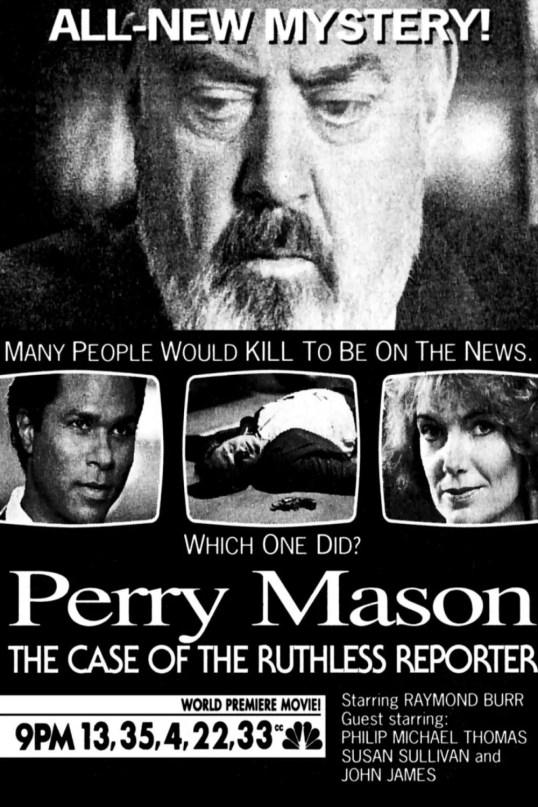
When arrogant news anchor Brett Huston (John James) is shot and killed, his co-anchor Gillian Pope (Kerrie Keane) is arrested and charged with the crime. It looks like an open-and-shut case because Brett was shot with Gillian’s gun. Luckily, Gillian is friends with Perry Mason (Raymond Burr) and soon Perry is on the case with Della Street (Barbara Hale) and Ken Malansky (William R. Moses).
Now this is how you do a Perry Mason movie! Brett’s murder is linked to a memo that he wrote in which he criticized the other members of the news team and argued that they should all be fired. All of the suspects are enjoyably eccentric. There’s a weatherman (Peter Jurasik) who wants to be a stand-up comedian. There’s the sports reporter (Philip Michael Thomas) who used and sold steroids. There’s the producer (Susan Sullivan), who was also Brett’s ex-wife. Brett even insulted the station manager (Jerry Orbach, who previously appeared as a different suspect in The Musical Murder). Ken, as usual, finds time for romance, this time with reporter Cassie Woodfield (Mary Page Keller) who appears to have someone trying to kill her as well. Along with a great cast of characters, this mystery had a solution that took me by surprise but which also made sense when I looked back on it. The final courtroom reveal was perfect. This is also probably the only Perry Mason film where the hours of a hamburger restaurant proved to be instrumental to the case.
Welcome to Late Night Retro Television Reviews, a feature where we review some of our favorite and least favorite shows of the past! On Thursdays, I will be reviewing Highway to Heaven, which aired on NBC from 1984 to 1989. The entire show is currently streaming on Tubi and several other services!
Merry Christmas!
Episode 4.12 “With Love, The Claus”
(Dir by Michael Landon, originally aired on December 23rd, 1987)
Jonathan and Mark find themselves working for a lawyer named Paul Burke (John Calvin). It’s the Christmas season and they help Paul out by taking his son to Newman’s Department Store. The kid wants to talk to Santa. What the kid doesn’t know is that there are several Santas at Newman’s. They work in shifts and they’re pretty cynical. However, the newest Santa (Bill Erwin) takes his job very seriously because …. he is Santa!
So, why is Santa working at a department store instead of getting things ready up at the North Pole? This episode never really explains. Instead, we get Santa taking offense when he’s asked to help the store sell it’s latest toy.
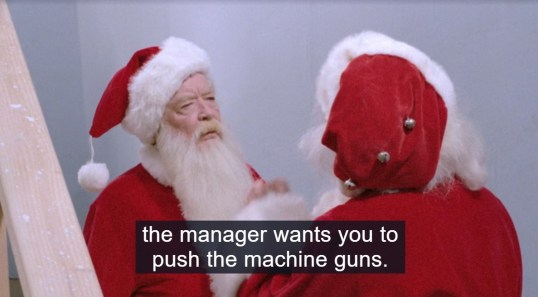
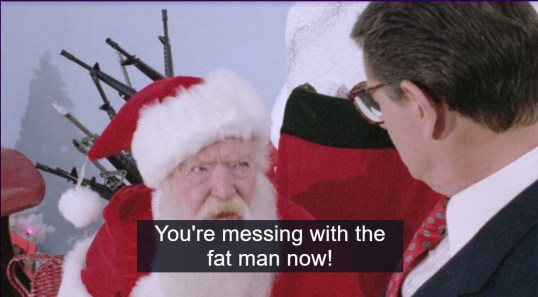
Santa says that there’s no way he’s going to push machine guns. He’s about peace and love! His boss, Mr. Grinchley (Robert Casper), threatens to fire him. Santa doesn’t react well to that.
Santa ends up unemployed and with nowhere to live. Jonathan arranges for Paul to represent Santa in a lawsuit that Santa has filed against Newman’s Department Store. The lead counsel for Newman’s just happens to Paul’s ex-wife, Donna (Wendie Malick).
You can probably guess where all this is going, right? Santa eventually ends up in jail after the chairman of Newman’s files a lawsuit against him. Santa says that he can’t stay in jail because Christmas Eve is approaching. Maybe Santa should have thought about that earlier.
This episode owed a lot to one of my favorite Christmas movies, Miracle on 34th Street. Of course, Miracle on 34th Street featured Edmund Gwenn, who gave a delightful performance as Santa. This episode features Bill Erwin, who basically plays Santa as being a half-crazed grump who won’t stop complaining. Seriously, this episode may feature the most unlikable Santa Claus this side of Rudolph The Red-Nosed Reindeer. I don’t know why Michael Landon directed Erwin to play Santa as if Santa was plotting to kill all of his enemies but it definitely wasn’t the right approach.
Seriously, Santa is really self-righteous in this episode.
I hate to criticize a Christmas episode and, as always, I’m sure that Michael Landon had the best and the sincerest of intentions. But this episode just didn’t work for me. Santa was too much of a jerk.
What were those years in your life where movies really became something special to you? I’d say mine began in around 1984 and extended all the way through about 1991, when I headed off to college and the realities of the world started kicking in. Our family got our first VCR around 1984, and this is when I first truly began to fall in love with the cinema. These are the years when I would spend every moment I could in our local video stores inspecting every film in their stock. So many of my favorite movies came out during this time and hold a sense of nostalgic value in my life even now. One of those movies is STAKEOUT, an action comedy from 1987 starring Richard Dreyfuss and Emilo Estevez.
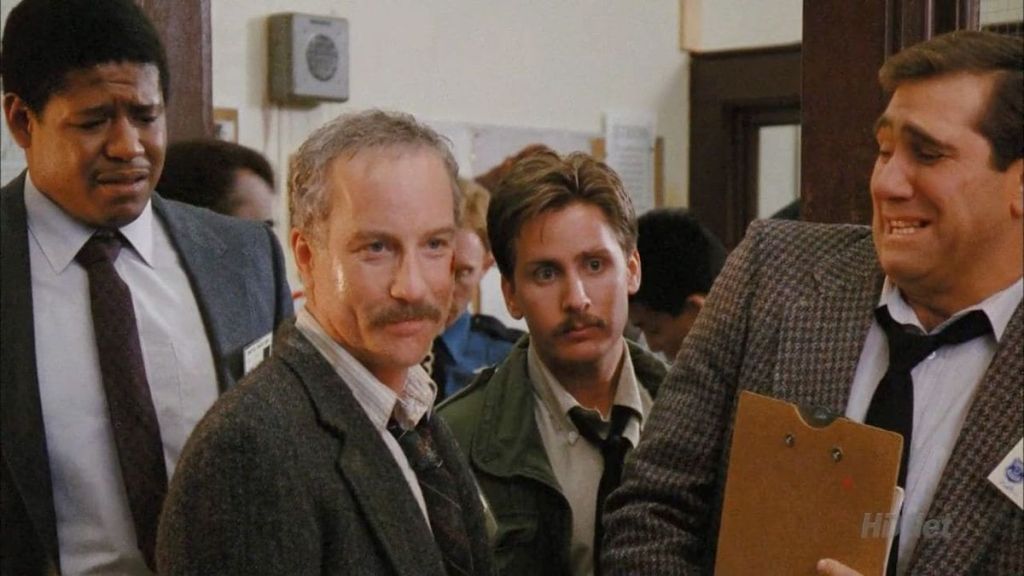
STAKEOUT begins with Richard “Stick” Montgomery (Aidan Quinn) escaping from prison, where he has been sent for killing an FBI agent a year earlier. Enter Seattle police detectives Chris Lecce (Richard Dreyfuss) and Bill Reimers (Emilio Estevez). They are assigned to stakeout the home of Montgomery’s beautiful ex-girlfriend Maria (Madeleine Stowe). In order to listen to her phone conversations, Chris impersonates a telephone repairman and meets her when he goes into her home to install the “bugs.” As fate would have it, he runs into Maria again at the local grocery store when he’s gone out to buy some supplies and donuts. She asks him to give her a ride home when she discovers she has a flat tire on her bike. He reluctantly gives her a ride home, but once he’s there, he puts up her groceries, she makes him a spicy dinner, and then he not so reluctantly makes love to her… all while his partner Bill is across the street waiting for his donuts. As you might imagine, this complicates the entire situation. And meanwhile, “Stick” Montgomery keeps making his way Seattle and Maria’s house where he stashed his cash before going away to prison.
STAKEOUT is one of those movies that our family rented in the late ‘80’s, and I immediately fell in love with. It’s my favorite kind of movie, the buddy cop film. Richard Dreyfuss and Emilio Estevez have a really nice chemistry together, and they come across as old friends. Even though there’s quite a bit of violence, the movie has a playful streak that I enjoy. There’s a series of running gags where Chris and Bill play practical jokes back and forth with the cops who relieve them on the stakeout each day, played by Dan Lauria and Forest Whitaker. The movie even throws in a little self-referential humor. In order to relieve the boredom of the stakeout, Estevez’ character is asking Dreyfuss movie trivia questions. He asks him to identify the movie where the line “this is no boating accident!” is from! Dreyfuss’ character has no idea. These are fun moments for me.
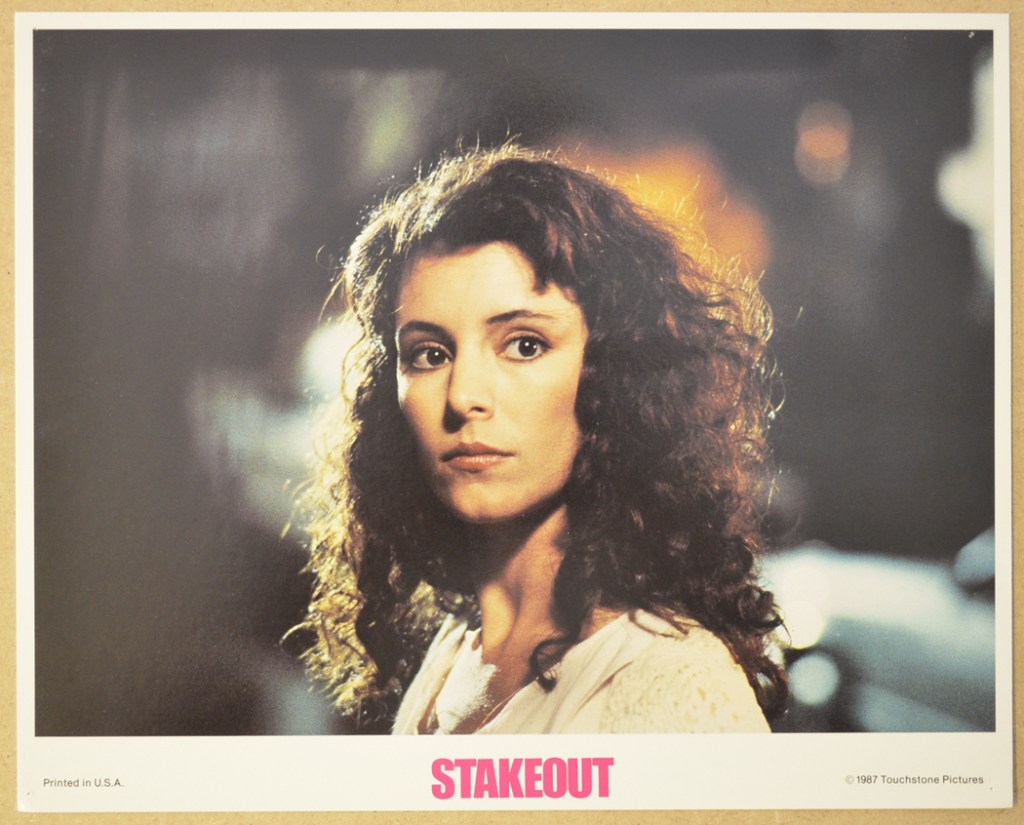
Another thing I love about STAKEOUT is the presence of the gorgeous Madeleine Stowe, who was making her first major film appearance. Seeing the film for the first time as a teenager of 14 years old made me a fan of hers for life. I’m not saying the movie was made specifically for 14-year-old boys, but it certainly wasn’t trying to push us away with its ad campaign that prominently featured the lovely Ms. Stowe. I’ll also point out that Aidan Quinn is effective and intimidating as the escaped murderer Richard “Stick” Montgomery. The fact that his character really does seem dangerous helps to make the film even more exciting when everything finally comes to a head. Veteran Director John Badham has made some really good movies in his career, including SATURDAY NIGHT FEVER (1977), BLUE THUNDER (1983), THE HARD WAY (1991), and NICK OF TIME (1995), to name a few. He knows what he’s doing, and I really started following his work based on how much I enjoyed STAKEOUT.
As much as I enjoy STAKEOUT, it’s one of those movies I don’t hear that much about these days even though it was a substantial box office hit. There was a misguided sequel made in 1993, ANOTHER STAKEOUT, that brought back Dreyfus, Estevez, and director Badham. I remember watching the sequel in the 90’s, but I honestly don’t remember anything about it. One of the reasons I enjoy writing about movies is because it gives me an opportunity to share a part of who I am, the things I enjoy, and maybe even serve as a reminder to others of films like STAKEOUT. I don’t think of these movies often myself, but when I was looking at my DVD collection earlier today, I smiled when I saw it and happily pulled it off the shelf to watch it again for the first time in several years!
Welcome to Retro Television Reviews, a feature where we review some of our favorite and least favorite shows of the past! On Thursdays, I will be reviewing South Central, which aired, for 10 episodes, on Fox in 1994. The entire show is currently streaming on YouTube!
This week, South Central comes to an end.
Episode 1.9 “Dog”
(Directed by Stan Lathan, originally aired on May 31st, 1994)
Deion finally gets to be the focus of an episode and it’s seriously, the most depressing 30 minutes ever.
After eight episode of never speaking and never smiling, Deion is briefly happy when a stray dog follows him and Andre home. Deion loves playing with the dog and he even starts to bark just like the dog. Joan, however, is not happy about the idea of having the dog in the house. As she sensibly points out, they don’t know if the dog is sick and dog’s are expensive to keep. Still, when she sees how Deion loves the dog, she says that the dog can stay as long as he doesn’t make a mess in the house. Andre agrees to watch over the dog.
Joan leaves for the Co-op, where Bobby has declared the day to be “Black Dollar Day.” Of course, as soon as Joan does leaves the house, the dog makes a mess on the floor. Neither Andre nor his friend Rashad are willing to clean it up, with Andre is more concerned with calling Nicole and begging her to take him back. Finally, Tasha’s friend Shanelle (Shar Jackson) cleans up the mess because she wants to get together with Andre. However, Andre rejects Shanelle, telling her that she needs to have more respect for herself. (Andre wasn’t too concerned about Shanelle’s self-esteem when she was cleaning up after the dog for him.) Later, Andre and Tasha catch Shanelle and Rashad fooling around in Joan’s bedroom. This leads to multiple fights and the dog getting so agitated that it bites Shanelle.
The end result is Shanelle goes to the hospital, animal control takes away the dog, and Deion is left without his only friend. The next morning, Deion steps out of the house and stands on the sidewalk, barking like a dog.
My God, what a depressing show! But I should also add that it was a remarkable well-acted episode, especially the scene in which Joan explained to Deion that the dog wouldn’t be coming back but that the dog was okay and still cared about him. Seriously, I’m tearing up just writing that and I’m not even dog person.
Let’s move on to the series finale.
Episode 1.10 “Date”
(Directed by W.E. Baker, originally aired on June 7th, 1994)
Joan orders Andre and Rashad to take Tasha to the Ujamaa Hi-Life and pushes Deion onto Sweets so that she can have the house to herself for a night. However, almost as soon as the kids leave, Ray (Ken Page) shows up. (Yay! Ray’s back!) Ray sweetly asks Joan if she would like to have dinner with him. They head out to the local catfish place but they discover that there is a 45-minute waiting time for a table. Except …. OH MY GOD, IT’S ISAIAH! Isaiah (Michael Beach) explains that he is friends with the owner of the restaurant and he always has a table. Isaiah invites Joan (and, by extension, Ray) to have dinner with him.
Needless to say, dinner is a bit awkward, with Ray and Isaiah each mentioning that they own multiple homes and tying to impress Joan. Isaiah is as much of a charming jerk as he was the last time he went out with Joan. Ray, once again, promises to always be there for Joan and Andre despite the fact that Joan is obviously not interested in him. As bad as I do feel for Ray, he should realize by this point that Joan doesn’t share his feelings. You can’t create chemistry where there isn’t any.
Meanwhile, at the Co-Op, Rashad and Andre look for dates (which I guess means that Andre is over Nicole) and Tasha eventually cheers up when she gets to perform on stage.
To be honest, it’s a bit of an underwhelming ending for a show that featured so many powerful episodes. The finale feels far more conventional in its humor than the previous episodes and that probably has something to do with the fact that this was the only episode of South Central to not be directed by Stan Lathan. The finale feels more than a bit off when compared to what came before but, at the same time, it’s nice that the show ended with Tasha finally getting a moment to be the center of attention.
South Central only ran for ten episodes and it’s easy to see why it struggled in the ratings. For a comedy, South Central could be a very dark show. There weren’t a lot of standard happy endings to be found in South Central and even the upbeat finale left viewers feeling that things were only going to get more difficult for the Mosely family. Joan is still going to be working herself to death at Ujamaa. Andre is still going to often be his own worse enemy. And, even after performing in front of the entire community, Tasha is still going to be the one who is always expected to sacrifice to help out around the house. This show was all about the small moments of happiness that can be found even in the most difficult of circumstances. Ultimately, though, those moments can only take you so far.
Next week, just in time for October, we start a new Thursday show and it features a ghost! Are you ready for …. Jennifer Slept Here!?
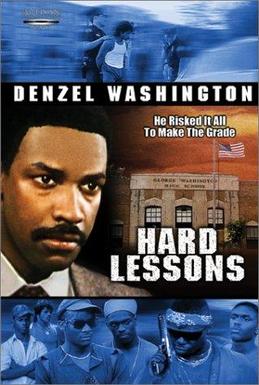
Welcome to Retro Television Reviews, a feature where we review some of our favorite and least favorite shows of the past! On Sundays, I will be reviewing the made-for-television movies that used to be a primetime mainstay. Today’s film is 1986’s The George McKenna Story! It can be viewed on Netflix, under the title Hard Lessons!
George Washington High School is a school that has defeated many well-meaning principals. The hallways are full of drugs and gang members. A good deal of the student body never shows up for class. Fights are frequent. The police are a common sight. The majority of the teachers are men like Ben Proctor (Richard Masur), burned-out and content to hide in the teacher’s lounge.
New Orleans-raised George McKenna (Denzel Washington) is the latest principal and, from the minute that he shows up at the school, he seems a bit more confident than the other principals that the school has had. He barely flinches when a raw egg hits his suit. When he hears a fight occurring, he doesn’t hesitate to head down the hall to investigate. McKenna is determined to make George Washington High into a worthwhile institution and that means inspiring both the students and the teachers.
When it comes to films about dedicated educators trying to reform a troubled school, most films tend to take one of two approaches. One approach, the well-intentioned but not always realistic liberal approach, features the teacher or the principal who demands respect but who also treats the good students and teachers with equal respect and who turns around the school through the power of benevolence. The other approach is the one where the principal or teacher grows frustrated and turns into an armed vigilante who forces the students to shut up and learn. Think of The Principal or The Substitute or Class of 1984. The first approach is the one that most teachers claim that they try to follow but I imagine that, for most of them, there’s an element in wish-fulfillment to be found in watching the second approach. In the real world, of course, neither approach is as automatically successful as it is in the movies.
The George McKenna Story was made for television and it’s based on a true story so, not surprisingly, it follows the first approach. Denzel Washington plays McKenna as someone who could probably handle himself in a fight if he ever got into one but, for the most part, the film portrays McKenna as succeeding by treating his students with more empathy and respect that they’ve gotten from anyone else in their lives. Though cranky old Ben Proctor thinks that McKenna’s methods are foolish and that he’s asking the teachers to do too much, McKenna starts to turn the school around. One student, whose father was threatening to make him drop out, ends up getting nearly straight A’s and reciting Shakespeare. Unfortunately, not everyone can be rescued. One student is arrested for murder and taken away by the cops but McKenna is still willing to be there for that student. McKenna doesn’t give up on his students and, unlike that music teacher in The Class of 1984, he doesn’t allow them to fall through a skylight either.
The George McKenna Story is a predictable film. It’s easy to guess which student will be saved by McKenna’s approach and which student will end up getting stabbed in a gang fight and which student will end up in prison. That said, the film definitely benefits from Denzel Washington in the lead role. Washington exudes confidence from the minute that he appears on screen and you’re left with little doubt that if anyone could reform a school simply through good intentions, it would definitely be Denzel Washington.
Welcome to Retro Television Reviews, a feature where we review some of our favorite and least favorite shows of the past! On Thursdays, I will be reviewing South Central, which aired, for 10 episodes, on Fox in 1994. The entire show is currently streaming on YouTube!
This week, Andre gets a gun!
Episode 1.7 and 1.8 “Gun”
(Dir by Stan Lathan, originally aired on May 24th, 1994)
I’m not a huge fan of the song Amazing Grace.
Okay, allow me to clarify. I know that it’s an important song. I know that it’s a song that was at least partially written as a protest against the Atlantic slave trade. I know that it’s a song that means a lot to many people. But I have to admit that I cringe whenever someone starts singing it in a movie or on a TV show because it’s always sung in such an overwrought manner and it usually indicates that the program is about to take an extremely heavy-handed term.
I point this out because the first 30 minutes of Gun features Tasha singing Amazing Grace several times around the house, once while a police helicopter hovers over her house. My first instinct was to cringe but actually, upon watching a second time , I realized that the scene with the helicopter is a powerful moment. Tasha sings not only in defiance of the police but the helicopter’s spotlight briefly turns her front porch into a stage. After six episodes of Tasha continually being told to sacrifice, it was nice to see a rare episode in which Tasha actually got a moment of triumph.
The majority of this two-part episode centers on Andre. Just as Tasha has spent six episodes being expected to constantly sacrifice for the family, Andre has spent six episodes trying to come to terms with the death of his brother Marcus while living up to his mother’s expectations and also trying to pursue a relationship with Nicole. In order to see Nicole, Andre has been riding the bus and, as we’ve seen, he’s gotten mugged, beaten up, and continually harassed for his troubles. This episode, Andre takes two things with him on his latest trip to Nicole’s. One is a pack of condoms, which leads to Nicole telling him that she doesn’t want to see him again unless he can figure out how to articulate how he really feels about her. The other is his mother’s gun, which he tucks in the waistband of his pants and which he flashes when a guy starts to give him and Rashad trouble. Rashad is excited about the gun, announcing that he and Andre now have “juice” and treating it almost like a toy. Andre, who has actually lost a family member to gun violence, is more serious about it, telling Rashad that he would like to use it on the people who killed his brother. (Of course, while Andre and Rashad stand in the house and handle the gun, Deion stands silently in the background, taking it all in.)
One interesting thing about this episode is that Andre’s mentor, Ray, is nowhere to be seen nor is he mentioned, even when Joan grounds Andre for forgetting to pick up Deion. Given the fact that Ray was last seen realizing that Joan will probably never love him the way the he loves her, it makes sense that Ray might need a break from the Mosely family but it also means that there’s no one, outside of his family, for Andre to talk to, with the exception of Rashad. At the Ujamaa Co-op, Bobby attempts to reach out to Andre and Rashad, telling him that he heard they had trouble on the bus and warning them about young men carrying guns. As well-intentioned as Bobby is, both Andre and Rashad are too young and immature to really understand his message of building up the community as opposed to destroying it. As opposed to Ray, who sometimes seemed too distant from the realities of life in Andre’s neighborhood, Bobby understands what is happening in the community but his insistence on trying to view everything in idealistic terms makes him ineffectual as an authority figure.
(If anything, Earl Billings’s perpetually annoyed Mayo Bonner, who trusts no one, seems like he might be the wisest of the older men on the show but his bad-tempered comments are mostly just played for laughs.)
Days later, Joan agrees to allow Andre to go to the High Life Party being held at the Co-op. Andre knows that Nicole will also be at the party and he wants to give her a letter that he’s spent the last few days writing and re-writing. While Joan and her next-door neighbor Sweets go through Andre’s bedroom and discover not only his condoms but also a first draft of the letter that he wrote for Nicole, Andre meets up with Nicole at the Co-op and ruins everything by once again flashing his gun at a guy who rudely steps in front of Nicole. Nicole leaves, even though her best friend Candi, who has taken a sudden interest in Rashad, refuses to leave with her. Andre chases after her and, on the bus, he tells her that only carries the gun for protection. Nicole says that her parents were right about Andre and refuses to talk to him for the rest of the ride. After Nicole gets off the bus, Andre tears up the love letter that he was going to give her and realizes that he will probably never see her again.
Yep, just another not-so happy ending on South Central! That said, it was also a realistic ending and the show deserves a lot of credit for having Nicole react realistically to Andre’s aggressive behavior. She freaks out when she sees that he has the gun and all of his excuses (and they are just excuses) cannot fix the damage of that one moment. And Nicole is totally in the right. What if the guy at the party had a gun? What if someone on the bus had a gun? Carrying a gun for protection is one thing and certainly, Andre has had enough bad things happen to him on this show that one can understand why he would feel like he needs some sort of protection. But, at the Co-op, there was no threat. Andre showed off the gun just to intimidate someone else. I would have dumped Andre too.
This was a powerful episode. In the end, Andre swears that he’s never going to carry another gun and watching it, the viewer hopes that he’s telling the truth but also knows that life is never as simple as one might hope.
Welcome to Retro Television Reviews, a feature where we review some of our favorite and least favorite shows of the past! On Thursdays, I will be reviewing South Central, which aired, for 10 episodes, on Fox in 1994. The entire show is currently streaming on YouTube!
This week, James Mosely returns to South Central!
Episode 1.5 “Men”
(Dir by Stan Lathan, originally aired on May 10th, 1994)
Because Tasha has a babysitting job and Andre is sneaking out of the house so that he can check in on Nicole, Joan finally has a night to herself. She goes next door, where Sweets (Paula Kelly) is throwing a party. Sweets thinks that Joan should hook up with Dr. Ray McHenry (Ken Page), who is Andre’s mentor and who also brings in a $100,000 a year and who is also obviously in love with Joan.
Joan, however, is more interested in Isaiah (Michael Beach), who is a local food distributor who comes to the Co-Op on a daily basis and demands to be paid for the food that he’s dropped off. Isaiah and Joan start talking and Joan is impressed to learn that Isaiah is also an independent building contractor and that he manages two apartment buildings. When Joan mentions that there are still cracks in her bedroom from the last earthquake, Isaiah offers to come over to her house and take a look at them. Joan takes him up on his offer.
Just when Joan and Isaiah are starting to get romantic, Tasha comes home from babysitting and see Joan and Isaiah kissing. Tasha, who still believes that her father is going to come back into her life at any minute, gets upset and runs out of the house. (As the child of divorced parents, this scene hit pretty close to home for me.) Tasha does eventually return, as does Andre. They both demands to know how Joan could bring some other man into the house. Andre shouts that Joan should stop leading on Ray. (Ray, of course, is standing in the room when he does so.) Joan tells both of her children that her personal life is her business and that she doesn’t owe them any explanations.
Of course, the next day, Joan tells Isaiah that she doesn’t feel like she can get into a relationship with him or anyone else. Her life is too complicated. Isaiah promises to wait until it’s less complicated.
This episode was a good example of what made South Central far more interesting than other sitcoms. Joan loves her children and she has sacrificed a lot to take care of them. But, as this episode shows, she’s not always happy about that fact. Having gotten married young and also having had to drop out of college after her divorce, Joan feels that she’s missed out on a lot of experiences. At the same time, I can understand why both Tasha and Andre felt upset. Andre doesn’t want anyone taking his role as “man of the house,” (though it’s not a role for which Andre is well-suited) and Tasha doesn’t want anyone replacing her father. And then you have poor old Ray, who is the nicest character on the show and who, if we’re going to be honest, allows himself to be taken advantage of by both Joan and Andre. None of the characters are all good or all bad. Instead, they’re all very human.
That said, this episode suffers a bit because Michael Beach, who is normally a very good actor, gives an oddly stiff performance as Isaiah. He’s handsome enough that it’s believable that Joan would want to invite him back to her room but the character doesn’t really have enough of a personality for one to feel that Joan is missing out by not having a long-term relationship with him.
Episode 1.6 “Dad”
(Dir by Stan Lathan, originally aired on May 17th, 1994)
Tasha is celebrating her 14th birthday but she’s not happy. She’s not happy about the decorations that Joan has hung in the backyard for her party. (“It looks like Deion did them,” she snaps about the decorations that Joan was up until four in the morning preparing.) She’s not happy when she discovers that the meat for the hamburgers was purchased at the Ujamaa co-op. (I agree. Co-op food is the worst.) She’s especially not happy because she has yet to receive a present in the mail from her father, James. Andre says that she’ll be grown and working at the post office herself before she ever receives anything from their father. Joan is upset over Tasha’s resentful attitude but she keeps repeating, “It’s her day.”
As opposed to his sister, Andre is happy because Nicole comes to the party with her friend, Candi (Madlina Williams). Though Andre’s friend, Rashad, originally dismisses Nicole as being “bougie,” he changes his mind as soon as he sees Candi. As for Nicole, she seems to be excited about finally seeing Andre’s house but it’s hard not to feel that Rashad has a point. In many ways, Nicole comes across like the type of rich activists who are convinced that they know what it’s like to struggle because they spent a week “living the wage.”
Halfway into the party, Tasha and Andre’s father, James (Glenn Plummer), shows up in the backyard. While Tasha is overjoyed to see her father, neither Joan nor Andre are happy to see him. James turns out to be very charismatic and soon, for everyone but Andre, he’s the life of the party. He even manages to get Joan to dance with him. When two gang members show up, uninvited, and nearly get into a fight with Andre, James is the one who is able to talk them into leaving the party. Everyone treating James like a hero is too much for Andre and the two of them argue. James accuses Joan of not properly raising Andre and says that Joan only cares about money and material things. James reveals that it was Joan who kicked him out of the house and demanded a divorce. James also suggests that Joan’s bad parenting is what led to Marcus’s death. Joan slaps James and orders him to leave but then she can only watch in horror as Tasha leaves with him.
Six hours later, Tasha returns home. When Joan asks Tasha what she and her father did for six hours, Tasha just says that they talked and had dinner and that they returned one of Joan’s presents so that James could use the money to buy a new jacket for Tasha. Joan says that Tasha can love her father but it would be nice if she could occasionally show some appreciation for everything that Joan does for her on a daily basis. The episode ends with the sound of Tasha sobbing.
Happy birthday!
Once again, I found myself very much relating to Tasha in this episode. On the one hand, it’s easy to see that, underneath James’s charm, he’s basically an immature man who can barely take care of himself. Tasha has idealized him, largely because she doesn’t have to deal with him on a day-to-day basis. He’s just someone who sends her gifts and tells her that her mother is the reason why they can’t be a family. At the same time, Joan may want to be thanked but how often has she thanked Tasha for taking care of Deion? Joan has sacrificed a lot for her kids but Tasha is often expected to sacrifice a lot as well. Andre gets away with everything because no one expects him to be responsible. Tasha, meanwhile, is expected to always be the responsible one. In the end, both James and Joan are guilty of making Tasha’s birthday about themselves instead of allowing it to be about Tasha.
That’s a pretty heavy theme for a sitcom but that’s what set South Central apart from other shows of the era. It’s also probably the main reason why South Central only lasted 10 episodes. As well-acted and well-written as this episode is, it’s still a birthday episode that ends with a 14 year-old girl sobbing in her living room. There’s not a laugh track in the world that’s going to lessen that pain.
Welcome to Retro Television Reviews, a feature where we review some of our favorite and least favorite shows of the past! On Thursdays, I will be reviewing South Central, which aired, for 10 episodes, on Fox in 1994. The entire show is currently streaming on YouTube!
This week, Andre is nearly killed while riding the bus and Joan is embarrassed by her new employer.
Episode 1.3 “RTD”
(Dir by Stan Lathan, originally aired on April 19th, 1994)
It’s Andre’s day to watch Deion but when Joan sees Andre’s report card and discovers that Andre failed one class and came close to failing several others, she orders him to go all the way to Inglewood to see his “mentor,” Ray (played by Ken Page). Because Joan has to go to work and there’s no one around who can drive Andre all the way across town, she gives Andre permission to ride the bus. However, she also orders him to sit in front, where it’s safe. Joan then tells Tasha that she’s going to have to give up her day to look after Deion. Tasha gets angry, wondering why she’s the one having to give up her freedom when she’s also the one who actually gets good grades and “doesn’t need a mentor to keep (her) from messing up (her) life.”
I have two thoughts about this.
First off, Tasha is absolutely right to be upset. Why did Joan adopt Deion when she was already financially struggling and she had two children to raise? The show suggests that Joan adopted Deion because she needed a replacement for Marcus but still, it does seem like the responsibility for looking after Deion falls on Tasha much more often than it does on Andre. When Tasha says that she feels that she’s punished for being responsible, she has a point. Obviously, someone has to look after Deion but Joan could, at the very least, acknowledge that the whole situation isn’t easy for Tasha.
Secondly, I have to admit that I’ve always taken the idea of riding the bus for granted. Of course, it’s not something that I do on a regular basis but, whenever I have been on a bus, I’ve felt safe and the only thing that really worried me was dealing with motion sickness. One of the things that South Central did so well was it showed how the experiences that I, as someone living in the suburbs, take for granted (like being able to safely ride a bus) are far different for people living in neighborhoods that are dealing with poverty and crime.
Andre and his friend Rashad, for instance, defy Joan and sit in the back of the bus, where they are eventually confronted by two gang members who steal Rashad’s radio. When Andre tries to stand up to them, one of them pulls a gun on him. Rashad escapes by jumping out the bus’s back window and probably the only thing that saves Andre’s life is that the gunman’s friend recognizes him as being Marcus’s brother. In the second episode, a friend of Marcus’s gave Andre money. In this episode, another one of Marcus’s friends saves Andre’s life. Marcus may be dead but his name still carries some power and it’s hard not to compare the respect that Marcus commands with Joan having to take a job bagging groceries just to keep her home.
Andre finally does reach Ray’s home and is immediately impressed with Ray’s big house, his big TV, and his stereo equipment. (He is less impressed with what’s playing on Ray’s radio, asking Ray why he’s listening to “white music.”) Ray tells Andre that the only way he’ll ever have a decent home is if he improves his grades and goes to college. Andre, however, is more interested in Nicole (Maia Campbell), who comes from a wealthy family and who works, “after school,” as Ray’s administrative assistant. When Andre hears that Nicole wants to go to Princeton, Andre decides that he wants to go there too.
Ray is hesitant to give Nicole’s number to Andre, which Andre takes to mean that Ray thinks that Andre isn’t good enough to date a girl from an upper class family. However, the next day, Ray has a change of heart and invites Andre to come to church with him and Nicole’s family. An excited Andre agrees but, unfortunately, this means taking the bus once again. When the guy who previously pulled a gun on him sees Andre on the bus, he not only beats up Andre but also steals his good church shoes.
Andre shows up at Ray’s house, bloody and barefoot. It’s not the best way for Andre to meet Nicole’s parents. When Nicole promises that she’ll check on how Andre is doing after church, Nicole’s mother responds, “No, you won’t.” Ouch!
Ray takes Andre home where Joan announces that Andre is no longer allowed to ride the bus, regardless of how he feels about Nicole. Andre, having paid Nicole’s cousin five dollars for her number, calls Nicole and promises her that they’ll see each other, regardless of what their parents think.
This was a strong episode. It can be easy to get annoyed with Andre, who tends to talk a big game but, watching this episode, it’s obvious that he’s perhaps the most naïve character on the show. The only male role model that he has in his life is Ray and, as this episode makes clear, Ray is well-meaning but doesn’t exactly understand the realities that Andre has to deal with on a day-to-day basis. I mean, what’s the point of having a mentor if there’s a good chance you’re going to get killed trying to visit him? Andre refuses to surrender and rides the bus a second time in order to see Nicole and he gets mugged for his trouble. With the whole world seeming to be against him, who can be surprised that getting good grades isn’t his number one concern?
Episode 1.4 “CO-op”
(Dir by Stan Lathan, originally aired on May 3rd, 1994)
It’s a big day for all the members of the Mosely family!
Andre manages to get a ride into Inglewood, where he shows up unannounced at Ray’s office and finally gets Nicole to agree to go out on a date with him on Friday. I have to admit that I cringed a bit at the scene where Andre showed up, if just because I worked as an administrative assistant when I first got out of college and I know how annoying it is to have some jerk show up and try to keep you from getting your filing done. If the previous episode was about revealing Andre’s hidden depths, this episode was all about his immaturity. Nicole’s decision to kiss Andre and make a date with him honestly felt more like her rebelling against her parents than actually being attracted to Andre as an individual.
While Andre is getting a date with Nicole, Joan is getting humiliated on television. When Bobby (Clifton Powell) arranges for the local news to come do a live spot from the Ujamaa Co-op, he introduces Joan as being someone that he (and the Co-op) saved from having to go on welfare by hiring her to bag groceries. When Joan snaps that Bobby humiliated her, Bobby challenges her to tell him what was inaccurate about anything he said. Joan points out that, for someone who claims to be all about sacrificing for the community, Bobby certainly has the money to afford “a new dashiki.” And Joan does have a point. Bobby is one of the more interesting characters on the show, mixing a sincere desire to improve his community with a healthy ego that prevents him from realizing just how condescending he can be when spreading his message.
Of course, with Andre and Joan both occupied, it falls on Tasha to once again sacrifice her plans so that she can take care of Deion and make sure that he goes to his therapy session. Deion, who doesn’t converse but does often yell, strikes Tasha at one point and, by the time Tasha arrives at the therapist’s office, she’s sick of dealing with him. The therapist (CCH Pounder) sends Deion to play in another room and then talks to Tasha. Tasha finally gets to talk about how unfair it is that, because she’s the responsible one, she’s the one who is always expected to give up her plans. This really was Tasha Scott’s showcase episode and she did a great job showing how difficult it is to have to carry the weight of the world on your shoulders. This episode works because it not only acknowledges Tasha’s anger but it also admits that there isn’t an easy solution. The therapist doesn’t come up with some perfect turn of the phrase that makes everything better. Instead, in the end, Tasha takes some comfort in the fact that the now calm Deion briefly reaches out towards her, showing her the first real appreciation that she’s received in the series.
Next week, Tasha and Andre’s father briefly returns to their lives.
Welcome to Retro Television Reviews, a feature where we review some of our favorite and least favorite shows of the past! On Thursdays, I will be reviewing South Central, which aired, for 10 episodes, on Fox in 1994. The entire show is currently streaming on YouTube!
Having just spent a year reviewing City Guys, it only seems appropriate to devote a month to looking at South Central. Both City Guys and South Central were sitcoms about growing up in an urban community and being forced to deal with grown-up issues at a very young age. However, in many ways, SouthCentral was the anti-City Guys. Whereas City Guys always ended with an easy solution and some words of wisdom from Ms. Noble, South Central was a frequently bleak show and one in which there were never any easy solutions. Perhaps not surprisingly, as opposed to the five seasons that City Guys received, South Central ran for only 10 episodes.
South Central revolves around one black family living in South Central Los Angeles. Joan Moseley (Tina Lifford) is a divorced mother, working hard to support her family and ending almost every day in a state of exhaustion. Andre (Larenz Tate) is Joan’s son, an underachieving high schooler who is continually at risk of flunking out of school and whose attempts to act hard cannot hide the fact that he’s essentially a sensitive soul. Tasha (Tasha Scott) is Joan’s daughter, who is intelligent but resents all of the responsibilities that have been put upon her. Deion Carter (Keith Mbulo) is Joan’s foster child, an autistic three year-old who was abandoned and who Joan brought into the house. Looming large over the family is the memory of Marcus, Joan’s oldest son, who was murdered shortly before the series begins.
Episode 1.1 “Pilot”
(Dir by Stan Lathan, originally aired on April 5th, 1994)
The pilot of South Central opens with a chaotic morning. Deion wakes up Joan by screaming. Tasha begs Joan for the money to buy a new jacket. In a scene that reminds us that, while South Central dealt with timeless issues, the show was definitely made in the 90s, Andre wants to get a beeper. Joan says that there is no way that her son is going to have a beeper and become a target of every gangbanger in the neighborhood. Joan says that only drug dealers carry beepers and she’s not willing to lose Andre the way that she lost Marcus.
What the family doesn’t know is that Joan is even more stressed than usual because she has lost her job. After working for the school district for 13 years, she has been laid off and she has not been able to find another job. (One potential employer is interested until he learns that she never graduated college because she dropped out after her husband left her.) When Joan goes to Ujamaa, the local black-owned co-op, she discovers that she’s been put on a list on people from whom checks can no longer be accepted. She gets into an argument with Lucille, the cashier. If Lucille looks familiar, that’s because she’s played by a young Jennifer Lopez.
Returning home, Joan discovers a message on her answering machine (another reminder that this pilot is from the 90s) from someone who works at a beeper store and who is checking to make sure that Andre gave his correct address. Andre comes home and refuses to surrender his beeper, accusing his mother of treating him like a child. Ray McHenry (Ken Page), a doctor who is obviously in love with Joan and who volunteers to mentor teenagers like Andre, comes by and reveals that, as a doctor, he carries a beeper of his own. A frustrated Joan accidentally calls Andre “Marcus.” Shaken, Joan announces that she doesn’t care what happens to her ungrateful, irresponsible children and then goes next door where she talks to her friend, Sweets (Paula Kelly). At first, Joan is upset when Sweets says that Joan is acting just as irrationally as her children but then Joan breaks down into tears, saying that she wishes that “it could all just stop.” Joan returns home, tells Tasha that she put her coat on layaway and makes peace with Andre. Bobby (Clifton Powell), the head of Ujamaa, calls the house and leaves a message that he thinks he can help Joan with her problem.
“What problem?” Tasha asks.
“We’ll talk about it tomorrow,” Joan says as the episode comes to a close.
As far as pilots go, the first episode of South Central did exactly what it needed to do. It introduced the characters, it told us enough about them to make them individuals while still leaving them room to grow and develop over the next few episodes, and it established everyone’s relationships. That said, the pilot’s dialogue was a bit more jokey and the laugh track was a bit more intrusive than they would be in later episodes, as if the show’s producers really wanted to make sure that everyone understood that, despite all of the serious stuff being discussed, South Central was a comedy.
Episode 1.2 “Money”
(Dir by Stan Lathan, originally aired on April 12th, 1994)
“Money” picks up the morning after the pilot. Joan tells Tasha and Andre that she has lost her job and has been unemployed for a month. Tasha asks if they’re going to have to go on welfare. “No!” both Joan and Andre snap at the same time. Andre announces that he’ll steal money from someone before he goes on welfare. Joan reprimands him and then heads down to Ujamaa in order to see what help Bobby was going to offer when he called the previous night.
Joan is expecting Bobby to offer her a line of credit but instead Bobby offers her a job. Bobby explains that he needs an assistant manager, who will do bookkeeping, community relations, and “bag groceries.” Joan is not happy to hear that, after all her years of experience, she’s being offered a job bagging groceries. She’s even less happy when Bobby tells her that the job only pays $350 a week.
“Embrace the Ujamaa spirit, sister,” Bobby tells her.
“Then I’m going to need more money, brother,” Joan replies.
Considering the fact that her family is struggling and Andre’s friend Rashad (Lamont Bentley) keeps coming by the house and eating all of their food, one might be tempted to think that Joan needs to set her pride aside for a moment. I certainly thought that the first time that I watched this episode. My mom worked a lot of jobs that she hated but she did it because she had a family to support. But, upon rewatching this episode, I found myself sympathizing with Joan. Joan was an administrator, someone who everyone agrees did a good job for 13 years. Now, she’s nearly broke and Bobby is offering her a position as a glorified cashier and he’s offering to pay her considerably less than she made before. Bobby’s offer not only comes across as being charity but Bobby’s reaction, when he hears that Joan wants more money, is to smugly tell her to suffer for the good of the community. The sensible thing would be for Joan to set aside her pride but, at this point, pride is about the only thing that Joan has left.
However, when Joan returns home, she discovers that Andre is mysteriously $500 richer. Andre tells Joan not to worry about where the money came from but Joan says that there’s no way that Andre got the money legally and that she won’t have it in the house. She attempts to flush the money down the toilet. Andre rescues the money and then admits that he got the money from Spoon, a gang member who was close to Marcus.
Joan drags Andre down to Spoon’s apartment building, where she discovers that, while the building may be covered in graffiti, Spoon’s apartment is full of expensive electronic equipment and furniture. Spoon lives with his mother, who explains that her son takes care of her. When Spoon comes out of his bedroom and says, “Marcus was my boy,” Joan snaps, “No, he was my boy!” and throws the money back in Spoon’s face. After telling Spoon’s mother that she should be ashamed of herself, Joan goes down to Ujamaa and accepts Bobby’s job offer.
More so than the pilot, this episode is a good representation of the show that South Central would become. None of the characters are idealized. Both Joan and Andre are stubborn. Tasha is too quick to get upset. Bobby can be condescending. But they’re all trying their best to make it through hard times without selling out their beliefs. The scene with Spoon and his mother was a bit heavy-handed but, at the same time, it also allowed Joan to make clear that she would rather be poor than make money off of the suffering of others in her community. It also revealed that the reason why she is so protective and strict with her children is because she feels that she failed Marcus. In the end, Joan shows that she’ll do what she has to do to feed her children, even if that means bagging groceries.
Next week: A bus ride leads to Andre not only getting mugged but also falling in love.
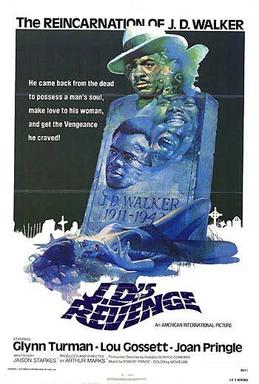
Ike (Glynn Turman) is a nice guy. He’s a law student living in New Orleans. When not studying, he makes money driving a taxi cab. He has a beautiful and loving wife named Christella (Joan Pringle). He has a nice but modest apartment. When we first see Ike, he is calmly and rationally breaking up a fight. Perhaps the only real complain that can be made about Ike is that he’s actually too nice. There’s nothing dangerous about Ike. He works hard. He studies. That’s about it.
When Christella and their friends tell him that he needs to take a night off from studying, Ike is reluctant. However, he finally agrees to go out with them. They start out at a strip club in the French Quarter and eventually, they end up watching a hypnotist. Ike is one of the men randomly selected to go up on stage. Amazingly, rational and mild Ike is easily hypnotized. The audience loves watching as Ike and the other men all reacts to hypnotic suggestion. What they don’t know is that, while in his trance, Ike has been … possessed!
That’s right! The ghost of J.D. Walker has entered Ike. Who is J.D. Walker? As we learn from a series of gauzy flashbacks, J.D. Walker was a gangster in the 1940s. He wore a fedora. He wore nice suits. He was every bit as flamboyant as Ike is mild. But then, one day, J.D. was killed, gunned down by his former business partner, Theotis Bliss (Fred Pinkard).
Soon, Ike starts to act … well, not like himself. Suddenly, Ike is using 1940s slang. He’s wearing 1940s clothes. He’s gambling. He mugs an old lady who gets in his cab and then abandons her on the wharf. When his wife asks him why he’s acting like a 1940s gangster, he gets violent. Soon, Ike is speaking in a different voice and dancing.
What does J.D. want? He wants revenge against not only the man who shot him but also Theotis’s younger brother, a popular preacher named Elijah (Lou Gossett, Jr.). As wild as the possessed Ike may be, he’s got nothing on Elijah. Elijah was a boxer before he became a man of God and he’s still liable to throw a punch or two during his sermons. Elijah, however, is also rather naive and has no hesitation about inviting J.D. to become a member of his congregation. Theotis, who is now Elijah’s manager, is a bit more suspicious…
An oddly paced film that never quite escapes the lengthy shadows of all of the horror films that inspired it, J.D.’s Revenge is worth seeing for the performances Glynn Thurman and Lou Gossett, Jr. Gossett is all energetic charisma in the role of the reverend, giving a performance that features just enough ambiguity that you’re never sure whether you should trust Elijah or not. Meanwhile, Thurman is very good as the mild-mannered Ike but he seems to be having an absolute blast whenever he gets to play the psychotic J.D. During the final confrontation between Ike/J.D. and the Bliss Brothers, Thurman’s performance is so bizarre and over the top that you simply cannot stop watching him.
J.D.’s Revenge was filmed in New Orleans, which add a little bit of gothic atmosphere to the film. As I write this, a lot of our readers may currently be in New Orleans for Mardi Gras. I wish them all well but I hope they’ll remember the lesson of J.D.’s Revenge. Just say no to hypnosis!


 Through the Shattered Lens