Real Men (1987, directed by Dennis Feldman)


Due to a chemical spill that is spreading through the ocean, life on Earth is going to end in five years unless something is done.  A group of friendly alien offer to give Earth either the “Good Package” or the “Big Gun.”  The Good Package can clean up the ocean.  The Big Gun is a big gun.  They both sound good to me!  The aliens only want a glass of water in return and they want that glass to be delivered by CIA Agent Pillbox.

Unfortunately, Pillbox has been killed in the field so the government tracks down a meek office worker named Bob Wilson (John Ritter) who looks just like Pillbox.  Tough and streetwise Nick Pirandello (Jim Belushi) is sent to recruit Bob and take him to the aliens.  Trying to stop Nick and Bob are a group of rogue CIA agents who would rather get the Big Gun than the Good Package.  Nick teaches Bob how to be a “real man” and Bob teaches Nick how to be a real friend.  They also beat up clowns.

A box office failure that did even worse with the critics, Real Men is a movie that was saved by cable.  When I was a kid, Real Men used to show up on HBO all the time.  Whatever flaws the film may have had, the mix of John Ritter’s physical comedy, Jim Belushi’s wiseguy attitude, and the action scenes made it the type of movie that was ideal for home viewing, especially if you had just gotten out of school and wanted to watch something before your parents came home and asked if you had done your homework.  Real Men was fun enough to hold up to repeat viewings but it was also slight enough that it wasn’t a huge tragedy if the channel got changed before the movie ended.

When I rewatched Real Men, I thought the film’s storytelling could have been tighter but it still turned out to be better than I was expecting.  There were a lot of classic buddy movies released in the 80s and while Real Men may not be the equivalent of a 48 Hours or a Midnight Run, John Ritter and Jim Belushi are still an entertainingly mismatched team.  Ritter again shows that he was a master at physical comedy while Belushi provides sarcastic commentary from the side.  A lot of the odd couple-style banter is predictable (Bob doesn’t smoke but Nick does) but Ritter and Belushi deliver their lines with enough conviction to still make it work.  Nick teaches Bob to believe in himself and Bob is able to both save the world and tell off the neighborhood bullies.  The film’s mix of action, science fiction, and broad comedy confounded critics in 1987 but it holds up today.
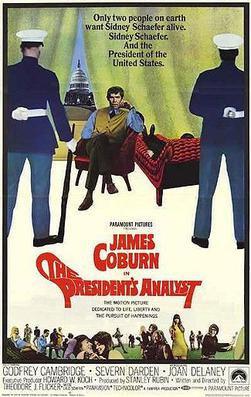
Shattered Politics #25: The President’s Analyst (dir by Theodore J. Flicker)


Presidents_movieposter “If I was a psychiatrist, which I am, I would say that I was turning into some sort of paranoid personality, which I am!” — Dr. Sidney Schaefer (James Coburn) in The President’s Analyst (1967)

Let’s just be absolutely honest about something.  Judging from what they regularly get caught saying and from some of the policies that they support, a good deal of politicians could probably use some sort of professional help.  That’s probably especially true of the men who sit in the Oval Office.  It can’t be easy to have to hide so many secrets, tell so many lies, and be constantly aware of how close the government is to actually collapsing.  We’ve had 44 Presidents and I imagine all of them probably could have used someone to talk to.

But here’s the thing.  We spend so much time worrying about the well-being of the President that we often don’t stop to think about the people who have to listen to them speak on a daily basis.  I imagine that being the President’s therapist must be a thankless job.  Not only do you have to spend hours listening to someone who you may not have voted for but, at the same time, you can’t share any of the information that you’ve learned.

That would certainly seem to be what’s happening with Dr. Sidney Schaefer (James Coburn), the title character of the wonderfully psychedelic 1967 satire, The President’s Analyst.  At the start of the film, Sidney is a supremely confident psychiatrist.  He can calmly and rationally deal with all of his patients problems and, in order to keep from getting overwhelmed, he has his own analyst (Will Geer).

One of his patients is Don Masters (Godfrey Cambridge), an agent for the Central Enquiries Agency (CEA) who is first seen casually murdering a man on the streets of New York.  (When Sidney discovers that Don is an assassin, he’s thrilled and impressed to discover that Don has managed to channel all of his hostility into his job.)  What Sidney doesn’t realize is that Don is testing him to see if he’s up to the job of serving as the President’s analyst.

At first, Sidney is thrilled with his new position but he soon discovers that being the closest confidante of the leader of the free world has its downside.  For one thing, Sidney is viewed by suspicion by Henry Lux (Walter Burke), the head of the Federal Bureau of Regulation (which, in this film, is exclusively staffed by people who are less than 5 feet tall).  Even beyond being targeted by the FBR, Sidney struggles with not being able to see his own therapist and discuss what he’s been told by the President.  Soon, Sidney is becoming paranoid and is even convinced that his girlfriend is a spy.

(And, of course, she is.)

So, Walter does what any sensible and paranoid person would do.  He makes a run for it.  Pursued by the FBR, the CEA, and a Russian assassin (a funny performance from Severn Darden, who also played Kolp, the sadistic torturer in Conquest of the Planet of the Apes), Sidney hides out with everyone from a group of hippies to a family of heavily armed, karate-trained, middle class “militant liberals.”

(The father of the militant liberal family is played by William Daniels, who decades later would play Mr. Feeney in Boy Meets World.)

Of course, there’s an even bigger conspiracy at work than even Sidney realizes.  The real threat is the TPC and I’m not going to tell you what that stands for.  You need to see the movie.

And really, The President’s Analyst is a film that you really should see.  What makes this film truly special — beyond the clever dialogue and the excellent performances and the great direction — is that it’s both a product of when it was made and a timeless portrait of power and paranoia.  It’s a time capsule that still feels incredibly relevant.


Embracing The Melodrama #19: Sin In The Suburbs (dir by Joe Sarno)


Sin In The Suburbs

Released in 1964, Sin In The Suburbs is probably one of the best films that you’ve never heard of.  The fact that it is also an unapologetic product of and for the grindhouse does nothing to change that fact.  Well-acted and telling a disturbingly(and occasionally amusingly) plausible story, Sin In The Suburbs is a masterpiece of exploitation cinema.

As you can probably guess from the title, the setting here is the suburbs.  To the naked eye, it’s a perfectly normal and placid neighborhood.  However, to the housewives who are expected to spend all of their time in their identical suburban homes while their husbands head into the city for the day, the suburbs have become an existential prison, a world of sexual frustration and repressed desires.

Everyone finds their own way to handle living in the suffocating atmosphere of suburban perfection.  Lisa Francis (Marla Ellis), for example, deals with it by sitting around her living room in black lingerie and waiting for various salesmen to come and knock on her door.

Geraldine Lewis (Audrey Campbell) isn’t quite as blatant as her neighbor, though Geraldine does find the time to dance with a teenage boy who comes by looking for her daughter, Judy (Alice Linville).  Geraldine does not know how to deal with her developing daughter and, as a result, Judy starts spending more and more time with another neighbor, Yvette Tallman (Dyanne Thorne).

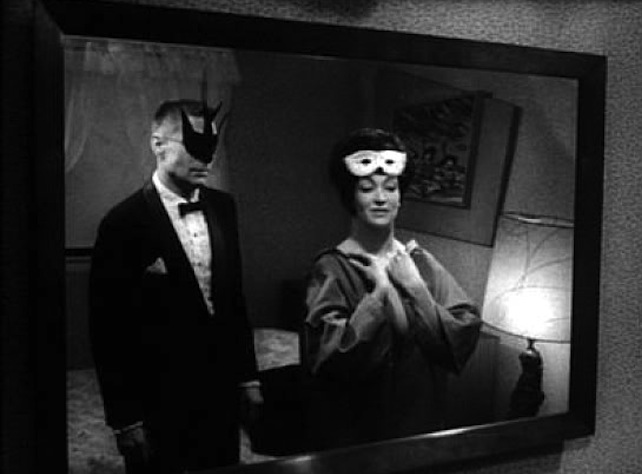
Yvette and her creepy brother Louis (W.B. Parker) run an interesting business on the side.  They set up suburban sex clubs, where everyone wears a robe and a mask and gets to engage in anonymous sex with their neighbors.  While Louis is certainly creepy looking whenever he puts on a mask that he himself describes as being “demonic,” director Joe Sarno goes out of his way to make this sex club look about as unsexy as possible.  The film’s characters may think that they’re being terribly sophisticated but Sarno undercuts their fantasy by playing up the seedy desperation of the sex club’s masked meetings.

In fact, it’s easy to laugh at the Tallmans’ ludicrous little club until the film’s final ten minutes, at which point a case of mistaken identity leads to one of the most downbeat endings ever.

Joe Sarno may have specialized in making what the rest of the world considered to be exploitation films but the fact that he was an artist at heart is obvious from watching Sin In The Suburbs.  Even before I decided to embark on this series of melodramatic film reviews, I had already seen a countless number of films about the what goes on behind closed suburban doors and none of them are quite as dark (or authentic) as the suburban Hell that Sarno portrays in Sin In The Suburbs.  There’s a seediness to the film that, while not exactly pleasant, is also so all-pervasive and convincing that it becomes oddly compelling.

As opposed to a film like Peyton Place, which gave us small town sin in glamorous technicolor, Sin in the Suburbs is filmed in drab black-and-white and takes place on sets that are notable for their minimal decoration.  The only time the film truly comes to life visually is when everyone is wearing a mask and hoping to conceal who they really are.  But even then, Sarno refuses to glamorize his characters.  Instead, he intentionally plays up the absurdity of a bunch of middle class suburbanites trying to convince themselves that they’re actually decadent free spirits.

If Jean-Paul Sartre had abandoned No Exit to instead write a grindhouse sex film, the end result would probably look a lot like Sin In The Suburbs.

sinsuburb

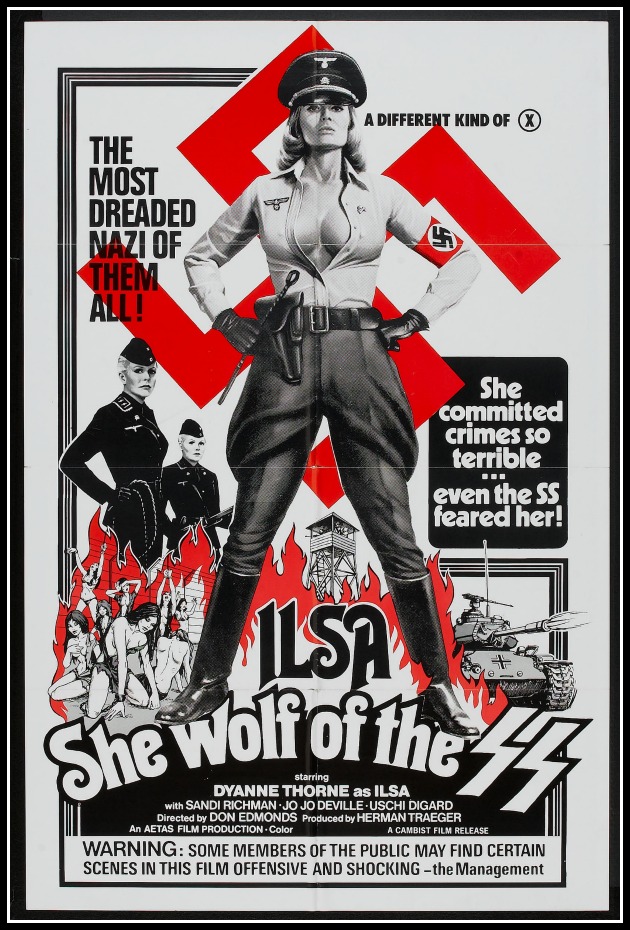
The Daily Grindhouse: Ilsa, She Wolf of the SS (dir. by Don Edmonds)


Our latest “Daily Grindhouse” is infamous for popularizing that subgenre of exploitation and grindhouse film involving Nazis and their atrocities during World War 2. The typical setting for these so-called “naziploitation” films always end up one of the Nazi stalags (POW camps) or even concentration camps (for the truly exploitative of the bunch). The film that truly started it all for this subgenre is none other than Ilsa, She Wolf of the SS.

Grindhouse has a certain amount of individuals who’re seen as icons in the industry. Ilsa would be the film which would make a certain individual an icon within grindhouse. That individual is the Las Vegas showgirl turned exploitation actress, Dyanne Thorne. It was her performance as the SS Commandant of the setting for the film which made Ilsa such a cult classic in the eyes of grindhouse aficionados. Her statuesque and buxom figure was such a presence in the film that it was difficult to take one’s eye off of her whenever she was in it.

The film set the benchmark on the naziploitation subgenre and also the rules on how to make one. Ilsa could be seen by younger fans of film this day and age as nothing but softcore pornography. They wouldn’t be too far off with that description. This film was all about sex and violence. Thorne’s character would be the instigator for both themes and central to every scene which had them. To say that rape and torture of female prisoners (and male prisoners who fail to satisfy Ilsa) became the  blueprint for naziploitation films would be an understatement.

Other films in this subgenre would take what Ilsa had created and up the ante. Adding in even more explicit violence and sex. They would begin to mash it up with other subgenres of grindhouse. This film is not for everyone and definitely not for children (and probably some adults as well), but for fans of grindhouse it’s mandatory screening.

There’s really no trailer about this flick which has been uploadedt. The grindhouse faux trailer created by Rob Zombie to be part of Grindhouse definitely was influenced by Ilsa, She Wolf of the SS.